
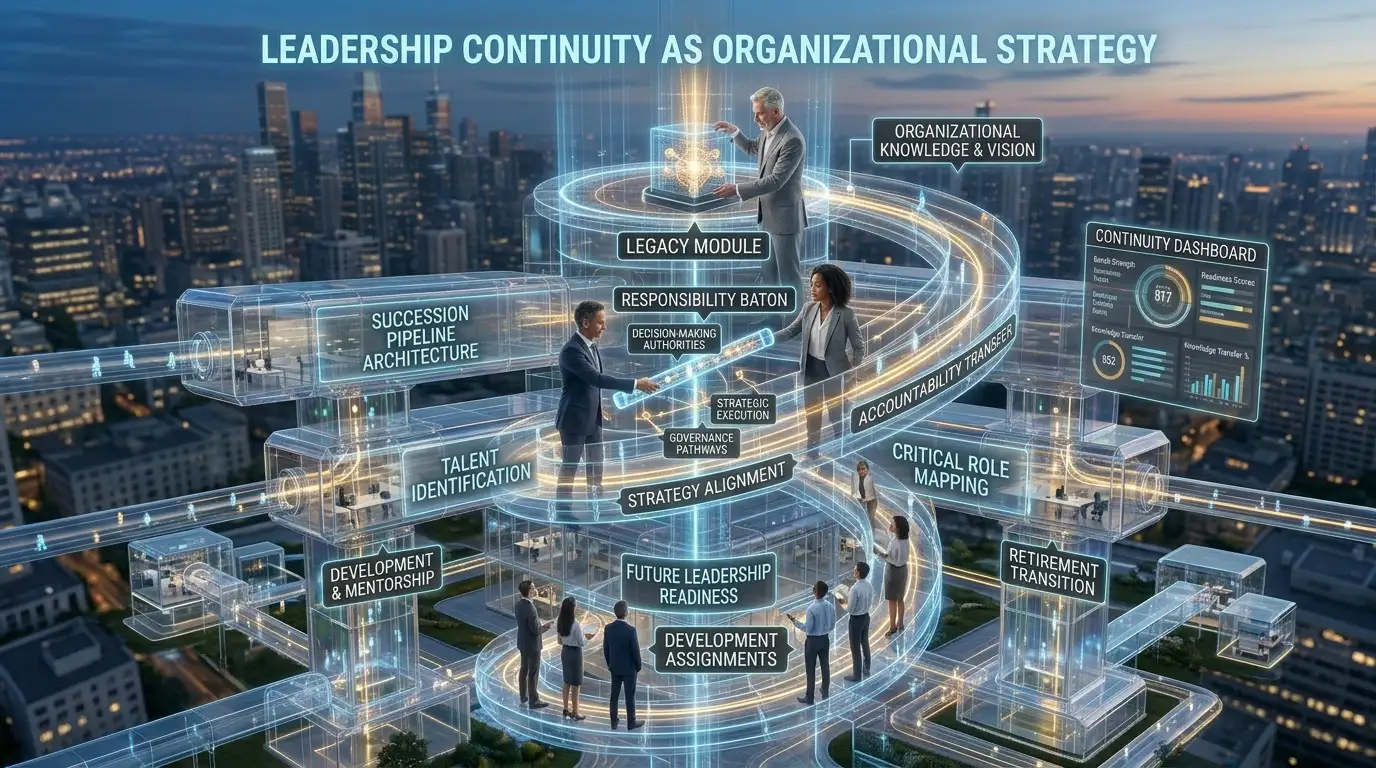
Leadership Continuity as
Organizational Strategy

Leadership continuity is not crisis management – it is the proactive organizational investment that ensures no single leadership departure, transition, or gap creates irreversible disruption to organizational performance, culture, or strategic direction.

Featured Snippet
What is leadership continuity?

Leadership continuity is the organizational capability to sustain strategic direction, cultural integrity, and operational performance through planned and unplanned leadership transitions. It requires deliberate investment in succession architecture, interim leadership capacity, knowledge transfer systems, and governance frameworks – transforming leadership continuity from a reactive organizational vulnerability into a proactive strategic strength.

Leadership Continuity Covers

What Leadership Continuity Covers

  • 1

    Succession Architecture

    Leadership continuity begins with succession readiness. Organizations with robust succession architecture treat every critical leadership role as a succession planning obligation – maintaining defined succession candidates, readiness assessments, and development timelines for every role whose vacancy would create organizational disruption if left unaddressed.

  • 2

    Knowledge Transfer Systems

    Critical organizational knowledge – strategic relationships, institutional context, decision-making history, cultural norms – is one of the most underestimated organizational assets at risk during executive transitions. Leadership continuity programs explicitly architect the transfer of this knowledge as a standing organizational practice, not a last-minute departure exercise.

  • 3

    Interim Leadership Capacity

    The deployment of experienced interim leaders is among the most effective organizational continuity interventions available. Unlike permanent searches, interim leadership deployments can be activated in days, provide immediate organizational stability, and create the time required for high-quality permanent succession decisions to be made without crisis-driven urgency.

  • 4

    Governance Continuity

    Leadership continuity extends to governance structures – ensuring that board knowledge, investor relationships, and regulatory authority relationships are maintained through executive transitions without gaps in organizational representation or credibility.

Leadership Continuity Matters

Why Leadership Continuity Matters to Boards

01

Investor confidence.

Institutional investors increasingly evaluate succession planning quality as a governance risk indicator. Organizations with transparent, rigorous succession architecture consistently demonstrate stronger investor confidence during transition events.

02

Talent retention.

Executive departures that are perceived as disorganized or poorly managed trigger voluntary attrition in the leadership layers immediately below the departing executive – precisely the talent the organization needs most during transition.

03

Strategic continuity.

Major strategic initiatives – market entries, M&A integrations, digital transformations – are particularly vulnerable to leadership transition disruption. Leadership continuity systems protect the organizational momentum these initiatives require.

04

Cultural integrity.

When a significant cultural architect departs without cultural continuity planning, organizational culture fragments along the fault lines of competing interpretations of what the organization values and how it operates.

Approach

Kintex Approach to Leadership Continuity

Kintex Consulting takes an integrated approach to leadership continuity – addressing succession planning, interim leadership capacity, knowledge transfer, and governance continuity as a unified system rather than as separate interventions.

Our continuity advisory begins with a leadership continuity risk assessment – mapping the current vulnerability of critical roles, identifying the highest-consequence succession scenarios, and evaluating the adequacy of existing succession architecture. From this diagnostic, we design and implement the continuity systems that close the most critical gaps – with governance integration, board reporting frameworks, and measurable readiness targets.

FAQ

Leadership Continuity

What is the most common leadership continuity failure in enterprise organizations?

The most common failure is treating succession planning as an annual HR exercise rather than a continuous board-level governance responsibility. Organizations that review succession readiness only in annual cycles consistently find themselves unprepared when transitions occur outside the review cycle – which unplanned departures, by definition, always do.

How does leadership continuity differ from succession planning?

Succession planning is a component of leadership continuity. Leadership continuity is the broader organizational capability that encompasses succession planning, interim leadership capacity, knowledge transfer architecture, governance continuity, and the cultural and talent retention systems that sustain organizational performance through transitions.

What does effective leadership continuity look like at the board level?

Effective board-level leadership continuity involves standing agenda items for CEO and C-suite succession readiness review, annual talent reviews that include leadership depth assessment, defined emergency succession protocols for unplanned departure scenarios, and board director ownership of succession oversight as a governance accountability – not a delegated HR function.

Protect organizational momentum through every leadership transition.