
Executive Transition &
Continuity
Every executive transition carries organizational risk. The organizations that navigate transitions with the least disruption and the fastest return to performance momentum are those that treat transition management as a strategic discipline — not an administrative function. Kintex Consulting’s executive transition and continuity practice manages the organizational risk and human capital complexity of senior leadership transitions from succession planning through permanent appointment and structured onboarding.

Executive transition management is the structured organizational process of planning, managing, and supporting senior leadership transitions — including departure planning, knowledge transfer, interim leadership deployment, permanent succession execution, and new executive onboarding — to protect organizational momentum, stakeholder confidence, and talent architecture through the highest-risk events in the organizational leadership lifecycle.
What Executive Transition Risk Looks Like
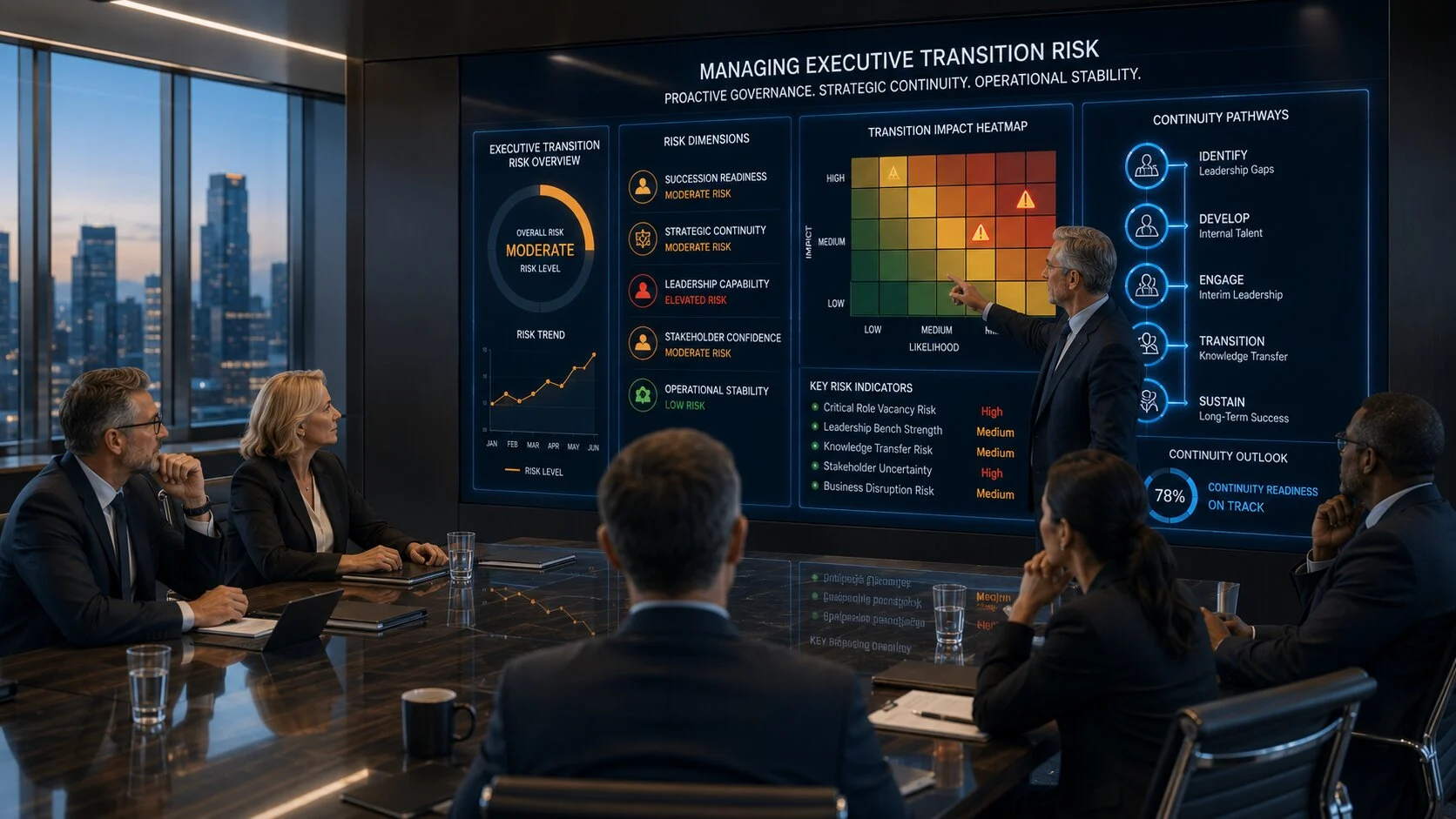
The organizational consequences of poorly managed executive transitions are well-documented. Research from Harvard Business School, Spencer Stuart, and McKinsey consistently identifies executive transitions as among the highest organizational risk events that enterprises regularly face. Approximately 40 percent of newly appointed executives fail to meet performance expectations within their first 18 months. The cost of transition failure at the C-suite level — including direct search costs, productivity loss, talent attrition, and strategic disruption — routinely exceeds two to three times annual compensation.
The organizations that avoid these outcomes share a common characteristic: they treat executive transitions as structured organizational processes, not personnel events. They invest in transition planning before departure, knowledge transfer during the transition period, interim leadership to bridge capability gaps, rigorous succession execution, and structured onboarding that accelerates new leader effectiveness. Kintex Consulting’s executive transition and continuity practice provides all of these capabilities as an integrated transition management system.
Transition Planning and Management
What is executive transition planning?
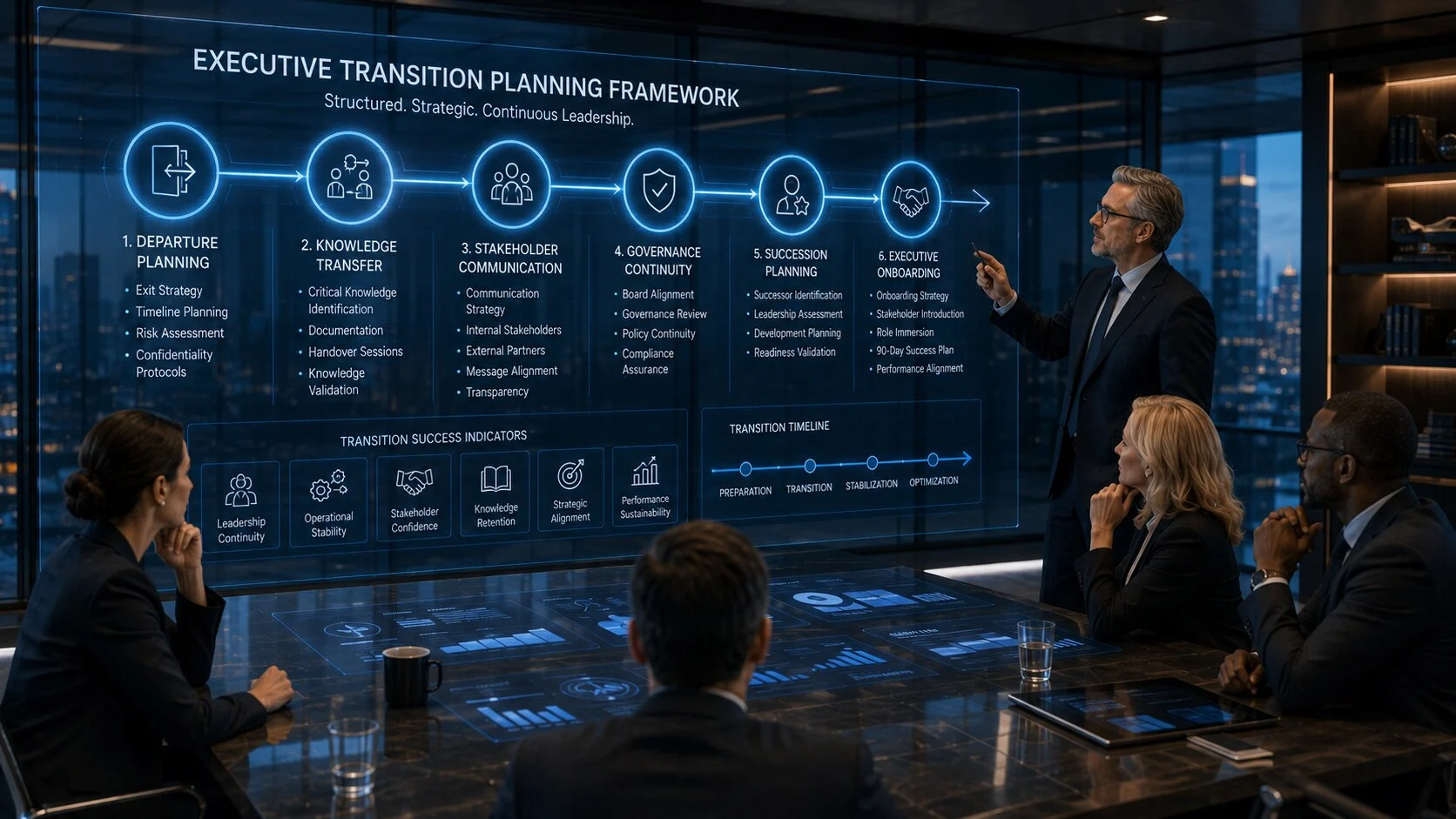
Executive transition planning is the advance organizational work that determines whether an executive transition is experienced as a managed evolution or an organizational crisis. It encompasses the development of knowledge transfer protocols, stakeholder communication architecture, interim leadership arrangements, successor development acceleration, board communication strategy, and the governance frameworks that maintain organizational performance during the transition period.
- Transition risk assessment evaluating the specific organizational risks created by the impending or recent transition: strategic continuity risk, talent retention risk, cultural continuity risk, stakeholder confidence risk, and governance continuity requirements.
- Knowledge transfer architecture designing the structured protocols through which critical organizational knowledge — strategic relationships, institutional context, decision-making history, cultural intelligence — is systematically transferred from departing to incoming leadership rather than lost through unstructured departure.
- Stakeholder communication design developing the communication strategy and messaging architecture that maintains investor, board, customer, and organizational confidence throughout the transition period — managing the narrative of organizational continuity and strategic stability that successful transitions require.
- Governance continuity planningensuring that board relationships, regulatory authority relationships, and governance accountability frameworks are maintained without interruption through leadership transitions.
Executive Onboarding Advisory
Executive onboarding is the structured process of supporting a newly appointed leader through the critical transition from appointment to full organizational effectiveness — accelerating the development of the organizational intelligence, stakeholder relationships, cultural understanding, and performance clarity that determine whether a new executive delivers on their appointment potential or underperforms against it.

McKinsey research consistently demonstrates that structured executive onboarding significantly improves new leader time-to-productivity, reduces the probability of first-year performance failure, and accelerates the development of the organizational relationships and cultural intelligence that determine leadership effectiveness in the new organizational context. Organizations that invest in structured executive onboarding protect the appointment investment they have made — whether through internal promotion or external search.
What Kintex executive onboarding delivers:
-
1Stakeholder mapping and relationship development support identifying the critical organizational stakeholders, their priorities, their perspectives on the organization’s challenges, and the relationship quality that new leadership authority requires. Structured engagement plans support the new executive in building these relationships with the intentionality and pace that early organizational trust requires.
-
2Organizational intelligence acceleration building the new executive’s understanding of organizational culture, decision-making dynamics, political landscape, and performance context through structured intelligence gathering, coach-facilitated insight development, and early organizational observation with professional debrief support.
-
3Early performance contract development working with the new executive and their organizational sponsor to define the specific priorities, performance expectations, and success criteria for the first 90 to 180 days — creating the clarity of mandate that accelerates effective organizational contribution and prevents the drift that often characterizes unstructured executive onboarding.
-
4Coaching support through transition challenges providing executive coaching through the specific organizational challenges, relationship navigation requirements, and leadership behavior adjustment that new organizational contexts create — accelerating the behavioral adaptation that transition success requires.
Outplacement Support
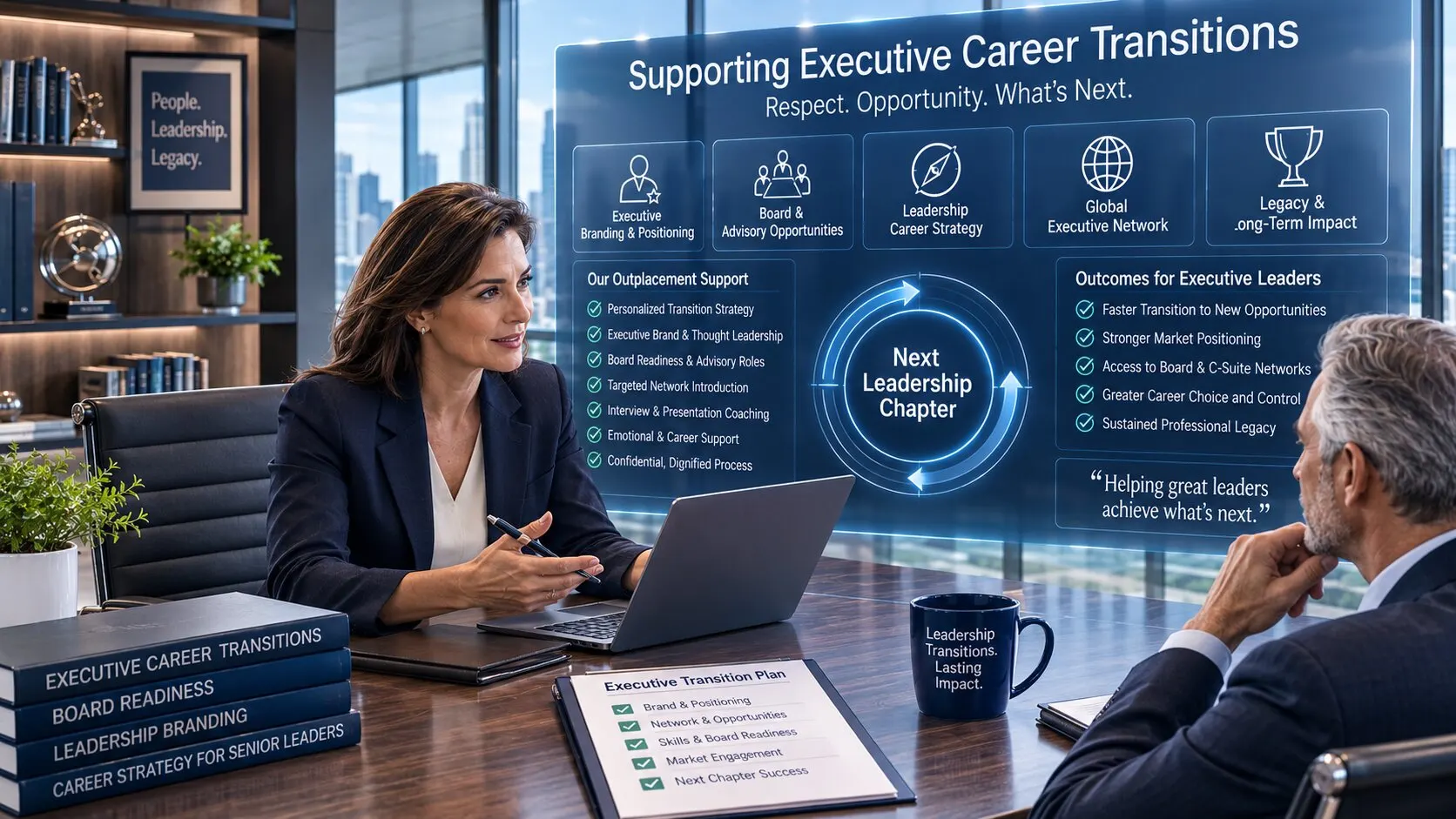
Executive outplacement is the career transition advisory and support services provided to departing executives — helping them navigate the senior career transition process with the professional support, market intelligence, and personal advisory that transitions at the most senior organizational levels require. It is structured for the specific realities of C-suite and senior leadership career transitions — which differ fundamentally from mid-career transitions in their complexity, timeline, market dynamics, and personal impact.
Why outplacement matters to organizations
it is an organizational brand, culture, and legal risk management decision. Organizations that support departing executives with professionalism and genuine care communicate to remaining leadership talent that the organization treats people with integrity regardless of the employment relationship’s direction. This signal directly affects talent retention, employer brand strength, and the organizational culture health that Kintex’s work seeks to build and protect.
characterized by abrupt termination, inadequate transition support, and reputational damage — creates ongoing legal risk, employer brand damage in talent markets where leadership networks are dense, and cultural signals that corrode the psychological safety and organizational trust that high-performance environments require.
What Kintex executive outplacement delivers:
-
1Career strategy advisory clarifying the executive’s market positioning, career objectives, transition timeline, and approach strategy — including board portfolio development, advisory role positioning, and executive re-entry search strategy.
-
2Market intelligence providing current, specific intelligence on organizational and sector opportunities aligned with the executive’s capability profile, career objectives, and geographic and compensation parameters.
-
3Personal brand and narrative development developing the executive’s board biography, LinkedIn positioning, and verbal career narrative for board applications, senior leadership searches, and advisory role conversations.
-
4Interview preparation and selection process coaching preparing executives for the specific assessment dynamics, stakeholder conversations, and selection process characteristics of senior leadership and board appointment processes.
-
5Negotiation advisory providing experienced guidance on compensation structure, contract terms, equity arrangements, and the specific negotiation dynamics of C-suite and board appointments.
-
6Transition wellbeing support addressing the personal dimensions of senior career transitions — the identity disruption, confidence challenges, and relationship dynamic shifts that leadership departures create — with the psychological intelligence and personal care that purely transactional outplacement ignores.
FAQ: Executive Outplacement
What makes senior executive outplacement different from standard outplacement services?
How long does executive outplacement typically take?
Interim Executives
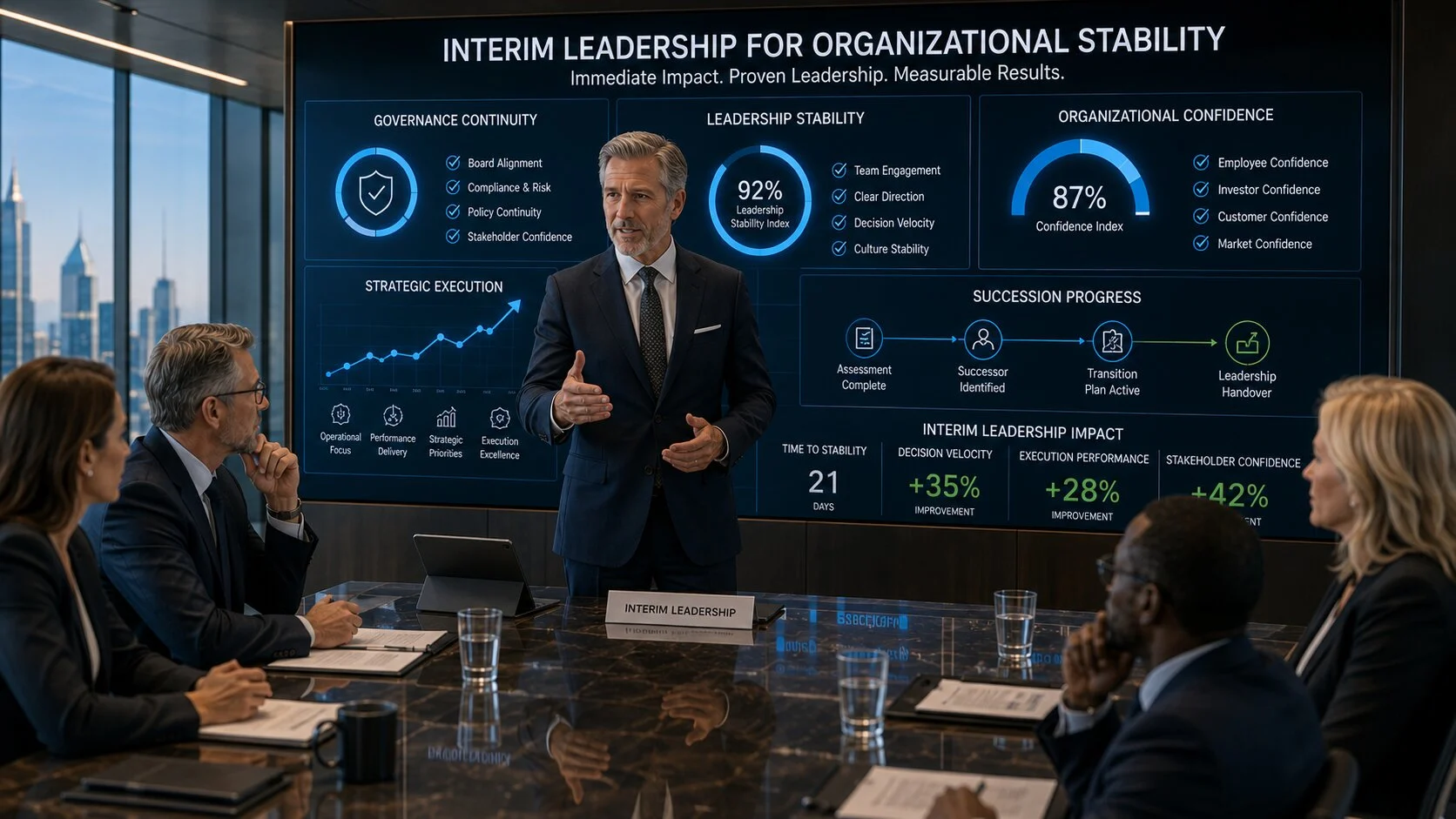
Kintex Consulting’s interim executive practice is a core component of executive transition management — providing the immediate organizational leadership capability that ensures performance continuity during the period between executive departure and permanent succession appointment.
Our interim executives are deployed with precise mandate definition, clear governance frameworks, and the practitioner credibility that immediate organizational authority requires. They create the organizational stability that enables high-quality permanent succession decisions to be made with deliberation rather than crisis-driven urgency.
When interim executives are required:
-
1Unplanned executive departures that create immediate organizational capability gaps requiring rapid deployment of boardroom-ready leadership.
-
2Post-merger integration leadership requirements that exceed existing organizational management capacity.
-
3Transformation initiative leadership where the organization lacks the specific change leadership experience the initiative demands.
-
4Succession timing gaps between the departure of an executive and the readiness or appointment of a permanent successor.
-
5Capability injection during rapid growth phases where leadership demand is outpacing internal pipeline development.
The Kintex interim practice
Kintex Consulting’s interim executive practice deploys practitioners who have held equivalent roles in comparable organizations — ensuring that interim leadership engagements bring genuine peer-level credibility, immediate organizational authority, and the practitioner intelligence that accelerates organizational performance from day one of the engagement.
Every engagement begins with precise mandate definition — clarifying the specific organizational objectives, performance standards, governance framework, timeline, and success criteria that define engagement success. This mandate clarity is what distinguishes practitioner interim leadership from organizational gap-filling and ensures that every Kintex interim engagement creates measurable organizational value independent of the permanent succession outcome.
What interim executives deliver:
- Immediate organizational stability — clear decision-making authority, visible leadership presence, and organizational confidence that the role is being managed rather than vacant.
- Strategic continuity — sustained execution of strategic priorities without the delay that leadership vacuums create.
- Capability injection — specific leadership experience and organizational knowledge that the organization needs for a defined period but does not need to acquire permanently.
- Succession support — in some engagements, interim leaders play an active role in identifying, assessing, and onboarding permanent successors — providing the organizational knowledge transfer that improves permanent appointment outcomes.
FAQ: Interim Executives
How quickly can Kintex deploy an interim executive?
What is the typical duration of an interim executive engagement?
Can an interim executive become the permanent appointment?
Why Choose Kintex for Executive Transition Management
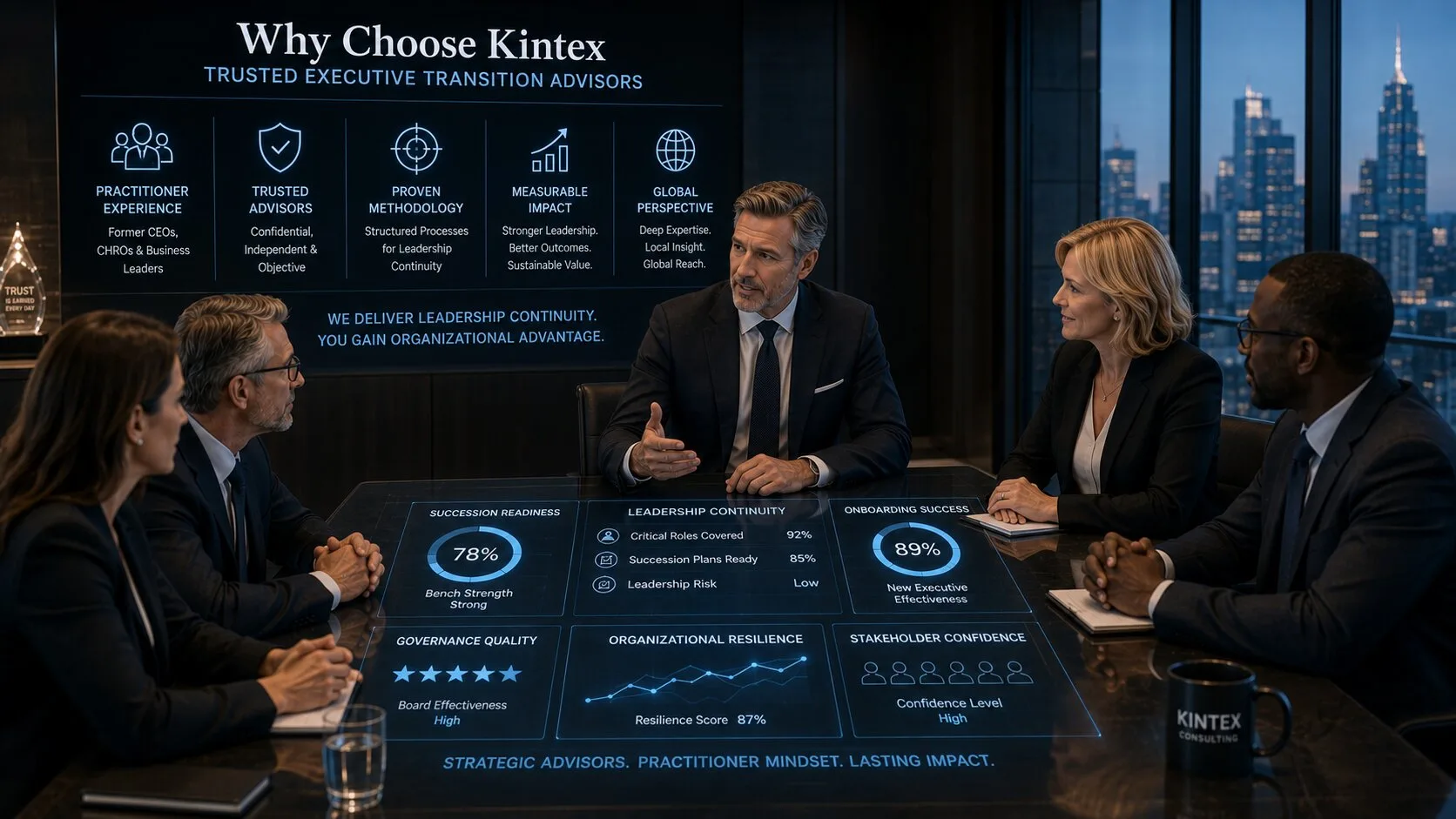
End-to-end transition capability
We manage the full executive transition lifecycle — from departure planning and knowledge transfer through interim leadership deployment, permanent succession execution, and structured onboarding. This end-to-end capability eliminates the coordination gaps that occur when organizations engage separate providers for each transition stage.
Speed and quality in crisis and planned scenarios
Our transition management capability is designed for both planned and unplanned executive departures — providing the rapid deployment capability that crisis scenarios require and the structural thoroughness that planned transitions enable. We maintain deployment-ready interim executive capacity to meet the urgency that unplanned departures create.
Organizational and human capability in balance
We address executive transitions as both organizational capability challenges and human experiences — ensuring that the departing executive is supported with the professionalism and care that organizational culture integrity requires, while the incoming executive receives the structured support that transition effectiveness demands.
Executive Transition & Continuity – FAQs
What are the most critical first steps when an unplanned executive departure occurs?
How does Kintex support executive succession when both interim and permanent search are needed simultaneously?
What is the board’s role in managing executive transition risk?
How does Kintex measure the success of executive transition management engagements?
Protect organizational momentum through every leadership transition.
Kintex Consulting’s executive transition and continuity practice serves boards, CHROs, and C-suite leaders navigating planned and unplanned executive transitions across all organizational levels.