
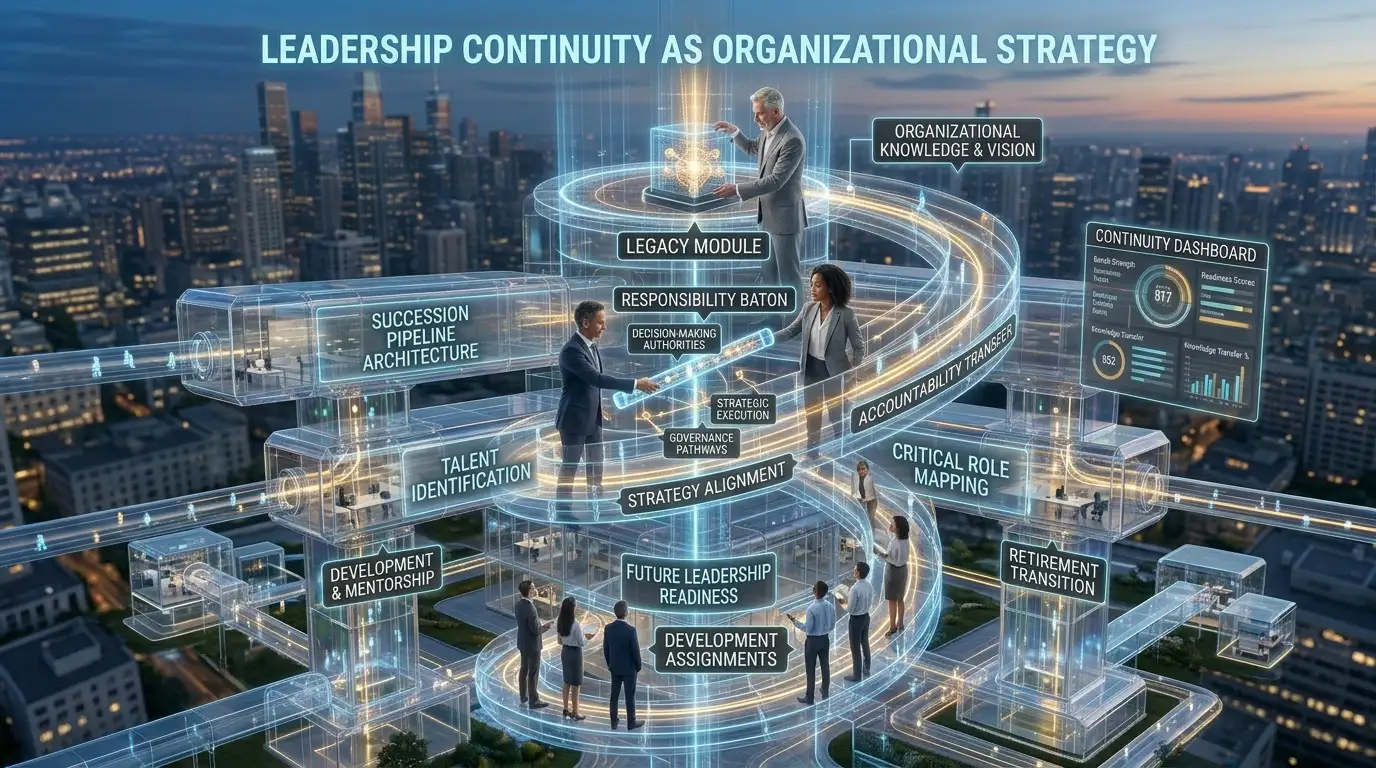
Leadership Continuity as
Organizational Strategy

Leadership continuity is not crisis management – it is the proactive organizational investment that ensures no single leadership departure, transition, or gap creates irreversible disruption to organizational performance, culture, or strategic direction.

leadership continuity
What is leadership continuity?

Leadership continuity is the organizational capability to sustain strategic direction, cultural integrity, and operational performance through planned and unplanned leadership transitions. It requires deliberate investment in succession architecture, interim leadership capacity, knowledge transfer systems, and governance frameworks – transforming leadership continuity from a reactive organizational vulnerability into a proactive strategic strength.

Leadership Continuity Covers

What Leadership Continuity Covers

  • 1

    Succession Architecture

    Leadership continuity begins with succession readiness. Organizations with robust succession architecture treat every critical leadership role as a succession planning obligation – maintaining defined succession candidates, readiness assessments, and development timelines for every role whose vacancy would create organizational disruption if left unaddressed.

  • 2

    Knowledge Transfer Systems

    Critical organizational knowledge – strategic relationships, institutional context, decision-making history, cultural norms – is one of the most underestimated organizational assets at risk during executive transitions. Leadership continuity programs explicitly architect the transfer of this knowledge as a standing organizational practice, not a last-minute departure exercise.

  • 3

    Interim Leadership Capacity

    The deployment of experienced interim leaders is among the most effective organizational continuity interventions available. Unlike permanent searches, interim leadership deployments can be activated in days, provide immediate organizational stability, and create the time required for high-quality permanent succession decisions to be made without crisis-driven urgency.

  • 4

    Governance Continuity

    Leadership continuity extends to governance structures – ensuring that board knowledge, investor relationships, and regulatory authority relationships are maintained through executive transitions without gaps in organizational representation or credibility.

Leadership Continuity Matters

Why Leadership Continuity Matters to Boards

01

Investor confidence.

Institutional investors increasingly evaluate succession planning quality as a governance risk indicator. Organizations with transparent, rigorous succession architecture consistently demonstrate stronger investor confidence during transition events.

02

Talent retention.

Executive departures that are perceived as disorganized or poorly managed trigger voluntary attrition in the leadership layers immediately below the departing executive – precisely the talent the organization needs most during transition.

03

Strategic continuity.

Major strategic initiatives – market entries, M&A integrations, digital transformations – are particularly vulnerable to leadership transition disruption. Leadership continuity systems protect the organizational momentum these initiatives require.

04

Cultural integrity.

When a significant cultural architect departs without cultural continuity planning, organizational culture fragments along the fault lines of competing interpretations of what the organization values and how it operates.

Succession Continuity

What is succession continuity?

Succession continuity is the organizational capability to maintain leadership effectiveness and strategic direction through planned and unplanned executive transitions – without loss of organizational momentum, stakeholder confidence, or performance quality. It requires the deliberate architecture of talent pipelines, development programs, governance processes, and transition protocols that collectively ensure no single leadership departure creates an organizational capability crisis.

Why it matters

The organizational cost of unplanned executive transitions is substantial. Organizations that lack succession continuity plans experience average time-to-fill periods of six to twelve months for senior leadership roles – during which organizational strategy stalls, talent engagement deteriorates, and stakeholder confidence erodes. Organizations with mature succession continuity systems reduce transition costs, maintain strategic momentum, and demonstrate the governance quality that boards and investors increasingly require.

What Kintex delivers
  • Succession talent identification establishes the internal and external talent pools from which critical role successors will be drawn – mapping individuals against specific succession scenarios with defined readiness timelines.
  • Leadership development acceleration provides the targeted developmental experiences – stretch assignments, coaching, executive education, cross-functional exposure – that close the gap between current capability and succession readiness within defined timeframes.
  • Succession governance integration ensures readiness is reviewed at board and executive committee level on a defined cadence – not only when vacancy creates urgency.
  • Knowledge transfer architecture ensures that critical organizational knowledge, relationship capital, and institutional intelligence are systematically transferred rather than lost through executive departure.
  • Transition planning protocols define the structured handover processes that minimize performance disruption during succession events.
Organizational impact

Organizations with mature succession continuity capabilities demonstrate significantly lower executive search costs, faster time-to-productivity for new leaders, stronger stakeholder confidence during transitions, and higher internal promotion rates that reinforce organizational culture and reduce the cultural disruption associated with external executive appointment.

Industries served
Technology
Healthcare
Financial services
Locations
North America Europe Australia Canada
Discuss Succession Planning With Kintex →

Executive Transition Risk

What is executive transition risk?

Executive transition risk is the organizational vulnerability created when a senior leader departs – whether planned or unplanned – without adequate succession readiness, transition planning, or organizational continuity architecture. It encompasses the financial, strategic, cultural, and talent risks that executive transitions create when organizations have not invested in proactive leadership continuity systems.

Why it matters

Research from Harvard Business School and leading executive search firms consistently demonstrates that executive transitions carry substantial organizational risk: approximately 40 percent of newly appointed executives fail to meet performance expectations within the first 18 months. The cost of an executive transition failure at the C-suite level typically exceeds two to three times the executive’s annual compensation when direct, indirect, and organizational disruption costs are fully accounted.

Risk categories
  • Strategic continuity risk – arises when the departing executive is the primary owner of strategic relationships, direction, or organizational knowledge – creating the risk that strategic momentum is disrupted by the transition.
  • Talent retention risk – emerges when executive departures trigger broader leadership team instability.
  • Cultural continuity risk – occurs when the departing executive has been a primary cultural architect – creating the risk that cultural norms erode without consistent modeling and reinforcement.
  • Stakeholder confidence risk – affects investor, customer, and partner relationships when transitions are perceived as unplanned or poorly managed.
Kintex approach

Kintex Consulting’s executive transition risk advisory provides the diagnostic and advisory support to identify, quantify, and mitigate executive transition risks before they materialize – through succession architecture review, interim leadership deployment, transition planning, and governance strengthening.

Executive Transition Risk
What are the most common causes of executive transition failure?

The most common causes are inadequate successor readiness assessment before the transition event, insufficient structured onboarding for incoming executives, cultural misalignment between the incoming leader and organizational expectations, and absence of a clear performance contract for the transition period.

How long does executive transition risk persist after a departure?

Research consistently identifies the first 12 to 18 months as the highest-risk period following a senior executive transition. Organizations with structured transition management typically reduce this risk window to six to nine months.

Discuss Transition Risk With Kintex →

Interim Leadership Risk

What is interim leadership risk?

Interim leadership risk is the organizational capability gap that emerges when a critical leadership role is vacant – due to unplanned departure, planned succession timing gaps, or organizational restructuring – and the organization must maintain operational and strategic performance without a permanent occupant in place.

Organizational consequences

Poorly managed interim leadership periods create organizational disruption that often exceeds the disruption of the original transition event. Decision-making authority becomes unclear, creating organizational paralysis. Team cohesion deteriorates without consistent leadership presence. Strategic initiatives stall without executive sponsorship. Talent attrition accelerates as high performers seek clarity about organizational direction and leadership stability.

How Kintex addresses it

Kintex Consulting deploys experienced practitioners – leaders who have held equivalent organizational roles at senior level – to bridge critical leadership gaps with the decisional authority, organizational credibility, and strategic continuity required to maintain performance through the transition period. Our interim leaders are deployed with clear mandates, defined success criteria, and the practitioner capability to make meaningful organizational progress during their engagement.

Enquire About Interim Leadership →

CEO Succession Risk

What is CEO succession risk?

CEO succession risk is the most consequential single leadership risk any board faces – the organizational vulnerability created by the absence of a credible, prepared, board-aligned CEO succession plan. It encompasses the risks created by unplanned CEO departure, failed succession execution, inadequate internal pipeline development, and the governance failure of boards that have not established rigorous CEO succession oversight.

Why it matters

CEO tenure at major enterprises averages approximately five years – meaning most boards will oversee at least one CEO transition during any given governance cycle. Despite this frequency, a substantial proportion of boards rate their CEO succession readiness as inadequate. The organizational and stakeholder consequences of poorly managed CEO succession are severe: market capitalization erosion, talent attrition, cultural disruption, strategic discontinuity, and reputational damage that can take years to repair.

Kintex CEO succession advisory

Kintex Consulting’s CEO succession advisory supports boards and governance committees in building rigorous CEO succession architecture: defining the leadership profile for future CEO needs, assessing internal candidate readiness against that profile, designing accelerated development pathways for internal successors, establishing governance protocols for succession oversight and decision-making, and managing the board-to-CEO relationship during transition to maximize organizational momentum.

CEO Succession Risk
How early should a board begin CEO succession planning?

Best practice is to begin formal succession planning three to five years before an anticipated transition — and to maintain a continuously updated succession plan as a matter of standing governance practice, regardless of anticipated timing.

What is the board’s role in CEO succession?

The board is ultimately accountable for CEO succession. This includes defining the leadership profile the organization will need, overseeing the development of internal candidates, maintaining an emergency succession protocol for unplanned departures, and managing the transition process and new CEO onboarding.

What distinguishes effective CEO succession from emergency replacement?

Effective CEO succession is a continuous process with identified candidates, development programs, readiness assessments, and governance oversight. Emergency replacement is a reactive search process triggered by unplanned departure – which consistently produces worse organizational outcomes than planned succession.

Discuss CEO Succession Risk With Kintex →
Approach

Kintex Approach to Leadership Continuity

Kintex Consulting takes an integrated approach to leadership continuity – addressing succession planning, interim leadership capacity, knowledge transfer, and governance continuity as a unified system rather than as separate interventions.

Our continuity advisory begins with a leadership continuity risk assessment – mapping the current vulnerability of critical roles, identifying the highest-consequence succession scenarios, and evaluating the adequacy of existing succession architecture. From this diagnostic, we design and implement the continuity systems that close the most critical gaps – with governance integration, board reporting frameworks, and measurable readiness targets.

FAQ

Leadership Continuity

What is the most common leadership continuity failure in enterprise organizations?

The most common failure is treating succession planning as an annual HR exercise rather than a continuous board-level governance responsibility. Organizations that review succession readiness only in annual cycles consistently find themselves unprepared when transitions occur outside the review cycle – which unplanned departures, by definition, always do.

How does leadership continuity differ from succession planning?

Succession planning is a component of leadership continuity. Leadership continuity is the broader organizational capability that encompasses succession planning, interim leadership capacity, knowledge transfer architecture, governance continuity, and the cultural and talent retention systems that sustain organizational performance through transitions.

What does effective leadership continuity look like at the board level?

Effective board-level leadership continuity involves standing agenda items for CEO and C-suite succession readiness review, annual talent reviews that include leadership depth assessment, defined emergency succession protocols for unplanned departure scenarios, and board director ownership of succession oversight as a governance accountability – not a delegated HR function.

Protect organizational momentum through every leadership transition.