
Organizational Health &
Transformation
Strategic ambition without organizational health is aspirational fiction. Kintex Consulting’s organizational health and transformation advisory builds the structural, cultural, and leadership conditions through which organizational strategy becomes sustainable organizational performance — diagnosing what is limiting your organization’s performance and partnering with executive teams on the transformation initiatives that create lasting organizational capability improvement.

Organizational health is the enterprise capability to align leadership, culture, strategy, and talent architecture in ways that produce sustained superior performance through changing conditions. McKinsey’s Organizational Health Index research, drawn from more than 1,500 organizations across 100 countries, demonstrates that organizational health is the strongest single predictor of sustained organizational performance — accounting for approximately half of the total variation in long-term financial performance between organizations operating in comparable competitive environments.
What Organizational Health Is and Why It Matters
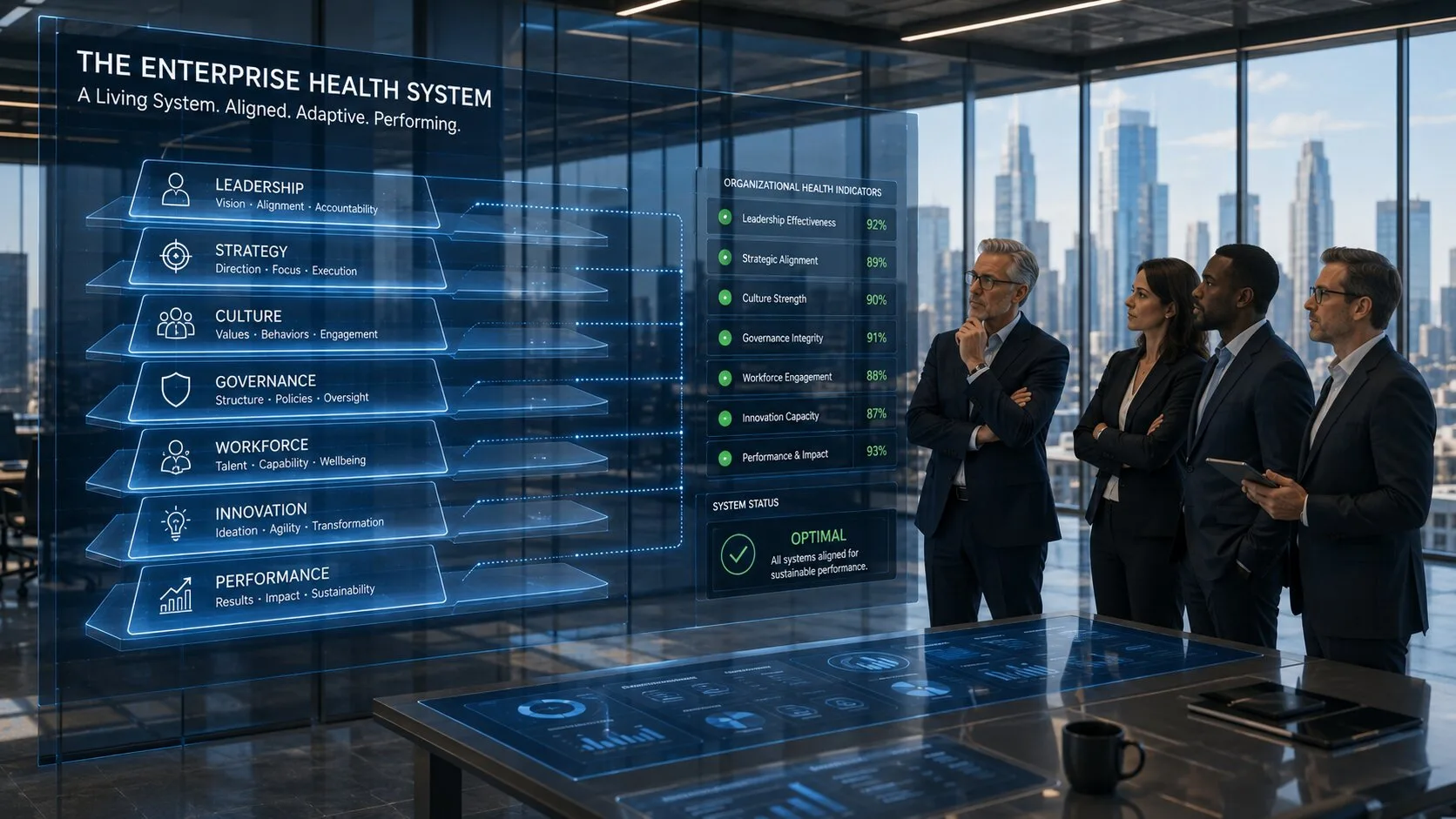
A measurement of employee satisfaction or engagement scores alone — though both are indicators.
The holistic organizational capability to align leadership, culture, strategy, governance, and talent in ways that produce sustained superior performance across changing market, competitive, and organizational conditions.
The distinction between healthy and unhealthy organizations is not strategy or market position — it is the organizational operating conditions that determine whether strategy is executed effectively or systematically frustrated by structural, cultural, and leadership friction. Organizations that invest in organizational health outperform organizations that focus on strategy alone, without addressing the organizational conditions through which strategy is delivered.
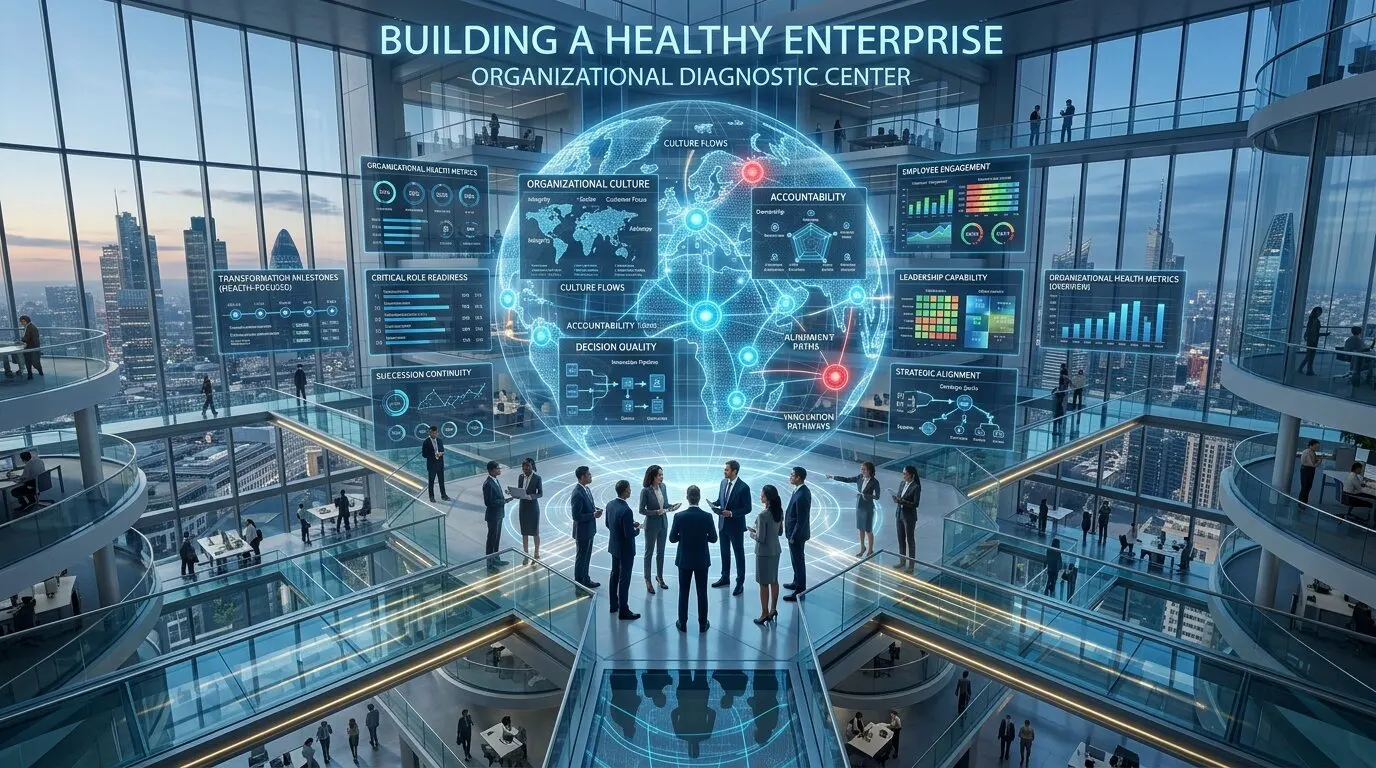
Organizational Health
What we diagnose
Kintex Consulting’s organizational health practice begins with rigorous diagnosis — assessing the organizational health dimensions that research identifies as most predictive of sustained performance: strategic direction clarity, leadership quality and consistency, culture and organizational climate, accountability architecture, coordination and decision-making quality, organizational capabilities, employee motivation and engagement, innovation and learning systems, and external orientation and market intelligence.
The organizational cost of unplanned executive transitions is substantial. Organizations that lack succession continuity plans experience average time-to-fill periods of six to twelve months for senior leadership roles – during which organizational strategy stalls, talent engagement deteriorates, and stakeholder confidence erodes. Organizations with mature succession continuity systems reduce transition costs, maintain strategic momentum, and demonstrate the governance quality that boards and investors increasingly require.
This diagnostic produces a precise organizational health profile — identifying the specific dimensions that are limiting organizational performance and prioritizing the intervention architecture that will produce the greatest performance improvement within the organization’s specific context and strategic timeline.
What we build
- Leadership behavior change programs shift the cultural signals leaders send through their daily interactions — addressing the root cause of most organizational culture challenges.
- Structural redesign aligns organizational architecture with strategic priorities — eliminating the structural friction that forces capable people to underperform.
- Governance strengthening improves decision-making quality and accountability — reducing the organizational paralysis created by unclear decision rights and misaligned incentives.
- Talent development investment closes organizational capability gaps — building the organizational capacity required to execute the strategy the organization has committed to.
- Culture measurement systems sustain health improvement beyond the advisory engagement — creating the organizational intelligence infrastructure that enables continuous health management rather than periodic diagnostic intervention.
Organizational impact
Organizations that invest in organizational health improvement consistently outperform sector peers on the financial and operational metrics that boards and investors prioritize. McKinsey research demonstrates that organizations in the top quartile of organizational health generate total returns to shareholders approximately three times higher than organizations in the bottom quartile — over a sustained multi-year measurement period.

Organizational Transformation Advisory
Organizational transformation is the deliberate, sustained process of fundamentally reshaping organizational systems, culture, structure, and capability to meet new strategic demands — whether driven by market disruption, growth ambition, M&A integration, regulatory change, digital imperative, or the recognition that current organizational design cannot deliver the strategy the organization requires.
Why Organizational Transformation Fails
McKinsey research consistently finds that approximately 70 percent of large-scale organizational transformation initiatives fail to achieve their intended outcomes. The most common failure causes are not strategic design errors — they are organizational.
Inadequate leadership alignment behind the transformation vision.
Insufficient investment in the human change management dimensions of transformation.
Failure to address cultural change as a deliberate transformation workstream.
Leadership communication not sustained with the frequency and authenticity transformation requires.
The Kintex Transformation Approach
Our transformation advisory begins with a clear-eyed diagnosis of the specific organizational design, leadership behavior, and cultural change required to achieve the transformation objective. We partner with executive teams to design the transformation roadmap, build the leadership coalition required to sustain change momentum, develop the communication architecture that maintains organizational alignment through the transformation journey, and measure progress against defined organizational health and performance outcomes.
Our practitioners have led organizational transformations from the inside — which means we understand the organizational political dynamics, change fatigue risks, leadership behavior change challenges, and implementation realities that abstract transformation frameworks consistently underestimate. This practitioner understanding is the difference between transformation advisory that produces actionable organizational change and advisory that produces well-structured presentations without implementation traction.
Transformation Workstreams We Lead
-
1Transformation strategy development and roadmap design.
-
2Leadership alignment and executive team development for transformation leadership.
-
3Change communication architecture and organizational narrative development.
-
4Culture assessment and deliberate culture evolution programming.
-
5Organizational structural redesign for strategic alignment.
-
6Governance redesign for decision-making quality and accountability.
-
7Capability gap assessment and talent development programming.
-
8Transformation progress measurement and organizational health tracking.
Why Choose Kintex for Organizational Health and Transformation
Diagnostic precision, not generic frameworks
We begin every organizational health engagement with rigorous diagnostic work — understanding the specific organizational dynamics, leadership behavior patterns, cultural characteristics, and structural conditions that are producing the performance limitations the organization is experiencing. Our intervention design is specific to your organizational reality, not adapted from a generic transformation template.
Practitioner-led, not consultant-delivered
Every Kintex organizational health engagement is led by practitioners who have led organizations through the challenges they now advise on. This means our advisory reflects the organizational reality of transformation from the inside — including the political complexity, change fatigue dynamics, and leadership behavior change challenges that consulting frameworks consistently fail to anticipate.
Integrated leadership and organizational perspective
We address organizational health as the integrated product of leadership quality, cultural conditions, structural design, and governance architecture — not as an isolated culture or engagement program. This integrated perspective produces organizational health improvement that is structural and durable rather than behavioral and temporary.
Organizational Health & Transformation – FAQs
How does Kintex measure organizational health improvement?
What is the most common cause of organizational transformation failure?
How long does organizational transformation take?
Can organizational health be improved without structural reorganization?
How does organizational culture relate to organizational transformation success?
Build an organization capable of executing the strategy you have committed to.
Kintex Consulting’s organizational health and transformation practice serves enterprise organizations navigating performance improvement, strategic transformation, M&A integration, and culture evolution.