
Workforce & Business
Transformation
When organizational strategy outpaces workforce architecture, execution suffers. Kintex Consulting’s workforce and business transformation practice advises enterprise organizations on the workforce strategy, organizational design, and business transformation decisions that align talent architecture with strategic direction — and provides the interim executive capability to execute through the transitions those decisions create.
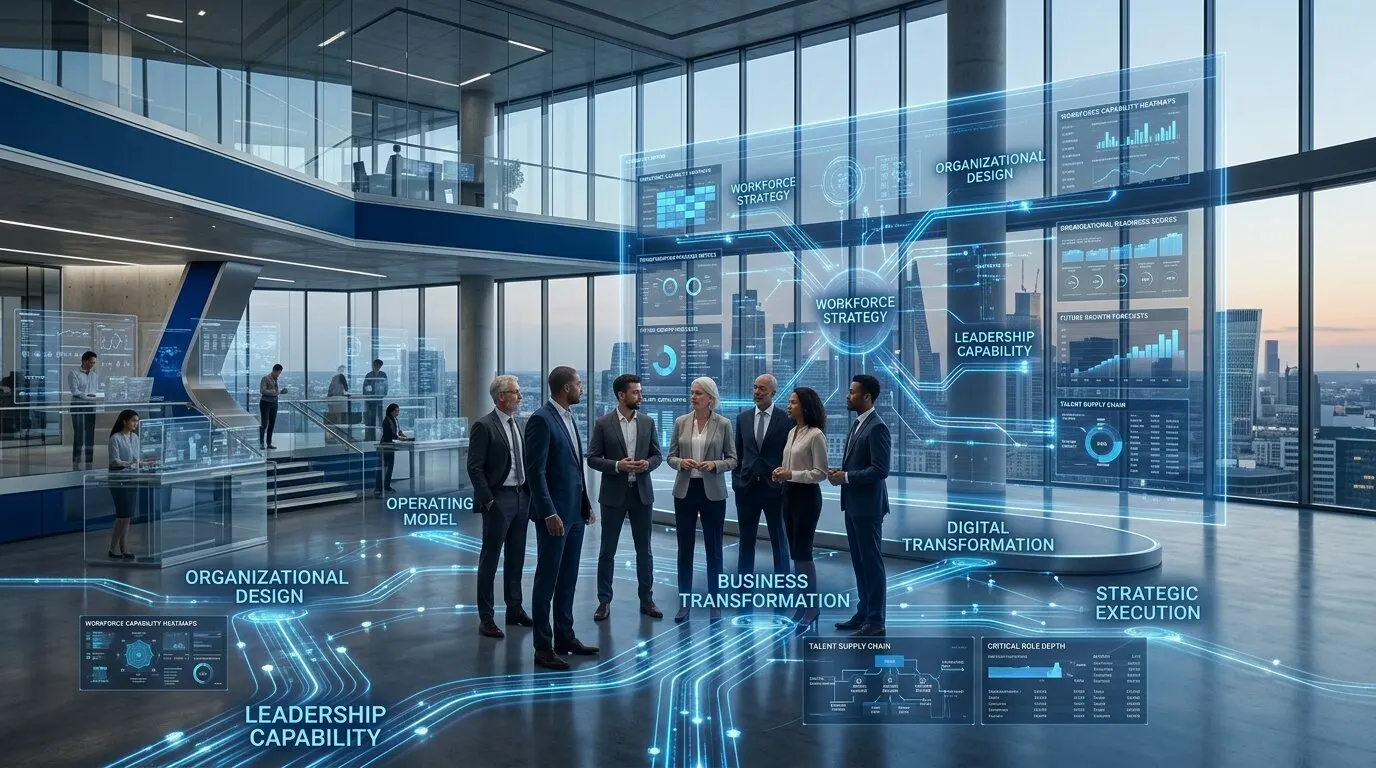
Workforce transformation is the deliberate process of reshaping an organization’s talent architecture — the composition, capability, distribution, and deployment of its human resources — to align with evolving strategic priorities, market demands, and organizational design requirements. It encompasses workforce strategy, organizational design, capability gap closure, and the operating model changes that enable organizations to execute new strategic directions with the talent systems their current architecture was not built to support.
What Workforce Transformation Addresses
Organizations face workforce transformation requirements when their talent architecture — built for historical strategy — is misaligned with the strategy they now need to execute. This misalignment manifests as capability gaps in critical functions, organizational design friction that slows execution, succession risk in roles where strategic importance has grown faster than talent depth, and workforce cost structures that do not reflect current strategic priorities.
Kintex Consulting’s workforce transformation advisory addresses the full scope of these challenges — from strategic workforce planning and organizational design through to interim executive deployment and business transformation leadership.
Strategic Workforce Planning
What is strategic workforce planning?
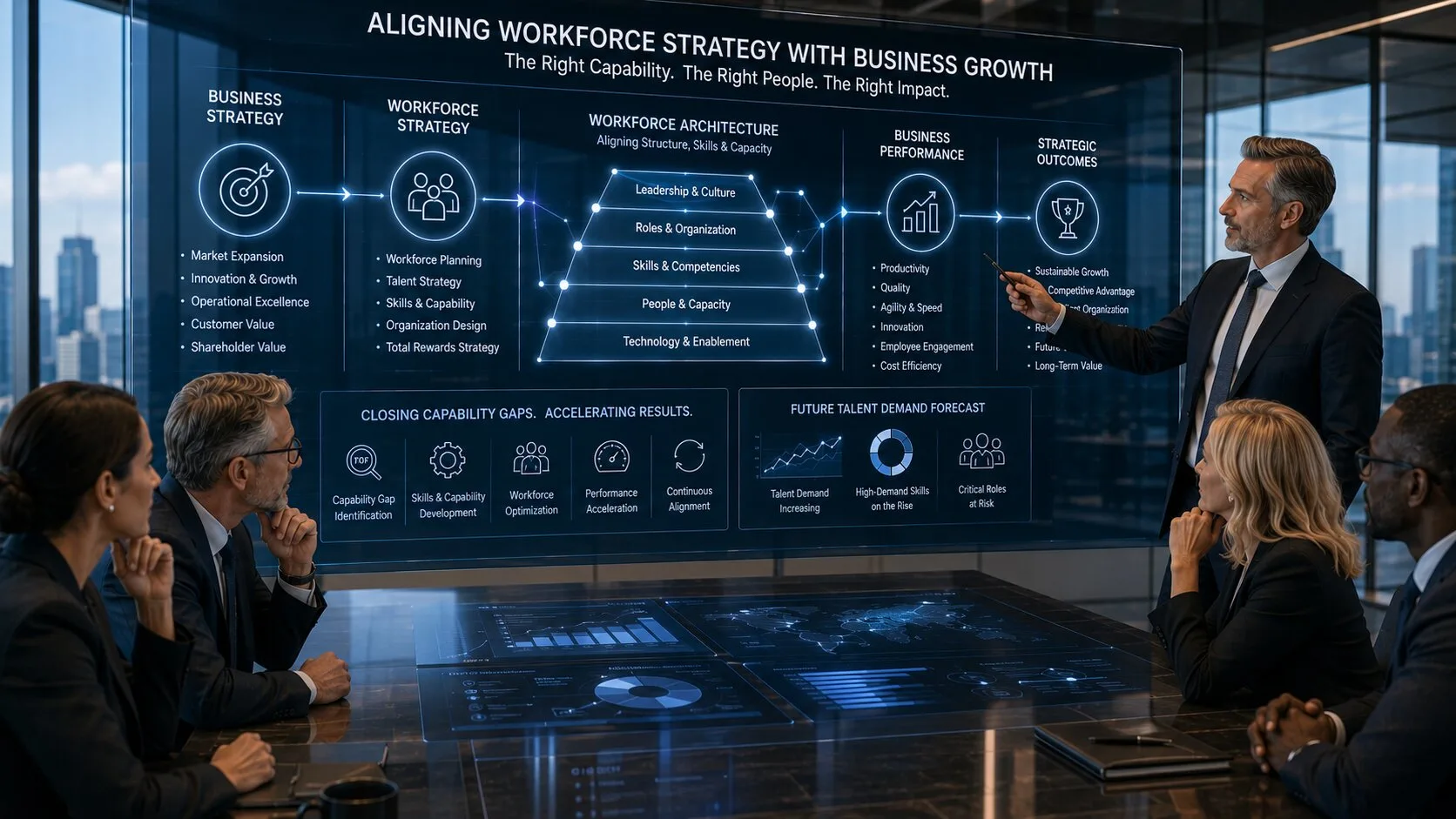
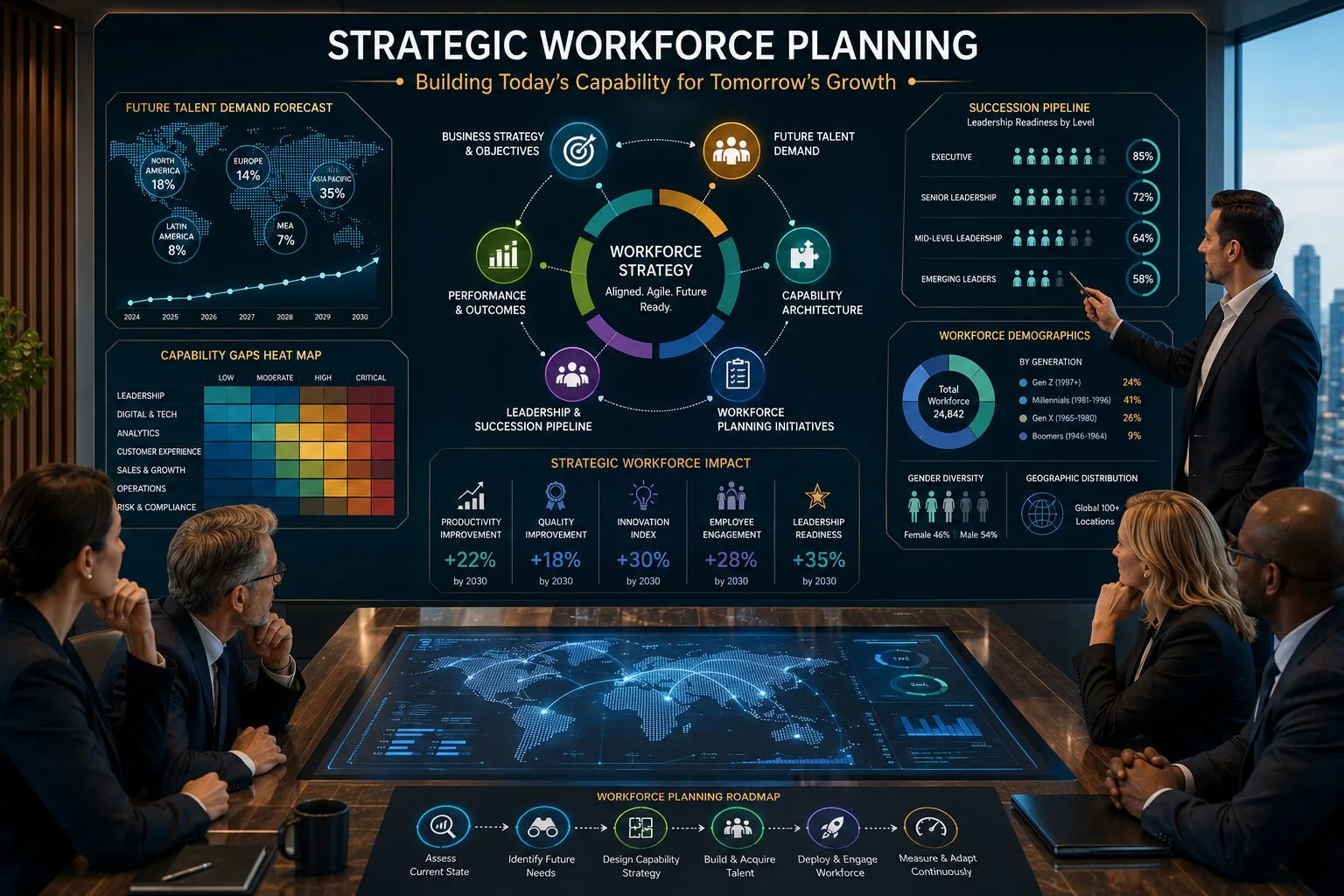
Strategic workforce planning is the organizational practice of anticipating the human capital requirements of future strategic scenarios and building the talent acquisition, development, and deployment systems required to meet those requirements ahead of the need. It connects organizational strategy to talent strategy — ensuring that the human capital architecture required for strategic execution is being built before capability gaps become execution constraints.
What Kintex delivers:
- Future workforce demand modeling — mapping the talent capability requirements of defined strategic scenarios across functions, geographies, and organizational levels.
- Current workforce capability assessment a — evaluating existing workforce capability against future demand scenarios to identify the capability gaps, surplus areas, and critical role risks that workforce strategy must address.
- Workforce strategy design— developing the talent acquisition, development, retention, and deployment strategies that close the most consequential gaps within defined organizational timelines and investment parameters.
- Implementation roadmap development— translating workforce strategy into the phased, governed action plans that organizational execution requires.
Organizational impact
Organizations with active strategic workforce planning capabilities consistently demonstrate faster strategic execution speed, lower critical role vacancy costs, stronger succession depth, and greater organizational resilience through market disruption than organizations that manage workforce composition reactively.
Organizational Design
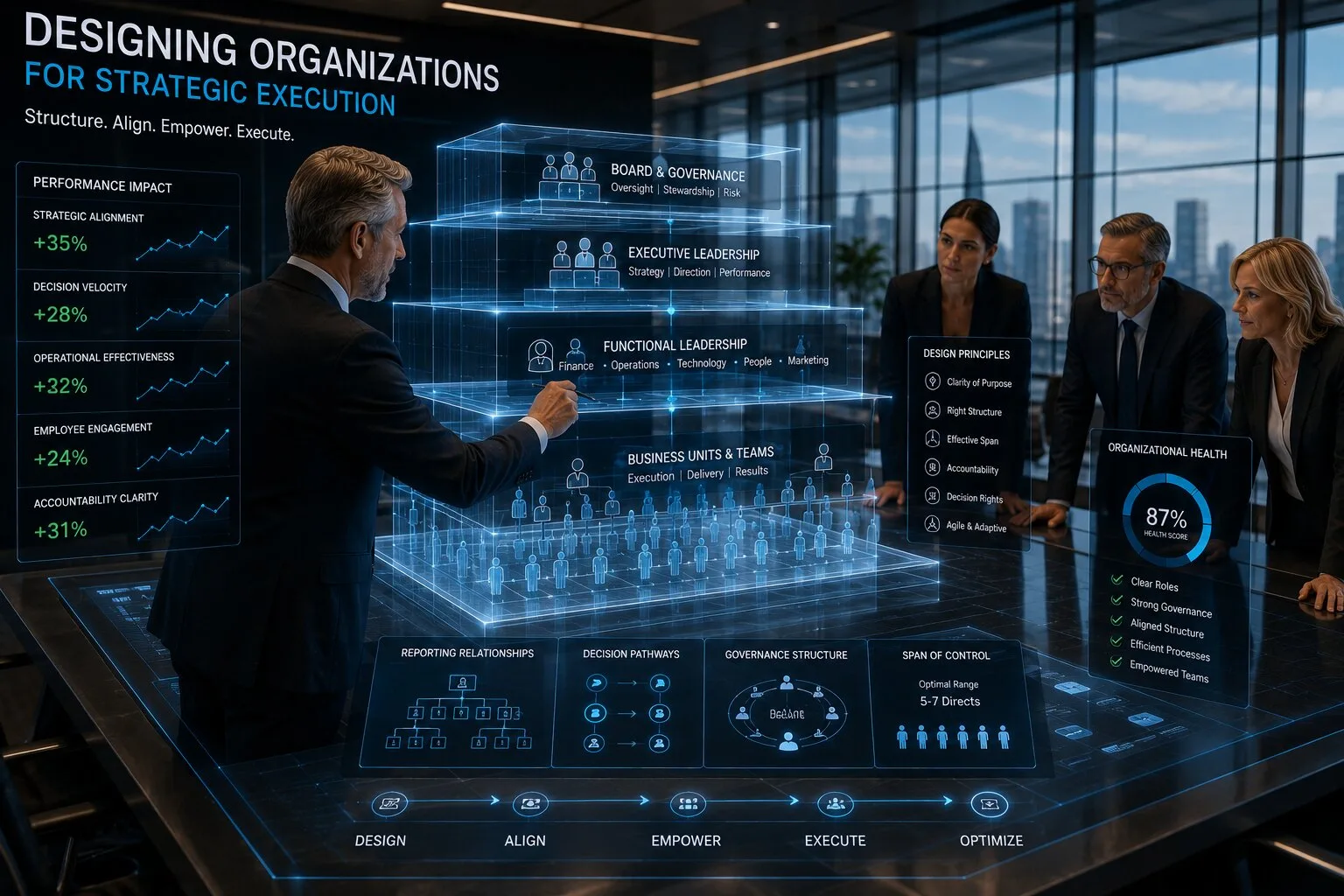
Organizational design is the structural architecture through which an enterprise organizes its human resources, decision-making authority, reporting relationships, and operating processes to execute strategy. Misaligned organizational design is among the most pervasive and most costly sources of organizational underperformance — creating the structural friction, duplication, decision-making ambiguity, and talent underutilization that erode organizational execution quality regardless of individual talent quality or strategic clarity.
What Kintex delivers:
evaluating the alignment between current organizational architecture and strategic direction, identifying the structural friction points that are most significantly constraining performance quality and execution speed.
establishing the organizational design criteria that will govern restructuring decisions — ensuring that design is driven by strategic logic rather than political compromise or historical inertia.
restructuring reporting relationships, decision rights, span of control, and coordination mechanisms to maximize strategic execution capability.
supporting the organizational change management, leadership communication, and governance transition that effective structural redesign requires.
Organizational Transformation Advisory
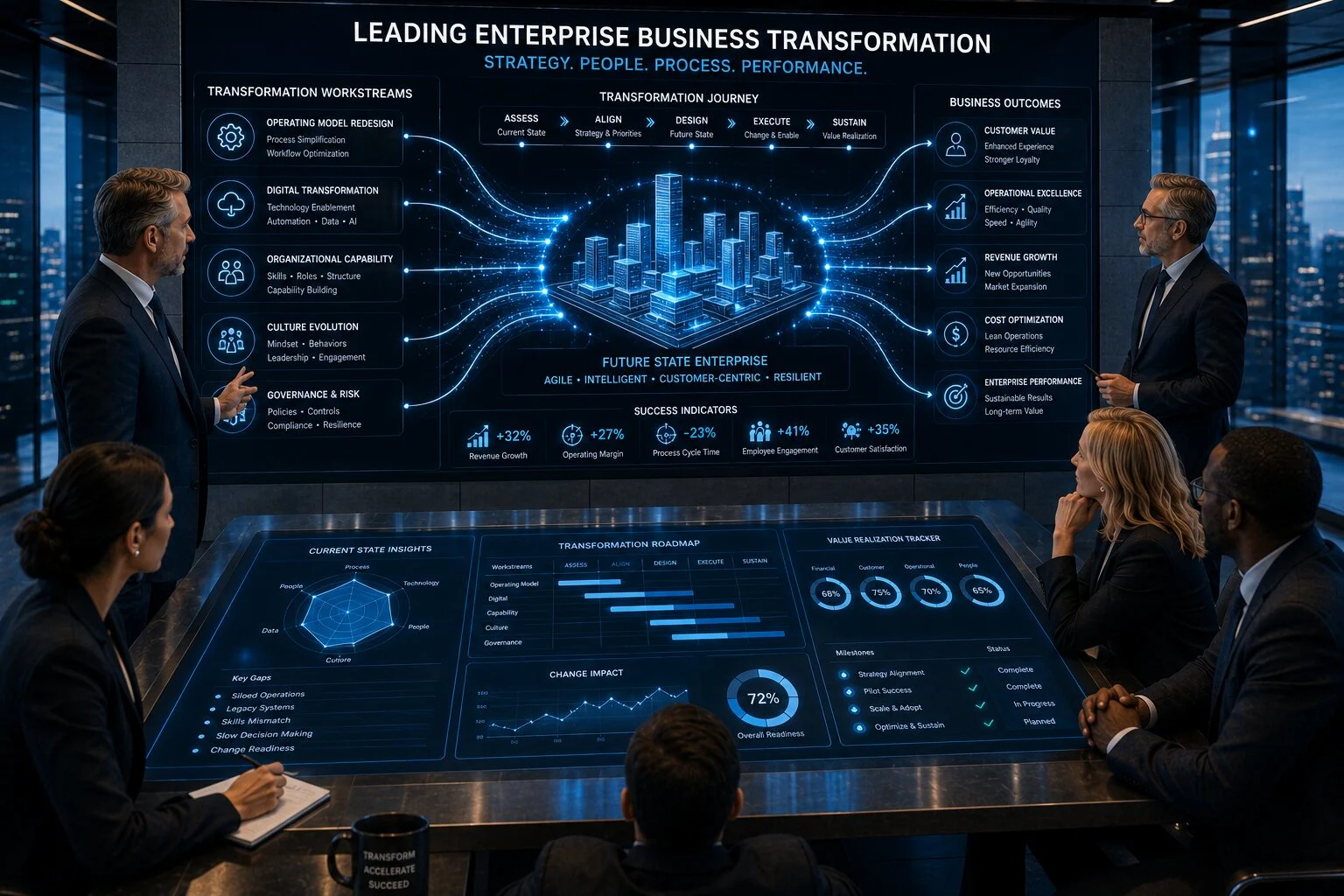
Business transformation is the deliberate, comprehensive reshaping of how an organization creates, delivers, and captures value — encompassing strategic repositioning, operating model redesign, digital capability building, M&A integration, and the cultural and organizational change required to sustain the transformation through the implementation challenges that all major organizational change creates.
When organizations need business transformation advisory:
-
1Market disruption requiring fundamental strategic repositioning when the business model that created organizational success is no longer sufficient for the competitive environment the organization now faces.
-
2Acquisition and merger integration when combining organizational systems, cultures, and leadership teams requires the organizational design, governance, and change management expertise that internal teams rarely possess at the scale required.
-
3Digital transformation when enabling technology adoption requires the organizational operating model, capability, and cultural change that technology implementation alone cannot produce.
-
4Operating model redesign when organizational structure, process architecture, and governance design are misaligned with strategic direction in ways that no amount of individual performance improvement will resolve.
Kintex approach
Our business transformation advisory is practitioner-led, board-level in perspective, and grounded in the organizational reality of executing major change through human systems under performance pressure. We bring the advisory precision and implementation experience that transforms well-designed transformation strategies into organizational outcomes.
Interim Executives
What are interim executives?
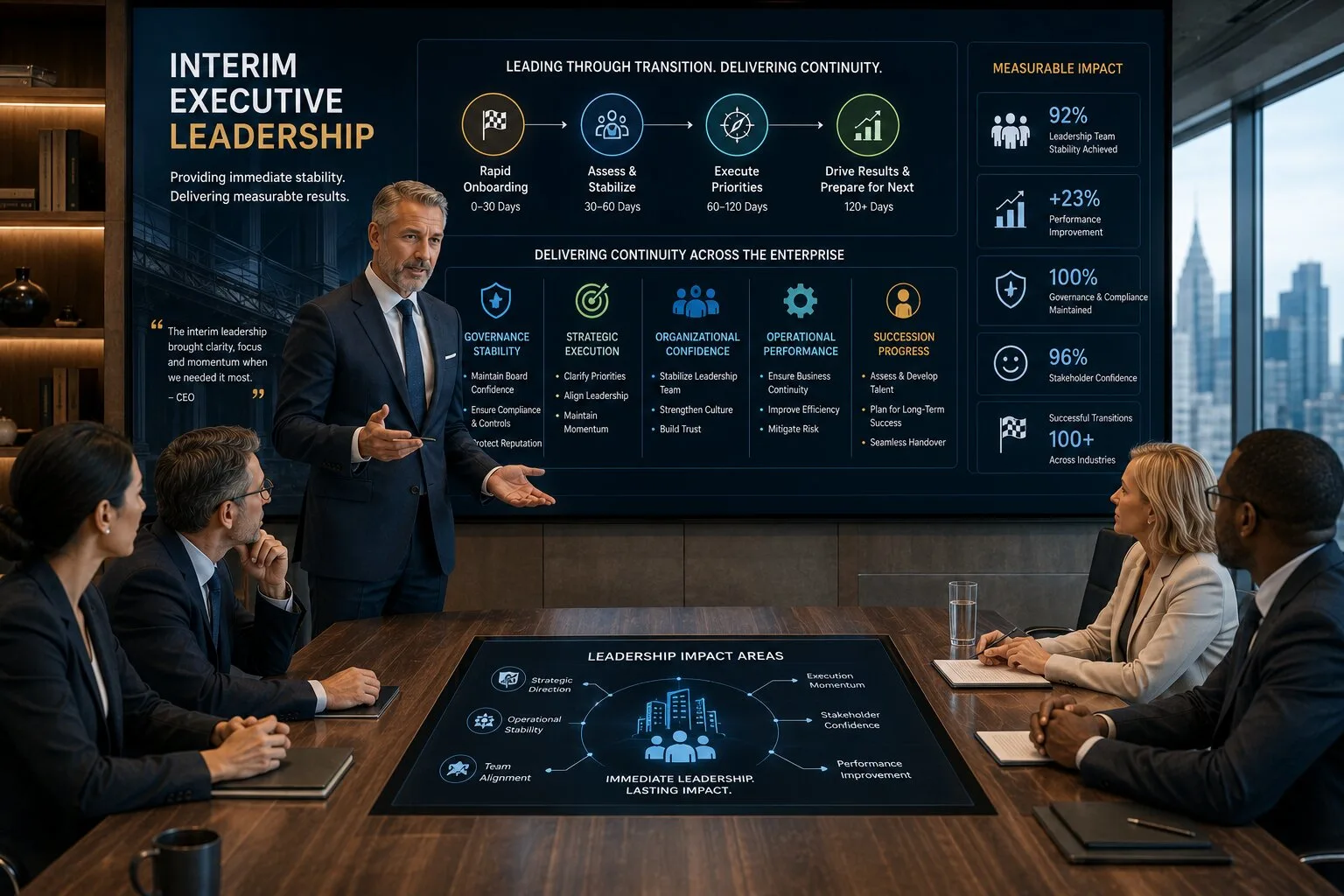
Interim executives are experienced senior leaders — typically with prior permanent roles at equivalent or
higher organizational levels — deployed on defined engagements to fill critical leadership vacancies, lead
specific transformation initiatives, provide capability injection during growth phases, or bridge succession
gaps during permanent search processes.
When interim executives are required:
-
1Unplanned executive departures that create immediate organizational capability gaps requiring rapid deployment of boardroom-ready leadership.
-
2Post-merger integration leadership requirements that exceed existing organizational management capacity.
-
3Transformation initiative leadership where the organization lacks the specific change leadership experience the initiative demands.
-
4Succession timing gaps between the departure of an executive and the readiness or appointment of a permanent successor.
-
5Capability injection during rapid growth phases where leadership demand is outpacing internal pipeline development.
The Kintex interim practice
Kintex Consulting’s interim executive practice deploys practitioners who have held equivalent roles in comparable organizations — ensuring that interim leadership engagements bring genuine peer-level credibility, immediate organizational authority, and the practitioner intelligence that accelerates organizational performance from day one of the engagement.
Every engagement begins with precise mandate definition — clarifying the specific organizational objectives, performance standards, governance framework, timeline, and success criteria that define engagement success. This mandate clarity is what distinguishes practitioner interim leadership from organizational gap-filling and ensures that every Kintex interim engagement creates measurable organizational value independent of the permanent succession outcome.
What interim executives deliver:
- Immediate organizational stability — clear decision-making authority, visible leadership presence, and organizational confidence that the role is being managed rather than vacant.
- Strategic continuity — sustained execution of strategic priorities without the delay that leadership vacuums create.
- Capability injection — specific leadership experience and organizational knowledge that the organization needs for a defined period but does not need to acquire permanently.
- Succession support — in some engagements, interim leaders play an active role in identifying, assessing, and onboarding permanent successors — providing the organizational knowledge transfer that improves permanent appointment outcomes.
FAQ: Interim Executives
How quickly can Kintex deploy an interim executive?
What is the typical duration of an interim executive engagement?
Can an interim executive become the permanent appointment?
Why Choose Kintex for Workforce & Business Transformation
Integrated workforce and organizational capability
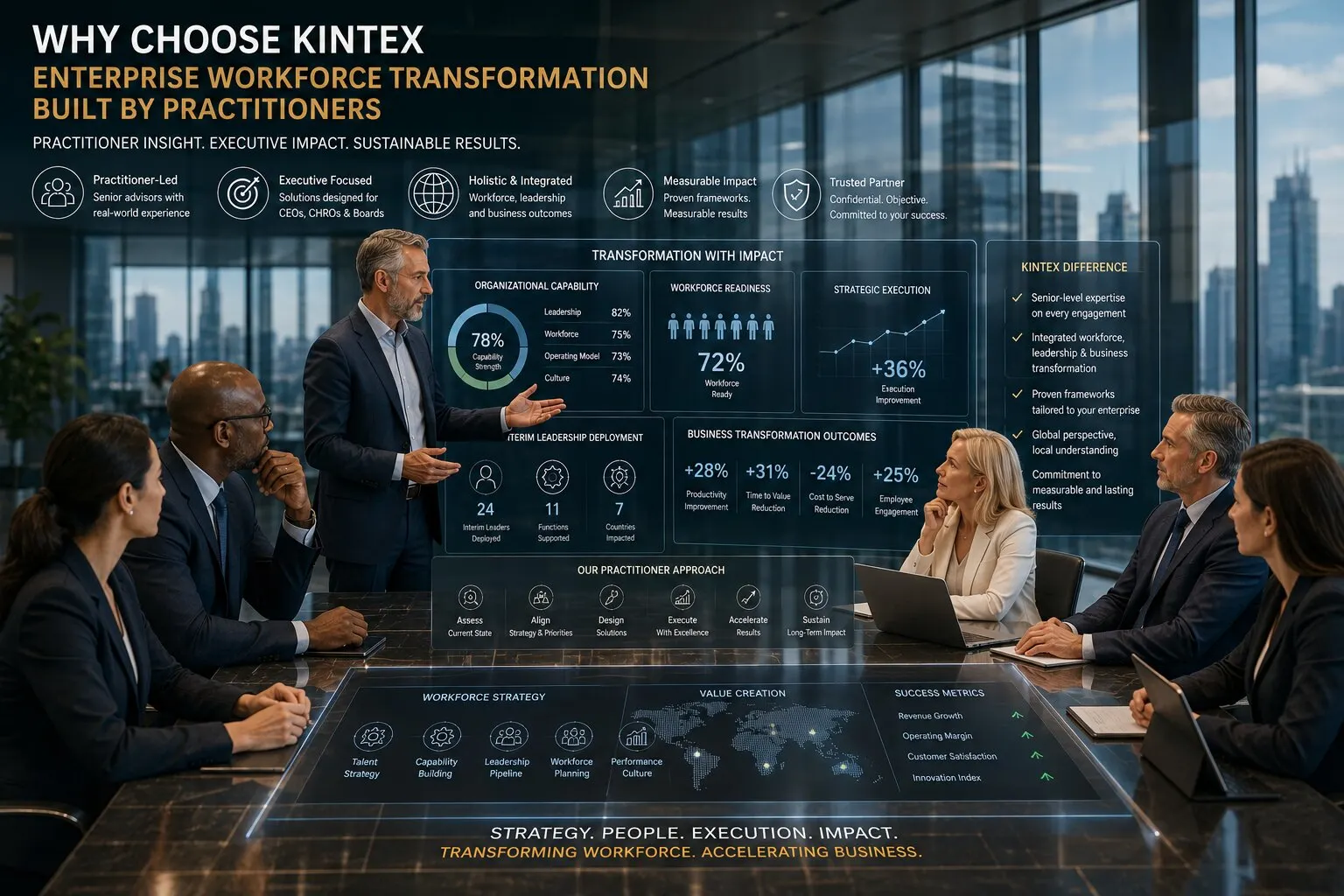
We address workforce transformation as an integrated challenge — connecting workforce strategy, organizational design, capability development, and executive deployment into a coherent organizational capability architecture rather than treating each as an isolated intervention.
Practitioner-led delivery
Our workforce and transformation advisors have led workforce strategy, organizational redesign, and business transformation from organizational leadership roles. They bring the implementation intelligence that distinguishes advisory that produces organizational change from advisory that produces strategic presentations.
Speed and quality in interim deployment
Our interim executive practice combines rapid deployment capability — typically one to three weeks from engagement to placement — with the quality standards of our permanent executive search practice. We do not compromise assessment rigour for deployment speed.
Workforce & Business Transformation – FAQs
What is the difference between workforce planning and headcount planning?
When should an organization engage an interim executive versus beginning a permanent search immediately?
How does organizational design affect talent retention?
Align your workforce architecture with the strategy you need to execute.
Kintex Consulting’s workforce and business transformation practice serves enterprise organizations navigating growth, transformation, M&A integration, and operating model evolution.