
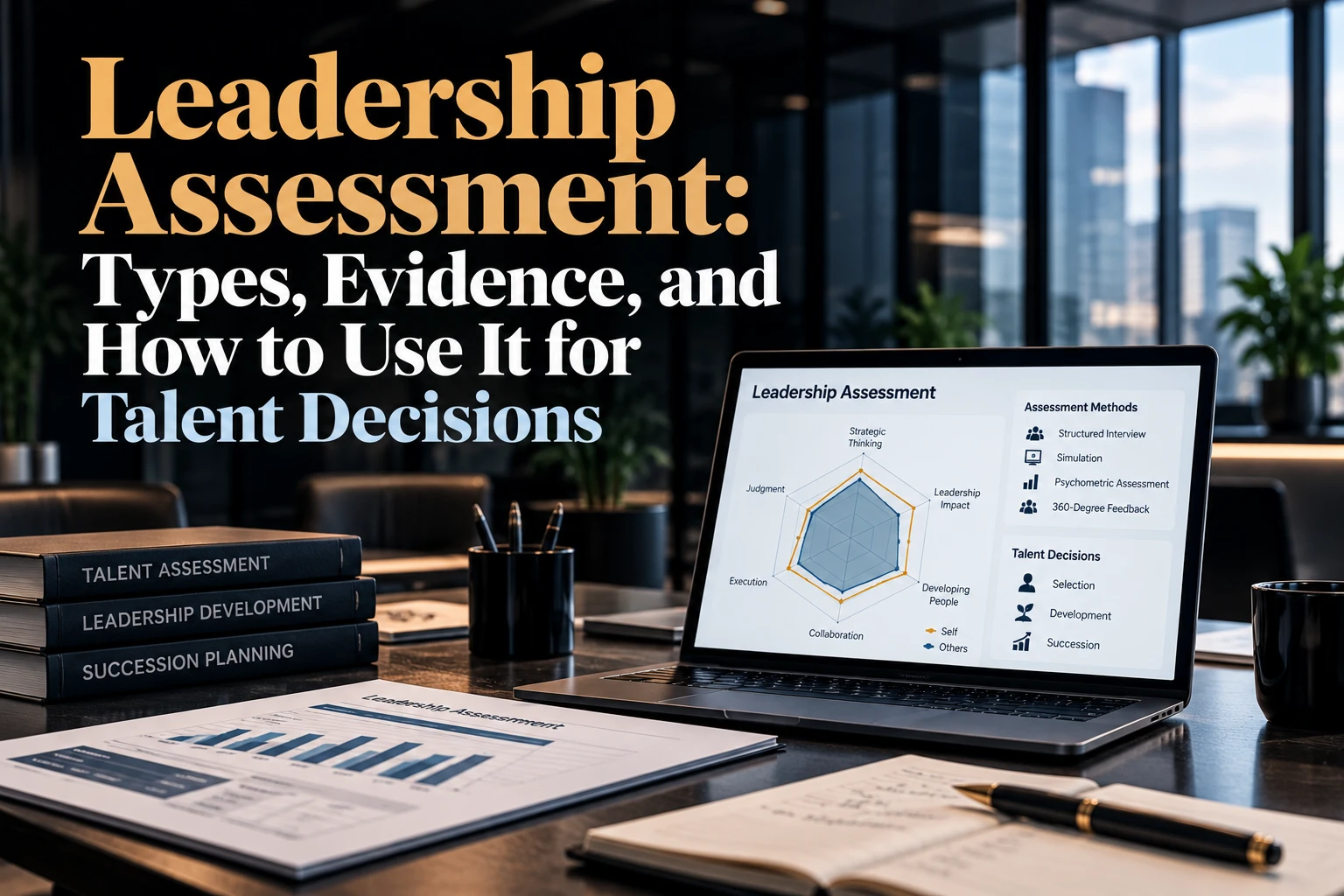
A leadership assessment is a structured process for measuring a person’s leadership capability, potential, and risks. Organizations use it to decide who to hire or promote, how to develop leaders, and who is ready for succession. Strong assessments combine several methods, such as simulations, structured interviews, and ratings from colleagues. The goal is better talent decisions based on evidence rather than impressions.
What Is a Leadership Assessment?
A leadership assessment is a systematic evaluation of leadership. It asks how well someone leads today. It also asks how well they are likely to lead in a larger role. The evidence comes from tests, observed exercises, interviews, and ratings from colleagues.
The word “systematic” matters. Informal judgments about leadership are common, but they vary from one observer to the next. A leadership assessment applies the same criteria, methods, and scoring rules to every person. That consistency makes results comparable and defensible.
Leadership assessment is a broad term. It covers first-time supervisors, middle managers, and senior leaders. When the focus is the C-suite, practitioners often call it an executive assessment. Executive assessments usually focus more on strategic judgment, stakeholder influence, and enterprise-level decisions.
What Leadership Assessments Measure
Most leadership assessments measure four kinds of attributes. Each one answers a different question about the leader.
- Capability: Can this person perform the core behaviors of the role? Examples include setting direction, coaching, deciding, and managing change.
- Potential: Can this person grow into larger and more complex roles? Potential depends on learning ability, motivation to lead, and adaptability.
- Derailment risk: Which behaviors might undermine this person under pressure? Examples include volatility, excessive caution, and arrogance.
- Motivation and values: Does this person want the role? Do their values fit its demands?
These attributes are usually defined through leadership competencies. A competency model translates strategy into observable behaviors. For example, a growth strategy built on innovation may prioritize experimentation and cross-functional influence. A good assessment measures the competencies that matter for the specific role, not a generic list.
Capability and potential are different things. A leader can perform very well today and still lack the attributes for a bigger role. Confusing the two is a common and costly error in talent management.
Leadership Assessment vs Performance Review vs Personality Test
Leadership assessment is often confused with two related practices. The differences affect how results should be used.
| Dimension | Leadership Assessment | Performance Review | Personality Test |
| Core question | How well does this person lead now, and how well might they lead next? | Did this person meet goals in the review period? | What are this person’s typical traits and preferences? |
| Time focus | Present and future | Past | Stable tendencies |
| Evidence sources | Several methods and raters | Mostly the manager’s judgment and results | Self-report questionnaire |
| Typical use | Selection, development, succession | Pay, rewards, accountability | Self-awareness; one input to assessment |
| Main limitation | Cost and design effort | Reflects the current role only | Describes tendencies, not demonstrated skill |
A performance management process shows what a leader has achieved. A personality test shows how someone tends to behave. A leadership assessment integrates these and other inputs to answer a forward-looking question.
Why Leadership Assessment Matters
Leadership assessment matters because leader quality shapes team outcomes, and leader selection is error-prone. Assessment reduces that error by replacing tenure and visibility with evidence about leadership behavior.
The stakes begin at the team level. Gallup estimates that managers account for at least 70% of the variance in employee engagement across business units. Gallup’s research links engagement to productivity and retention. A weak manager choice therefore affects a whole team.
Yet promotion decisions often rely on the wrong signals. Gallup’s analysis suggests companies fail to pick the candidate with the right management talent 82% of the time. This figure comes from Gallup’s own talent measures, so treat it as directional. Gallup also found managers often believed they were promoted for past individual success or tenure.
Peer-reviewed research supports the same concern. A 2019 study in the Quarterly Journal of Economics tested it directly. The authors used data on almost 40,000 sales workers across 131 firms.
Firms tended to promote their best salespeople, even though these people became worse managers. Other observable traits predicted managerial success better than sales results did. The authors add that promotion incentives might justify this cost, or firms may simply be choosing poorly.
This pattern is often called the Peter Principle. Leadership assessment addresses it by measuring leadership behavior directly. Past performance still matters, but it becomes one input rather than the deciding factor.
The pipeline problem adds urgency. DDI, a leadership consultancy, surveyed 2,185 HR professionals and 10,796 leaders for its 2025 HR Insights Report. On average, only 49% of critical leadership roles could be filled immediately by internal candidates. Without reliable assessment data, organizations cannot see who is ready now and who needs development.
What Individual Leaders Gain
Assessment also benefits the people being assessed. A well-run assessment gives leaders a clearer view of their strengths, gaps, and blind spots. It turns vague career advice into specific development targets.
It can also make advancement fairer. When promotion decisions rest on structured evidence, visibility and self-promotion tend to carry less weight. Effective leaders who are less visible get a more equal chance to be recognized.
Start With the Decision: Selection, Development, or Succession
The purpose of a leadership assessment should determine its design. A tool that works well for development can be risky for hiring. A tool built for hiring may feel too clinical for coaching.
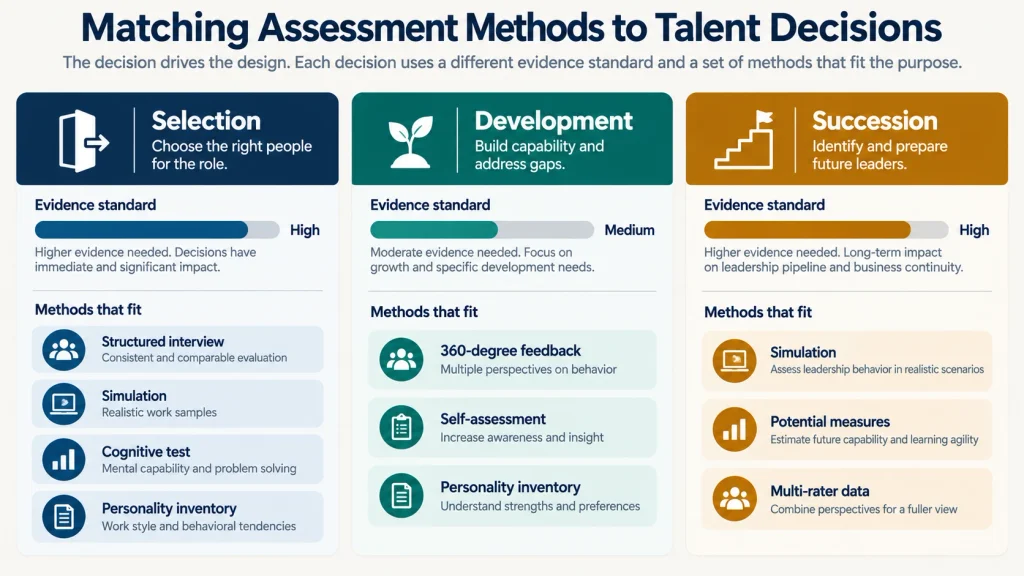
The reason is that each decision carries different consequences. Selection decisions affect careers and carry legal exposure. Development decisions shape learning investments and depend on trust and candor. Succession decisions bet on future performance in roles the person has never held.
| Decision | Core question | Evidence standard | Methods that fit best | Who sees results |
| Selection and promotion | Who should get this role? | High: validated, job-related, consistent | Structured interviews, simulations, cognitive and personality tests | Decision makers, with feedback to candidates |
| Development | Where should this leader grow? | Moderate: credible and useful to the leader | 360-degree feedback, self-assessments, personality inventories | The leader and their coach, by agreement |
| Succession | Who is ready for larger roles, and when? | High: predictive of success in future roles | Simulations, potential measures, multi-rater data, career history | Talent review committees |
Succession planning needs its own lens. It asks about readiness for roles the person has not yet experienced. That requires measures of leadership potential, not only current results.
In a 2010 Harvard Business Review article, Jean Martin and Conrad Schmidt warned against mistaking current performance for potential. They recommended testing candidates for ability, engagement, and aspiration.
One practical rule follows. Decide who will see the results before anyone completes an assessment. Leaders tend to answer more candidly when they know how data will be used. Changing the purpose after collection can damage trust in every future assessment.
Types of Leadership Assessment Methods
Leadership assessment methods differ in two important ways. Some ask people to describe themselves or others, while others test or observe performance directly. Some are generic, while others are built around the specific role. These differences shape what each method can tell you.
Self-Assessments
Self-assessments ask leaders to rate their own behaviors, preferences, or skills. They are fast, inexpensive, and useful for reflection. Many free online leadership assessments fall into this category.
Their weakness is accuracy. People are not always good judges of their own leadership. Self-ratings can also shift toward a flattering picture when stakes are high. Use self-assessments to open development conversations, not to decide promotions.
360-Degree Feedback
360-degree feedback collects ratings from a leader’s manager, peers, direct reports, and sometimes customers. The leader completes a self-rating for comparison. The value lies in the contrast between how leaders see themselves and how others experience them.
This data captures reputation, which is how leadership actually lands with other people. However, it reflects current perceptions, not future readiness. Ratings can also be shaped by office politics and personal relationships. For these reasons, 360 feedback fits development better than high-stakes selection.
Personality Inventories
Personality inventories measure stable tendencies such as conscientiousness, sociability, and emotional stability. Leadership-focused inventories often cover two sides of personality. The “bright side” describes how people behave at their best. The “dark side” describes behaviors that emerge under stress, fatigue, or complacency.
Well-validated inventories add useful information to both selection and development. Quality varies widely, however. Some popular tools were built for self-awareness and should not be used to screen candidates. Some programs also add emotional intelligence measures, which range from ability tests to self-report scales.
Cognitive Ability Tests
Cognitive ability tests measure reasoning, problem solving, and learning speed. These abilities matter more as roles grow in complexity. Senior leaders must process ambiguous information and decide with incomplete data.
Cognitive tests are standardized and efficient. They can also show differences in average scores between demographic groups. Organizations should monitor them for fairness and combine them with other methods.
Situational Judgment Tests
Situational judgment tests present realistic workplace dilemmas. The leader chooses or ranks possible responses. A typical scenario might involve a high performer who is damaging team morale.
These tests measure practical judgment in context. They scale well and can reflect an organization’s culture. Their limitation is simple: choosing a good answer is not the same as carrying it out.
Structured Behavioral Interviews
Structured behavioral interviews ask every candidate the same job-related questions. Trained interviewers score answers against defined rating scales. Questions often ask for past examples, such as leading a team through a failed project.
Structure is the key word. Unstructured interviews let interviewers follow their instincts, which invites bias and inconsistency. As the next section shows, structured interviews have some of the strongest predictive evidence available.
Simulations and Assessment Centers
Simulations place leaders in realistic tasks and observe their behavior. Exercises may include a coaching role-play, an inbox of competing priorities, or a stakeholder presentation. Trained assessors rate what the leader actually does.
An assessment center combines several simulations with other methods. Multiple assessors observe each participant across exercises. The U.S. Office of Personnel Management describes them as especially suited to evaluating senior managerial and leadership skills. Their main drawbacks are cost and design effort.
How Well Do Leadership Assessments Predict Performance?
Well-designed leadership assessments predict performance moderately well. The strongest methods are structured and specific to the job. No single method is perfect, which is why combinations tend to outperform any one tool.
What the Validity Research Shows
Validity describes how well assessment results predict later outcomes, such as job performance. It is usually expressed as a correlation, where 0 means no prediction and 1 means perfect prediction. Reliability comes first: a tool must measure consistently before it can predict anything. Even moderate validity can improve decisions meaningfully across many hires and promotions.
The most important recent evidence is a 2022 reanalysis by Paul Sackett and colleagues. They found that earlier research had overcorrected for a statistical artifact called range restriction. Procedures that ranked high before mostly kept their rank, but their estimates fell by .10 to .20. Even so, the authors concluded that selection procedures remain useful.
Several findings matter for leadership assessment:
- Structured interviews ranked highest, with a mean validity of .42.
- Empirically keyed biodata, which scores life history items against outcomes, followed at .38.
- Work sample tests came in at .33.
- Cognitive ability tests fell to .31, well below the older estimate of .51.
These figures describe job performance in general, not leadership roles specifically. They also vary widely across settings. In a 2023 follow-up, the authors described the interview estimate as roughly .42, plus or minus .24. In practice, the quality of design and delivery strongly affects how well any method performs.
Why Structured, Job-Specific Methods Predict Better
The Sackett findings share a pattern. Methods built around the specific job tend to outperform general psychological measures. Three mechanisms help explain why.
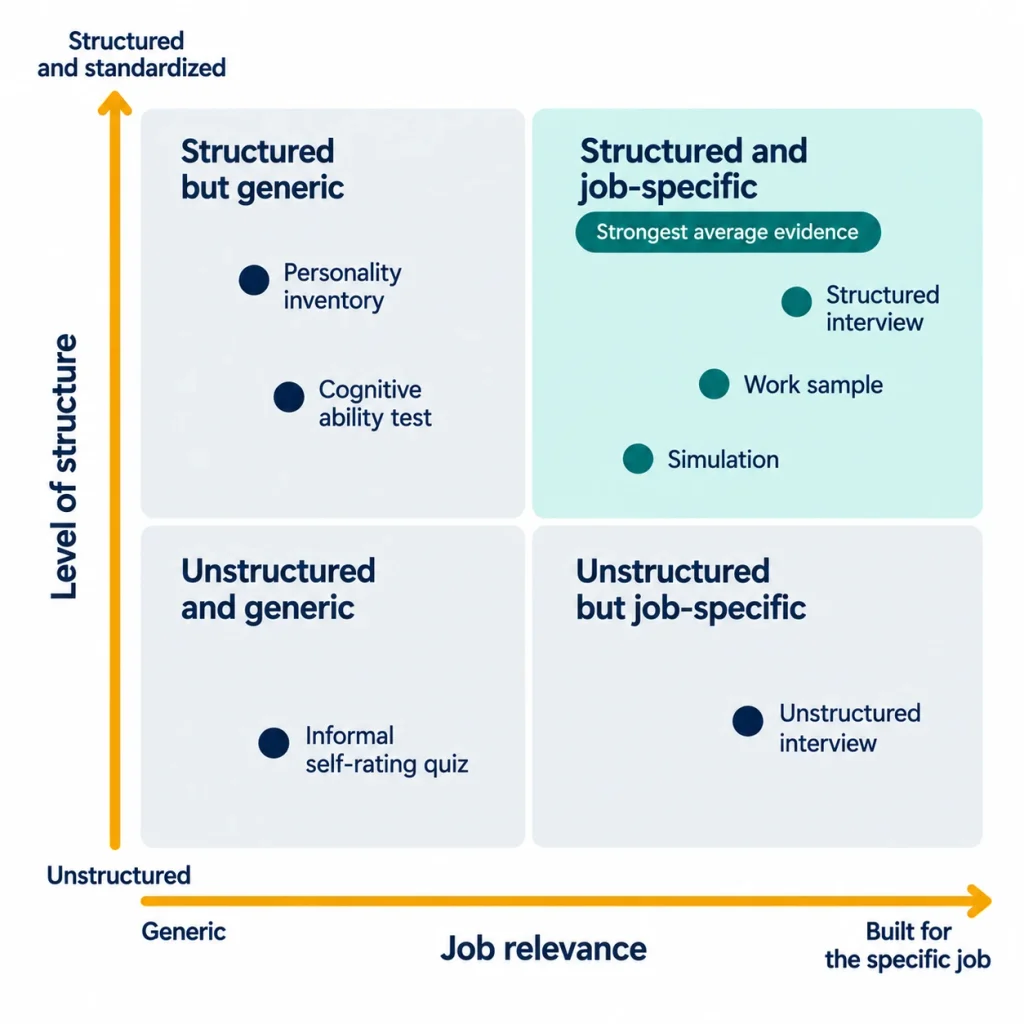
First, job-specific methods target the behaviors the role actually requires. A coaching simulation asks the leader to coach, rather than to describe a coaching style.
Second, structure reduces noise. Standard questions, rating scales, and trained assessors make scores more consistent across people. Third, some formats are harder to fake. Research suggests situational judgment tests are less prone to faking than traditional self-report questionnaires.
This does not make self-report useless. Personality data can explain why a behavior occurs.
Suppose a 360 shows that peers see a leader as slow to decide. A personality inventory might reveal a strong need for certainty before acting. Together, the two results point to a specific and workable development target.
Popular Leadership Assessment Tools and Their Intended Uses
Many well-known tools are marketed or used as leadership assessments. Their publishers designed them for different purposes, and those purposes matter. The table below summarizes common tools by intended use.
| Tool | What it measures | Best use | Key caution |
| Myers-Briggs Type Indicator (MBTI) | Personality type preferences | Self-awareness and team communication | The publisher states it does not condone MBTI use for hiring or selection |
| Everything DiSC | Behavioral and communication style | Team and interpersonal development | Official DiSC guidance says it is not recommended for pre-employment screening |
| CliftonStrengths | Ranked talent themes | Strengths-based development | Rank-orders a person’s own themes rather than scoring them against a role standard |
| Hogan Development Survey | 11 derailment tendencies that emerge under pressure | Coaching, development, and risk review | Scores indicate risk, not certainty |
| Multifactor Leadership Questionnaire (MLQ) | Transformational, transactional, and passive-avoidant leadership behaviors | Development and research | Published psychometrics apply to the multi-rater form, not the self form alone |
| CCL Benchmarks 360 | Leadership skills and behaviors rated by others | Development with normative comparison | Reflects current perceptions rather than future readiness |
The pattern is clear. Several of the most famous tools are development instruments. They can be valuable in coaching programs and team workshops. When the decision is hiring or promotion, choose instruments with documented validity evidence for that purpose.
How to Conduct a Leadership Assessment
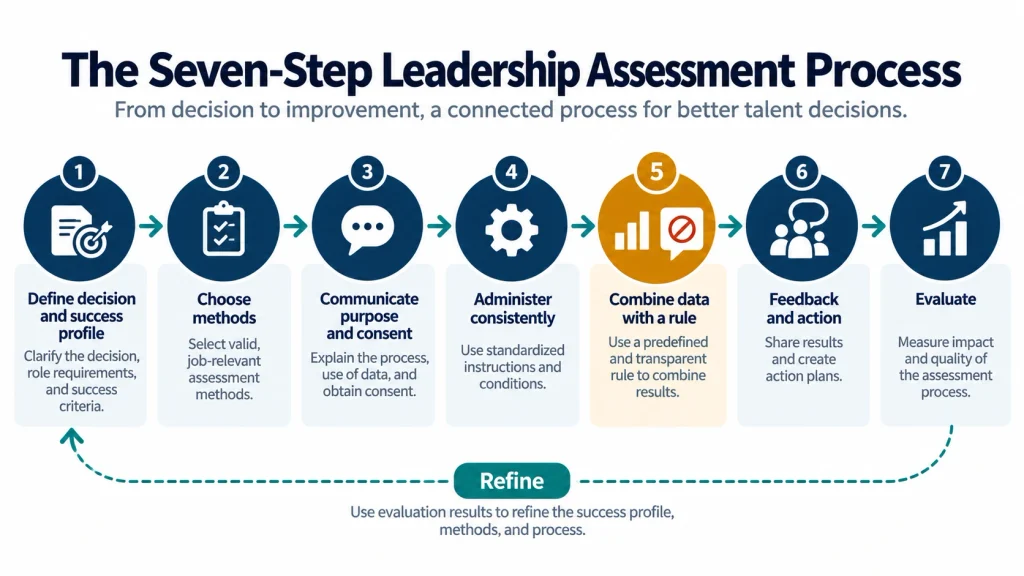
A sound leadership assessment follows a clear sequence. Each step removes a specific source of error, from vague criteria to biased judgment.
Step 1: Define the Decision and the Success Profile
Start by naming the decision the assessment will support. Then define what effective leadership looks like in the target role. Build this definition from a job analysis, strategy documents, and interviews with successful incumbents. Without a clear success profile, every later step risks measuring the wrong things.
Step 2: Choose a Combination of Methods
Select two to four methods that cover capability, potential, and risk. Match the strength of evidence to the stakes of the decision. For a senior promotion, a simulation, structured interview, and personality inventory might work together. For a development program, a 360 and a self-assessment may be enough.
Step 3: Communicate Purpose, Consent, and Data Use
Tell participants why they are being assessed and who will see the results. Explain how long data will be kept and how it will influence decisions. Clear communication tends to improve candor and reduce anxiety. It is also increasingly a legal expectation, as a later section explains.
Step 4: Administer Consistently
Give every participant the same instructions, time limits, and conditions. Train assessors and interviewers on the rating scales. Where possible, use more than one assessor for each exercise. Consistency protects both accuracy and fairness.
Step 5: Combine Data With a Rule, Not a Gut Feeling
Many organizations collect good data and then combine it informally in a meeting. Research suggests this weakens prediction.
A 2013 meta-analysis by Nathan Kuncel and colleagues compared two approaches. Mechanical combination uses a predefined formula or weighting. Holistic combination relies on the judgment of the people in the room.
For predicting job performance, mechanical combination improved prediction by more than 50%. The loss from holistic judgment appeared even when experts combined the data. One plausible reason is that people overweight vivid details, such as one impressive answer. Discussion still has a role, but it should follow the calculated scores.
Step 6: Turn Results Into Feedback and Action
Deliver results through a trained feedback provider, not a report in an inbox. Help the leader choose one to three priorities. Then link those priorities to concrete support, such as a stretch assignment or executive coaching. Assessment without follow-through tends to create awareness without lasting behavior change.
Step 7: Evaluate the Program
Track whether assessed leaders succeed after selection or improve after development. Compare outcomes such as team engagement, retention, and performance ratings. Review selection rates across demographic groups. Evaluation turns a one-time exercise into a system that improves over time.
How to Interpret Leadership Assessment Results
Interpreting results well requires more than reading scores. The most useful insights come from context and patterns. These include the comparison group, gaps between raters, risks under pressure, and the conditions for change.
Compare Scores With the Right Benchmark
Most assessment reports compare a leader’s scores with a norm group, often shown as percentiles. A percentile only has meaning relative to that group. A score at the 60th percentile among frontline supervisors may mean something different among senior executives. Ask which norm group the report uses and whether it matches the role.
Read Self-Other Gaps Carefully
The gap between self-ratings and others’ ratings is one of the richest signals in 360 data. A meta-analysis in The Leadership Quarterly examined how leaders’ self-ratings compare with observers’ ratings. Leaders tended to rate their relationship-oriented behaviors higher than observers did. For task-oriented behaviors, their self-ratings were lower or similar.
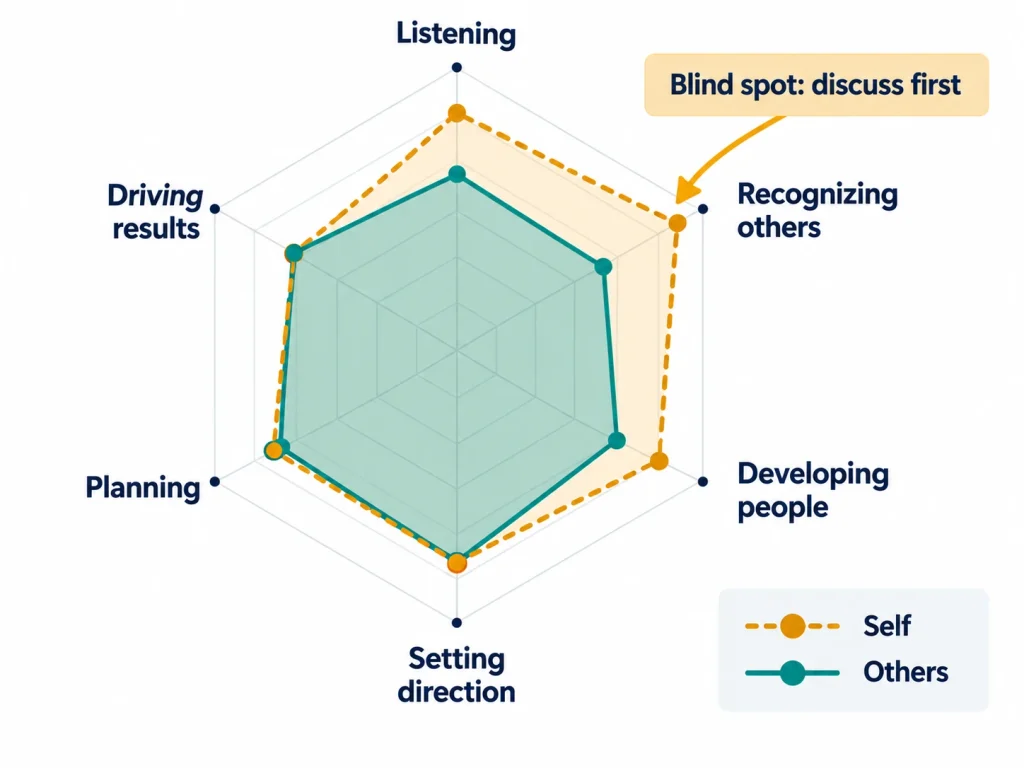
These gaps matter for careers. A 2014 study led by Center for Creative Leadership researchers examined career derailment potential. Peer ratings were typically the strongest predictors, while self-ratings mattered least.
Derailment potential was lowest when leaders rated themselves below others’ ratings. It was also low when self and others agreed on high ratings.
In practice, treat a large overrating gap as a development priority. It suggests the leader may not see how their behavior affects others. That blind spot can matter more than any single low score.
Treat Derailers as Risks, Not Labels
Leadership derailment describes a once-promising leader who is fired, demoted, or plateaus below expected levels. Instruments such as the Hogan Development Survey measure tendencies linked to this risk. Hogan describes these behaviors as typically emerging under stress or when leaders stop monitoring themselves.
A high derailer score is a warning, not a verdict. Many derailers are strengths used to excess. A leader with high standards may become overly critical under deadline pressure. The useful questions are when the risk appears and which safeguards can manage it.
Understand Why Feedback Can Backfire
Feedback does not automatically improve performance. A landmark 1996 meta-analysis by Avraham Kluger and Angelo DeNisi analyzed 607 effect sizes. Feedback improved performance on average. However, more than one-third of feedback interventions actually decreased performance.
Their explanation centers on attention. Feedback that keeps attention on the task tends to help. Feedback that pulls attention toward the self, such as a threat to self-image, can hurt. A harsh report delivered without support can trigger exactly this reaction.
Multisource feedback shows a similar pattern. A 2005 meta-analysis of 24 longitudinal studies found that improvement after multisource feedback was generally small. The authors argued that improvement is more likely under certain conditions. These include accepting the need to change, setting goals, and taking development action.
The implication is practical. The value of an assessment depends heavily on how results are delivered and supported. Budget for feedback, coaching, and follow-up, not only for the instrument.
Fairness, Legal, and AI Considerations
When assessment results influence hiring or promotion, they become part of employment decisions. That brings legal duties, fairness obligations, and new rules for AI-based tools.
In the United States, the Uniform Guidelines on Employee Selection Procedures cover promotion as well as hiring. They include the “four-fifths rule.” A group’s selection rate below 80% of the highest group’s rate is generally treated as evidence of adverse impact.
Adverse impact is not automatically unlawful. However, the employer may then need to show the procedure is job-related and properly validated.
The growth of AI in hiring adds another layer. New York City’s Local Law 144 covers automated tools that substantially assist hiring or promotion decisions. Enforcement began on July 5, 2023.
Covered employers need an independent bias audit within the year before use. They must also publish a summary of the results and notify candidates or employees in advance. A December 2025 New York State Comptroller audit found enforcement weak, and the city agreed to strengthen it. Some U.S. states, such as Illinois, have also added AI rules to their employment discrimination laws.
In Europe, the EU AI Act treats AI used for recruitment, promotion, and performance evaluation as high risk. The Digital Omnibus on AI entered into force on July 27, 2026. It moved these high-risk obligations to December 2, 2027.
The delay changes the timing, not the requirements. Organizations using AI-scored interviews or automated talent analytics should prepare documentation, human oversight, and risk controls now.
Two other duties apply broadly. Assessment results are personal data, so privacy laws such as the EU’s GDPR govern their collection and storage. Disability laws, such as the Americans with Disabilities Act, can require adjusted test formats or extra time as accommodations.
Three practices reduce risk in any jurisdiction. First, document the link between each method and the success profile. Second, monitor outcomes by demographic group. Third, keep a named person accountable for every consequential decision.
Professional standards, such as the SIOP Principles for the Validation and Use of Personnel Selection Procedures, give further guidance.
Common Leadership Assessment Mistakes
Most failures in leadership assessment come from design and use, not from the instruments themselves. Five mistakes appear repeatedly.
- Promoting on performance alone. Strong individual results feel like proof of leadership ability. As the Peter Principle research shows, they often are not.
- Using development tools for selection. Tools built for self-awareness often lack evidence for predicting performance. Using them to hire weakens decisions and adds legal risk.
- Relying on one method. Every method has blind spots. Combining methods lets the strengths of one offset the weaknesses of another.
- Combining data by discussion. Informal debate lets one vivid impression outweigh systematic evidence. Score first, then discuss.
- Collecting data without follow-through. Reports that lead nowhere erode trust. Participants may answer less candidly the next time.
Many organizations embed assessment within broader leadership development programs to avoid the last mistake. The assessment then becomes the diagnostic starting point for learning, not a standalone event.
Conclusion
Leadership assessment is a decision tool. Its value depends on matching the method to the decision it supports. Development needs candor and credible feedback. Selection and succession need validated, job-related evidence.
Current performance is useful evidence, but it is not the same as potential. Structured, job-specific methods have the strongest average evidence. Combining methods with a clear rule improves accuracy further. Feedback helps most when it is delivered well and followed by action.
Over time, disciplined assessment builds a clear map of leadership capability across the organization. That map supports fairer promotions, stronger pipelines, and better-targeted development. Fairness checks and clear data rules keep that map trustworthy. Organizations that assess with this discipline are better positioned to avoid costly leadership mistakes.
A leadership assessment ends with a clear picture of a leader’s strengths, gaps, and risks. The next need is turning those findings into structured growth. A leadership development plan converts assessment results into specific goals, experiences, and support. It gives those insights a structure for sustained development.
Frequently Asked Questions
Six questions drawn from question-led ranking pages and competitor FAQ sections. Live People Also Ask boxes were not visible to the research tools, so question demand was inferred from these pages. Questions the article already answers (types, best tool, 360 for succession, executive vs leadership assessment) were removed.
Can you fail a leadership assessment?
It depends on the purpose. Development assessments usually have no pass mark; they show strengths and gaps. Selection and promotion assessments compare you with a role standard, so results can decide whether you advance.
How should I prepare for a leadership assessment?
Ask what the assessment is for and which methods it uses. Prepare two or three specific stories about leading people, making decisions, and handling conflict. Answer personality items honestly, because some inventories include scales that flag overly favorable responding.
How long does a leadership assessment take?
A short self-assessment often takes 10 to 15 minutes. An online battery of personality and cognitive tests can take two to three hours. Multi-rater feedback and assessment centers take longer, because they involve other raters or several exercises.
Are free online leadership assessments worth taking?
They can support private reflection and start a useful conversation with a manager or coach. Before trusting one, check who built it and what it claims to measure. Look for published reliability and validity evidence, and for feedback tied to specific behaviors rather than broad labels.
What questions are asked in a leadership assessment?
Questions vary by method. Self-report items ask you to rate statements such as “I give clear feedback on missed deadlines.” Interviews ask for examples, such as a time you delivered an unpopular decision. Situational judgment items describe a dilemma and ask you to rank possible responses.
Can AI be used in leadership assessment?
Yes. Vendors use AI to score video interviews, analyze written responses, and send development prompts during daily work. Evidence for many AI-scored methods is still developing, so ask vendors for validation studies and bias audit results.