
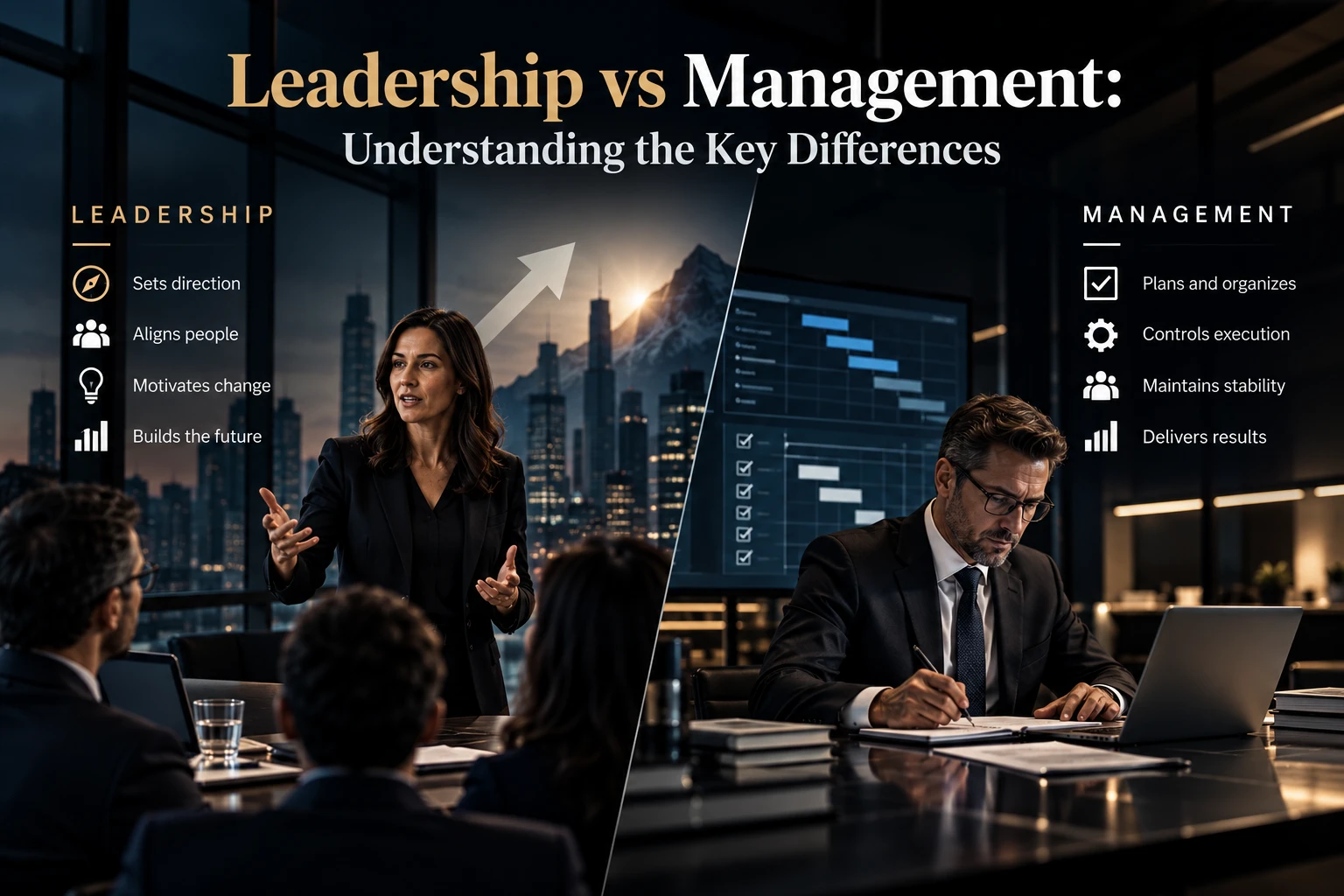
Leadership and management are related but distinct functions inside any organization. Management brings order and consistency to complex work through planning, organizing, and control. Leadership creates movement and change by setting a vision and aligning people around it. Both functions matter. A team with only management stays efficient but rarely adapts. A team with only leadership stays inspired but rarely delivers.
What Is Leadership?
Leadership is the ability to set a direction and move people toward it, even without formal authority. A leader influences others through trust, vision, and example rather than through position alone.
Leadership matters because organizations operate in changing conditions. Markets shift, technology evolves, and competitors adapt. Without leadership, a team can run its existing processes well and still miss the moment those processes stop working. Harvard Business School professor John Kotter described leadership as the function responsible for coping with change.
This is why leadership development gets so much organizational attention. An organization can teach process skills fairly quickly. The judgment, trust, and vision that leadership requires usually take years of experience and deliberate practice to build.
Core Elements of Leadership
Three elements consistently appear in definitions of leadership.
Establishing direction means defining where a team or organization needs to go. A leader often sees this need before it is obvious to everyone else.
Aligning people means building a shared understanding of that direction. A leader communicates the vision so the people who must carry it out actually buy into it.
Motivating and inspiring means appealing to values, purpose, and emotion to keep people moving forward, especially through setbacks.
Leadership does not require a title. Someone without formal authority can still act as a leader by shaping how a team thinks about a problem.
What Is Management?
Management is the set of practices that bring order, consistency, and predictability to an organization’s work. A manager plans, organizes, staffs, and controls resources so that goals get met reliably.
Where leadership deals with an uncertain future, management deals with a complex present. Kotter described this function as coping with complexity. As organizations grew larger through the twentieth century, management emerged as a discipline. It keeps complexity from turning into chaos.
Management matters because vision alone does not deliver results. Even the most inspiring strategy needs budgets, staffing plans, and accountability structures behind it. Otherwise it stays an idea instead of becoming an outcome.
Core Elements of Management
Planning and budgeting means setting targets, timelines, and resource allocations needed to reach a goal.
Organizing and staffing means designing the right structure and placing the right people into it.
Controlling and problem solving means monitoring results against the plan and correcting course when something goes wrong.
Management relies on formal authority. A manager’s ability to direct work usually comes from their position in the organizational chart, not from personal influence alone.
Why the Terms Get Used Interchangeably
Leadership and management get treated as synonyms for a practical reason. Most people who lead a team also hold a management title, so the two functions blend together in daily experience.
Job postings reinforce the confusion. A listing for “team lead” or “manager” often asks for both planning skills and the ability to motivate people. It rarely separates which requirement belongs to which function.
The confusion also has a history. In 1977, Harvard Business School professor Abraham Zaleznik published “Managers and Leaders: Are They Different?” in Harvard Business Review. He argued that managers and leaders are fundamentally different types of people. He described managers as focused on order, control, and quick resolution of problems. Leaders, in his view, were more willing to tolerate ambiguity while pursuing a vision.
Kotter’s 1990 framework built on this idea but reframed it. Kotter did not treat leadership and management as opposing personality types. Instead, he described them as two complementary systems that most people practice in different proportions, often within the same role.
Leadership vs Management: The Key Differences
The clearest way to compare leadership and management is through Kotter’s own framework. He introduced it in his 1990 Harvard Business Review article, “What Leaders Really Do.” Kotter argued that leadership and management are complementary systems of action, each with its own purpose and activities.
| Dimension | Management | Leadership |
| Primary purpose | Copes with complexity | Copes with change |
| Time orientation | Present | Future |
| Creates agendas through | Planning and budgeting | Establishing direction |
| Builds capacity through | Organizing and staffing | Aligning people |
| Executes through | Controlling and problem solving | Motivating and inspiring |
| Primary outcome | Predictability and order | Change and movement |
| Source of influence | Formal authority | Trust and personal influence |
Focus: Coping With Change vs Coping With Complexity
Management exists because modern organizations are complex, with many people, processes, and dependencies to coordinate. Without management, that complexity collapses into confusion.
Leadership exists because conditions keep changing. Without leadership, an organization can run its current playbook well but fail to notice when the playbook stops working.
Consider a department that hits every quarterly target through tight process control. It can still lose relevance when a competitor changes the market. Strong management alone did not catch the shift. That gap is what leadership is meant to close.
Neither function replaces the other. A well-managed but poorly led organization tends to get very efficient at doing the wrong thing. A well-led but poorly managed organization tends to have inspiring plans that never get executed.
Time Horizon: Present Execution vs Future Direction
Managers concentrate on the current planning cycle. Their success is usually measured by whether this quarter’s targets, budgets, and deliverables are met.
Leaders concentrate on where the organization needs to be positioned next. Their success is measured by whether the organization is ready for what comes after the current plan ends.
This does not mean managers ignore the future or leaders ignore the present. It means their primary attention sits at different points on the timeline.
Source of Influence: Formal Authority vs Personal Trust
A manager’s authority is usually granted by the organization. It comes with a title, a reporting line, and defined decision rights.
A leader’s influence is usually earned. People follow a leader because they trust that person’s judgment or vision, independent of any title.
This distinction explains why someone can hold a management title without truly leading anyone. It also explains why someone with no formal title can still lead a team through a difficult project.
Primary Outcome: Order vs Movement
Management is judged by consistency. A well-managed team produces reliable, predictable results over time.
Leadership is judged by progress. A well-led team moves toward a meaningfully different future, even when the path there is less predictable.
Organizations need both outcomes. Consistency without progress leads to stagnation. Progress without consistency leads to chaos.
Where Leadership and Management Overlap
Leadership and management are not opposites, and the same person often performs both functions. Leading a team through change still requires organizing resources and tracking results. Strong leaders usually need working management skills too.
The overlap is largest in day-to-day supervisory roles. A first-line supervisor manages schedules and workflows while also needing to motivate the people doing that work. Most roles require a blend of both functions rather than a pure version of either one.
The overlap narrows at the extremes. A technical specialist can lead a project with no management authority at all, influencing peers purely through expertise and credibility. An operations controller can manage a process without ever needing to inspire anyone, since the process itself defines the work.
Can You Be a Leader Without Being a Manager?
Yes. Leadership is a function, not a job title. Someone without direct reports can still set direction, build trust, and influence how a team approaches a problem.
This distinction matters for organizations trying to identify leadership potential early. Limiting leadership development to people who already hold management titles overlooks a lot of talent. Employees at any level can already demonstrate influence and judgment, regardless of where they sit on the org chart. A senior engineer who shapes how a whole team approaches a technical decision is leading, even without a manager title.
The reverse is also true. Holding a management title does not automatically make someone a leader. A manager who only enforces process, without building trust or communicating direction, is performing management functions without leadership functions.
This is part of why Kotter concluded that most organizations are over-managed and under-led. Companies often promote based on technical performance or tenure, which produces competent managers who were never developed as leaders.
Leadership Styles That Complement Strong Management
Not all leadership looks the same. The distinction between leadership styles adds useful nuance to the leadership versus management comparison. Researchers often separate transformational leadership from transactional leadership.
Transactional leadership operates close to management. It relies on clear expectations, structured rewards, and correction when performance falls short. It works well for stable, well-defined work.
Transformational leadership operates closer to the pure leadership function Kotter described. It focuses on inspiring people around a shared vision and encouraging them to exceed baseline expectations, particularly during change.
Most effective leaders use both styles depending on the situation. Transactional methods keep routine work reliable. Transformational methods carry a team through uncertainty or transformation.
Situational leadership adds a further layer. It suggests that the right style also depends on how experienced a particular team member is with a particular task. A new hire may need more directive management, while a seasoned employee may need only light-touch leadership.
Skills That Define Effective Leaders
Certain skills recur across research on effective leadership.
Vision communication lets leaders translate abstract strategy into a story people can understand and act on.
Emotional intelligence lets leaders read how people are reacting to change and adjust their approach.
Decisiveness under uncertainty lets leaders make calls without complete information, since waiting for certainty often means waiting too long.
Change management capability lets leaders anticipate resistance to new direction. They address it directly instead of hoping it resolves on its own.
Coalition building lets leaders create alignment across departments and stakeholders who do not report to them directly.
Talent development lets leaders spot potential in others and create stretch opportunities that grow the next generation of leadership.
These skills tend to develop through experience, feedback, and deliberate practice rather than through a single training course.
Skills That Define Effective Managers
Management draws on a different, complementary skill set.
Planning and prioritization lets managers break large goals into achievable steps with realistic timelines.
Delegation lets managers assign work based on individual strengths and monitor progress without micromanaging.
Performance management lets managers set clear expectations, track results, and give direct feedback when performance falls short.
Resource allocation lets managers decide how budget, time, and staff get distributed across competing priorities.
Process discipline lets managers build repeatable systems so results do not depend entirely on individual heroics.
Conflict resolution lets managers address friction between team members before it disrupts a project’s timeline or quality.
Strong managers apply these skills consistently, even when the work is routine and unglamorous.
When to Lead and When to Manage
The two functions call for different approaches depending on the situation. Recognizing which one a moment requires is a practical skill in itself.
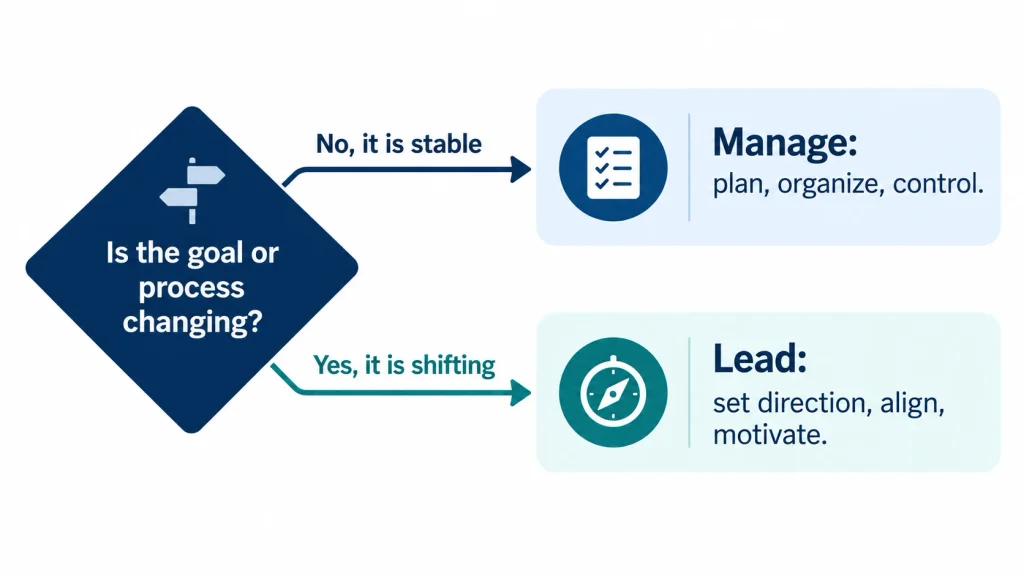
A situation calls for management when the goal is well defined and the process is known. The main risk is execution slipping. Rolling out a routine budget cycle or maintaining a stable production process are management situations.
A situation calls for leadership when the goal itself is unclear or conditions are shifting. People may also need convincing to change direction. Launching a new strategy or responding to a sudden market shift are leadership situations.
Many situations need both at once. A major system migration needs both. A leader builds buy-in for the change, while a manager plans the cutover and controls the risks.
Warning Signs to Watch For
Under-leading often shows up as a team that hits every deadline but seems disengaged. Team members may resist change or stay unclear on why the work matters beyond the task list.
Under-managing often shows up as a team that feels energized and aligned around a vision. That same team may still miss deadlines, duplicate effort, or lose track of who owns what.
Neither pattern fixes itself on its own. Recognizing which one describes a team is the first step. From there, decide whether the immediate need is stronger planning and structure, or clearer direction and buy-in.
Why the Distinction Matters for Organizations
The leadership versus management distinction is not only academic. It has measurable consequences for engagement, retention, and performance.
The Manager’s Impact on Employee Engagement
Gallup’s research has found that managers account for at least 70 percent of the variance in team employee engagement scores. This holds across business units. In practical terms, the gap between a highly engaged and a disengaged team comes down mostly to who manages it. Pay and perks play a smaller role.
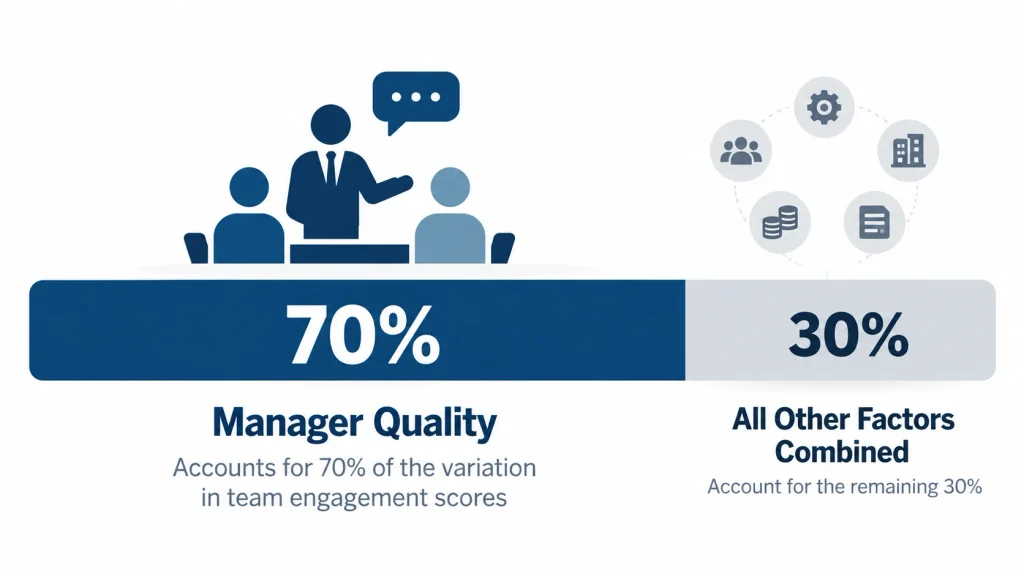
This finding matters because engagement overall is low. According to Gallup’s State of the Global Workplace: 2026 Report, only 20 percent of employees worldwide were engaged at work in 2025. In the United States and Canada, the figure was 31 percent.
The implication is direct. An organization that wants to raise engagement should invest in how its managers lead, not just in what they administer. A manager who only executes tasks, without building trust and direction, is unlikely to move engagement much on their own.
The Cost of Promoting Without Developing Leadership Skills
Many organizations promote based on individual performance in a prior role, then assume leadership ability will follow automatically. Multiple workplace surveys, including a widely cited CareerBuilder survey, point to the same pattern. More than half of new managers receive no formal training before they start managing people.
This pattern is sometimes called the accidental manager problem. Research from talent management firm Development Dimensions International links first-time manager training gaps to higher stress. New managers who learn through trial and error are also more likely to later regret taking the promotion.
The underlying issue is a mix-up between the two functions. Someone can be an excellent individual contributor, a largely task-focused skill. That alone does not mean they have practiced the alignment and motivation skills that leadership requires.
Common Mistakes When Leadership and Management Are Confused
Promoting on technical skill alone happens when organizations move the strongest individual performer into a management role. The assumption is that expertise in the work will translate into the ability to lead people doing that work. The two skill sets are related but not the same. The resulting manager often struggles with the people side of the role.
Treating leadership as a title rather than a function is a common mistake. Organizations invest in leadership development only for people who already hold senior titles. This overlooks employees at any level who are already demonstrating influence and sound judgment. It also narrows the pool of people being prepared for larger roles.
Managing change with management tools alone happens when organizations try to drive change purely through planning, controls, and top-down directives. This approach skips the alignment and motivation that leadership provides. Kotter’s research into failed change efforts found this gap repeatedly. A likely explanation: people commit less to a change they were told about than one they helped shape.
Leading without follow-through happens when a leader sets an inspiring direction. They never build the plans, structure, or accountability to execute it. This produces vision without results, since management’s contribution is missing, and it often leaves teams excited but directionless.
Ignoring the manager’s role in engagement happens when organizations invest heavily in culture programs and perks. This overlooks the fact that most of the engagement gap sits with individual managers, not company-wide initiatives.
How to Build Both Capabilities
Most roles require a blend of leadership and management. Development should target both rather than assuming one produces the other.
Start with a clear assessment. Identify whether a gap is about direction and influence, which is leadership, or about planning and execution, which is management. Choose a development approach from there.
Pair structured management training, covering planning, delegation, and performance management, with real leadership practice. That might mean leading a cross-functional initiative or managing through an organizational change.
Use feedback loops such as 360-degree feedback to check the balance. Too much management-style authority, or too much leadership-style inspiration, signals a gap in structure.
Identify high-potential employees early as part of succession planning. Give them exposure to leadership situations before they are formally promoted into management roles.
Consider executive coaching for managers who show strong technical and process skills. They may need targeted support building vision, influence, and change leadership.
Pair newer managers with an experienced mentor who has visibly balanced both functions. Watching how someone else handles the trade-off is often more useful than a training manual.
Give new managers support before they need it. The training gap tends to appear right at the point of promotion. Organizations that prepare high-potential employees in advance avoid the sharpest version of the accidental manager problem.
Frequently Asked Questions
Can someone be a good manager but a poor leader, or vice versa?
Yes. A manager can run efficient, well-organized operations without ever inspiring anyone toward a larger vision. Likewise, a visionary leader can struggle with budgets, staffing, and day-to-day execution, since the two skill sets develop somewhat independently.
What typically comes first, management skills or leadership skills?
Most people build management skills first, since they are usually required immediately after a first promotion. Leadership skills, such as building trust and communicating vision, tend to develop later through experience leading people through change.
Can leadership be taught, or is it an innate trait?
Research is mixed. Kotter’s framework treats leadership as a set of practices, such as aligning people and motivating them, that can be developed through experience and coaching. Earlier research by Abraham Zaleznik leaned toward viewing leaders as a distinct personality type. Even so, most current leadership development programs assume the core skills can be built.
Is transactional leadership the same thing as management?
They overlap heavily but are not identical. Transactional leadership uses clear expectations and structured rewards, similar to management, but it is still classified as a leadership style because it focuses on directing people rather than only administering processes.
Should very small teams or startups worry about the leadership versus management distinction?
In a small team, one person often does both by necessity. The distinction becomes more important as the organization grows and needs to separate planning and inspiring people across multiple layers.
Why do employees often respond better to being led than to being managed?
Management relies on formal authority, which can produce compliance without real commitment. Leadership relies on trust and shared purpose, which tends to produce more effort, especially on difficult or ambiguous work.
Conclusion
Leadership and management are complementary systems, not competing philosophies. Management copes with complexity through planning, organizing, and control. Leadership copes with change through vision, alignment, and motivation.
Most roles require both in different proportions. A title does not determine which function someone is performing at any given moment. What matters is whether an organization has enough of each capability, distributed across the people who need it. That mix keeps it both stable and adaptable.
Organizations that treat the two as interchangeable risk under-investing in one. A team that is only managed struggles to adapt. A team that is only led struggles to execute. The strongest organizations deliberately build both.
Leadership assessment can reveal where a person’s capabilities lean, and where the real gaps sit. Once those gaps are identified, the next step is targeted development. Leadership development can build the behaviors that turn a capable manager into a well-rounded leader. That includes vision communication and change management.