

Leadership development is the structured process of building an organization’s capacity to lead. It combines assessment, challenging experience, developmental relationships, formal instruction, and applied practice, and it operates at both the individual and the collective levels. Done well, it improves decision quality, retention, and succession readiness. Done as a series of workshops, it produces satisfied participants and very little else.
That last sentence is the whole problem in miniature.
Leadership development has been the number one priority on HR agendas for years running. It also has one of the worst reputations of any corporate investment, and not without cause. This article covers what it actually is, what the research says about whether it works, why so many programs fail, and how to build one that survives contact with the job.
What Is Leadership Development?
At its simplest, leadership development is everything an organization does deliberately to increase its stock of leadership capability.
The word “deliberately” is doing a lot of work there. People become better leaders through experience whether or not anyone designs for it. Development, as a discipline, is the attempt to make that process faster, more reliable, and less dependent on who happens to get lucky with their first boss.
Note also that it is not the same as training. Training is one input. A development system also includes who gets which assignment, who mentors whom, how feedback reaches people, and whether anyone follows up six months later. Formal instruction is usually the smallest and most visible piece.
Leader Development and Leadership Development Are Different Things
Here is a distinction the academic literature makes carefully and almost every commercial article skips.
Leader development builds an individual’s capability. It invests in one person’s judgment, skill, and self-knowledge. Think of it as human capital.
Leadership development builds the collective capacity of a group to set direction, create alignment, and sustain commitment. It invests in the relationships, shared understanding, and working norms between leaders. Think of it as social capital.
Most programs are leader development wearing the other name. They pull individuals out, improve them one at a time, and send them back into a system that has not changed. That works fine when the constraint really is individual capability. It fails completely when the constraint is that your senior team does not trust each other or that three functions are optimising against each other.
Before designing anything, it is worth asking which problem you have. The answer determines whether you should be running a cohort program or getting a leadership team into a room together to fix how they work.
Why This Sits at the Top of the Corporate Agenda
Gartner’s HR priorities survey put leader and manager development in first place for three consecutive years, based on responses from 1,403 HR leaders. In the same research, three quarters of HR leaders reported that their managers were overwhelmed by expanded responsibilities, and 69% said leaders and managers were not equipped to lead change. Its C-level community survey found the same priority holding into 2026.
The workforce data explains why. Gallup’s State of the Global Workplace 2026 report found global employee engagement at 20% in 2025, the lowest level since 2020. The decline was driven almost entirely by managers, whose engagement fell from 31% in 2022 to 22% in 2025 while non-manager engagement barely moved. The people responsible for employee engagement are now roughly as disengaged as the people they lead.
Trust has moved the same direction. DDI’s Global Leadership Forecast 2025, covering 10,796 leaders and 2,185 HR professionals across more than 50 countries, found trust in immediate managers at 29%, down from 46% in 2022. HR confidence in the leadership bench sat at 20%. That figure had improved from 11% in 2020, which still leaves four out of five organizations without confidence in their own pipeline.
So the demand is real and the diagnosis is broadly shared. The disagreement is about whether the standard response actually helps.
Does Leadership Development Actually Work?
Ask most executives privately and you will get a shrug. The public evidence is more encouraging than the shrug suggests, but it comes with conditions attached.
The Evidence Is Better Than the Reputation
The strongest single piece of evidence is a meta-analysis by Lacerenza and colleagues published in the Journal of Applied Psychology in 2017. It pooled 335 independent samples and concluded that leadership training is substantially more effective than previously believed.
The effects were positive across all four evaluation levels: participant reactions, learning, transfer to the job, and organizational results. Transfer, the level most practitioners are cynical about, actually showed the largest effect of the four.
That is a genuinely important finding, and it is worth being precise about what it means. It does not mean any given program works. It means that leadership training, as a category, produces real change when it is designed properly, and the same paper identifies which design choices separate the programs that work from the ones that do not.
Two Numbers Worth Retiring
Two statistics circulate constantly in this field. Both are worse than they look.
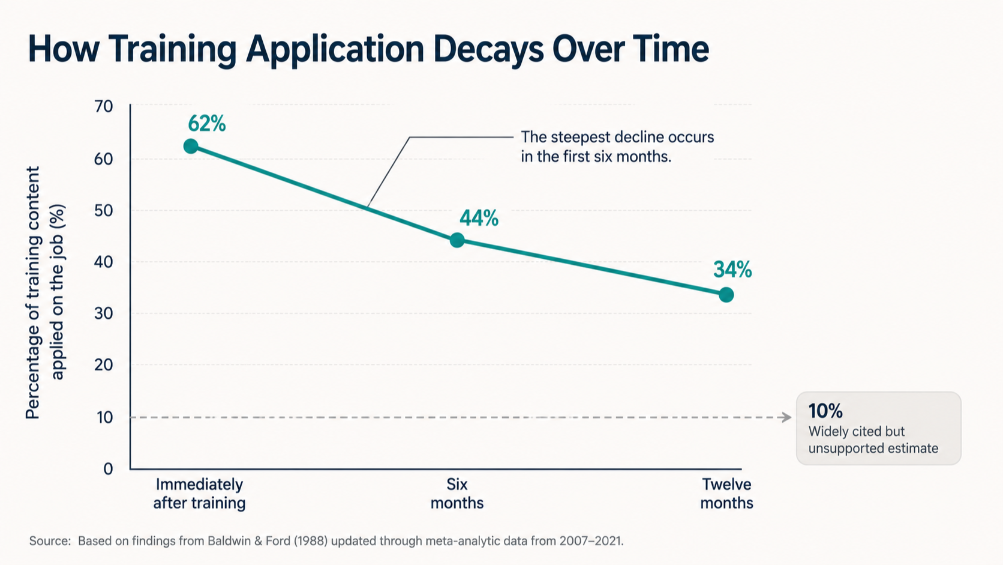
The first is that only 10% of training transfers to the job. This traces back to a 1982 article in Training and Development Journal by David Georgenson, who introduced it as a rhetorical question about what training directors say. He cited no evidence for it because he was not making an empirical claim. Fitzpatrick documented this in 2001, and Farrington revisited it in 2011, yet the number is still quoted in serious publications as though it were a research finding.
Better estimates exist. Saks and Belcourt found that 62% of training content was applied immediately after training, falling to 44% at six months and 34% at one year. Those are real numbers from real measurement, and they tell a much more useful story: transfer is not the problem, decay is. What happens in month four matters more than what happens in the classroom.
The second number is the claim that leadership development is a $366 billion global industry. Trace it and you find content marketers citing each other. There is no methodology behind it that survives inspection. Real spending is large, but if you need a figure for a business case, use your own budget rather than that one.
Why Programs Fail
The most useful published diagnosis remains a 2014 McKinsey Quarterly article by Gurdjian, Halbeisen and Lane. It identifies four failure modes, and a decade later they have not aged much.
They Ignore Context
Most programs assume one set of leadership skills fits every situation. It does not. The authors describe a European services CEO with an outstanding record during a growth market who failed in a downturn because he kept encouraging innovation when what the business needed was direction and financial discipline. Same person, same qualities, different context, opposite result.
The practical fix is uncomfortable for anyone who likes comprehensive frameworks: pick two or three capabilities that matter most for your specific strategy and drop the rest. A European retail bank did exactly that, focusing on the ability to persuade and motivate peers without formal authority, and reported a 15% productivity improvement. One capability, chosen because it was both scarce and decisive.
Long competency lists feel thorough. In practice they give everyone permission to work on nothing in particular. If you are building a leadership competency framework, resist the urge to make it complete.
They Separate Learning From Real Work
Off-site programs have genuine value. Stepping away from operational pressure creates room to think, and that room is hard to find any other way.
The failure comes when the reflection never reconnects to the job. Participants have a meaningful week, return to an unchanged inbox, and behave exactly as before within a fortnight.
Tying development to live business projects fixes this, but only if the projects are real. McKinsey describes a medical device company where a participant spent months building a solution as his development project, presented it to the board, and was told a full-time team was already working on it and no board would take a leadership-program by-product seriously. He left the company shortly after. Fake projects are worse than no projects. Stretch assignments only develop people when the stakes are genuine.
They Skip the Mindset Underneath the Behavior
You can teach delegation all day to someone who believes that if they let go of a decision it will be made badly and they will be blamed. The behavior will not change, because the belief driving it has not been touched.
This is the part organizations most often avoid, because surfacing those beliefs is uncomfortable for everyone in the room. The McKinsey authors are blunt about it: if there is no discomfort, the behavior probably is not changing.
A useful test when designing a module is to ask what someone would have to stop believing in order to do the new thing. If the answer is “nothing,” you are probably teaching something they already know.
They Never Measure Anything
Most evaluation begins and ends with a feedback form. The predictable consequence is that facilitators optimise for pleasant sessions rather than difficult ones.
This matters beyond the data. When an organization does not measure something, it signals that the thing is not serious. Leadership development gets treated exactly as seriously as its measurement suggests it should be.
The Components of a Leadership Development System
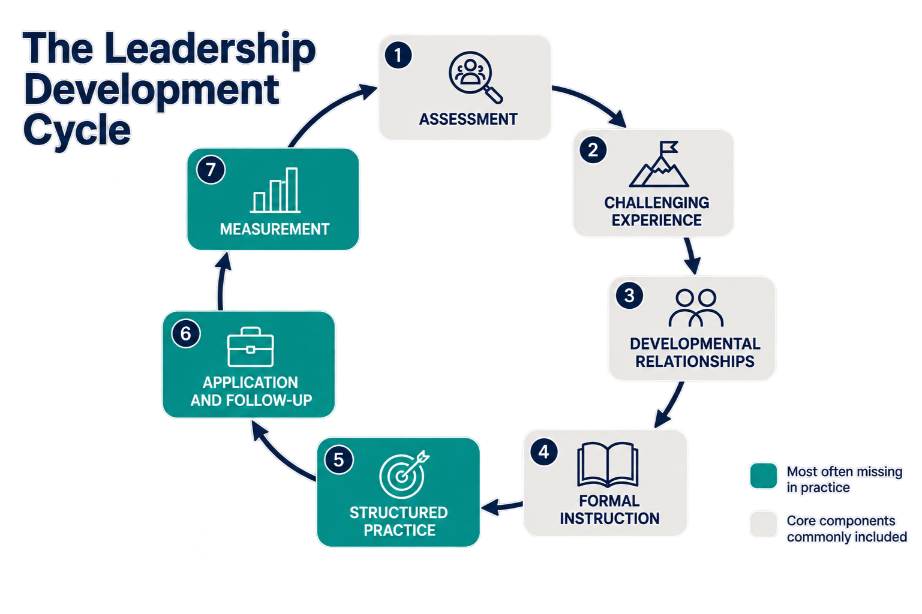
Programs vary enormously, but the working parts are fairly consistent. What differs is how many of them an organization actually operates.
| Component | What it does | Common failure |
| Assessment | Establishes where capability actually sits, using evidence rather than reputation | Skipped entirely, or replaced with the participant’s own opinion |
| Challenging experience | Builds judgment through consequential work | Assignments given for exposure, not for the specific capability being built |
| Developmental relationships | Provides feedback, perspective, and pattern recognition from people further along | Mentoring pairs assigned administratively, then never supported |
| Formal instruction | Supplies frameworks, language, and technique efficiently | Treated as the whole program rather than one input |
| Structured practice | Converts knowledge into behavior through repetition with feedback | Absent, because it is the most expensive part to run |
| Application and follow-up | Sustains change past the decay window | Ends when the cohort graduates |
| Measurement | Tells you whether any of it worked | Reduced to attendance and satisfaction scores |
Two components are worth singling out. Executive coaching is the highest-leverage form of developmental relationship because it combines feedback with accountability over time, which is precisely what one-off events lack. And mentoring programs work well when the mentor is chosen for relevant experience rather than seniority, and badly when they are matched by org chart proximity.
What About 70-20-10?
You will encounter this model constantly: 70% of development from challenging experience, 20% from other people, 10% from formal training. It appears on most pages about this topic, usually stated as fact.
Its origin deserves more attention than it gets. The ratios came out of research at the Center for Creative Leadership, most notably the Lessons of Experience study, in which roughly 190 successful executives were asked retrospectively where they felt their most meaningful development had come from. Lombardo and Eichinger published the resulting proportions in 1996, and their own phrasing was careful: the odds are that development will be about 70%, about 20%, about 10%.
Three limitations follow from that. The data is self-reported and retrospective, which is a weak method for causal claims about learning. The original sample was small and demographically narrow, being largely white male US executives in large companies. And the ratios were descriptive of that group, never validated as targets.
None of which makes the model useless. Its central claim, that experience does most of the developmental work and formal instruction does the least, is directionally well supported and matches what practitioners observe. Treat it as a reminder to invest in assignments and relationships rather than only in courses. Do not treat it as a budget formula, and be wary of anyone who does.
Designing for Level
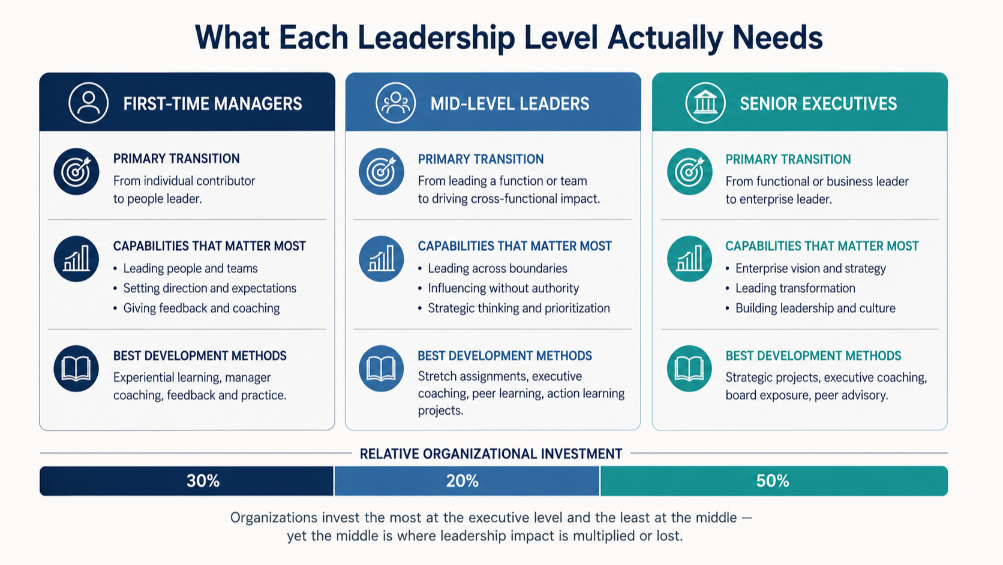
The same content delivered to every leadership level is one of the more reliable ways to waste money. What each level needs differs substantially.
First Time Managers
The transition from doing the work to getting work done through others is the sharpest discontinuity in any career, and most organizations handle it worst. New managers typically need the basics: setting expectations, giving feedback that lands, running a one-to-one that is not a status update, and handling their first performance problem.
This is where structured first time manager training earns its keep, because the failures at this level are common, predictable, and teachable. It is also where the payoff is largest, since first-line managers touch the most people.
Mid-Level Leaders
Here the scope exceeds personal capacity, and the constraint shifts. Mid-level leaders need to influence across functions where they have no authority, prioritise under genuine resource conflict, and develop people rather than just direct them.
This level is chronically under-served. Organizations invest at the entry point and at the top, and leave the middle to work it out, which is also the level where most operational execution actually happens.
Senior Executives
Senior development is less about skill acquisition and more about perspective, judgment under ambiguity, and the discipline of consistency. At this level a leader’s behavior is interpreted symbolically by hundreds of people who never meet them.
It is also the level where honest feedback is scarcest, which is why external coaching and structured 360 degree feedback matter more here than anywhere else. Seniority insulates people from exactly the information they need most.
The Design Features That Predict Success
This is where the Lacerenza meta-analysis becomes genuinely practical. Rather than asking whether training works, it asked which characteristics separate effective programs from ineffective ones. Five findings translate directly into design decisions.
Conduct a needs analysis first. Programs built on an actual diagnosis of the capability gap outperformed programs built on assumption. This sounds obvious and is skipped constantly.
Build in feedback. Not satisfaction surveys, but feedback to participants about their own behavior, which gives development something concrete to attach to.
Use multiple delivery methods, and make sure practice is one of them. Information transfer alone produces knowledge. Practice produces capability.
Space the sessions. Distributed learning outperformed compressed learning. The two-day intensive is convenient for calendars and poor for retention.
Be deliberate about attendance policy and duration. Both moderated effectiveness, which means these are design choices rather than logistics.
Put those together and a defensible shape emerges: diagnose first, run over months rather than days, include real practice with feedback, and connect each session to something the participant has to do before the next one.
That last point addresses the decay problem directly. If transfer falls from roughly 62% to 34% over a year, the intervention that matters most is whatever happens in months two through twelve, and almost no program budgets for it.
How to Measure Leadership Development
Most organizations measure attendance and satisfaction because those are easy. A more useful sequence runs across four layers, and each one costs more effort than the last.
Start with reaction data, but treat it as a hygiene check rather than evidence. High satisfaction tells you the program was not actively bad. It tells you nothing about change.
Then measure learning, ideally through something more demanding than a quiz. Case-based judgment, a presented plan, or a structured discussion will reveal whether anything landed.
Then measure behavior change, which is the layer that actually matters. The cleanest method is a 360 assessment before the program and another six to twelve months after, comparing shifts in how others describe the leader’s behavior. This directly addresses learning transfer, which is where most programs quietly fail.
Finally, track downstream indicators. Promotion rates and retention among participants compared with a similar non-participant group. Engagement and attrition in the teams those leaders run. Where development was tied to a specific business project, the outcome of that project. American Express, according to the McKinsey account, compared average team productivity before and after training as a straightforward measure of change.
None of this is a controlled experiment and it should not pretend to be. But an organization that tracks behavior change and team-level outcomes will know far more than one counting seats filled.
Where Organizations Go Wrong
Treating Development as a Reward
Development places get allocated to strong performers as recognition rather than to the leaders whose capability gaps are most consequential. This feels fair and gets the allocation backwards. Development should follow need and potential, which is why disciplined high potential identification matters more than a nomination process.
Building the Program Before the Business Case
An organization decides it needs leadership development, selects a provider, runs a cohort, and only afterwards asks what problem it was solving. The sequence should start with the strategy, move to the capabilities that strategy requires, and only then to design. Programs built in the wrong order tend to be comprehensive and irrelevant at the same time.
Developing the Leader and Ignoring the Job
A manager with twelve direct reports, no decision authority, and a full individual contributor workload will not become a better coach because they attended a course on coaching. Gallup’s finding that manager engagement collapsed while non-manager engagement held steady points at a structural problem, not a skills problem.
Before investing in development, it is worth checking whether the role is actually doable. Sometimes the intervention with the highest return is redesigning the job.
Starting the Pipeline Too Late
Capability takes years to build, and the need for it arrives on someone else’s schedule. Organizations that begin developing successors when a departure is announced are already too late, which is what the 20% bench-confidence figure ultimately reflects.
Frequently Asked Questions
What is the difference between leadership development and management training?
Management training builds capability for running a system: planning, budgeting, resourcing, and performance processes. Leadership development builds capability for setting direction and influencing people toward it. Most roles need both, and programs that promise leadership while actually teaching administrative process are a common source of disappointment.
Does virtual leadership development work as well as in-person?
The meta-analytic evidence favours face-to-face delivery that is not self-administered, which suggests fully self-paced online programs are the weakest format. That said, delivery mode mattered less than whether the program included practice, feedback and spacing, so a well-designed virtual cohort will outperform a poorly designed in-person workshop.
Should participation in a leadership development program be mandatory?
Attendance policy was found to moderate effectiveness, so this is a real design decision rather than an administrative one. Mandatory attendance ensures coverage but can bring in resistant participants, while voluntary attendance selects for motivation and tends to miss the leaders who need it most.
How much do organizations typically spend per leader?
There is no reliable universal benchmark, and most circulating figures do not survive scrutiny. As an upper bound, McKinsey noted that customised programs from a top business school can reach $150,000 per person. Internal cohort programs cost a small fraction of that, and the more useful question is usually cost per behavior change rather than cost per seat.
Can a small company run leadership development without a formal program?
Yes, and often more effectively than a large one. The components that matter most are assignment design, feedback, and structured reflection, none of which require a budget line. A small company can deliberately rotate a manager through a difficult project, pair them with an experienced adviser, and hold a monthly review of what changed.
What is an individual leadership development plan?
It is a written commitment covering two or three specific behaviors a leader will change, the experiences that will build them, who will give feedback, and how progress will be reviewed. Plans fail when they list capabilities rather than behaviors, because a capability cannot be practised on a Tuesday but a behavior can.
How long before a leadership development program shows results?
Behavior change is usually visible within three to six months if the program includes practice and feedback, while team-level indicators such as engagement or attrition typically take longer. The transfer research suggests that measuring at six and twelve months tells you far more than measuring at the end of the program.
Conclusion
Leadership development has a worse reputation than the evidence justifies, and the gap between the two is mostly explained by design. The meta-analytic research is clear that training produces real change in behavior and results. It is equally clear that the effect depends on doing specific things: diagnosing the gap first, building in feedback, spacing the work over months, and including genuine practice rather than only instruction.
The failure modes are just as well documented. Programs go wrong when they ignore the organization’s actual context, when reflection is severed from real work, when uncomfortable beliefs go unexamined, and when nobody measures whether anything changed.
Two habits would improve most programs immediately. The first is being ruthless about scope, choosing two or three capabilities that matter for your strategy instead of a comprehensive framework that dilutes attention. The second is budgeting for the year after the program rather than the week of it, because the evidence on decay says that is where the return is won or lost.
And it is worth staying honest about the limits. Development builds capability. It does not fix a role that cannot be done, a leadership team that does not function, or a structure that makes good judgment impossible. Those are different problems, and no cohort program has ever solved them.
Building leadership capability answers the question of how good your leaders are. It does not answer whether you have enough of them, in the right places, ready at the right time. Once development is producing capable leaders, the next question becomes one of supply and timing: which roles are critical, who is genuinely ready for them, and what happens if a key leader leaves in six months. Succession planning is the discipline that turns a population of developed leaders into a reliable pipeline, and it is the natural next step for any organization that has got its development system working.