
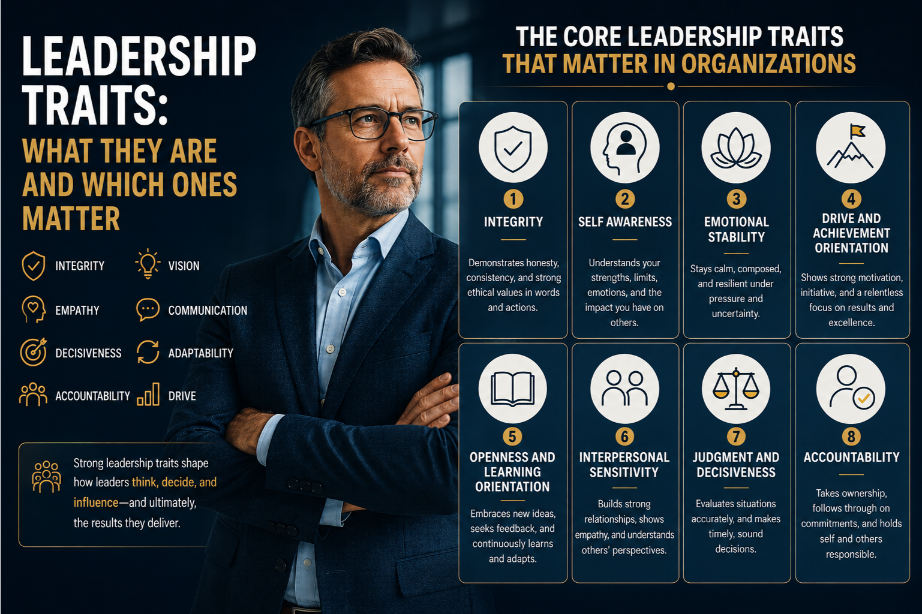
Leadership traits are the relatively stable personal characteristics that shape how a person leads. They include integrity, emotional stability, drive, openness, self awareness, and interpersonal sensitivity. Traits matter, but they work indirectly. A trait shapes the behaviors a leader repeats under pressure, and those behaviors shape how teams perform. Research supports a moderate link between traits and leadership outcomes, which means traits influence leadership success without determining it.
What Are Leadership Traits?
A leadership trait is a personal disposition that stays fairly consistent across time and situations. Traits describe what a person tends to do, not what they know how to do.
This distinction matters more than it appears. A trait is a tendency. A skill is a learned capability. A behavior is the visible action that others actually experience.
Traits sit at the deepest level of this system. They are formed early, they change slowly, and they surface most clearly under pressure. When a project fails or a decision carries real risk, a leader falls back on disposition rather than training.
That is why traits deserve attention in hiring, promotion, and succession decisions. They predict how someone will operate when conditions stop being comfortable.
Leadership Traits, Skills, and Behaviors Are Not the Same Thing
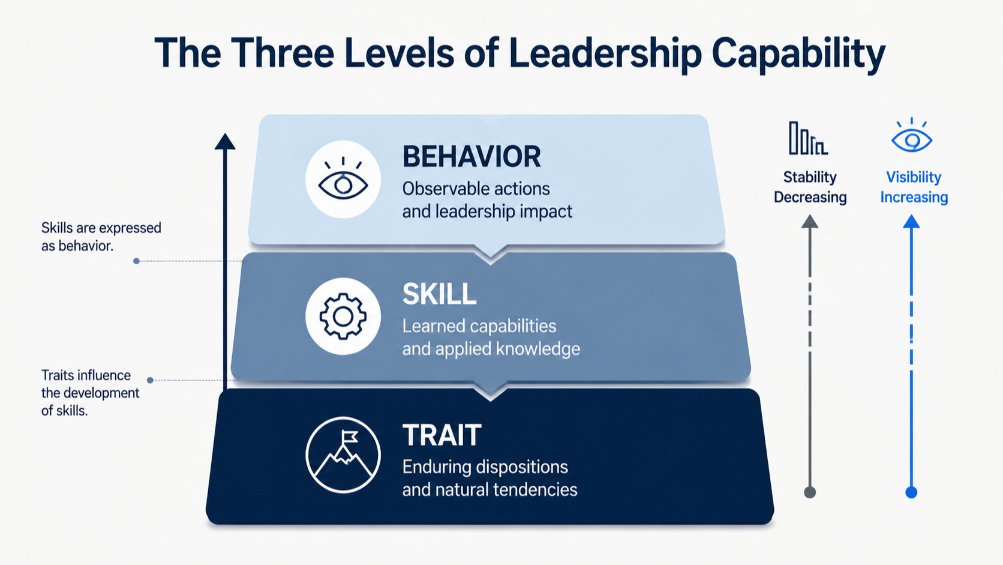
Most leadership content mixes these three levels. The result is confusion about what can be trained and what cannot.
| Level | What it is | How stable | How it is developed | Example |
| Trait | An underlying disposition | High. Changes slowly over years | Indirectly, through habit and feedback | Emotional stability |
| Skill | A learned capability | Moderate. Improves with practice | Training, coaching, repetition | Running a difficult performance conversation |
| Behavior | An observable action | Low. Varies day to day | Direct practice and reinforcement | Asking a quiet team member for their view |
Communication is the clearest example of this confusion. It is often listed as a leadership trait. It is better understood as a set of skills and behaviors that are supported by traits such as interpersonal sensitivity and self awareness.
The practical implication is direct. If you treat a skill as a fixed trait, you stop developing people who could improve. If you treat a trait as a quick training topic, you design programs that produce no lasting change. Understanding the levels helps organizations choose the right leadership skills interventions for the right problem.
What Research Actually Shows About Leadership Traits
Trait research has a long history, and the honest summary is that traits matter moderately rather than decisively.
The Personality Evidence
The most cited evidence comes from a meta-analysis by Judge, Bono, Ilies, and Gerhardt, published in the Journal of Applied Psychology in 2002. The authors organized 222 correlations from 73 samples using the five-factor model of personality. The corrected correlations with leadership were Extraversion at .31, Conscientiousness at .28, Openness to Experience at .24, Neuroticism at minus .24, and Agreeableness at .08.Taken together, the five traits produced a multiple correlation of .48 with leadership.
Read that carefully. Extraversion was the strongest single correlate, yet the relationship is moderate. Agreeableness, which many popular lists treat as central, showed almost no relationship at all.
The pattern tells us something useful. Personality contributes real signal, but it leaves most of the variation in leadership outcomes unexplained.
Why Traits Alone Do Not Predict Effective Leadership
This limitation was identified early. In a major review published in 1948, Ralph Stogdill concluded that no consistent set of traits separated leaders from non-leaders across different situations. A person who led effectively in one setting might not lead in another. Leadership was reframed as a relationship shaped by situational requirements rather than a fixed personal quality.
Modern evidence refines rather than reverses that conclusion. A 2011 meta-analysis by DeRue and colleagues in Personnel Psychology found that leader traits and behaviors together explain at least 31 percent of the variance in leadership effectiveness criteria. Behaviors tended to explain more variance than traits, and the results supported a model in which behaviors carry the effect of traits through to effectiveness.
This is the single most useful finding for practicing managers. Traits influence outcomes mainly by shaping behavior. Two leaders with similar dispositions can produce different results depending on which behaviors they actually practice.
It also explains why leadership styles vary so much among people with similar personality profiles.
The Core Leadership Traits That Matter in Organizations
The traits below are selected because they appear consistently across research traditions, follower expectation surveys, and practitioner frameworks. Each is described in terms of what it produces, not just what it is.
Integrity
Integrity is consistency between stated values, decisions, and actions. It is the trait followers care about most.
In the long running Characteristics of Admired Leaders research by Kouzes and Posner, four qualities rank far above the rest and are the only four selected by more than sixty percent of respondents: honest, forward-looking, competent, and inspiring. Honesty is selected more often than any other characteristic.
Integrity works by reducing the cost of interpretation. When a leader is predictable in principle, people stop spending energy decoding motives and start acting on information.
Self Awareness
Self awareness is accurate knowledge of your own tendencies, effects, and limits.
It functions as a correction mechanism. Every other trait can be misapplied, and self awareness is what allows a leader to notice the misapplication early. Leaders low in self awareness tend to repeat the same failure pattern in new situations.
Self awareness also underpins emotional intelligence, since recognizing your own emotional state is a precondition for managing it in others.
Emotional Stability
Emotional stability is the ability to stay composed when conditions become uncertain or hostile. In personality research it appears as the low end of Neuroticism, which showed a negative correlation with leadership of minus .24 in the Judge meta-analysis.
The mechanism is transmission. Teams read a leader’s state and use it to calibrate their own. A composed leader keeps the team’s attention on the problem. A volatile leader moves the team’s attention onto the leader.
Drive and Achievement Orientation
Drive is sustained energy directed at goals. It shows up as persistence after setbacks and as unwillingness to leave problems unresolved.
Drive is the trait that converts good intentions into finished work. Its value is highest in ambiguous environments where no one is assigning tasks.
Its limitation is that drive without judgment produces motion rather than progress.
Openness and Learning Orientation
Openness is receptiveness to new information, methods, and disconfirming evidence. It correlated at .24 with leadership in the Judge meta-analysis.
In practice this trait supports learning agility, which is the capacity to draw lessons from experience and apply them in unfamiliar conditions. Openness matters most when the environment changes faster than the organization’s playbook.
Interpersonal Sensitivity
Interpersonal sensitivity is the ability to read what other people are experiencing and respond in a way that fits.
This trait produces information. Leaders who are difficult to talk to receive filtered reports, which degrades decision quality long before it damages morale. Sensitivity supports psychological safety, the condition under which people raise problems early rather than concealing them.
Note the qualification. Warmth alone is not effective leadership. Agreeableness correlated at only .08 with leadership, which suggests that being pleasant is not the active ingredient. Reading people accurately and acting on what you read is different from simply being agreeable.
Judgment and Decisiveness
Judgment is the capacity to reach sound conclusions with incomplete information. Decisiveness is the willingness to commit once the available information stops improving.
The two must be paired. Judgment without decisiveness produces stalled organizations. Decisiveness without judgment produces fast mistakes.
Cognitive ability contributes here, but so does experience in the specific domain. This is one of the traits most sensitive to context.
Accountability
Accountability is ownership of outcomes, including outcomes that were only partly within your control.
It works through modeling. When a leader publicly absorbs responsibility for a failure, the team learns that reporting bad news is survivable. When a leader deflects, the team learns to hide problems until they are unrecoverable.
How Leadership Traits Turn Into Organizational Results
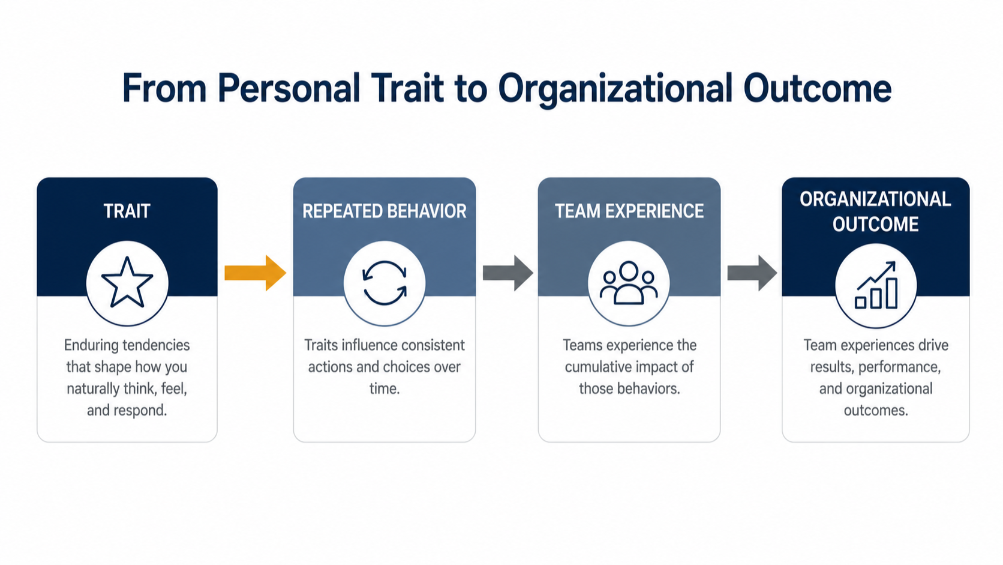
Most discussions of leadership state that traits matter. Fewer explain the path by which a personal disposition becomes an organizational number.
The chain runs in four steps.
Trait to behavioral tendency. A disposition makes some behaviors easier and more frequent. A leader high in interpersonal sensitivity asks more questions without being told to.
Behavior to team experience. Repeated behaviors form the daily experience of the team. This is where clarity, trust, and safety are actually created or destroyed.
Team experience to team outcomes. The team’s experience shapes discretionary effort, information flow, and speed of correction. Gallup estimates that managers account for at least 70 percent of the variance in employee engagement scores across business units, which indicates how much of the team experience is attributable to the person leading it. This is the strongest available evidence that employee engagement is a leadership variable rather than a program variable.
Team outcomes to organizational outcomes. Aggregated across units, these differences appear in retention, productivity, and execution reliability.
The mediating step is the important one. Behaviors carry the effect of traits, which is why behavior focused development can improve results even when underlying dispositions stay the same.
Current conditions raise the stakes. DDI’s Global Leadership Forecast 2025 reported that trust in immediate managers fell to 29 percent, a decline of 37 percent since 2022. The same study found 71 percent of leaders reporting increased stress. Traits that support composure and trust building are under more load than they were a few years ago.
Traits That Get People Promoted Are Not Always Traits That Make Them Effective
Leadership research distinguishes between two outcomes: emergence, meaning who becomes recognized as a leader, and effectiveness, meaning who produces results once in the role.
The distinction is practically important because organizations often select for one and expect the other.
In the Judge meta-analysis, extraversion was the most consistent correlate of leadership across both emergence and effectiveness. Visible, talkative, socially confident people are noticed. Being noticed is a promotion advantage regardless of whether it improves decision quality.
This creates a predictable organizational failure. Confidence is easy to observe in a promotion panel. Judgment, composure under sustained pressure, and accountability are not. The result is leadership pipelines that select for presence and later discover a gap in substance.
The correction is straightforward but uncomfortable. Assessment of leadership potential should weight evidence of behavior under difficulty more heavily than evidence of visibility in meetings.
When a Strength Becomes a Risk
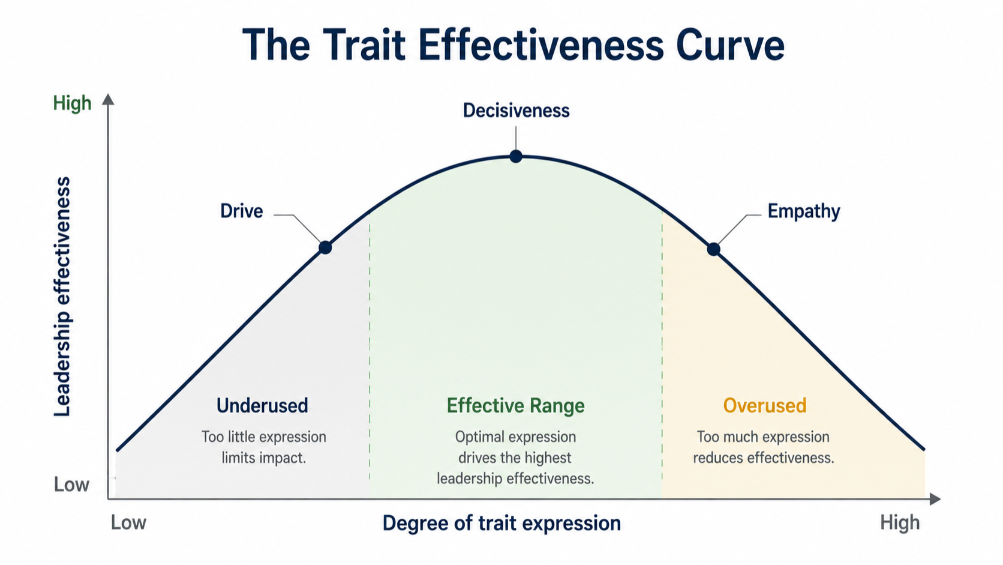
Almost every ranking page treats traits as linear, as if more is always better. Practical experience and derailment research both suggest otherwise. Strengths pushed past their useful range become the most common cause of leadership derailment.
| Trait | Healthy expression | Overuse expression | Organizational consequence |
| Drive | Persistence through obstacles | Relentless pressure regardless of cost | Burnout and quiet attrition |
| Decisiveness | Timely commitment | Closing decisions before evidence is in | Repeated costly reversals |
| Confidence | Steadiness in uncertainty | Dismissal of contrary information | Blind spots that reach the board late |
| Empathy | Accurate reading of team needs | Avoidance of difficult conversations | Poor performance goes uncorrected |
| Openness | Willingness to reconsider | Constant redirection | Team loses a stable operating focus |
| Accountability | Ownership of outcomes | Absorbing everything personally | Bottlenecked decisions and leader overload |
The pattern is consistent. Overuse is usually a self awareness failure rather than a character failure. The leader continues applying a strength that once worked, in a situation that no longer rewards it.
This is why development conversations should ask which strengths a leader is over relying on, not only which weaknesses need fixing.
How Context Changes Which Traits Matter
Trait requirements shift with the situation. This is the oldest finding in the field and still the most underused.
Consider three common contexts.
Crisis or turnaround. Emotional stability, decisiveness, and drive move to the front. The organization needs direction faster than it needs consensus.
Stable operations at scale. Conscientiousness, accountability, and consistency matter most. The value comes from reliability, not from reinvention.
Innovation and transformation. Openness, learning orientation, and tolerance for ambiguity dominate. Excessive conscientiousness can slow experimentation.
The same person may be an excellent fit for one of these and a poor fit for another. That is not a judgment about their worth as a leader. It is a statement about fit, which is what situational leadership thinking is designed to address.
For organizations, the implication is that trait requirements should be defined per role and per stage, not written once as a universal ideal profile.
Are Leadership Traits Inherited or Developed?
Both, and the proportions are known more precisely than most discussions assume.
A twin study by Arvey and colleagues, published in The Leadership Quarterly in 2006, found that approximately 30 percent of the variance in leadership role occupancy was attributable to genetic factors, with non-shared environmental factors accounting for the remainder.
Two qualifications matter. First, this measures whether people end up in leadership roles, not how well they lead. Second, roughly 70 percent of the variance was environmental, which points to experience, opportunity, and development.
The workable conclusion is this. Underlying dispositions are partly inherited and change slowly. The expression of those dispositions is highly developable.
A naturally reserved leader will probably not become naturally outgoing. That leader can still build the habit of speaking early in meetings, communicating decisions in writing, and creating structured space for input. The trait stayed. The behavior changed. Because behavior is what carries the effect through to effectiveness, that change is sufficient.
How to Assess Leadership Traits Without Guessing
Most trait judgments in organizations are made informally, from impressions formed in meetings. That method is unreliable because it measures visibility rather than disposition.
A more defensible approach uses several sources.
Structured behavioral evidence. Ask candidates and leaders to describe specific past situations, then probe for what they actually did, not what they believe about themselves. Patterns across several examples reveal disposition.
Multi rater input. A 360-degree feedback process captures how the leader’s behavior is experienced by people above, beside, and below them. Gaps between self rating and other ratings are themselves a self awareness measure.
Validated personality measures. These are useful as one input among several. They should never be used alone for selection decisions, because the correlations with leadership are moderate rather than predictive at the individual level.
Observation under pressure. Simulations, stretch assignments, and cross functional projects show composure and judgment in ways that interviews cannot.
A structured leadership assessment combining these sources gives a far more accurate picture than any single instrument. It also produces the specific evidence needed for a development plan.
How to Develop Leadership Traits
Traits are not switched on by a workshop. But behavior is trainable, and behavior is what the organization actually experiences.
An effective development sequence works in four moves.
Start with an accurate baseline. Development that begins with a flattering self assessment produces nothing. Multi rater data and honest feedback establish where the real gap sits.
Target behaviors, not personality. Convert the trait goal into an observable action. “Be more decisive” is not actionable. “Set a decision deadline and communicate the choice within two working days” is.
Build the behavior into the calendar. New behaviors survive when they are attached to existing routines such as weekly team meetings, one to one conversations, or project reviews. Behaviors that depend on remembering to try harder do not last.
Use structured support. Executive coaching is effective here because it provides repeated reflection on real situations rather than abstract content. Coaching works on the gap between intention and observed behavior, which is exactly where trait expression can shift.
Expect months, not weeks. Trait expression changes at the speed of habit formation, and it regresses under stress. That is normal and should be planned for rather than treated as failure.
Common Mistakes Organizations Make With Leadership Traits
Treating a trait list as a selection checklist. No validated universal list exists. Requirements depend on the role and the situation.
Confusing traits with skills. This leads organizations to train things that need habit change and to give up on things that could be trained.
Selecting for confidence. Confidence is easy to observe and only loosely related to judgment.
Ignoring overuse. Development plans that only address weaknesses miss the most common derailment path.
Defining trait profiles once and never revisiting them. Requirements shift as the business changes. Trait criteria used in succession planning should be reviewed whenever strategy changes materially.
Frequently Asked Questions
What is the difference between leadership traits and leadership competencies?
Traits are personal dispositions that stay fairly stable. Competencies are defined clusters of behavior an organization expects in a specific role, and they usually combine traits, skills, and knowledge. Competency frameworks are written per organization, while traits are individual characteristics.
Do leadership traits differ between men and women?
Research on leadership effectiveness has not established meaningful trait differences that explain performance gaps. Studies more often find differences in how identical behaviors are perceived and rated by others, which is an evaluation issue rather than a trait issue.
Are leadership traits the same across cultures?
Not entirely. A 2024 meta-analytic study extending the Judge research found that in collectivist societies, five-factor traits, and Extraversion and Agreeableness in particular, were stronger predictors of leader effectiveness. Trait requirements should be reviewed when leading across regions.
Which leadership traits are most important for first time managers?
Self awareness and accountability tend to matter most at the first transition, because new managers must shift from delivering work personally to being judged on other people’s output. Composure under criticism also becomes relevant much earlier than most people expect.
Can someone be an effective leader without being charismatic?
Yes. Charisma helps people get noticed and selected, but it is not required for effectiveness. Reliability, judgment, and consistent follow through produce results without a strong public presence.
How long does it take to change how a leadership trait shows up?
Behavioral change is usually visible to others within three to six months when a specific behavior is practiced regularly and supported by feedback. The underlying disposition does not change on that timeline, and the new behavior often slips under acute stress.
Do personality tests predict who will be a good leader?
Not reliably on their own. The measured relationships between personality traits and leadership outcomes are moderate, so personality data should be one input alongside behavioral evidence, multi rater feedback, and observation in demanding situations.
What is the difference between a leadership trait and a value?
A trait describes how a person tends to behave. A value describes what a person believes should matter. Integrity sits close to both, because it is the consistency between the two rather than either one alone
Conclusion
Leadership traits are real, measurable, and moderately predictive. They are not destiny.
The evidence supports a clear picture. Personality traits show consistent but moderate relationships with leadership outcomes. Behaviors explain more variance than traits and carry the effect of traits through to effectiveness. Situational requirements determine which traits are advantages and which are liabilities.
For leaders, this means the practical work sits at the behavior level. You do not need to become a different person. You need to know your dispositions well enough to notice where they help, where they overshoot, and which specific behaviors need to become reliable.
For organizations, it means trait thinking should inform selection and development rather than replace them. Assess disposition carefully, define requirements by role and context, watch for strengths in overuse, and invest in the behavioral habits that turn a personal quality into a team outcome.
Traits describe the raw material. What a leader builds with it is the actual work.
Accurate trait assessment produces a clear picture of where a leader’s tendencies help and where they create risk. That picture only becomes valuable when it is converted into a structured plan with targeted behaviors, real practice, and measured progress. Leadership development provides the system for making that conversion, turning trait insight into sustained capability across a leadership pipeline.