
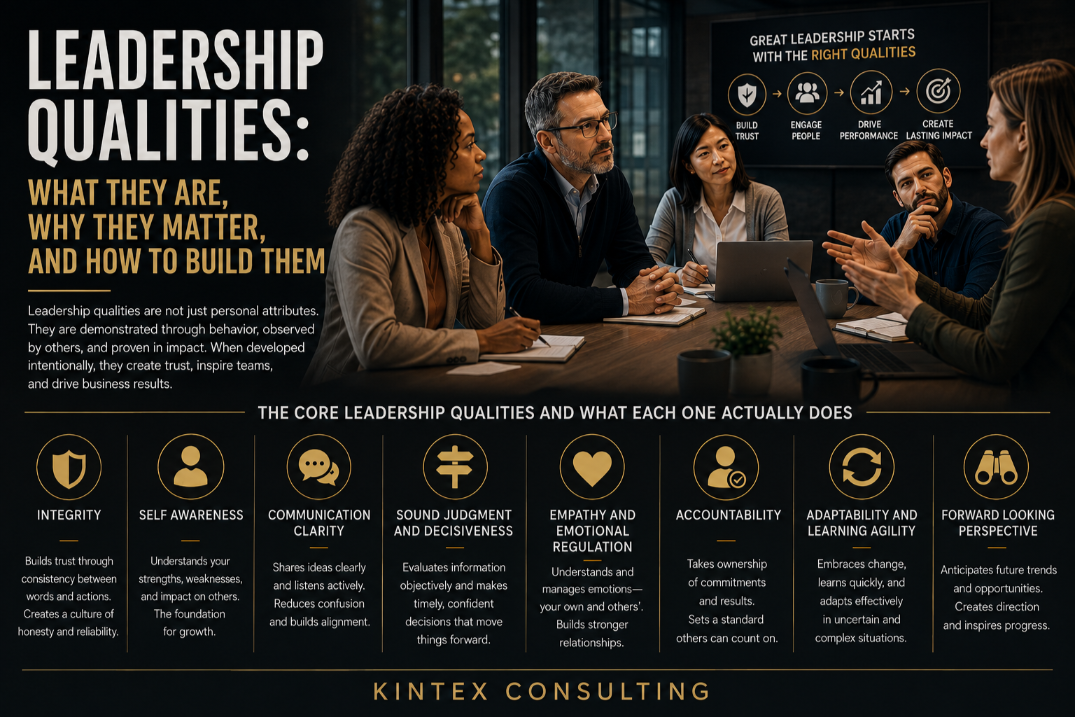
Leadership qualities are the personal characteristics and consistent behaviors that determine how effectively someone guides, influences, and develops other people. They include integrity, self-awareness, clear communication, sound judgment, empathy, accountability, and adaptability. These qualities matter because they shape the daily conditions in which people work. Research consistently links the quality of immediate leadership to team engagement, retention, and performance.
Most articles on this topic hand you a numbered list. A list is a starting point, not an answer. The harder and more useful questions are why these qualities produce results, which ones matter most in your specific situation, when a strength turns into a liability, and how much of this can actually be developed.
This article addresses those questions.
What Are Leadership Qualities?
A leadership quality is a characteristic that other people attribute to a leader based on repeated, observable behavior. It is not something a leader declares about themselves. It is a judgment formed by the people around them over time.
This definition has a practical consequence. You cannot possess a leadership quality privately. If your team does not experience you as decisive, you are not functioning as a decisive leader in that context, regardless of how you see yourself.
That distinction explains why self-assessment alone is a poor guide to leadership capability, and why the gap between how leaders see themselves and how their teams see them is one of the most common findings in leadership assessment.
Qualities, Traits, Skills, and Behaviors Are Not the Same Thing
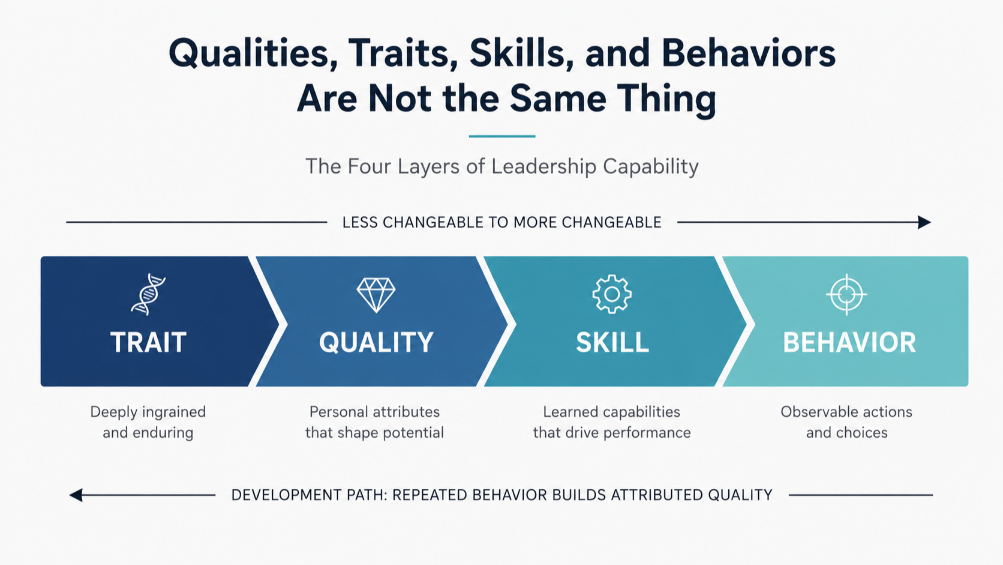
Most content on this topic uses these four words interchangeably. They are not the same, and the difference determines whether an organization should hire for something, train it, or simply require it.
| Concept | What it is | How it appears | How it changes |
| Trait | A stable underlying disposition, such as conscientiousness or extraversion | Consistent tendencies across most situations | Slowly and only partially |
| Quality | A characteristic others attribute to a leader from repeated behavior | Judgments such as “she is fair” or “he is decisive” | Through sustained behavior change |
| Skill | A learned capability applied to a task | Structuring a decision, running a difficult conversation | Through instruction, practice, and feedback |
| Behavior | A single observable action | Asking for dissent before closing a decision | Immediately, by choice |
Read the table from right to left and you have a development path. Behaviors are the most controllable layer. Repeat a behavior consistently and people begin to attribute a quality to you. That is how leadership qualities are actually built.
Read it left to right and you have a selection insight. Traits are the least changeable layer, which is why organizations should assess for them at hiring and develop the layers to their right.
Why Leadership Qualities Matter More Than Most Organizational Programs
Leadership qualities matter because their effects are local and immediate. Company-wide initiatives operate at a distance. A manager operates on someone’s Tuesday.
Gallup estimates that managers account for at least 70% of the variance in employee engagement scores across business units. That figure is often misquoted. It does not mean a manager single-handedly determines engagement. It means that when engagement differs between teams inside the same organization, with the same pay, tools, and mission, most of that difference traces back to who is leading each team.
The current environment sharpens the point. Gallup’s State of the Global Workplace 2026 report found that global employee engagement fell to 20% in 2025, the lowest level since 2020, at an estimated cost of $10 trillion in lost productivity, roughly 9% of global GDP.
The driver was managers themselves. Manager engagement dropped from 31% in 2022 to 22% in 2025, while non-manager engagement moved only from 20% to 19%. Managers have effectively lost the engagement advantage they once held over the people they lead.
Trust has followed a similar path. DDI’s Global Leadership Forecast 2025, based on responses from 2,185 HR professionals and 10,796 leaders across more than 50 countries, reported that trust in immediate managers fell to 29% from 46% in 2022. Seventy-one percent of leaders reported increased stress, and 40% of those had considered leaving leadership roles.
None of this is inevitable. Gallup found that within best-practice organizations, 79% of managers were engaged in 2025, close to four times the global average. The variable is not the economy. It is how leadership is selected, supported, and developed. This is why employee engagement is better understood as an output of leadership quality than as a standalone programme.
The Core Leadership Qualities and What Each One Actually Does
The qualities below appear consistently across leadership research and across the pages that currently rank for this topic. What follows is not just a list. Each entry explains the function the quality performs.
Integrity
Integrity means acting consistently with stated values, especially when it is costly. It is the most consistently demanded leadership quality on record. In Kouzes and Posner’s long-running research on admired leaders, honesty is selected more often than any other characteristic, by close to nine in ten respondents.
Its function is to reduce the cost of prediction. When people can predict how a leader will behave, they stop spending energy on self-protection and hedging. That reclaimed energy goes into the work. Integrity is not a moral ornament. It is an efficiency mechanism.
Self Awareness
Self awareness is accurate knowledge of your own tendencies, triggers, strengths, and blind spots. The Center for Creative Leadership places it among the essential characteristics of good leaders, and it functions differently from the others on this list.
Self awareness is a gating quality. It does not directly produce a team outcome. It determines whether every other quality can be corrected when it misfires. A leader who cannot see that they are dominating a discussion cannot adjust. Without self awareness, feedback has nothing to attach to.
Communication Clarity
Clarity is the ability to make priorities, decisions, and expectations understandable and to explain the reasoning behind them.
Its function is to reduce ambiguity, which is expensive. When people are unclear about what matters, they either escalate for confirmation, which consumes leadership time, or guess, which produces rework. Clear communication is upstream of almost every other performance measure, which is why it appears in every credible list of leadership qualities.
Note that clarity is not the same as talking often. Google’s Project Oxygen defines the relevant behavior as communicating and listening, which places the emphasis on two-way exchange rather than message volume.
Sound Judgment and Decisiveness
Decisiveness is the willingness to commit to a course of action with incomplete information and to own the outcome.
Its function is to convert deliberation into motion. Organizations rarely fail from a single wrong decision. They fail from accumulated indecision, where opportunities expire while consensus is pursued. Google added strong decision-making to its manager behaviors in 2018 specifically because employees said they wanted more of it.
The important qualifier is that decisiveness without judgment is just speed. The quality is the pairing: deciding at the right time, at the right level, with the right amount of information.
Empathy and Emotional Regulation
Empathy is accurately understanding what other people are experiencing. Emotional regulation is managing your own reactions so that they do not distort the situation. Together they form the practical core of emotional intelligence in a leadership setting.
The function is signal quality. A leader who reacts badly to bad news receives less bad news. Over time, that leader operates on a filtered picture of reality. Empathy and regulation keep the information channel open, which matters most exactly when conditions are difficult.
Accountability
Accountability is taking ownership of outcomes, including failures, without redirecting blame.
Its function is to set the standard for everyone else. Accountability is one of the few qualities that propagates almost automatically. Teams calibrate their own willingness to admit problems to what they observe in their leader. When a leader deflects, the team learns to conceal, and problems surface later and larger.
Adaptability and Learning Agility
Adaptability is adjusting one’s approach when conditions change. Learning agility is the related capacity to extract usable lessons from unfamiliar situations and apply them quickly.
The function here is preventing the most common form of leadership failure: continuing to apply an approach that once worked after the conditions that made it work have disappeared. This quality has become more important as organizations absorb faster technology cycles and more frequent restructuring.
Forward Looking Perspective
Being forward looking means having and articulating a credible view of where the group is going.
In Kouzes and Posner’s research it is the second most selected characteristic, chosen by roughly seven in ten respondents, and it is the one that most sharply distinguishes leaders from competent individual contributors. Its function is to make present effort meaningful. Without a visible destination, work becomes a series of disconnected tasks, and discretionary effort declines.
How a Personal Quality Becomes a Business Outcome
This is the step most articles skip. A quality is a personal characteristic. Profitability is an organizational result. Something has to connect them.
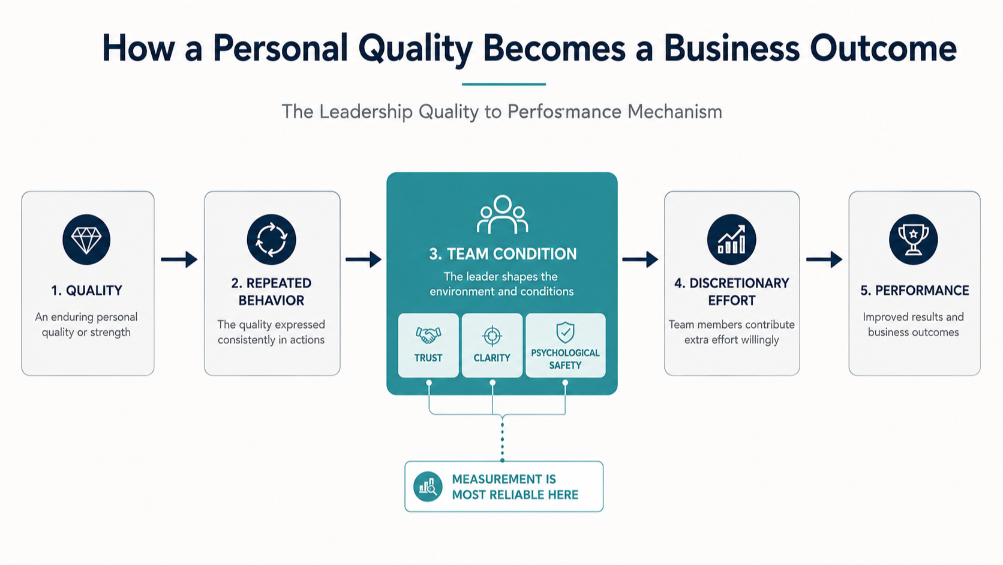
The chain runs like this:
Quality → repeated behavior → team condition → discretionary effort → performance
Quality only reaches the organization through behavior. Integrity that is never expressed in a visible decision changes nothing. Behaviors, repeated, create team conditions: trust, clarity, and the sense that it is safe to speak up.
Those conditions are where the evidence becomes concrete. Edmondson’s study of 51 work teams in a manufacturing company found that team psychological safety was associated with learning behavior, and that learning behavior mediated the relationship between safety and team performance. The word mediated matters. Safety did not improve performance directly. It enabled a behavior, and that behavior improved performance.
That is the general shape of the mechanism. Leadership qualities do not act on results. They act on conditions, and conditions determine how much of people’s capability actually reaches the work.
The practical implication is that leadership improvement should be measured at the condition layer, not only at the results layer. Results move slowly and have many causes. Conditions move faster and are far more clearly attributable to leadership.
Why the Right Leadership Qualities Depend on Context
Generic lists imply that every quality matters equally to every leader. They do not.
Organizational Level Changes the Weighting
The table below is an interpretive framework rather than a research finding. It reflects how the demands of leadership shift as scope increases.
| Level | Qualities that carry the most weight | Why |
| First time manager | Communication clarity, empathy, accountability | Influence is direct and personal; most failures are interpersonal |
| Mid-level leader | Judgment, delegation, adaptability | Scope exceeds personal capacity; work must move through others |
| Senior executive | Forward looking perspective, integrity, emotional regulation | Influence is indirect and symbolic; consistency is scrutinised |
The pattern is that as scope grows, qualities visible at a distance matter more than qualities experienced up close. A senior leader is judged largely on consistency and direction, because most of the organization never interacts with them personally.
Business Conditions Change the Weighting
Conditions matter as much as level. During stable growth, coaching and development capability carries more weight. During change management and restructuring, clarity, emotional regulation, and decisiveness dominate, because ambiguity is the primary source of harm.
GLOBE research across 62 societies adds a further dimension. Some attributes, including integrity and charismatic value-based characteristics, were endorsed as contributing to outstanding leadership across cultures. Others were not. Participative leadership was the most culturally contingent dimension studied. This is a caution against exporting a single leadership profile globally without adjustment, and a reason to treat leadership styles as adaptable rather than fixed.
When a Leadership Quality Becomes a Liability
This is the largest gap in the existing coverage of this topic, and the most useful thing to understand.
Leadership qualities do not have straight-line effects. More is not reliably better.
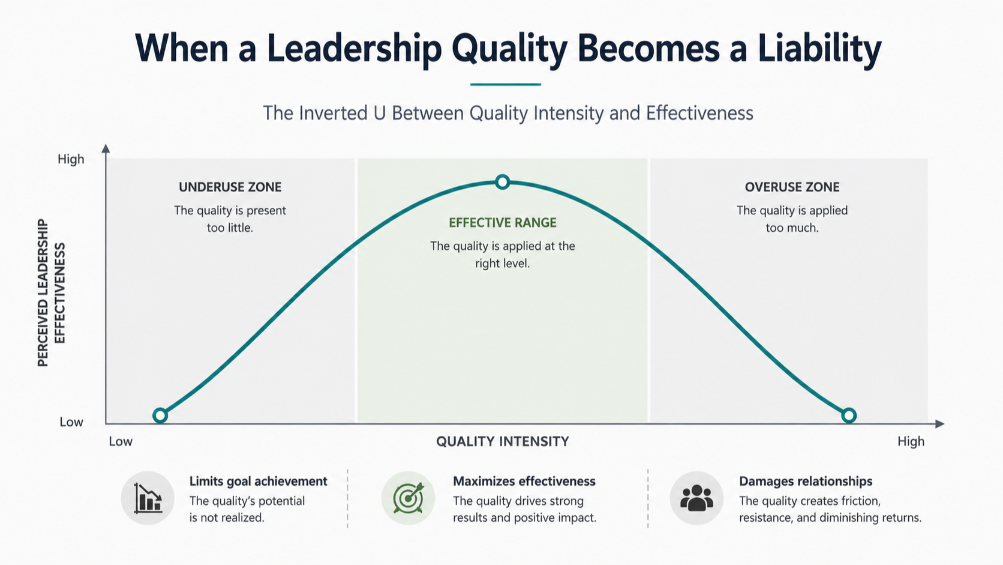
Ames and Flynn demonstrated this directly for assertiveness. Their research, published in the Journal of Personality and Social Psychology, found a curvilinear relationship: leaders seen as markedly low in assertiveness and leaders seen as markedly high in assertiveness were both appraised as less effective. They traced this to a trade off. High assertiveness damages relationships. Low assertiveness limits goal achievement. Effectiveness sits between the two.
The authors made a broader point that applies well beyond assertiveness. Research focused on what makes a leader can miss what breaks one.
The same logic extends to other qualities in predictable ways:
- Decisiveness pushed too far becomes closure before the information is in.
- Empathy pushed too far becomes conflict avoidance and unaddressed underperformance.
- Adaptability pushed too far becomes strategic drift, where the team never knows what is stable.
- Accountability pushed too far becomes a leader absorbing problems that the team should be learning to solve.
- Vision pushed too far becomes disconnection from operational reality.
There is an important practical consequence. Leaders under pressure tend to fall back on their strongest quality and apply more of it. If that quality is already at or past its useful point, pressure makes performance worse, not better, and the leader experiences this as trying harder.
This is why the most valuable development question is usually not “Which quality should I add?” but “Which of my strengths am I overusing, and under what conditions?”
Can Leadership Qualities Be Developed?
Almost every article on this topic asserts that leadership qualities can be learned. The claim is broadly right, but the evidence is more specific than the assertion.
What the Evidence Actually Supports
Two research streams matter here, and they answer different questions.
Behavioural genetics addresses how much is predisposed. Arvey and colleagues, using a classical twin design with 238 identical and 188 fraternal male twins, found that approximately 30% of the variance in leadership role occupancy was attributable to genetic factors, with non-shared environment accounting for the remainder. A companion study of female twins produced a comparable figure of about 32%. A later study using a different design produced a more conservative estimate of roughly one quarter.
Read that carefully. It concerns role occupancy, meaning who ends up in leadership positions, not how effective they are once there. And it leaves the clear majority of the variance to environment and experience.
Trait research addresses which dispositions correlate with leadership. Judge and colleagues meta-analysed 222 correlations from 73 samples and found that the five-factor model of personality showed a multiple correlation of .48 with leadership, with extraversion the single most consistent correlate at .31. These are meaningful associations. They are not determinism, and they combine leader emergence with leadership effectiveness.
Training research addresses whether development works. Lacerenza and colleagues meta-analysed 335 independent samples and concluded that leadership training is substantially more effective than previously believed, producing improvements in participant reactions, learning, on-the-job transfer, and organizational results.
Taken together, the defensible position is this. Predisposition influences who tends to step forward. It does not determine who becomes effective. The developable portion is large, and structured development produces real change.
What Makes Development Work
The same meta-analysis is more useful for its conditions than its headline. Programmes were more effective when they included a needs analysis, incorporated feedback, used multiple delivery methods including practice, and spaced sessions over time rather than compressing them.
The pattern is that leadership qualities respond to repeated practice with feedback, not to exposure. This is why a single workshop rarely changes anything, and why executive coaching and structured on-the-job practice tend to outperform one-off events.
How to Assess Leadership Qualities Honestly
Because qualities are attributed by others, self-rating is the weakest available evidence. Three sources are stronger.
The first is structured multi-source feedback. Well-designed 360 degree feedback collects observations from people at different vantage points. Its value lies less in the average score than in the gaps: between self-view and others’ view, and between how peers and direct reports experience the same leader.
The second is behavioral evidence. Ask for specific instances rather than ratings. “Describe the last time this leader changed their position after being challenged” produces better information than “rate their openness from one to five.”
The third is outcome patterns. Conditions leave traces. Regretted attrition concentrated in one team, problems that consistently surface late, or decisions that repeatedly reopen are all diagnostic signals about leadership quality, and they are harder to game than a survey.
A simple diagnostic sequence, offered as a practical framework rather than a validated instrument, is to ask: which condition on my team is weakest, which behavior of mine most plausibly contributes to it, and what quality does that behavior express.
Common Mistakes Organizations Make With Leadership Qualities
Promoting for Technical Performance
This is the most persistent error. Strong individual output signals task capability, not the qualities that make someone effective through others. These are different capabilities and require separate assessment.
Treating the List as a Checklist
Organizations build competency models with twelve or more qualities and then rate every leader on all of them. The result is a diffuse development plan that changes nothing. Two or three well-chosen behavior changes outperform a comprehensive scorecard.
Developing Leaders While Ignoring the System
A leader who lacks time, authority, or clear priorities cannot express good judgment. Gallup’s finding that manager engagement fell sharply while non-manager engagement held roughly steady suggests the pressure is structural, not personal. Training a depleted manager does not fix a design problem.
Ignoring the Leadership Bench Until It Is Urgent
DDI found HR confidence in the leadership pipeline at 20%, improved from 11% in 2020 but still leaving four in five organizations without confidence in their own bench. Qualities take years to develop, which makes succession planning a present-tense activity rather than a future one.
Confusing Likeability With Leadership Quality
A leader people enjoy working for is not automatically a leader people perform well for. The qualities that matter are the ones that change conditions, not the ones that generate goodwill.
Frequently Asked Questions
What is the difference between leadership qualities and management qualities?
Leadership qualities relate to influence, direction, and how people are moved toward a shared goal. Management qualities relate to coordination, planning, resourcing, and control of work. Most roles require both, and the practical distinction is that management maintains a system while leadership changes where the system is going.
What are the most common negative leadership qualities?
The most frequently observed are blame shifting, inconsistency between stated values and actual decisions, micromanagement, and defensiveness in response to bad news. GLOBE research across 62 societies found that self-protective leader attributes were negatively endorsed across cultures, making them among the few characteristics almost universally seen as obstacles to good leadership.
Are the same leadership qualities valued in every country?
Not entirely. GLOBE research across 62 societies found that some attributes, including integrity and charismatic value-based characteristics, were endorsed almost everywhere as contributing to outstanding leadership. Participative leadership was the most culturally contingent dimension, meaning expectations around involving others in decisions vary significantly by region.
How should I describe my leadership qualities in a job interview?
Name the quality, then give a specific situation, the behavior you chose, and the result. Because qualities are attributed by others rather than self-declared, evidence carries far more weight than adjectives. Where possible, include an instance where the quality was costly to apply, since that is what distinguishes a genuine characteristic from a preference.
Which leadership quality matters most for someone becoming a manager for the first time?
Communication clarity is usually the highest-return starting point, because most early management failures come from unclear expectations rather than from poor strategy. Accountability follows closely, since new managers are watched carefully for how they handle their first visible mistake.
How long does it take to develop a leadership quality?
There is no reliable general timeline, and any specific figure should be treated with caution. What the training research does indicate is that development spaced over time with practice and feedback outperforms concentrated one-off sessions, which suggests months of applied repetition rather than days of instruction.
Can someone be an effective leader without being extraverted?
Yes. Meta-analytic research found extraversion to be the most consistent single personality correlate of leadership at .31, which is a meaningful association but far from a requirement. Extraversion appears to help most with emerging as a leader rather than with being effective once in the role.
Conclusion
Leadership qualities are best understood as attributions that other people make based on what a leader repeatedly does. That reframing changes how the topic should be approached. Qualities are not a fixed personal inventory to be audited once. They are the accumulated result of behavior, and behavior is the layer leaders can actually control.
The evidence supports several firm conclusions. Predisposition matters but does not determine outcomes, since roughly 30% of the variance in who occupies leadership roles traces to genetics and considerably less is known about effectiveness. Structured development works when it includes needs analysis, feedback, practice, and spacing. Qualities produce results indirectly, by shaping team conditions such as trust and psychological safety, which in turn determine how much capability reaches the work.
Two cautions deserve to travel with the list. Context changes the weighting, so the qualities that matter most depend on organizational level, business conditions, and culture. And qualities have limits, since strengths taken past their useful point reduce effectiveness rather than increasing it.
The current data makes this practical rather than academic. With global engagement at its lowest level since 2020 and manager engagement falling three times faster than that of the people they lead, leadership quality is not an abstraction. It is the most concentrated point of leverage most organizations have, and the one most consistently underinvested in.
Understanding which leadership qualities matter is diagnostic work. It tells you what good looks like and where a specific leader currently stands. It does not close the gap. Once the gap between current behavior and required behavior is clear, the next question is structural: how an organization builds those qualities deliberately, at scale, across a whole population of leaders rather than one person at a time. A well-designed leadership development system connects assessment to targeted practice, feedback, and application, which is what converts a list of desirable qualities into observable behavior change.