
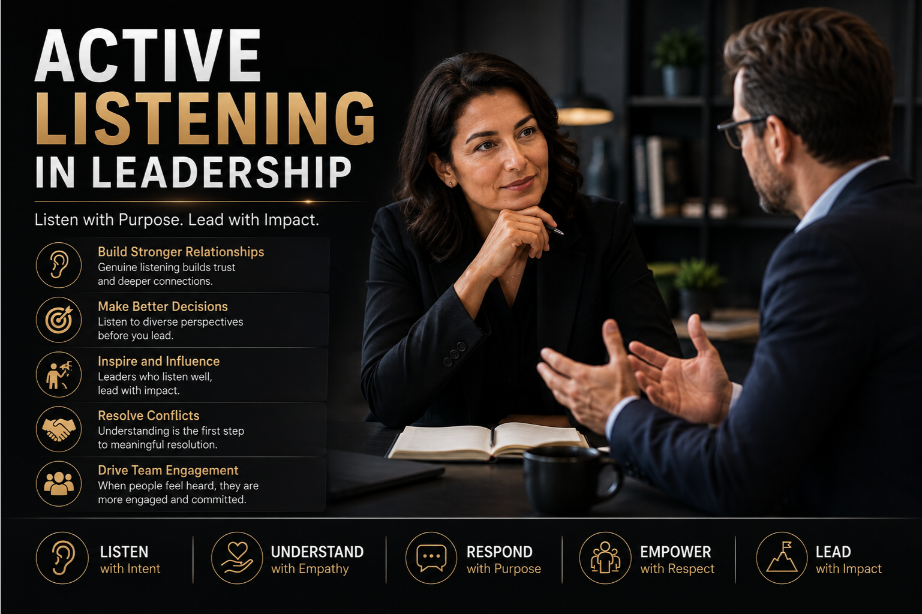
Active listening is one of the most useful skills a leader can develop. It means more than hearing someone’s words. It means giving the person your attention, trying to understand their point of view, and responding in a way that shows you have listened.
For leaders, this matters because employees do not always say everything they think. If people feel ignored or judged, they may stop sharing ideas, concerns, or problems. When leaders listen well, people are more likely to speak openly. That gives leaders better information and helps them make better decisions.
What Is Active Listening in Leadership?
Active listening in leadership means giving someone your full attention, understanding what they are saying, and responding in a thoughtful way. It includes listening to both the words a person uses and the feelings behind those words.
Active listening is different from simply hearing someone. You may hear an employee explain a problem while thinking about your next meeting or planning what you want to say. You are there, but you are not fully listening.
Active listening asks you to slow down and focus on the person speaking. Put away distractions. Let the person finish their thought. Ask questions when something is unclear. Repeat the main point in your own words when you want to check your understanding.
This is especially important for leaders because there is a power difference between a leader and an employee. Employees may already feel that their leader has more control over their work or career. If a leader interrupts, dismisses concerns, or answers too quickly, employees may decide that speaking up is not worth the effort.
Over time, leaders may hear only what people think they want to hear.
Active listening helps prevent this. It gives employees more room to speak honestly and gives leaders access to information they may otherwise miss. This makes active listening an important part of leadership communication.
Why Active Listening Matters for Leaders
Active listening is a common goal in leadership coaching. The source material reports that Optify’s analysis of 1,994 coaching goals found active listening in about 18% of all goals. It was the most common coaching topic in that analysis.
The source also reports several other results:
- Active listening was linked to about a 25% reduction in workplace errors.
- Misunderstandings fell by about 40%.
- Managers who received active listening training saw a 30% improvement in employee satisfaction scores.
These findings point to a simple idea. Better listening can change how people work together.
The value goes beyond avoiding mistakes. When employees believe their leaders listen to them, they may feel more comfortable sharing ideas, raising problems, asking questions, and taking part in difficult discussions. This can support team engagement, trust, and better teamwork.
Listening also supports other leadership skills. It helps leaders give better feedback because they understand the situation before responding. It helps with coaching because the leader can focus on what the employee actually needs. It can also help during change because employees have a place to raise concerns and explain what they are experiencing.
A leader does not need to have every answer. Sometimes the most useful thing a leader can do is listen carefully enough to understand the problem before trying to solve it.
What the Research Shows
Research in several areas supports the value of active listening.
Work engagement: A study of 548 employees found a positive relationship between active and empathetic listening by supervisors and employee work engagement. The relationship was especially strong for dedication, which reflects enthusiasm and a sense of accomplishment at work.
Psychological safety: Google’s Project Aristotle found psychological safety to be an important factor in effective teams. The research also pointed to behaviors such as giving people a fair chance to speak and showing awareness of other people’s feelings. Both behaviors are closely connected to good listening. This makes psychological safety at work an important part of healthy team communication.
Listening and action: Research from the Center for Creative Leadership found that employees felt twice as much listened to when their leader listened and then took action compared with employees whose leader listened but did nothing.
This last point is easy to miss. Listening is not only about what happens during a conversation. People also notice what happens afterward.
If an employee raises a problem and the leader takes action, explains the decision, or follows up later, the employee can see that the conversation mattered.
Training: The source material reports that active listening training can improve listening skill scores by about 30%. It also reports that 8 to 10 hours of training can reduce workplace conflicts by more than 50%.
These findings suggest that listening is not just a natural talent. It is a skill that can be practiced and improved.
Core Active Listening Skills
Active listening involves several skills that work together. A leader does not have to use a special technique in every conversation, but these six skills provide a useful guide.
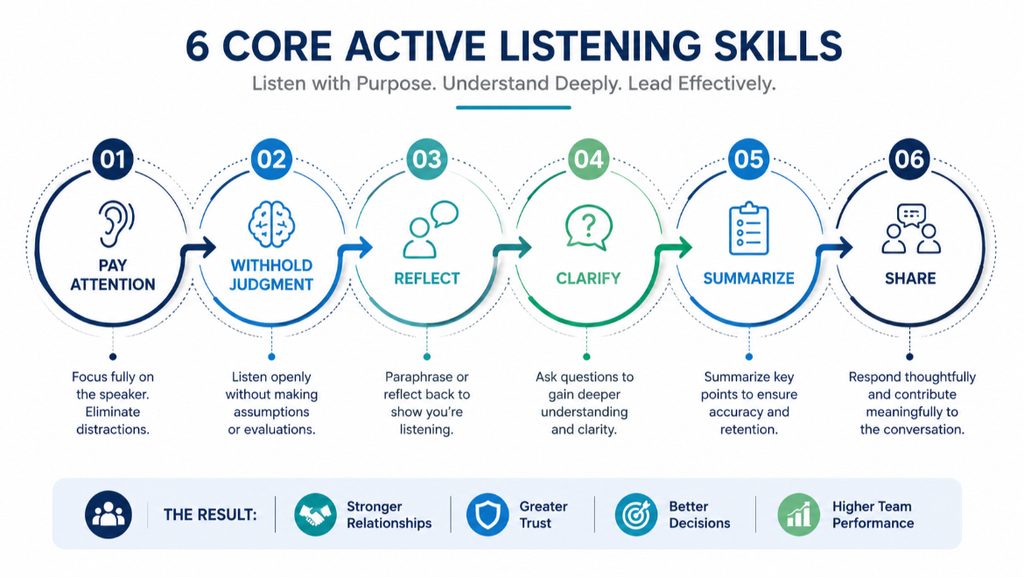
Pay Attention
Paying attention means giving the person your full focus.
Start with simple things. Put your phone away. Close unrelated tabs on your computer. Stop checking email while someone is talking to you. If you are in a meeting, give the speaker your attention instead of looking around the room.
Mental focus is harder than physical focus. Many people start preparing their answer while the other person is still speaking. When this happens, part of the message can be missed.
Try a simple habit. Before you answer, make sure you can explain the main point the other person just made. This helps keep your attention on their message instead of your own response.
Nonverbal communication also shows whether you are paying attention. Natural eye contact, an open posture, and small signs of attention can help the speaker feel heard. Looking at your watch, checking your phone, or turning away can send the opposite message.
The goal is not to stare at someone or use forced body language. It is simply to make it clear that you are present.
Withhold Judgment
Withholding judgment means giving someone time to finish before deciding whether you agree with them.
This can be difficult for leaders. Leaders are often expected to make decisions and solve problems quickly. That habit can lead to interruptions.
An employee starts explaining a problem, and the leader already thinks they know the answer. The leader jumps in. The employee stops talking. Something important may never be said.
This can happen again and again until employees learn to keep their thoughts to themselves.
You do not have to agree with everything you hear. Listening first does not mean giving up your own view. It means making sure you understand the other person’s view before you respond.
This is also part of emotional intelligence. Leaders need to notice their own reactions and manage them while listening to someone else.
A useful question to ask yourself is, “Do I understand this yet, or am I already judging it?”
That small pause can change the conversation.
Reflect and Validate
Reflecting means saying back what you think you heard. It gives the other person a chance to tell you if you understood them correctly.
You might say, “So, what I’m hearing is that the deadline is the main problem.”
Or you could say, “It sounds like you’re frustrated because you’ve raised this issue before.”
Validation is slightly different. It means recognizing what the person is feeling or the effort they have made. You might say, “I can see why that was difficult” or “Thank you for telling me about this.”
You do not have to agree with the person to validate their experience. You are simply showing that you understand why the situation matters to them.
This is especially useful during difficult conversations. People often want to know that their concern has been heard before they are ready to discuss solutions.
That simple recognition can make a conversation feel safer and more respectful. It is closely connected to empathy in leadership, where leaders try to understand what another person is experiencing without assuming that they have the same feelings.
Clarify
Clarifying means asking questions when you are not sure what someone means.
Good questions help remove guesswork. Instead of assuming what an employee means, ask them to explain.
You might ask:
- “Can you tell me what happened?”
- “What do you think caused the problem?”
- “What would you like to see change?”
- “Can you give me an example?”
Open questions often work better than questions that can be answered with only “yes” or “no.”
It is also fine to say that you did not understand something. Saying, “Can you explain that another way?” is better than pretending you understand when you do not.
This becomes especially important when people from different cultures, age groups, or areas of expertise work together. The same words can mean different things to different people.
Good leaders do not assume. They ask.
Summarize
Summarizing means bringing the main points of a conversation together.
For example:
“Let me make sure I have this right. You are worried that the deadline is too short, the team does not have enough people, and you have already raised the issue. Is that correct?”
The other person can then correct anything you misunderstood.
A summary is useful because conversations can contain many details. Without one, two people may leave the same meeting with very different ideas about what was discussed.
Summaries are especially helpful during performance reviews, project meetings, conflict discussions, and important decisions.
They can also make the next step clear. Everyone knows what was discussed and what needs to happen next.
Share and Act
Listening should lead somewhere.
After you understand what someone is saying, respond in a thoughtful way. Sometimes you may offer advice. Sometimes you may need to investigate a problem. Sometimes the right response is simply to explain what you can or cannot do.
Taking action does not always mean doing exactly what the other person asked.
For example, an employee may report a problem with a process. You may not be able to change the process immediately. But you can look into it, explain what you found, and tell the employee what will happen next.
This is where trust grows.
People notice when leaders listen and then forget about the conversation. They also notice when leaders listen and follow up. This connects active listening with feedback and coaching skills, because good feedback starts with understanding what the other person needs.
Active listening is therefore not finished when the person stops talking. The follow-up is part of the skill.
Active Listening Frameworks
Frameworks can make listening easier to practice, especially when you are still developing the habit.
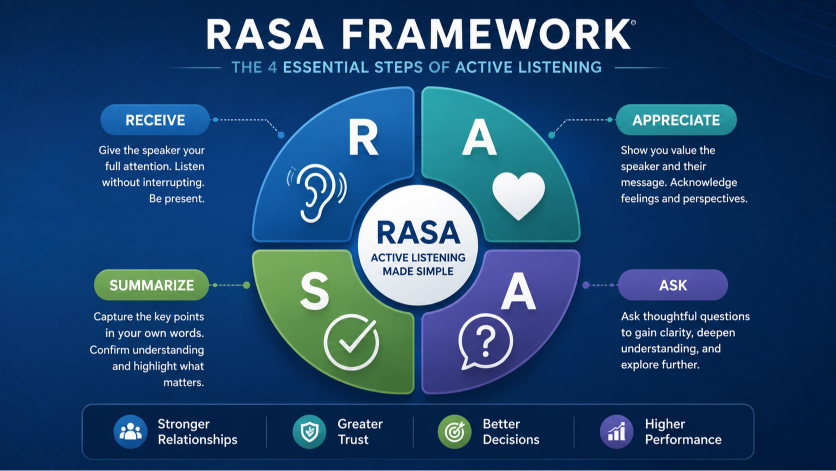
The RASA Framework
Julian Treasure’s RASA framework uses four steps.
Receive: Give the person your attention and listen to what they are saying.
Appreciate: Show that you are listening through small responses such as a nod, eye contact, or a short verbal response.
Summarize: Repeat the main idea in your own words to check your understanding.
Ask: Ask questions when you need more information or want the person to explain something further.
The framework is simple enough to use during team meetings, coaching conversations, and one-to-one discussions.
The REAL Framework
David Burkus’s REAL framework also uses four steps.
Receive: Give the speaker your full attention.
Engage: Show that you are listening through your words and body language.
Align: Check that you understand the speaker’s meaning.
Learn more: Ask follow-up questions and stay curious.
The main difference is in the final step. REAL treats listening as a way to keep learning rather than simply reaching the end of a conversation.
| Framework | Best For | Main Idea |
| RASA | Meetings, coaching, everyday conversations | Listen, show attention, summarize, and ask |
| REAL | Leadership development and management | Listen, engage, check understanding, and learn more |
| 6-Skill Model | Feedback and performance conversations | Includes sharing and acting as the final step |
Common Barriers and How to Overcome Them
Even good listeners can struggle when a conversation becomes difficult.

The Image of Leadership
Some leaders believe they need to talk more because they are in charge. They may worry that being quiet will make them look weak. But it does not.
A leader can show confidence by asking a good question and giving someone room to answer. Sometimes the person with the best question is more useful than the person with the fastest answer.
Planning Your Response
It is easy to think about what you will say next while someone else is talking. The problem is that you may miss what they are saying.
Try to understand the full message before preparing your answer. If you can explain the person’s main point clearly, you probably listened well.
Jumping to Solutions
Leaders often want to fix problems quickly. That is useful when the problem is clear, but it can be harmful when the leader does not yet understand what is really happening.
Before offering advice, ask what the person wants.
You could say, “Do you want me to listen, give you advice, or help you work through the problem?”
That simple question can prevent you from solving a problem the person did not ask you to solve.
Digital Distraction
A phone notification may take only a few seconds to check, but it can break your attention.
When a conversation matters, put the phone away and close unrelated windows. Give the conversation the same attention you would expect from someone speaking with you.
Emotional Reactivity
Listening becomes harder when someone criticizes you. Your first reaction may be to defend yourself. Instead, pause. Let the person finish. Take a breath before answering. You do not have to accept every criticism as true. You do need to understand what the person is trying to tell you.
Avoiding Difficult Conversations
Leaders sometimes delay difficult conversations because they do not want to make things uncomfortable.
The problem usually does not disappear.
A small issue can become a larger one when nobody talks about it. Employees may become frustrated, tension can grow, and people may start discussing the problem privately instead of with the person who can help.
Addressing concerns early is usually easier than waiting until the problem becomes serious.
Cultural and Generational Differences
People do not all communicate in the same way. Some people make strong eye contact. Others may avoid it.
Some speak directly. Others use a softer approach. People can also have different ideas about when it is appropriate to interrupt.
Do not assume that one style is always right. Ask questions. Pay attention to the person. Be willing to adjust your own style when needed.
Active Listening in Virtual and Hybrid Environments
Remote work makes listening a little harder because leaders cannot see all the usual signs of attention.
Small actions can help.

Keep your camera on when appropriate. Looking toward the camera can make the conversation feel more personal. You do not need to stare at the camera the entire time, but try to avoid looking at unrelated screens.
Take notes. Notes help you remember important details. They can also show that you take the conversation seriously. If appropriate, tell the person that you are taking notes so they know what you are doing.
Use more verbal feedback. In a face-to-face conversation, people can see your body language more easily. Online, simple phrases such as “I understand” or “Let me make sure I have this right” can show that you are paying attention.
Remember personal details. Remote teams can miss the small conversations that happen naturally in an office. Remembering something an employee told you before can show that you see them as a person, not just as someone on a screen.
How to Develop Active Listening Skills
Active listening is a learnable skill, not a fixed personality trait. Research confirms that intentional practice produces measurable improvement.
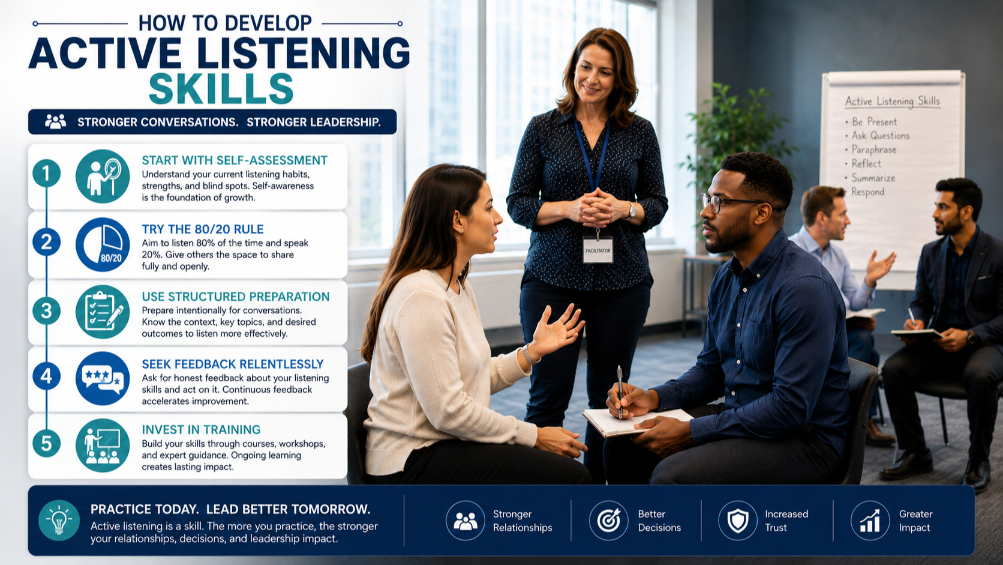
Start with Self-Assessment: Record yourself in a meeting or ask a trusted colleague for honest feedback. Do you interrupt? Do you ask more questions than you make statements? Do your follow-up actions match what was discussed?
Practice the 80/20 Rule: Aim to listen 80% of the time and speak 20%. This ratio feels unnatural to most leaders, but it creates space for others to share fully. In practice, this means asking one more question than you initially think necessary before offering your perspective.
Use Structured Preparation: Before important conversations, remind yourself of the framework you intend to use. Write “RASA” or “REAL” at the top of your notes. This simple cue keeps you anchored to the discipline of listening rather than drifting toward reactive speaking.
Seek Feedback Relentlessly: Ask direct reports specifically about your listening. Do not ask “How was that?” Ask “What did you hear me say?” and “What could I have understood better?” Then act on what you learn.
Invest in Training: Active listening training programs increase listening skills scores by an average of 30%. The investment is modest, 8 to 10 hours can reduce workplace conflicts by over 50%, but the returns are substantial. Structured programs provide frameworks, practice opportunities, and external accountability that accelerate growth beyond what self-study can achieve.
Frequently Asked Questions
What is active listening in leadership?
Active listening in leadership is the intentional practice of giving full attention to a speaker, understanding their message and emotional subtext, and responding in ways that confirm comprehension and build trust. It goes beyond passive hearing to involve deliberate engagement and disciplined focus.
Why is active listening important for leaders?
It builds trust, reduces errors by 25%, cuts misunderstandings by 40%, improves employee satisfaction by 30%, and creates the psychological safety necessary for innovation and honest dialogue. It is also the number one coaching priority for leaders, appearing in 18% of all coaching goals.
What are the core skills of active listening?
The six core skills are: paying attention, withholding judgment, reflecting and validating, clarifying, summarizing, and sharing or acting on what you heard. Together, these create a complete listening cycle that transforms conversation into understanding and action.
What is the RASA framework for active listening?
RASA stands for Receive, Appreciate, Summarize, and Ask. Developed by communication expert Julian Treasure, it provides a simple structure for transforming listening from a passive activity into an intentional practice.
What is the REAL framework for active listening?
REAL stands for Receive, Engage, Align, and Learn more. Developed by organizational psychologist David Burkus, it is designed specifically for leaders and emphasizes ongoing discovery through follow-up questions.
How does active listening differ from passive listening?
Passive listening is surface-level. You may appear attentive but are not fully absorbing meaning or emotional cues. Active listening involves conscious effort to stay present mentally, emotionally, and physically. You paraphrase what you have heard, ask clarifying questions, and provide feedback that proves engagement.
What are common barriers to active listening?
Common barriers include the image of leadership that equates talking with authority, planning your response while the other person speaks, jumping to solutions too quickly, digital distractions, emotional reactivity, and failure to adapt to cultural or generational differences in communication style.
How can leaders listen better in virtual meetings?
Keep your camera on, look into the lens to simulate eye contact, take visible notes, use reflective language more frequently, and make an effort to remember personal details from previous conversations. These behaviors compensate for the reduced nonverbal information available in virtual settings.
Is listening enough, or must leaders also act?
Listening alone is not enough. Research shows that employees whose leaders listen and then take action feel twice as listened-to as those whose leaders listen but do nothing. The full cycle of active listening includes closing the loop between what is heard and what is done.
Can active listening be learned?
Yes. Active listening is a learnable skill, not a fixed personality trait. Training programs increase listening skills scores by an average of 30%. With intentional practice, structured frameworks, and feedback, leaders can develop strong active listening capabilities.
How does active listening relate to psychological safety?
Active listening creates psychological safety by signaling that every voice matters. Google’s Project Aristotle found that teams with high psychological safety are the most effective, and behaviors like equality in conversational turn-taking and high social sensitivity, both rooted in listening, correlate with high performance.
What is the 80/20 rule in active listening?
The 80/20 rule suggests that leaders should aim to listen 80% of the time and speak 20%. This ratio creates space for others to share fully and ensures that the leader’s contributions, when they come, are informed by complete understanding rather than partial information.
Conclusion
Active listening is not just a soft skill. For leaders, it is a basic part of building trust, strong teams, and good performance. Leaders deal with constant information, busy schedules, and pressure to make quick decisions. Taking the time to stop, pay attention, and understand people can make a real difference.
The research discussed in this article shows why listening matters. It can help reduce mistakes and misunderstandings, improve employee satisfaction, and create a workplace where people feel safer sharing ideas and concerns. Other leadership skills, such as giving feedback, coaching, delegation, and leading change, also become more effective when leaders first take the time to listen.
Becoming a better listener does not require a complicated process. Start by paying attention. Let people finish speaking. Ask questions when you are unsure. Check that you understood what they meant. Ask others for feedback about your listening, and most importantly, follow up when action is needed.
Good listening is built through small actions repeated over time. Put away the phone. Give someone your full attention. Stay curious instead of assuming you already know the answer. Listen before you respond.
When people know their leader will listen, they are more likely to speak honestly, share ideas, and raise problems early. That can make the team stronger and help the organization make better decisions.
Better leadership starts with better listening.