

What Is Leadership Communication
Leadership communication is the intentional practice of conveying ideas, vision, and direction in ways that inform, inspire, and align others toward shared goals. It encompasses verbal, nonverbal, and written messages delivered across multiple channels and audiences, from one-on-one conversations to organization-wide announcements.
Unlike general business communication, leadership communication carries the added responsibility of shaping culture, building trust, and influencing behavior. It is how leaders translate strategy into action, transform abstract goals into meaningful work, and create the psychological safety that allows teams to perform at their best. Effective leadership communication is not about being the loudest voice in the room; it is about being the clearest, most consistent, and most trustworthy.
Why Leadership Communication Matters
Leadership communication sits at the intersection of organizational performance and human connection. When leaders communicate well, teams understand what is expected, why it matters, and how their work contributes to something larger. When communication falters, confusion spreads, trust erodes, and performance suffers.
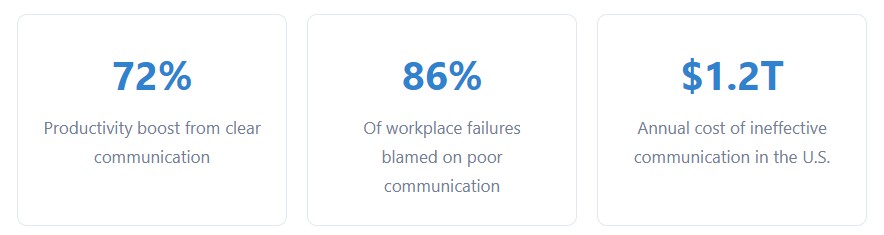
The data makes the case plainly. Research indicates that leaders who communicate with clarity and purpose can raise team productivity by up to 72%. Conversely, ineffective communication costs U.S. organizations approximately $1.2 trillion annually, averaging about $12,506 per employee. These are not abstract figures; they represent wasted hours, missed deadlines, duplicated effort, and talented people walking out the door because they no longer trust what leadership says.
Beyond the numbers, leadership communication shapes the daily experience of work. It determines whether employees feel heard, whether they believe their contributions matter, and whether they trust that leadership has their best interests in mind. In an era of rapid change, remote work, and information overload, the ability to communicate with clarity, empathy, and consistency has become one of the most consequential skills a leader can develop.
Core Leadership Communication Skills
Effective leadership communication is built on a foundation of specific, learnable skills. While no single skill guarantees success, the combination of active listening, clarity, empathy, transparency, storytelling, and nonverbal awareness creates a communication style that is both authoritative and approachable.
Active Listening
Active listening is the disciplined practice of focusing entirely on the speaker, understanding their message, and responding in ways that confirm comprehension. It is not passive hearing; it is intentional engagement.

Many leaders spend most conversations planning their next response rather than absorbing what is being said. This habit creates blind spots. When leaders fail to listen, they miss early warning signs of team distress, overlook innovative ideas, and signal to employees that their input is not valued. Over time, this erodes psychological safety and reduces the quality of information flowing upward.
Active listening involves several concrete behaviors: eliminating distractions during conversations, allowing the speaker to finish without interruption, paraphrasing what was heard to confirm understanding, and asking open-ended questions that invite deeper exploration. Leaders who practice active listening create environments where people feel safe sharing bold ideas, admitting challenges, and taking the kind of calculated risks that drive innovation.
The impact is measurable. Organizations with employees skilled in active listening report 25% higher productivity and 40% better retention rates. When people feel genuinely heard, they contribute more fully. When they do not, they withdraw.
Clarity and Conciseness
Clarity is the ability to express ideas in simple, direct language that leaves no room for misinterpretation. It means stripping away jargon, avoiding unnecessary complexity, and stating the core message upfront.
Leaders often assume that more detail equals more clarity. The opposite is usually true. When messages are overloaded with information, recipients struggle to identify what matters most. In remote and hybrid work environments, where nonverbal cues are limited, clarity becomes even more critical. Research indicates that poor communication is a primary driver of workplace failure, with misalignment costing organizations billions in lost productivity annually.
Practical clarity involves leading with the bottom line, using the BLUF (Bottom Line Up Front) approach favored by military and executive communicators. It means defining expectations precisely: who is responsible, what success looks like, and by when. It also means checking for understanding rather than assuming it. The most effective leaders ask, ‘What did you hear me say?’ rather than ‘Did you understand?’ because the former reveals gaps while the latter invites polite but unhelpful agreement.
Empathy
Empathy in leadership communication is the capacity to understand and acknowledge others’ emotions, perspectives, and circumstances before responding. It does not mean agreeing with every viewpoint or avoiding difficult messages. It means recognizing the human reality behind the work.
Empathetic leaders adjust their communication based on what they know about their audience. They acknowledge stress during deadlines, listen without defensiveness to feedback, and adjust expectations when personal challenges arise. This is not weakness; it is strategic awareness. Employees with empathetic leaders are 76% more likely to be engaged at work, and organizations with empathetic leadership report improvements in efficiency, job satisfaction, and creativity.
However, empathy must be genuine. When leaders express concern without following through, employees perceive it as performative, and trust suffers. The discipline is to pair empathetic listening with consistent action, closing the loop between what is heard and what is done.
Transparency and Trust
Transparency is the practice of sharing information openly, explaining the reasoning behind decisions, and acknowledging what is unknown. It is not about revealing every detail; it is about providing enough context for people to act with confidence.

Trust in leadership is built on three pillars: clarity, consistency, and follow-through. When leaders communicate transparently, they signal respect for their teams and invite reciprocal openness. A 2025 Gallup survey found that 29% of employees lack clear, honest, or consistent communication from leaders. This gap is not typically caused by malice; it stems from competing demands, tight timelines, and the natural discomfort of sharing uncertain or unwelcome news.
Transparent leaders explain the “why” behind decisions, not just the “what.” They communicate earlier than feels comfortable, acknowledging what is known, what is not, and when more information will follow. They admit mistakes without deflection and model accountability. Over time, these behaviors create a culture where information flows freely, rumors have less room to grow, and teams operate from shared understanding rather than speculation.
Storytelling
Storytelling is the art of embedding facts and directives within narratives that make them memorable, meaningful, and motivating. People remember stories far better than statistics alone. Research from Stanford University found that stories can be 22 times more memorable than facts alone, because narratives engage emotional and cognitive processing simultaneously.
Effective leadership storytelling follows a clear structure: a relatable challenge, the actions taken to address it, and the outcome or lesson learned. The hero of the story should often be the team member or customer, not the leader. This approach transforms abstract strategy into shared purpose and makes organizational values feel lived rather than laminated.
Storytelling is particularly powerful during change or crisis, or when rallying teams around a new vision. It is not appropriate for every communication; routine updates and operational instructions benefit from directness, but for moments when alignment and motivation matter most, narrative is one of the most potent tools a leader possesses.
Nonverbal Communication
Nonverbal communication is how we communicate without using words. It includes our facial expressions, body language, eye contact, and tone of voice. These signals can change how people understand what we say.
For example, a leader might say, “I am confident,” but speak in a shaky voice and avoid eye contact. People may notice these signals and doubt the message. Research by Dr. Albert Mehrabian found that when words and nonverbal signals conflict while expressing feelings or attitudes, people often give more weight to facial expressions and tone of voice. This finding does not apply to every type of communication.
For leaders, words and actions should match. If a leader says, “Everything is going to be fine,” but looks worried and avoids eye contact, employees may not believe the message. On the other hand, a calm voice, open posture, and natural eye contact can make a leader’s message feel more honest and reassuring.
This is also important during video meetings. Because people can see less of each other, facial expressions, eye contact, posture, and voice become more important.
Simple actions can make a big difference. Look at people when they speak, show that you are listening, keep a relaxed posture, and let your facial expression match your message. When a leader’s words and body language tell the same story, people are more likely to trust the message.
Leadership Communication Frameworks
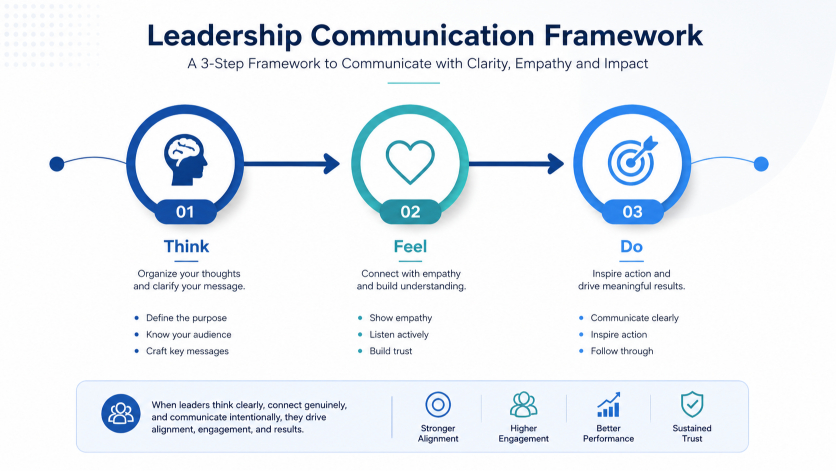
Structured frameworks help leaders organize their thinking and deliver messages with greater impact. The following models are among the most practical for common leadership scenarios.
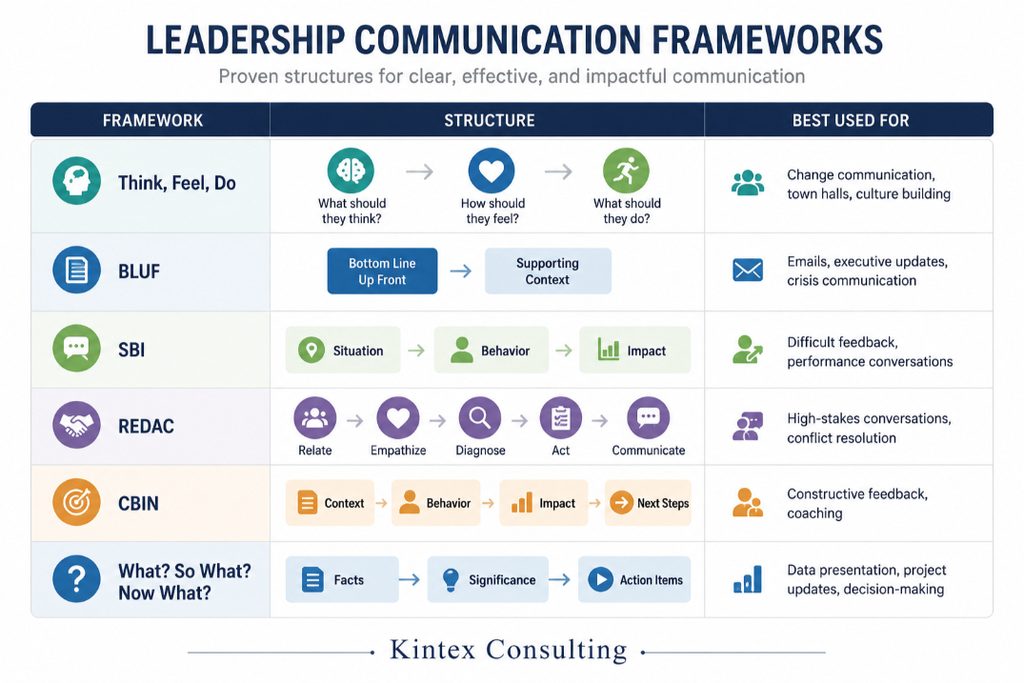
These frameworks are not scripts. They are scaffolding that helps leaders organize their intent before speaking. The most effective communicators internalize several models and select the right one based on the audience, stakes, and desired outcome. A leader preparing for a difficult conversation might use REDAC to build psychological safety before addressing the issue. A leader presenting quarterly results might use BLUF to respect the executive audience’s time. The discipline is not in memorizing frameworks but in choosing the right structure for the moment.
Common Barriers and How to Overcome Them
Even skilled communicators encounter obstacles. Understanding the most common barriers allows leaders to anticipate and address them proactively.
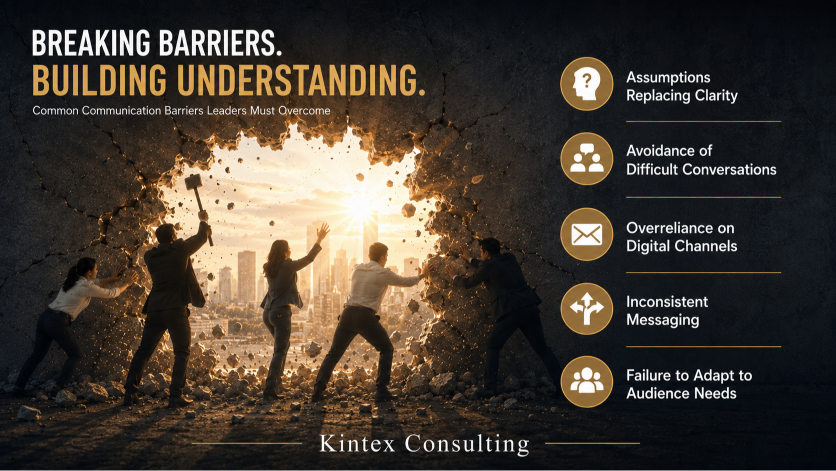
Assumptions Replacing Clarity
Leaders often assume that because they understand a situation, everyone else does too. This leads to skipped context, unexplained priorities, and teams left guessing. The remedy is to slow down and make expectations explicit, checking for understanding rather than assuming it.
Avoidance of Difficult Conversations
Many leaders delay or soften difficult messages to avoid discomfort. While this may feel considerate in the moment, it creates more confusion later. Issues surface indirectly through tension, disengagement, or rumor. The remedy is to address concerns early and directly, with calm respect, before they compound.
Overreliance on Digital Channels
Digital communication is a leading source of workplace misunderstanding. Email strips away tone, body language, and immediate clarification, making misinterpretation far more likely than in face-to-face conversation. The remedy is to match the channel to the message: use video or voice for sensitive topics, reserve email for straightforward information, and never let digital convenience override relational necessity.
Inconsistent Messaging
When leaders send mixed signals, teams struggle to know what to follow. Inconsistent messaging erodes trust quickly, as employees look for alignment between what is said and what is done. The remedy is to align messages across channels and leaders, repeat core priorities more than feels necessary, and ensure that actions match words.
Failure to Adapt to Audience Needs
Not everyone processes information the same way. Some need detailed explanations; others want the headline. Generational, cultural, and personality differences all shape communication preferences. The remedy is to segment messaging, provide multiple formats where possible, and ask rather than assume about audience needs.
Organizational Impact
The effects of leadership communication extend far beyond individual conversations. They shape organizational culture, employee engagement, and business performance.

Engagement and Retention
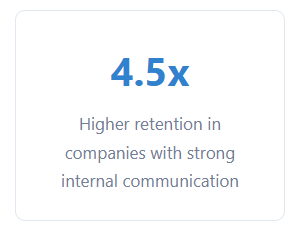
Companies with strong internal communication practices experience up to 4.5 times higher employee retention. When people understand how their work connects to organizational goals, they are more invested in outcomes. When they feel invisible or uninformed, they look elsewhere.
Productivity and Efficiency
Clear communication reduces the time spent clarifying instructions, fixing errors, and managing conflict. Cross-functional teams with strong communication can be 50% more efficient than those operating in silos. In hybrid and remote environments, where informal check-ins are harder to come by, intentional communication becomes the primary mechanism for maintaining momentum.
Innovation and Psychological Safety
Teams that communicate openly are more likely to share unconventional ideas, challenge assumptions, and experiment. This requires leaders who model vulnerability, respond to failure with curiosity rather than blame, and create spaces where dissent is welcomed rather than punished.
Crisis Resilience
Organizations that communicate proactively and transparently during crises recover trust significantly faster than those that retreat into defensive messaging. The leader who calls affected clients directly, acknowledges what happened, and outlines next steps builds credibility that outlasts the crisis itself.
How to Develop Leadership Communication Skills
Leadership communication is not an innate talent reserved for a select few. It is a discipline that improves with intentional practice.
Assess Your Starting Point
Begin with self-awareness. Record yourself presenting, solicit honest feedback from trusted colleagues, and review your written communication for clarity and tone. Identify patterns: Do you interrupt? Do you use jargon? Do your messages match your actions?
Practice Structured Preparation
Before important conversations or presentations, use a framework to organize your thinking. Define your central message, anticipate questions, and decide what you want the audience to think, feel, and do. Preparation reduces anxiety and increases precision.
Seek Feedback Relentlessly
Ask direct reports, peers, and mentors for specific input on your communication style. Do not ask, “How was that?” Ask, “What did you hear me say?” and “What could I have made clearer?” Then act on what you learn.
Invest in Training
Leaders who complete communication training show 42% improvement in leadership effectiveness scores within six months. Structured programs provide frameworks, practice opportunities, and external perspective that accelerate growth beyond what self-study can achieve.
Rehearse and Reflect
Musicians rehearse. Athletes practice. Leaders often wing it. Rehearsal surfaces awkward phrasing, unclear transitions, and moments where the message loses momentum. After each significant communication, spend five minutes reflecting on what worked and what did not. Over time, these small adjustments compound into significant improvement.
Frequently Asked Questions
What is leadership communication?
Leadership communication is the intentional practice of conveying ideas, vision, and direction through verbal, nonverbal, and written messages to inform, inspire, and align others toward shared goals. It goes beyond information sharing to shape culture, build trust, and influence behavior.
Why is leadership communication important?
It directly impacts productivity, engagement, retention, and trust. Poor communication costs U.S. organizations approximately $1.2 trillion annually, while clear leadership communication can boost productivity by up to 72% and increase retention by 4.5 times.
What are the most important leadership communication skills?
The core skills include active listening, clarity and conciseness, empathy, transparency, storytelling, and nonverbal communication awareness. Together, these create a communication style that is both authoritative and approachable.
How can leaders improve their communication skills?
Through self-assessment, structured preparation using frameworks, seeking specific feedback, investing in training, and consistent rehearsal and reflection. Research shows leaders who complete communication training improve effectiveness scores by 42% within six months.
What is the difference between leadership communication and management communication?
Management communication focuses on task coordination, process updates, and operational directives. Leadership communication emphasizes vision, inspiration, trust-building, and cultural influence. Both are necessary, but leadership communication addresses the “why” while management communication addresses the “how.”
What are common barriers to effective leadership communication?
Common barriers include assumptions replacing clarity, avoidance of difficult conversations, overreliance on digital channels, inconsistent messaging, failure to adapt to audience needs, and information overload. Each can be addressed through intentional practice and structured frameworks.
How does empathy improve leadership communication?
Empathy allows leaders to understand team members’ perspectives and emotions, adjusting messages to meet people where they are. Employees with empathetic leaders are 76% more likely to be engaged, and empathetic leadership correlates with higher job satisfaction, creativity, and efficiency.
What communication frameworks do leaders use?
Popular frameworks include Think-Feel-Do for change communication, BLUF for executive updates, SBI for feedback, REDAC for difficult conversations, CBIN for coaching, and “What? So What? Now What?” for data presentation. The best leaders select the right framework for each situation.
Why do leaders avoid difficult conversations?
Leaders often avoid difficult conversations due to fear of conflict, discomfort with emotional reactions, or uncertainty about how to frame the message. However, avoidance compounds problems. Managers who delay difficult conversations see 35% lower team performance over time.
How can leaders communicate more transparently?
By explaining the “why” behind decisions, communicating earlier than feels comfortable, admitting what is unknown, setting clear expectations, and inviting questions and feedback. Transparency is not about sharing everything; it is about providing enough context for people to act with confidence.
What role does nonverbal communication play in leadership?
Nonverbal cues, including body language, tone, and facial expressions, can account for up to 93% of how messages are interpreted. Congruence between verbal and nonverbal signals is essential for credibility. In video calls, where visual cues are limited, leaders must be especially mindful of their presence.
How does leadership communication affect team innovation?
Teams led by managers who practice active listening demonstrate 38% higher innovation rates. When leaders create psychological safety through open communication, team members feel safe sharing unconventional ideas, challenging assumptions, and experimenting without fear of blame.
Conclusion
Leadership communication is not a soft skill or a secondary concern. It is the primary mechanism through which strategy becomes action, vision becomes shared purpose, and individual contributors become aligned teams. In an environment defined by complexity, change, and distributed work, the ability to communicate with clarity, empathy, and consistency has become one of the most consequential capabilities a leader can develop.
The path to mastery is not mysterious. It requires self-awareness, structured practice, a willingness to seek feedback, and the discipline to match actions to words. Leaders who invest in their communication skills do not merely become better speakers; they become more trusted, more influential, and more effective at guiding organizations through uncertainty toward meaningful outcomes.
The conversation you have today shapes the culture your team experiences tomorrow. Choose clarity over ambiguity. Choose presence over distraction. Choose intention over reaction. The quality of your leadership will be measured, above all, by the quality of your communication.