
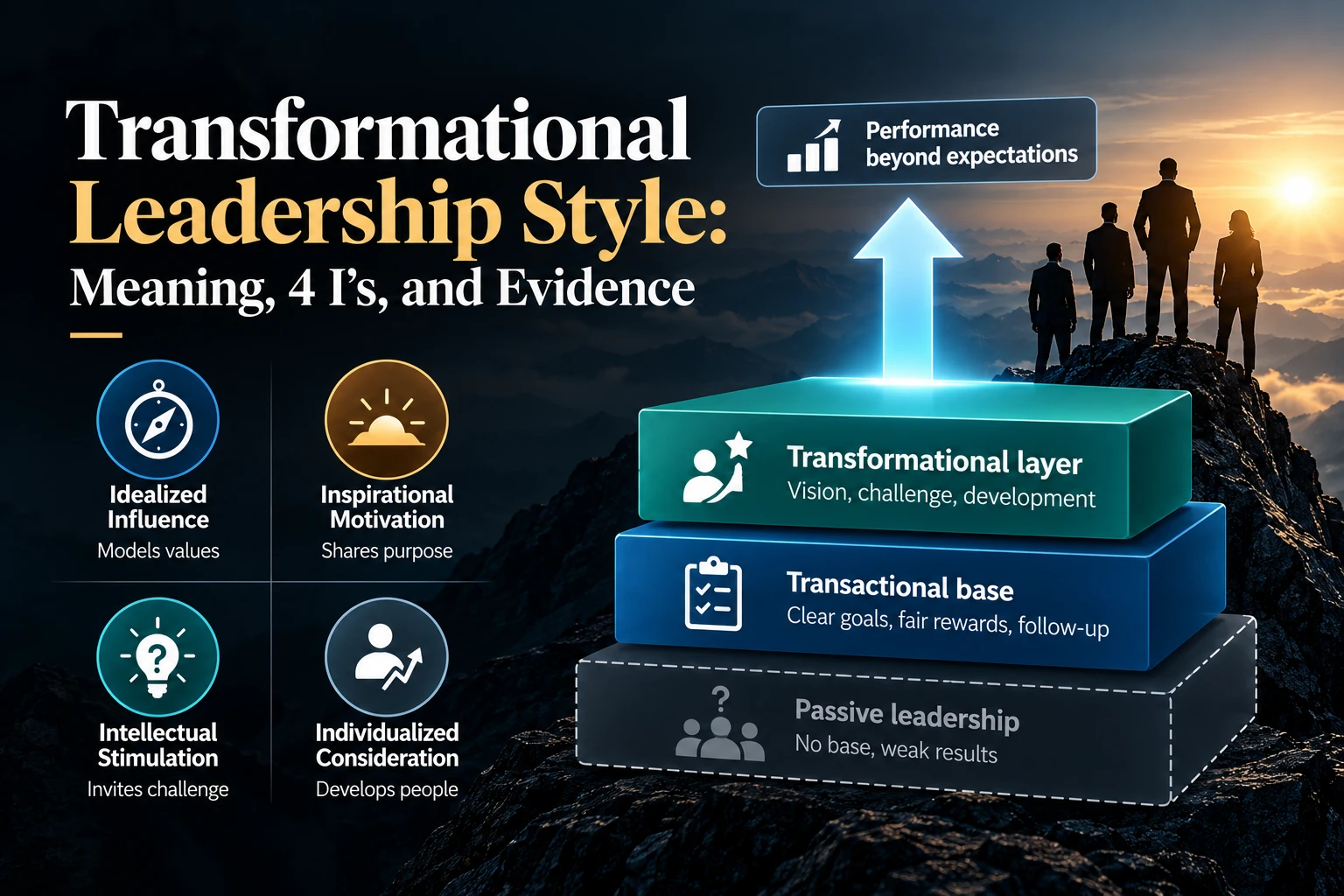
The transformational leadership style inspires followers to look beyond self-interest and pursue a shared vision. Leaders do this through four behaviors: idealized influence, inspirational motivation, intellectual stimulation, and individualized consideration. The goal is to raise motivation, commitment, and capability, not just compliance. Research links the style to stronger performance, but fit depends on context, integrity, and follower needs.
Among leadership styles, this one is often described as inspirational. That description is incomplete. The style is a system of behaviors that changes how people interpret their work. Style matters because it shapes whether people commit, question, or merely comply. Understanding that system helps leaders use the style well and avoid its risks.
This guide explains the style step by step. It covers the origins, the four behaviors, and the mechanism. It then reviews the evidence, the limits of that evidence, and the conditions where the style fits. It ends with ethics, measurement, and development.
What Is the Transformational Leadership Style?
Transformational leadership is a style in which a leader’s behavior changes how followers think, feel, and act. The leader builds a shared vision, models values, challenges assumptions, and develops people as individuals. Followers commit to goals because the goals feel meaningful, not only because rewards or rules require effort.
Three features separate the style from routine management. It is relational, because it works through trust and personal example. It is elevating, because it raises expectations and motivation. It is developmental, because success includes followers growing into leaders.
Routine management checks whether tasks are complete. The transformational style also checks whether people understand the purpose and are developing as they work.
Where the Style Comes From
James V. Downton first used the term in 1973, in a study of revolutionary leaders. Political scientist James MacGregor Burns brought the idea into mainstream thinking in his 1978 book, Leadership.
Burns contrasted two types of leadership. In his view, transactional leadership trades rewards for effort. Transforming leadership helps leaders and followers raise each other to higher levels of motivation and morality.
Bernard Bass rebuilt the idea as a testable theory in his 1985 book, Leadership and Performance Beyond Expectations. He made two changes that still shape research today.
- He argued that transformational and transactional leadership are separate dimensions, not opposite ends of one line. A leader can show both.
- He treated the behaviors as morally neutral in principle. A leader could use them for good or for self-serving ends.
Bass and Avolio later built the Multifactor Leadership Questionnaire (MLQ) to measure the style. Most large studies rely on it. Later sections return to the moral question that this neutrality raises.
The Four I’s of Transformational Leadership
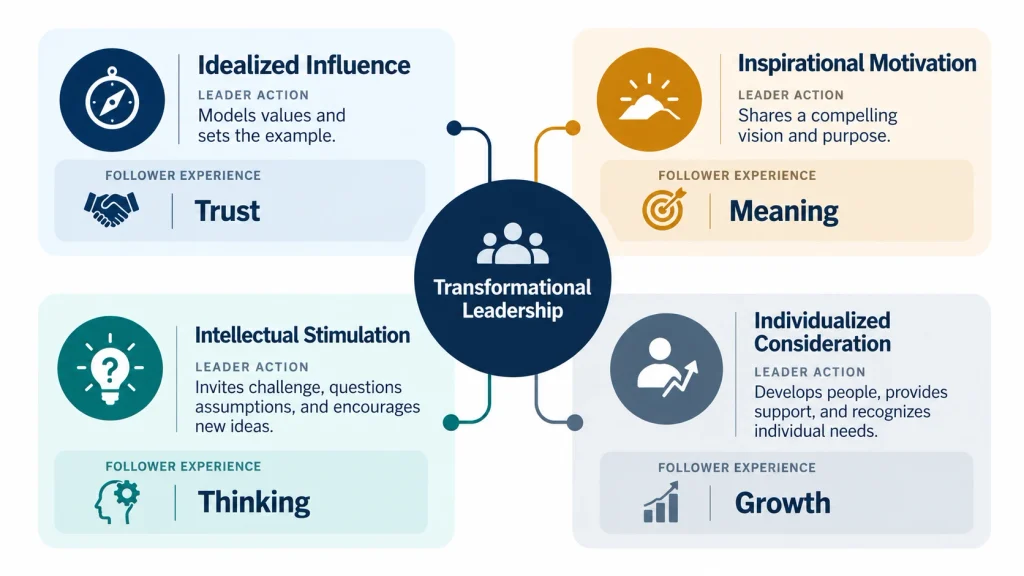
The four I’s are the core behaviors of the style. They are idealized influence, inspirational motivation, intellectual stimulation, and individualized consideration. Effective leaders tend to draw on all four rather than relying on one or two. Each one shapes a different part of the follower experience: trust, meaning, thinking, and growth.
| Component | Leader focus | What followers experience | Observable behavior |
| Idealized influence | Trust and role modeling | Admiration and confidence in the leader | Acts consistently with stated values, owns mistakes, shares the cost of sacrifice |
| Inspirational motivation | Vision and meaning | Purpose and optimism | Links goals to purpose, sets high expectations, stays calm under pressure |
| Intellectual stimulation | Questioning and creativity | Permission to challenge and experiment | Invites dissent, reframes problems, treats errors as learning |
| Individualized consideration | Development of each person | Feeling seen and supported | Coaches, adapts support, delegates for growth |
Idealized Influence
Idealized influence is the leader’s role as a trusted example. Followers admire and respect the leader, and many want to act in similar ways.
Trust comes from consistent behavior and ethical standards, not from a job title. A leader who asks for candor must accept it. A leader who asks for sacrifice must share the cost.
One proposed mechanism is identification. Followers may adopt the leader’s values when the leader’s actions match the leader’s words. When words and actions split, the effect can reverse, and people may stop believing the vision.
The MLQ splits this component in two. One part captures the leader’s behavior. The other captures the charisma that followers attribute to the leader.
Inspirational Motivation
Inspirational motivation is the leader’s ability to give work meaning. The leader states a vision that people want to join. The leader also sets high expectations and shows confidence that the team can meet them.
A vision works only when people can connect it to daily work. A vague slogan does not do that. A strong message explains what the team will achieve, for whom, and why it matters.
A clear vision also shapes organizational culture. Repeated messages and visible choices tell people which behaviors count. Optimism matters too. Teams read the leader’s tone during uncertainty, and calm confidence signals that goals are reachable.
Intellectual Stimulation
Intellectual stimulation means challenging assumptions and inviting new ideas. The leader asks why current methods exist and whether better ones are available.
This behavior builds problem-solving capacity. People learn to question, test, and improve their own work. It also spreads ownership, because people help shape the solution.
The behavior depends on psychological safety. If a leader punishes early ideas, people stop offering them. A leader should challenge the idea, not the person.
Dimensions of the style do not all work the same way. A study of six South Korean hotels used its own four-dimension model. It found that intellectual stimulation influenced creativity, which in turn influenced task performance.
Individualized Consideration
Individualized consideration means treating each person as an individual with distinct needs, strengths, and goals. The leader listens, coaches, and adapts support.
This behavior separates the style from generic inspiration. A strong speech can move a room. Personal attention shows each person that the vision has a place for them.
The behavior draws on emotional intelligence, because leaders must notice how each person is doing. It also takes time. Leaders need to protect space for regular one-to-one conversations, or the behavior fades under workload pressure.
Together, the four behaviors cover trust, meaning, thinking, and growth. A weakness in one may leave a gap that the others cannot fill.
Key Characteristics of Transformational Leaders
Characteristics describe how the four I’s appear in daily conduct. The theory defines the style by behavior, not by personality type. That distinction matters, because behavior can be observed, rated, and changed.
The list below is an analytical synthesis of the four behaviors. It is not a research taxonomy.
- Consistency. The leader’s actions match the leader’s stated values. This supports idealized influence.
- Clear purpose. The leader explains why goals matter and what success looks like. This supports inspirational motivation.
- Openness to challenge. The leader invites questions and treats dissent as information. This supports intellectual stimulation.
- Attention to people. The leader learns what each person needs to grow. This supports individualized consideration.
- Follow-through. The leader turns ideas into priorities and owners. This links the style to transactional discipline.
The last characteristic is easy to overlook. Yet it explains why strong leaders combine both styles.
How the Transformational Leadership Style Works
The style works by changing how followers interpret their work and themselves. Self-concept theory proposes that transformational leaders raise self-efficacy, encourage value internalization, and strengthen identification with the group. Those psychological states can then raise discretionary effort, learning, and cooperation.
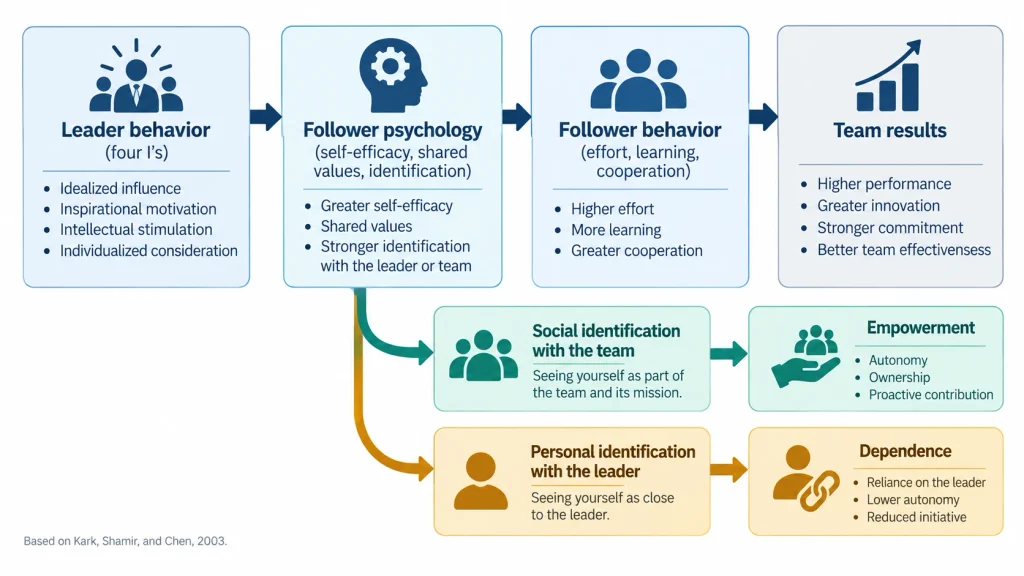
Self-efficacy is a person’s belief that they can succeed at a task. Value internalization means people adopt the mission as their own. Group identification means people see the team’s success as their success.
This section offers a simple synthesis. Leader behavior changes follower psychology. Follower psychology changes follower behavior. Follower behavior changes team results. Treat this chain as a practical summary, not a proven causal model. Critics note that current theories do not fully specify how each dimension works.
The table below maps each behavior to its likely effect. It is an analytical summary, not a research finding.
| Behavior | Likely psychological effect | Likely follower response |
| Idealized influence | Trust and identification | Cooperation and adoption of values |
| Inspirational motivation | Meaning and optimism | Persistence toward goals |
| Intellectual stimulation | Curiosity and ownership | Idea sharing and experimentation |
| Individualized consideration | Feeling valued, growing confidence | Learning and commitment |
The Two Faces: Empowerment and Dependence
Kark, Shamir, and Chen studied 888 bank employees under 76 branch managers. Transformational leadership related to both empowerment and dependence on the leader. Personal identification with the leader linked to dependence. Social identification with the unit linked to empowerment.
This finding carries a practical warning. Leaders should build commitment to the mission and the team, not only to themselves. Otherwise, team performance may rise and fall with one person. Building follower psychological empowerment through shared decisions and skill development protects against that risk.
What Research Says About the Outcomes
Transformational leadership has one of the largest evidence bases in leadership research. The evidence has clear strengths and clear limits.
Meta-Analytic Evidence
Meta-analyses combine many studies to estimate an overall pattern. Two are especially useful for managers.
Judge and Piccolo (2004) analyzed 626 correlations from 87 sources. They found an overall validity of .44 for transformational leadership. Contingent reward scored .39, and laissez-faire leadership scored negative .37. Validity here means the average correlation between the style and outcome measures. A correlation of .44 signals a sizable link. It does not prove that the style caused the outcomes.
Wang and colleagues (2011) reviewed 117 independent samples from 113 studies. Transformational leadership related positively to individual follower performance and to performance at the team and organization levels. The link was stronger for contextual performance than for task performance across most settings.
Contextual performance means helpful behavior beyond the formal job, such as cooperation and initiative. This suggests the style matters most for discretionary effort. That is the effort people choose to give. This reading is a synthesis of the findings, not a finding itself.
Practitioner guides often add employee engagement and retention to the benefits list. Those links are plausible. Leaders should measure them locally rather than assume them.
Advantages at a Glance: How Strong Is the Evidence?
Guides list many advantages of the style. The table below rates the support found in this review. The ratings are an analytical judgment based on the studies cited in this guide.
| Claimed advantage | Support in this guide | Reading |
| Stronger outcomes across criteria | Judge and Piccolo meta-analysis of 87 sources | Substantial association, direction unproven |
| Team and organization performance | Wang and colleagues, 113 studies | Positive association, strongest for discretionary behavior |
| Follower development | Military field experiment with 54 leaders | Experimental support in one setting |
| Commitment and branch financial results | Bank field experiment with 20 managers | Experimental support, very small sample |
| Creativity | Study of six South Korean hotels | Limited support from one sector |
| Engagement and retention | Practitioner guides | Plausible, not established here |
Support is strongest for overall outcomes and discretionary performance. Support is thinner for creativity, engagement, and retention.
Experimental Evidence: Can the Style Be Trained?
Most studies survey people once. Experiments are rarer. Random assignment to training or no training adds causal weight.
In a bank study, nine managers received transformational leadership training and eleven did not. Training included a one-day session and four monthly booster sessions. Afterward, the training showed significant effects on subordinates’ perceptions of the leaders. It also showed effects on organizational commitment and on two aspects of branch-level financial performance.
A randomized field experiment with 54 military leaders tested the style with training. Leaders trained in the transformational style had a more positive impact on direct followers’ development. They also had a more positive impact on indirect followers’ performance. The comparison group received eclectic leadership training.
Together, these studies suggest the behaviors can be learned. Both studies were limited in scale and setting, so leaders should not treat them as universal proof.
Limits of the Evidence
The evidence is broad, but it has weaknesses. Leaders should know them.
Many studies ask the same followers to rate both the leader and the outcomes. Shared rating methods can inflate the links. Single-time surveys also cannot show direction. Satisfied, high-performing teams may simply rate their leader more favorably.
Van Knippenberg and Sitkin (2013) raised four deeper problems. The concept lacks a clear definition. Theories do not fully specify how each dimension works. Measures mix the behavior with its effects. Common tools also fail to reproduce the dimensions that theory predicts. The authors urged researchers to study more clearly defined aspects of leadership instead.
Overlap is another issue. Judge and Piccolo found that transformational leadership correlated .80 with contingent reward. A 2023 meta-analysis of leadership and mental health also noted that highly correlated styles may be redundant.
The balanced conclusion is practical. The evidence supports the style’s value, but it does not offer a proven formula for every team. Leaders should also check objective results, such as delivery metrics, alongside follower ratings.
Transformational vs Transactional Leadership
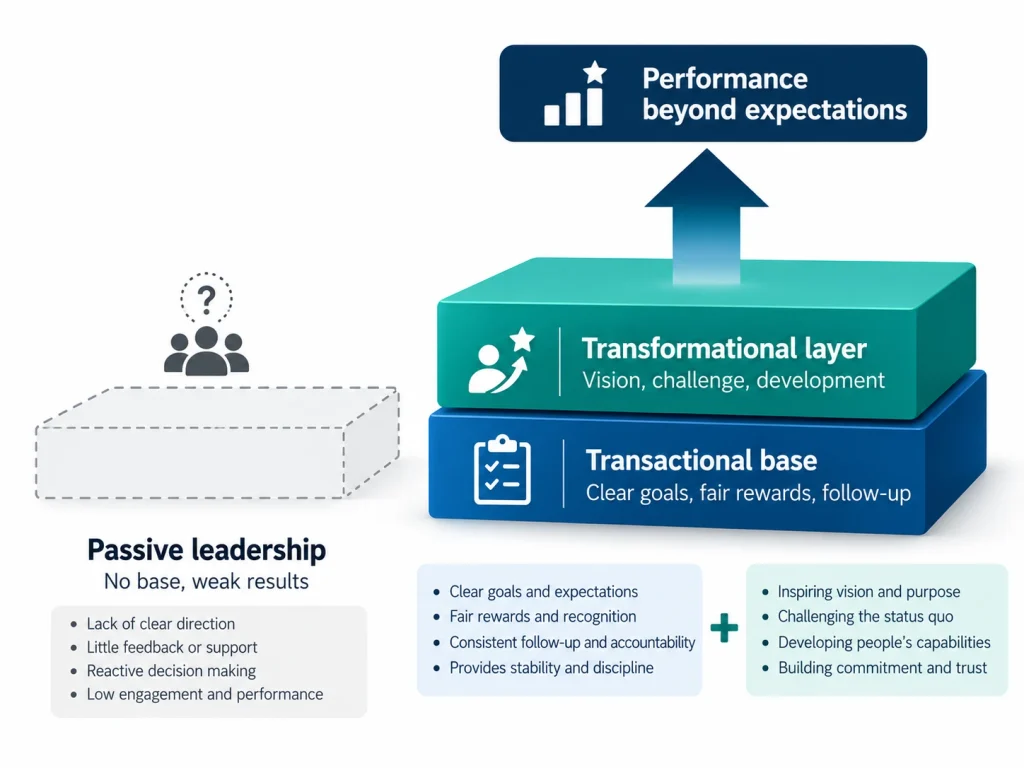
Transformational leadership motivates through purpose and development. Transactional leadership motivates through clear expectations and exchange. Bass treated them as separate dimensions, so a leader can use both.
| Dimension | Transformational | Transactional |
| Core logic | Inspire and develop | Exchange rewards for performance |
| Motivation source | Meaning and commitment | Rewards and clarity |
| Leader role | Coach, role model, change agent | Monitor, clarify, reward |
| Main contribution | Discretionary effort and change | Clear standards and reliable execution |
| Main risk | Vision without follow-through, dependence | Compliance without commitment |
| Strongest evidence | Overall validity of .44 | Contingent reward validity of .39 |
Bass proposed the augmentation hypothesis. Transformational behavior adds to good transactional leadership rather than replacing it. Wang and colleagues found augmentation over contingent reward for contextual performance and team-level performance.
Some guides describe transactional leadership as fear-based or shallow. The evidence does not support that view for contingent reward. Clear goals and fair rewards scored .39 in the Judge and Piccolo analysis. The weaker styles were laissez-faire leadership, which related negatively to outcomes, and management by exception, which related inconsistently.
The contrast with passive leadership is sharper. Transformational leadership correlated negative .65 with laissez-faire leadership. Laissez-faire leaders avoid decisions and step in late. That pattern is the opposite of the active, developmental behavior the transformational style requires.
Related Leadership Styles
Several neighboring styles overlap with the transformational style. In servant leadership, follower wellbeing comes first, and organizational goals follow. In authentic leadership, self-awareness and an internalized moral perspective are central. The leader-member exchange model focuses on the quality of each one-to-one relationship, and it overlaps with individualized consideration.
Hoch and colleagues tested whether ethical, authentic, and servant leadership explain outcomes beyond transformational leadership. Authentic and ethical leadership added little. Servant leadership showed more promise as a stand-alone approach. The behaviors often matter more than the label.
When the Style Fits and When It Does Not
No study shows that one style always wins. The best reading of the evidence is conditional. The framework below is an analytical synthesis, not an empirical model.
Ask four questions before choosing the style.
- Does the work need change, learning, or discretionary effort? The evidence is strongest here.
- Are followers ready? People new to a task may need direction before stretch goals.
- Are procedures fixed or safety-critical? Clear rules must lead in that case.
- Do systems exist to turn inspiration into action? Goals, owners, and resources are essential.
| Situation | Fit | Reason | What to combine |
| Strategy shift or culture change | High | People must accept new goals and behaviors. | Clear milestones and fair rewards |
| Innovation and problem-solving work | High | Idea generation and discretionary effort matter. | Psychological safety and clear decision rights |
| Stable, routine operations | Moderate | Reliable execution matters more than inspiration | Clear standards and prompt feedback |
| Rule-bound or safety-critical tasks | Low as the lead style | Procedures must be followed exactly | Use vision to support compliance, not replace it |
| New team needing direction | Moderate | Followers may need structure before stretch | Task guidance plus individual coaching |
One 2026 study of online project teams found that transformational leadership built trust better on highly challenging projects. Transactional leadership worked better when the challenge was low. This is one study, but it fits the logic of the framework.
Change efforts illustrate the pattern. In change management, people must accept new goals and behaviors. Transformational behavior helps with acceptance. Transactional behavior helps with milestones, accountability, and follow-through.
Virtual and Hybrid Teams
The evidence on remote teams is mixed. Purvanova and Bono (2009) ran an experiment with 39 leaders who led both face-to-face and virtual teams. The effect of transformational leadership on team performance was stronger in virtual teams. The leaders were college students leading small team projects, so workplace transfer is uncertain. A 2023 literature review, however, reports that the style may lose strength in highly dispersed teams, because communication is harder.
Leaders should therefore make the four I’s explicit in remote settings. Written vision statements, scheduled one-to-one time, and open discussion channels can replace hallway contact.
Cultural Context
The GLOBE project tested leadership attributes in 62 cultures. Results supported the view that specific charismatic and transformational attributes are widely endorsed. This measures what people admire in leaders, not proven results.
Delivery still needs local judgment. GLOBE also found that some leadership behaviors, such as participative leadership, are much more culturally sensitive. Leaders should adapt tone and method while keeping the underlying behaviors.
Disadvantages, Ethical Risks, and Common Mistakes
The main disadvantages are dependence on the leader, vision without execution, strain from high expectations, and ethical misuse. Because the style is powerful, misuse carries real costs. Ethics is central to any honest discussion.
Bass and Steidlmeier (1999) contrasted authentic transformational leadership with pseudo-transformational leadership. They compared the leader’s moral character, the ethical values in the vision, and the morality of the process. Pseudo-transformational leaders tend to create followers who depend on them.
Leaders can test themselves with one question. Would I welcome followers challenging this vision in public?
Common Mistakes
The mistakes below combine research findings with analytical judgment.
- Vision without systems. Leaders inspire but skip priorities, owners, and metrics. People feel motivated but cannot act. Better practice pairs the vision with clear goals and regular reviews.
- Charisma over substance. Followers may mistake confidence for competence. Critics call the habit of crediting leaders for team results the romance of leadership. Better practice uses evidence and invites challenge.
- Building dependence. Followers who identify mainly with the leader may hesitate to act alone. Better practice shares decisions and develops successors.
- One-size-fits-all inspiration. Some followers want structure and clear instructions. Better practice adapts support to each person.
- Stretch without support. High expectations with too few resources can strain people. Better practice matches ambition with capacity and recovery time.
How to Measure and Develop the Style
Measuring the Style
The MLQ asks followers to rate how often a leader shows each behavior on a five-point scale. It is the most frequently used instrument in leadership research. The current version covers nine factors: five transformational, three transactional, and one laissez-faire. The standard form has 45 items. Thirty-six items measure the nine factors, and nine items measure outcomes such as extra effort and effectiveness.
Followers provide the ratings, so results reflect perception. Leaders can pair such tools with 360-degree feedback to compare self-view with follower view. Use the results as conversation starters, not verdicts.
A Quick Self-Check
This five-question check is not a validated instrument. It is a prompt for reflection.
- Can my team state our purpose in one sentence?
- Do my actions match my words when the choice is costly?
- When did someone last change my mind?
- Do I know each person’s development goal?
- Who owns each priority, and how will we know it worked?
Questions one to four map to the four I’s. Question five checks follow-through. A weak answer shows where to start.
Building the Behaviors
The two experiments show that structured support can change behavior. A practical approach follows.
- Collect a baseline. Ask followers how often you show each of the four I’s.
- Focus on one behavior for a set period, instead of improving everything at once.
- Turn the behavior into a visible habit. The table below offers examples.
- Seek a mentor or executive coaching support. The best mentors offer support but also challenge the leader’s assumptions.
- Re-measure after several months. Compare follower ratings with team results.
| Component | Practice to try | What to watch |
| Idealized influence | Share one decision and the value behind it, including one mistake | Whether people raise problems earlier |
| Inspirational motivation | Restate one goal in two sentences naming the purpose and the beneficiary | Whether people can explain the goal themselves |
| Intellectual stimulation | Ask “what are we missing?” before each major decision | Whether new options and objections appear |
| Individualized consideration | Hold one development conversation per direct report each month | Whether people request stretch tasks |
Organizations can build these steps into a leadership development program. That program should include feedback, practice, and time for reflection.
System-Level Support
Individual effort has limits. Organizations shape whether leaders can use the style at all. Four supports help.
- Time. Leaders need room for coaching and one-to-one conversations.
- Feedback. Regular follower input shows how behavior lands.
- Incentives. Reward leaders for developing people, not only for short-term output.
- Selection and promotion. Assess how candidates treat followers, not only how they present a vision.
These are practical recommendations drawn from the mechanisms above. They are not findings from a single study.
Transformational Leadership Examples: How to Read Them
Popular guides name famous executives and public figures as transformational leaders. Common names include Satya Nadella, Reed Hastings, Nelson Mandela, and Mahatma Gandhi. These lists are illustrations, not measurements. They rarely show follower ratings of the leader’s behavior. Success also has many causes beyond leadership style.
A teaching scenario shows the four I’s in practice. This is an illustration, not a real case.
A hospital operations director must reduce discharge delays. She explains how delays affect patients and staff. She follows the same checklist as her team. She asks nurses where the process breaks and tests their ideas. She coaches each unit manager on the barriers that person faces.
She also sets weekly measures and names an owner for each step. That last move is transactional. It turns motivation into results. The scenario shows the augmentation idea in action.
Now consider a second illustration. A founder gives inspiring speeches about a bold new product line. She sets no priorities and names no owners. Teams chase every idea, and deadlines slip. Enthusiasm fades into fatigue. The vision was strong, but the system was missing. Inspiration needs structure to last.
Frequently Asked Questions:
Can introverts be transformational leaders?
Yes, but research suggests introverts may face a relative disadvantage. Studies link extraversion with a tendency to adopt a transformational style and with emerging into leadership roles. The style is defined by behaviors, though, and quiet behaviors such as listening, coaching, and asking sharp questions count.
What is the difference between transformational and charismatic leadership?
Charismatic leadership relies mainly on the leader’s personal appeal, and it can create dedication to the leader. Transformational leadership includes charisma through idealized influence, but it adds intellectual stimulation and individualized consideration. Judge and Piccolo noted that the two bodies of theory have much in common.
What is the difference between transformational and transformative leadership?
They are different theories with similar names. Transformative leadership begins with questions of justice and democracy and critiques inequitable practices. Scholars have defined it as distinct from the transformational approach. Transformational leadership, from Burns and Bass, focuses on motivating followers and improving organizational outcomes.
Does transformational leadership work in small businesses and startups?
Early evidence is supportive. A study of 102 start-ups, rated by 372 employees, found a significant positive effect of founder transformational leadership on performance. It found no significant direct effect for transactional or laissez-faire leadership. Founders should still share decisions to avoid dependence on one person.
Is transformational leadership effective during a crisis?
It can help, but the evidence is limited. Some scholars argue that followers look to transformational leaders for direction in uncertain times. A May 2020 survey of 293 people in Indonesia linked transformational leadership to perceived crisis management effectiveness. Treat this as suggestive, and pair vision with clear roles and fast decisions.
Conclusion
The transformational leadership style is a set of leader behaviors that build trust, meaning, curiosity, and personal growth. The four I’s give leaders a practical map. The research supports the style’s value, especially for discretionary effort and team performance.
The research also shows limits. Measures overlap, many designs are correlational, and the concept remains contested. The most useful view is conditional. Leaders should combine transformational behavior with clear goals and fair rewards.
Over the long term, the style works when commitment attaches to the mission, not to one person. Integrity is the condition that makes everything else work. The strongest leaders are measured partly by whether their followers grow into leaders.
A conditional view of style raises a practical question. How should a leader adjust direction and support as follower readiness changes? The answer lies in situational leadership, which matches leader behavior to follower readiness and task demands.