
Emotional intelligence in leadership is a leader’s ability to recognise emotions in themselves and others, understand what those emotions mean, and use that information to guide behavior and decisions. It is usually described in four domains: self-awareness, self-management, social awareness, and relationship management. Research links it to job performance and leadership behavior, though the size of that link is smaller than the popular literature claims.
That last clause matters more than it sounds.
Emotional intelligence is probably the most oversold construct in leadership. It is also genuinely useful. Both things are true at once, and the reason most articles on this topic are unhelpful is that they only tell you the first half. This one covers what the peer-reviewed evidence supports, which widely repeated numbers you should stop using, when emotional capability matters most, and how to build and assess it honestly.
What Is Emotional Intelligence in Leadership?
The construct entered psychology in 1990, when Peter Salovey and John Mayer defined it as a set of abilities for perceiving, using, understanding, and managing emotion. Daniel Goleman took it to a mass audience with his 1995 book and, more consequentially for business, a 1998 Harvard Business Review article arguing that emotional intelligence was the distinguishing feature of effective leaders.
Applied to leadership, the idea is straightforward. Leaders work through other people. Working through other people is an emotional business, whether or not anyone acknowledges it. A leader who reads a room accurately and manages their own reactions has better information and more options than one who does not.
That is the reasonable version of the claim. Most of what follows is an attempt to work out how much of it holds up.
The Four Domains Most Leadership Models Use
Nearly every leadership treatment of emotional intelligence uses some version of four domains, split across two axes: self versus others, and awareness versus management.
Self-awareness is accurate recognition of your own emotional states and their effects. It is the foundational domain because it gates the others. A leader who cannot tell they are frustrated cannot manage the frustration, and will misattribute it to whatever is in front of them.
Self-management is regulating those states so they inform your behavior rather than dictate it. Not suppression. A leader who never shows frustration is not regulating, they are concealing, and people usually notice anyway.
Social awareness is reading emotions in others and in groups, including the political and cultural currents a team is operating in. This is the domain most often confused with agreeableness. Reading a room accurately and being nice to everyone in it are different capabilities.
Relationship management is using all of the above to influence, develop, resolve conflict, and build the working relationships that get things done.
The structure is intuitive and useful for organising development. It is worth knowing that the four-domain framing is Goleman’s practitioner model rather than the version that has held up best in measurement research, which brings us to the part almost nobody covers.
Three Competing Models, and Why the Difference Matters
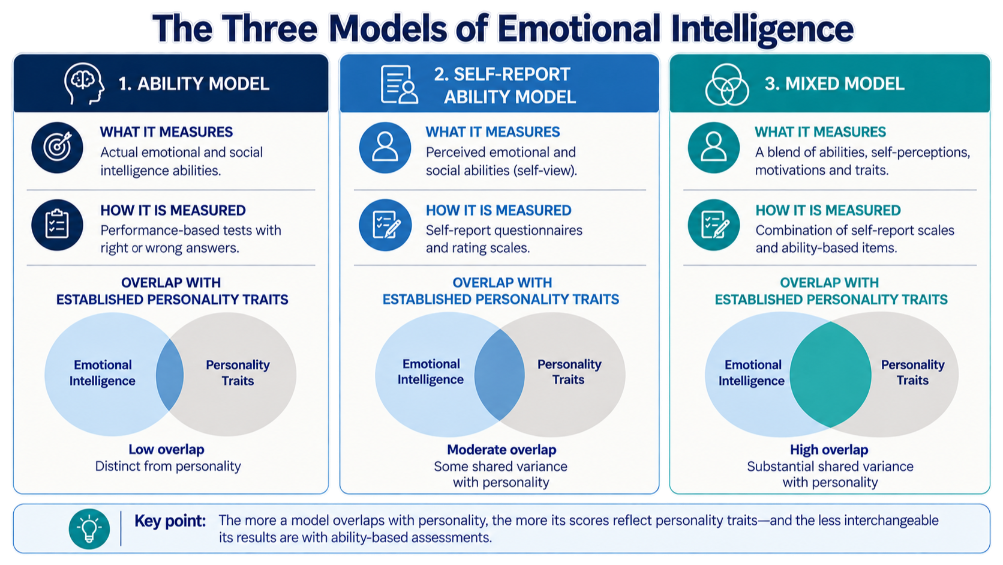
There is not one emotional intelligence. There are three research traditions, and they measure meaningfully different things. If you are handed an assessment result, this determines what it means.
| Model | What it measures | How it is measured | What to watch |
| Ability model | Emotional reasoning treated as a genuine cognitive ability | Performance tests with scored right and wrong answers, such as the MSCEIT | Closest to a real intelligence measure, but some subscales have been criticised for reliability |
| Self-report ability model | Your own estimate of your emotional abilities | Self-completed questionnaires based on the four-branch model | You are rating a capability using the very capability in question |
| Mixed model | A broad bundle of emotional competencies, motivation, and personality-adjacent traits | Self-report or multi-rater competency inventories | Overlaps substantially with established personality traits |
The practical consequence is that a high score on a mixed-model instrument and a high score on an ability test are not the same finding, and a leader can plausibly score well on one and poorly on the other. When someone tells you emotional intelligence predicts something, the first useful question is which of these three they measured.
Why It Matters Specifically for Leaders
The general case for emotional capability applies to anyone. The leadership case is more specific, and it rests on a mechanism worth spelling out.
A leader’s emotional state does not stay contained. It propagates through a team, because people watch their leader for cues about how worried they should be. This is why the same information delivered by a composed leader and an agitated one produces different team behavior.
More importantly, a leader’s emotional reactions determine what information they receive. A leader who responds badly to bad news gets less bad news. Over months, that leader is making decisions on a filtered picture of reality while believing things are going well. This is the single most expensive consequence of poor emotional regulation in a senior role, and it compounds silently.
There is a third strand. Emotional capability is what makes the hard parts of the job possible. Delivering a difficult message without triggering defensiveness, holding a line under pressure, staying useful during conflict. These are not soft extras. They are the actual work of management.
The current environment makes this concrete. Gallup’s State of the Global Workplace 2026 report found global employee engagement at 20% in 2025, with manager engagement falling from 31% in 2022 to 22% in 2025. DDI’s Global Leadership Forecast 2025 put trust in immediate managers at 29%, down from 46% three years earlier. Whatever else those numbers reflect, they describe a workforce where the relationship between leaders and their teams is under real strain, and employee engagement is the visible symptom.
What the Research Actually Shows
Here is where this article parts company with most of what you will read on the topic.
The Meta-Analytic Evidence
The best available synthesis is a 2011 meta-analysis by O’Boyle and colleagues in the Journal of Organizational Behavior. It classified studies into the three streams described above and examined their relationships with job performance.
The corrected correlations ranged from .24 to .30. All three streams predicted job performance. Two of them showed incremental validity beyond both cognitive ability and the Five Factor Model of personality, adding 5.2% and 6.8% of explained variance respectively. Tests for publication bias found negligible influence on the effect sizes.
That is a real finding and a genuinely positive one. Emotional intelligence tells you something about performance that IQ and personality tests do not. It is also a modest finding. Correlations in the .24 to .30 range mean emotional intelligence accounts for somewhere in the region of 6% to 9% of the variance in performance. Useful. Not transformative.
Hold that number in mind for the next two sections.
The Measurement Problem That Changes Everything
In 2010, Harms and Credé published a meta-analysis in the Journal of Leadership and Organizational Studies examining the relationship between emotional intelligence and transformational leadership across 62 independent samples. Their headline result should be far better known than it is.
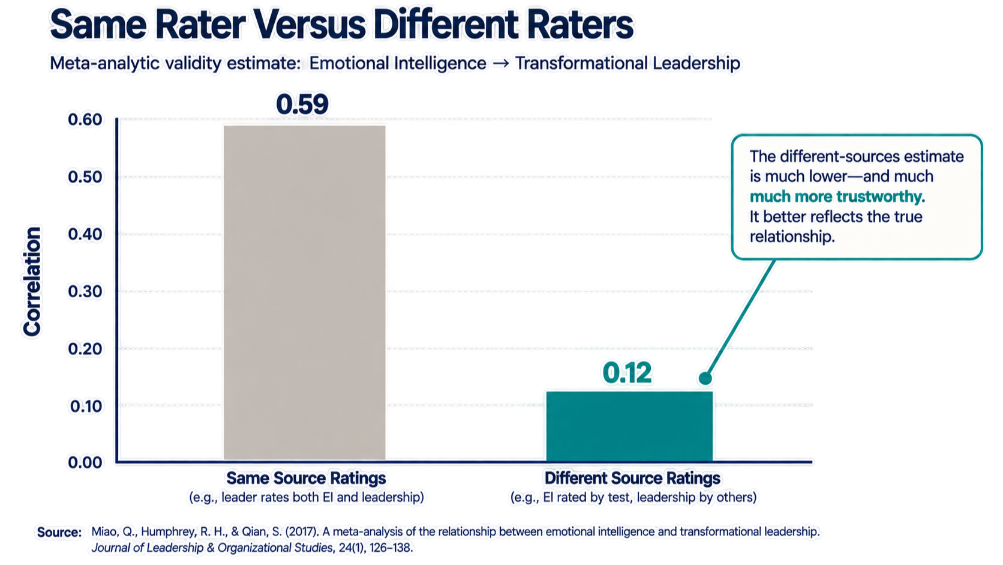
When emotional intelligence and leadership behavior were rated by the same source, whether that source was the leader, their subordinates, peers, or superiors, the validity estimate was .59. A strong relationship, consistent with the enthusiastic claims in the popular literature.
When the two constructs were rated by different sources, the estimate fell to .12.
That gap is the story. Most of the apparent relationship between emotional intelligence and good leadership exists because the same person is judging both. If I think well of you, I rate you high on emotional intelligence and high on leadership, and the correlation between those two ratings tells us about my impression of you rather than about you.
The authors also found that cross-source agreement was low for both constructs, .16 for emotional intelligence and .14 for transformational leadership. In other words, people do not agree much about how emotionally intelligent a given leader is.
This does not mean emotional intelligence is worthless. A correlation of .12 is not zero, and the O’Boyle findings on job performance used a broader evidence base. What it means is that any claim built on same-source ratings should be treated as roughly five times too strong, and that includes a great deal of what gets published about this topic.
Four Statistics Worth Retiring
If you have read anything about emotional intelligence at work, you have met these numbers. All four are worth dropping from your slide deck.
“Emotional intelligence explains 58% of job performance.” This comes from TalentSmart, a company that sells emotional intelligence assessments, based on internal testing that has not been published in a peer-reviewed journal with an accessible methodology. Set it against the meta-analytic estimate of roughly 6% to 9% and the problem is obvious. The vendor figure is around ten times larger than the best independent evidence supports.
“90% of top performers have high emotional intelligence.” Same source, same absence of published method. It is also a statistic with a structural weakness: without knowing the base rate of high emotional intelligence in the whole population, the figure tells you very little.
“People with high EQ earn $29,000 more per year.” Same origin again. Even taken at face value, it is a raw association in which seniority, industry, education, and cognitive ability are doing unmeasured work.
“Nearly 90% of the difference between star and average senior leaders is emotional intelligence.” This one is Goleman’s, from the 1998 HBR article, and he did write it. The context matters though. It came from analysing competency models built by the companies themselves, in a population of people who had already been selected into senior roles. That is a study design that would struggle to produce any other answer, and it is not equivalent to an independent test of predictive validity.
None of this means the underlying idea is wrong. It means the popular case for it has been built on numbers that will not survive a determined finance director, and you do not need them. The honest version, that emotional intelligence adds real predictive value beyond intelligence and personality, is defensible and sufficient.
Where Emotional Intelligence Matters Most
Treating emotional intelligence as uniformly important is part of why the claims got inflated. It is more useful to ask where the returns are highest. The following is practical reasoning from the evidence rather than a research finding in itself.
Emotional capability matters most where the work is emotionally demanding. Roles involving frequent conflict, negotiation, customer distress, clinical care, or sustained influence without authority put a premium on it. Roles that are largely analytical and individually executed put much less.
It matters more during disruption than during stability. Restructuring, layoffs, integration after an acquisition, and any period of sustained uncertainty all multiply the emotional content of a leader’s job. A leader who is adequate in calm conditions can become a genuine liability in these.
It matters more as span increases. A leader with six direct reports can compensate for weak emotional reading through sheer contact time. A leader with sixty cannot.
And it matters least when the constraint is something else entirely. A team failing because its priorities conflict, its tooling is broken, or its goals are incoherent will not be rescued by a more empathetic manager. Diagnosing an emotional problem where a structural one exists is a common and expensive error.
What It Looks Like in Daily Leadership Behavior
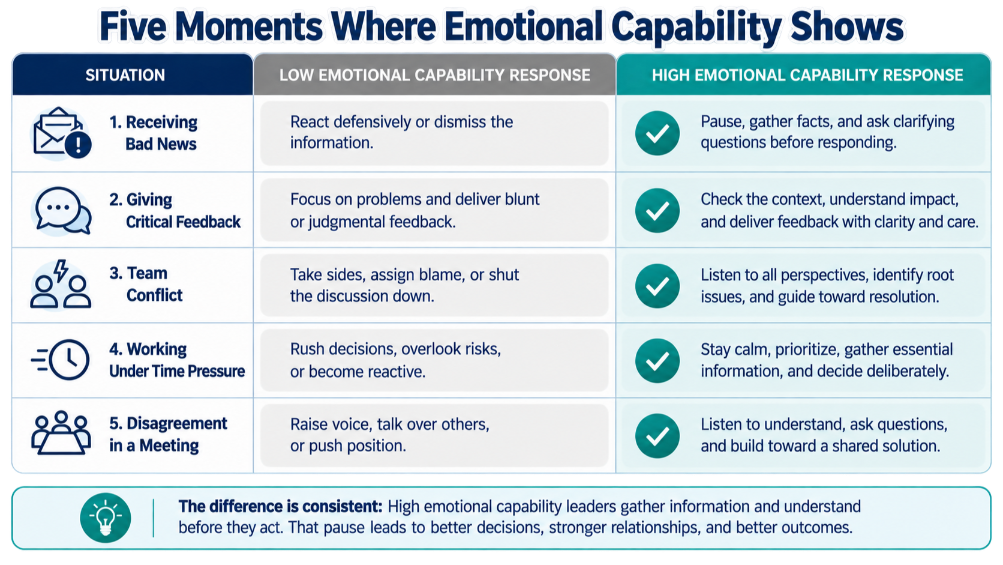
Emotional intelligence is invisible as a construct and highly visible as behavior. This is the level at which it can actually be observed and developed.
| Situation | Low emotional capability | High emotional capability |
| Receiving bad news | Reacts, questions the messenger, fixes immediately | Registers the reaction, asks questions first, addresses the problem separately from the emotion |
| Giving critical feedback | Softens it into ambiguity, or delivers it bluntly and calls it honesty | Says the difficult thing clearly and manages the delivery so it can be heard |
| Team conflict | Avoids it, or resolves it by decree | Surfaces what the disagreement is actually about, which is often not the stated issue |
| Under time pressure | Urgency leaks outward and the team absorbs it as alarm | Communicates the pressure without transmitting the panic |
| Disagreement in a meeting | Wins the exchange | Notices who stopped contributing and finds out why |
The pattern across the right-hand column is a small gap between stimulus and response. Almost everything described as emotional intelligence in practice comes down to inserting a pause where most people react, and using that pause to gather information.
This is also why giving difficult feedback and conflict resolution are the two skills where development effort pays back fastest. They are the situations where the gap between low and high capability produces the largest difference in outcome.
The Dark Side and the Overuse Problem
Emotional intelligence is a capability, and capabilities are morally neutral. This is obvious once stated and almost never stated.
Salovey and Mayer flagged it in their original 1990 paper, noting that people whose emotional competencies are channelled antisocially may create manipulative scenes or lead others toward harmful ends. Kilduff, Chiaburu and Menges developed the point in a 2010 review, arguing that in competitive rather than cooperative environments, emotionally skilled individuals can use those skills to influence strategically chosen targets, display or conceal emotions for personal gain, and control emotion-laden information.
The practical implication is uncomfortable for anyone selling emotional intelligence as a virtue. Developing a leader’s ability to read and shape emotions increases their capacity to lead well and their capacity to manipulate. Which one you get depends on intent, and intent is not something a training programme installs.
There is a second and more common failure at the other end. Emotional capability gets overused as a reason to avoid necessary discomfort. A leader who is exquisitely attuned to how a message will land, and therefore never delivers it, is not being emotionally intelligent. They are using emotional reading to justify conflict avoidance. Genuine capability includes the willingness to cause short-term discomfort in service of something that matters, which is precisely why empathetic leadership is not the same as accommodating leadership.
Can Emotional Intelligence Be Developed?
Almost every article on this topic says yes. Two meta-analyses actually tested it.
Mattingly and Kraiger, publishing in Human Resource Management Review in 2019, analysed 58 published and unpublished studies of emotional intelligence training using pre-post or treatment-control designs. They found a moderate positive effect regardless of design, and the effect held across participant gender and across both ability and mixed-model measures.
Hodzic and colleagues, publishing in Emotion Review in 2018, examined 28 interventions that included control groups and reported a moderate effect of around 0.51 standard deviations.
So the answer is a qualified yes, with the same qualification that applies to leadership training generally. The effect is moderate, not dramatic, and it depends on how the training is designed. Both bodies of work note the field’s continuing reliance on self-report outcome measures, which is a meaningful limitation given everything said above about self-report.
What appears to work in practice follows the pattern of skill development generally. Start with external feedback rather than self-assessment, because self-awareness is the one domain a person cannot bootstrap alone. Work on a small number of specific situations rather than the construct in general. Practise with feedback over months rather than attending a workshop. And pair it with something that creates accountability, which is why executive coaching tends to outperform classroom delivery for this particular capability.
How to Assess It Without Fooling Yourself
Given that self-report is the weakest available method, and also the most commonly sold, assessment deserves care.
Multi-rater feedback is the pragmatic default. Well-designed 360 degree feedback gathers observations from people at different vantage points, and its value here is less in the score than in the disagreement. Where peers and direct reports describe the same leader differently, you have found something worth investigating.
Behavioral evidence beats ratings. Asking a team “describe the last time this leader changed their mind after someone pushed back” produces better information than asking them to rate openness on a five-point scale.
Outcome traces are the hardest to game. Does bad news reach this leader early or late? Do people raise problems in their meetings or after them? Is regretted attrition concentrated on their team? These are downstream signals of emotional climate, and they are more reliable than any questionnaire.
A workable sequence, offered as a practical approach rather than a validated instrument: identify the situation where your team’s behavior most often surprises you, ask what you might be doing that makes that situation harder to raise with you, and check that hypothesis with someone who will tell you the truth.
Where Leaders and Organizations Go Wrong
Treating It as a Personality Verdict
Emotional intelligence gets discussed as though it were a fixed characteristic that a person either has or lacks. The training evidence says otherwise, and the framing does real damage. Leaders told they are low in emotional intelligence tend to hear it as a statement about who they are rather than about a set of behaviors they could change.
Using It as a Substitute for Directness
The most common corporate distortion. Emotional intelligence gets invoked to mean pleasantness, and organizations end up with leaders who are careful, warm, and unable to say anything difficult. Clarity is not the opposite of emotional intelligence. It is usually a product of it.
Hiring on a Self-Report Score
Given that the whole construct is about accurate self-perception, using a self-completed questionnaire to select leaders has an obvious circularity problem. It is also easy to fake in a selection context, where every respondent knows what the desirable answer looks like.
Expecting It to Compensate for Weak Judgment
A leader who reads people beautifully and makes poor decisions is still a poor leader. Emotional intelligence is one input among several, worth somewhere in the region of 6% to 9% of performance variance according to the best available estimate. It is not the whole of leadership qualities, and treating it as the master variable crowds out attention to judgment, domain expertise, and strategic thinking.
Frequently Asked Questions
What is the difference between emotional intelligence and empathy?
Empathy is one component of emotional intelligence, sitting within the social awareness domain. Emotional intelligence also covers recognising and regulating your own emotions and using emotional information to influence and manage relationships. A leader can be highly empathetic and still lack emotional intelligence if they cannot manage their own reactions.
Is emotional intelligence more important than IQ for leaders?
The evidence does not support that framing. Meta-analytic work shows emotional intelligence adds predictive value beyond cognitive ability rather than replacing it. Popular claims that success is mostly emotional intelligence and only marginally IQ come from vendor material rather than peer-reviewed research.
How do you demonstrate emotional intelligence in a job interview?
Describe a situation where you noticed something others missed, name the emotional dynamic accurately, and explain what you did differently as a result. Interviewers can distinguish a real account from a rehearsed one because real accounts include the part where your first read was wrong.
Do emotional intelligence tests actually work?
It depends entirely on which type. Performance-based ability tests have the strongest theoretical grounding but have drawn criticism over the reliability of some subscales. Self-report and mixed-model questionnaires are easier to administer, overlap heavily with personality measures, and are straightforward to fake in a selection setting.
Is emotional intelligence different across cultures?
The emotional signals themselves and the norms around expressing them vary considerably by culture, so a leader who reads a room accurately in one country may misread it in another. The underlying capability appears to travel; the specific cues and appropriate responses do not.
Can someone have too much emotional intelligence?
The capability itself is not the problem, but its misapplication is documented in two directions. It can be used to manipulate rather than to cooperate, and it can be used to justify avoiding necessary confrontation. Both are failures of how the capability is applied rather than of having too much of it.
Does emotional intelligence decline under stress?
The behaviors associated with it certainly become harder to sustain, because stress narrows attention and shortens the gap between reaction and response. This is a practical argument for building the habits during calm periods, since the situations where they matter most are precisely the ones where they are hardest to access.
Conclusion
Emotional intelligence in leadership is real, useful, and considerably smaller than advertised. The meta-analytic evidence supports a genuine relationship with job performance that adds something beyond cognitive ability and personality. It does not support the claim that it explains the majority of performance or the bulk of the gap between star and average leaders.
The most important thing to take from the research is methodological rather than substantive. When emotional intelligence and leadership quality are judged by the same person, the apparent relationship is roughly five times stronger than when they are judged independently. Once you know that, a great deal of the confident writing on this subject becomes readable as evidence about impressions rather than about leaders.
None of which is a reason to ignore it. Emotional capability determines what information reaches a leader, how a team behaves under pressure, and whether difficult conversations happen at all. Those things matter regardless of what any correlation coefficient says. It can be developed, moderately and with effort, through feedback and sustained practice rather than a workshop.
The honest position is less exciting than the marketing and more durable. Emotional intelligence is one real capability among several that make a leader effective. Build it deliberately, measure it through other people rather than through yourself, and be suspicious of anyone who tells you it is the only thing that matters.
Individual emotional capability pays off through the environment it creates around a leader. A team that receives bad news well, disagrees openly, and surfaces problems early is showing the accumulated effect of how its leader has handled those moments over time. That environment has a name and a substantial research literature of its own. Psychological safety is the team-level condition that emotionally capable leadership tends to produce, and understanding it is the natural next step for anyone who wants to know what all of this is ultimately for.