

Self-awareness in leadership is a leader’s ability to understand their own emotions, values, strengths, and weaknesses. It also means recognizing how these traits affect the people around them. This combines internal self-awareness, seeing yourself clearly, with external self-awareness, understanding how others actually see you. Leaders who develop this skill make better decisions. They build stronger trust, and they adapt more effectively to organizational challenges.
What Self-Awareness in Leadership Means
Self-awareness in leadership describes how accurately a leader understands their own inner world. It also covers how well they understand their impact on others. Organizational psychologist Tasha Eurich’s research identifies two distinct dimensions: internal self-awareness and external self-awareness. Effective leaders need both. A leader can be strong in one dimension and weak in the other. Each imbalance creates a different kind of leadership problem.
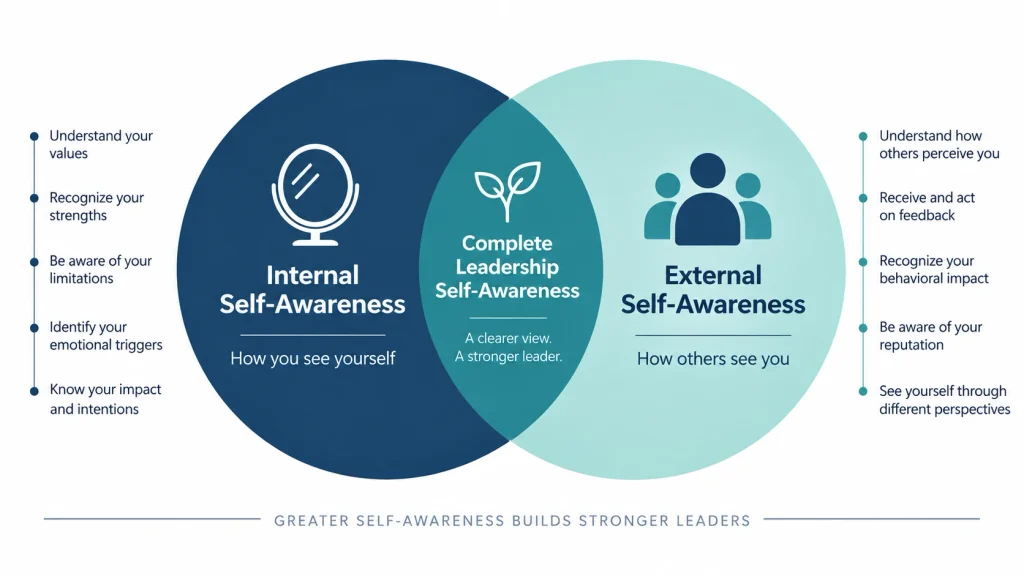
Internal Self-Awareness
Internal self-awareness is how clearly a leader sees their own values, emotions, and motivations. It includes recognizing what drives a decision. It also includes noticing what triggers stress or frustration. Eurich’s research describes this dimension through seven areas of self-knowledge: values, passions, aspirations, fit, patterns, reactions, and impact.
A leader with strong internal self-awareness can explain why they made a decision, not only what the decision was. They notice an emotional reaction before it shapes their behavior. This awareness gives leaders a stable foundation. Without it, leaders tend to react to situations instead of responding to them deliberately.
External Self-Awareness
External self-awareness is how accurately a leader understands the way others perceive them. A leader might believe they are approachable. Their team, meanwhile, might experience them as intimidating. This gap between self-perception and others’ perception is common. It tends to grow wider as a leader gains authority.
External self-awareness depends on one input many leaders slowly lose access to: honest feedback. Leaders who actively seek candid input from colleagues, direct reports, and peers tend to close this gap over time. Leaders who avoid feedback, whether intentionally or not, tend to widen it.
Why Self-Awareness Matters for Leaders
Self-awareness matters because it shapes the accuracy of a leader’s decisions. It also shapes the strength of their relationships. Over time, it shapes the performance of their organization. Leaders who see themselves clearly interpret feedback more accurately. They adjust their behavior when something is not working. They also build the kind of trust that keeps teams engaged.
Decision-Making and Judgment
Self-aware leaders identify their own biases before those biases shape a decision. This matters because leadership decisions rarely come from pure logic alone. They come from a mix of experience, emotion, and pattern recognition. A leader who does not recognize their own patterns risks repeating the same mistakes.
Recognizing an emotional reaction, such as frustration during a tense negotiation, gives a leader space to pause. That pause allows a more deliberate choice. Leaders with low internal self-awareness are more likely to mistake a strong emotional reaction for sound judgment. Over time, this produces decisions that feel confident in the moment. Those same decisions often do not hold up under scrutiny.
Trust and Team Relationships
Teams calibrate their trust in a leader partly by watching whether the leader’s self-image matches reality. When a leader claims a strength they do not actually have, employees notice the gap quickly. They often notice it even when they never say so directly.
Self-aware leaders are more willing to acknowledge a mistake. They credit a team member’s contribution accurately, and they ask for help in areas where they are weak. These behaviors signal honesty, and honesty is a core input to trust. A leader who can name their own weaknesses without becoming defensive makes it safer for the team to speak up. This helps concerns surface before they become serious problems.
Organizational and Financial Performance
The connection between self-awareness and performance extends beyond any single leader. The Korn Ferry Institute analyzed 6,977 self-assessments from professionals at 486 publicly traded companies. The analysis compared each person’s self-rated strengths against how their coworkers rated the same skills.
The analysis found a clear pattern. Professionals at weaker-performing companies had roughly 20 percent more of these self-perception gaps. This was compared with professionals at financially stronger companies. This does not prove that self-awareness alone drives financial results. It does suggest that inflated self-perception across a leadership team tends to appear alongside weaker organizational performance.
This finding gives self-awareness a business case that goes beyond individual development. It is also worth weighing in succession planning. Leaders who cannot see their own gaps are less likely to close them. Those gaps eventually affect the people they manage.
Self-Awareness and Emotional Intelligence
Self-awareness is not the same as emotional intelligence. It is, however, the foundation on which emotional intelligence is built. Psychologist Daniel Goleman’s widely used model breaks emotional intelligence into five components: self-awareness, self-regulation, motivation, empathy, and social skills.
Self-awareness comes first in this model for a simple reason. A leader cannot regulate an emotion they do not recognize. A leader also cannot read another person’s emotional state accurately if they cannot first read their own. This is why self-awareness functions as the entry point into the broader emotional intelligence in leadership framework. It is not a separate, competing skill.
| Aspect | Self-Awareness | Emotional Intelligence |
| Definition | Understanding your own emotions, values, and impact on others | The broader ability to recognize, manage, and respond to emotions in yourself and others |
| Scope | One specific competency | A set of five interconnected competencies |
| Role | The foundation competency | Self-awareness enables the other four components |
| Leadership example | Recognizing that criticism makes you feel defensive | Managing that defensiveness and responding constructively |
How to Recognize a Self-Aware Leader
Self-aware leaders share a set of observable behaviors that separate them from leaders who only believe they are self-aware. These habits show up in everyday moments, not just during a crisis.
For instance, these leaders ask for feedback before giving it to others. When mistakes happen, they own them specifically rather than offering a vague apology. They also distinguish their intent from their actual impact, treating any gap between the two as useful data rather than a personal insult. Instead of relying on a single default approach, they adjust their communication style to fit the listener. Most notably, they describe their own weaknesses with the same accuracy they use for their strengths.
A simple habit connects all of these actions. A self-aware leader treats self-perception as a hypothesis rather than a fact. They assume their own view might be incomplete, so they actively test it against outside input. In contrast, a leader without this habit treats their self-image as settled, which blocks the exact feedback needed to fix it.
Fortunately, these behaviors are completely learnable. They are not fixed traits that a leader either has or lacks permanently. Anyone can build them deliberately through practice, repetition, and honest feedback over time.
Why Leaders Lose Self-Awareness as They Rise
Self-awareness in leadership tends to erode with seniority. This is not because senior leaders are less capable of introspection. It happens because they receive less honest feedback. Their own track record of success can also reinforce an inflated sense of accuracy about their self-perception.
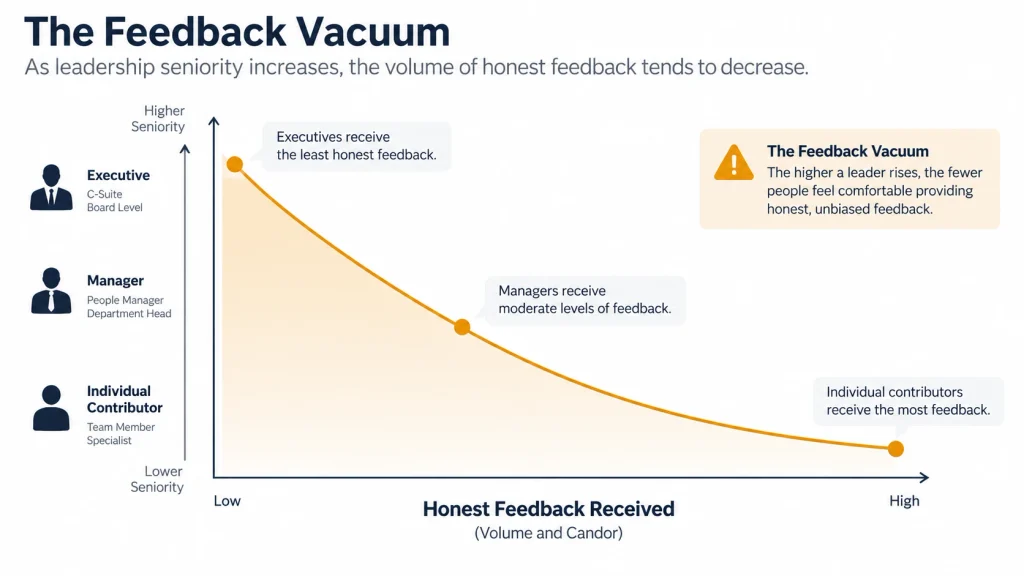
The Feedback Vacuum
As positional authority increases, the people around a leader often become less willing to volunteer criticism. Raising a concern with someone who controls your evaluation carries real risk. The same is true for someone who controls your budget or your next promotion. Positive feedback feels socially safer to give than negative feedback. It tends to flow upward more freely.
A leader who does not actively counteract this pattern can mistake silence for agreement. Over time, this creates a widening gap the leader cannot see. The people best positioned to point it out often have the most reason to stay quiet.
Common Leadership Blind Spots
Certain patterns show up repeatedly in leaders with low external self-awareness. Recognizing these patterns is often the first step toward fixing them.
Leaders often speak longer in meetings than they realize. This reduces how much input the rest of the team can give. Some leaders use their good intentions as an excuse for their actual impact. They assume good intentions wipe out harmful behavior. Others rely on strengths that helped them early in their careers. They fail to update those strengths when their roles change. A common pattern also appears in how leaders explain results. They credit their own skill for success, but blame outside factors for setbacks.
The same mechanism strengthens each of these patterns. A behavior that once worked well gets marked as a strength. The leader keeps repeating it without checking if the situation has changed. Early in a career, having the most answers builds a reputation for skill. In a senior role, that same habit shuts out the team’s thinking. It slows decisions down instead of speeding them up.
Consequences of Low Self-Awareness
Unaddressed leadership blind spots get worse over time. Decisions get made on wrong information because the leader’s view no longer matches reality. Talented employees may check out rather than keep raising concerns that seem to go nowhere. Great technical skills cannot save a leader from failing if they ignore one main root cause. That cause is an unaddressed gap between how a leader sees themselves and how their team experiences them. This pattern is commonly described as leadership blind spots. Fixing this gap directly, rather than treating each symptom separately, tends to solve several of these problems at once.
How to Build Self-Awareness as a Leader
Leaders build self-awareness through structured feedback, deliberate reflection, and tracked outcomes. No single method is sufficient on its own. Internal and external self-awareness require different inputs. Reflection strengthens internal self-awareness, while feedback strengthens external self-awareness. A leader who wants a complete picture needs both.
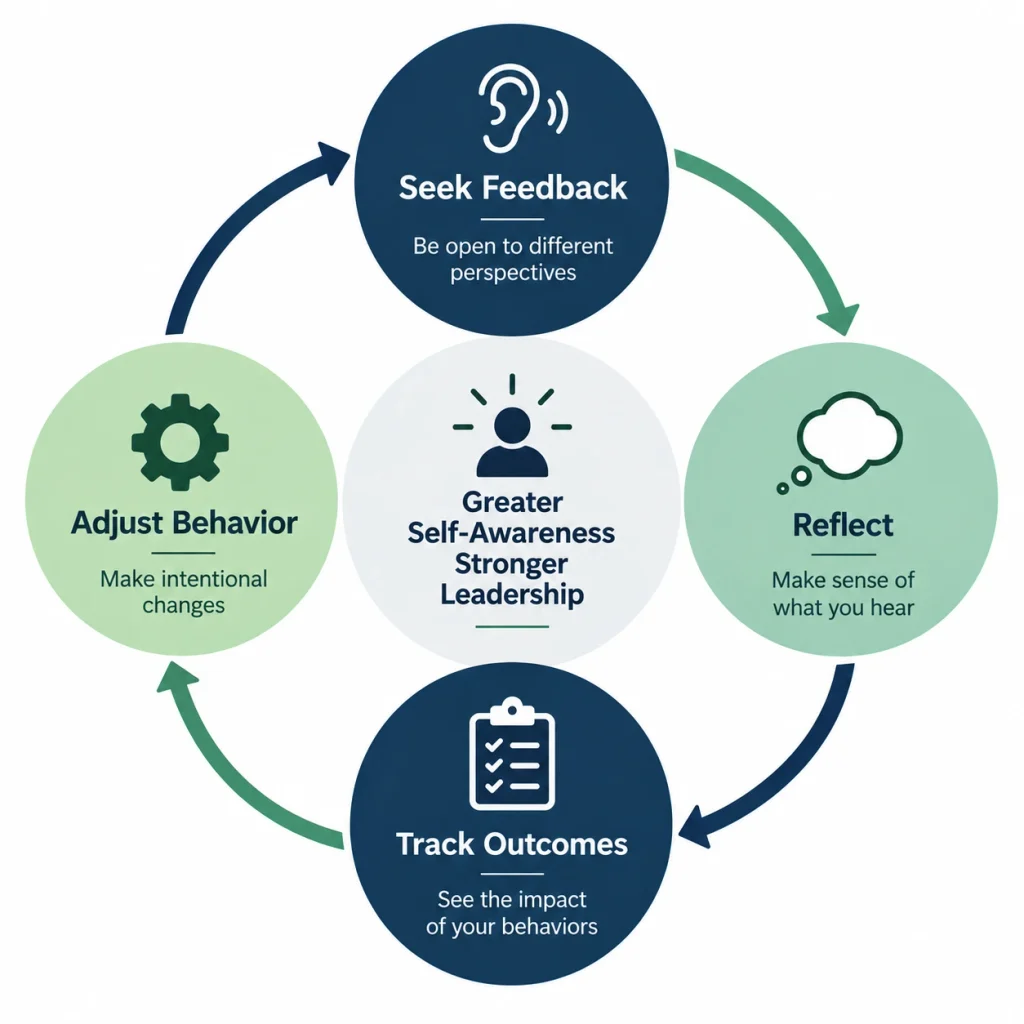
Seek Structured Feedback
Formal 360-degree feedback processes compare a leader’s self-ratings against ratings from others. This includes input from their manager, peers, and direct reports. This structure matters because it surfaces a specific kind of gap. It is the same gap the Korn Ferry analysis measured. That gap is the difference between how a leader sees a skill and how others actually experience it. Repeating this process periodically, rather than once, lets a leader track whether gaps are actually closing.
The value of a 360-degree process depends on how the results get used. A leader who receives the report but never discusses it gains little. A leader who follows up with a small number of raters gets far more from the same data. Asking a clarifying question and sharing planned changes both add real value.
Practice Deliberate Self-Reflection
Reflection is most useful when it focuses on specific, observable events. Open-ended self-analysis tends to produce less insight. Research on this topic has found that asking why an outcome happened often triggers rationalization. People default to explanations that protect their self-image.
Asking what happened, and what could change next time, works better. It tends to produce more accurate self-understanding. This small shift in wording keeps reflection focused on behavior a leader can actually change.
Find a Candid Feedback Partner
A single trusted colleague can reveal patterns a formal survey misses. This works best when the leader chooses the relationship deliberately. Asking specific questions works better than a general request for feedback. A useful question asks what one behavior helps the team most, and what one behavior gets in the way.
This kind of relationship works differently from a formal review. It relies on ongoing, low-stakes conversation rather than an annual report. This makes it easier to catch a pattern while it is still small. A leader who checks in every few weeks hears about problems sooner than one who checks in once a year. Problems caught early are almost always easier to correct.
Use Behavioral and Psychometric Assessments
Structured assessments give leaders a consistent baseline for comparison. This includes emotional intelligence inventories and personality-based tools. Common categories include instruments such as the EQ-i 2.0, alongside broader behavioral assessments used in leadership development programs. These tools work best as a starting point for conversation. They are not a final verdict on a leader’s character or potential. A score on any single assessment is one data point among several, not a complete picture.
Track Decisions Against Outcomes
Before an important decision, a leader can write down what they expect to happen and why. Months later, they can compare the actual outcome against that expectation. This reveals where their judgment was accurate and where it was not. This method turns everyday decisions into an ongoing self-awareness practice.
Over time, this record often reveals a pattern rather than a single mistake. A leader might consistently underestimate how long a project will take. They might also consistently overestimate how ready a team is for a new responsibility. Once a pattern becomes visible in writing, it is far easier to correct.
The Limits of Self-Awareness: Avoiding Overanalysis
Self-awareness has a point where it stops helping. Excessive introspection can turn into rumination. A leader may analyze a decision so many times that they lose the confidence to act on it. The goal of self-awareness is accurate self-understanding that leads to better action. It is not constant self-monitoring that delays action.
This risk is sometimes called the double-edged sword of self-awareness. A leader who over-analyzes every interaction may become hesitant. They may second-guess decisions that were reasonable the first time. This is different from genuine self-awareness, which is meant to inform action, not replace it.
A few guardrails help leaders avoid this trap. Time-boxing reflection, for example limiting post-decision analysis to a fixed window, prevents rumination from spreading. Pairing each reflection with one concrete next step keeps the practice action-oriented. Leaders also benefit from distinguishing ordinary reflection from repetitive worry. The second rarely produces new insight.
Self-Awareness Under Pressure and Uncertainty
Self-awareness becomes most valuable during high-stress situations, not routine ones. Under pressure, the brain’s threat response can override deliberate thinking. This can push a leader toward reactive decisions that favor short-term relief over long-term outcomes.
A self-aware leader notices the physical signs of this threat response as they happen. A faster heartbeat is one example. A sudden urge to micromanage a task that had been running fine is another. Recognizing these signs early gives a leader a brief but important window. That window creates space to pause before reacting.
This pause matters because a team often takes its emotional cue from its leader. A leader who stays grounded during a crisis signals that it is safe to keep thinking clearly. A leader who reacts impulsively tends to transmit that same urgency downward. This usually makes the situation harder to manage, not easier.
Building this kind of self-awareness works best when practiced in advance. It should not be invented in the moment. Leaders who have already identified their stress triggers are better positioned to recognize them quickly. This is one reason the development methods described earlier matter even during calm periods. They build the self-knowledge a leader will need to draw on later.
How Organizations Can Support Leadership Self-Awareness
Individual effort alone cannot close an organization’s self-awareness gap. Culture plays an equal role in determining whether leaders receive honest input.
When a team lacks psychological safety, feedback flows in a predictable pattern. Praise moves upward, and criticism moves downward, so leaders rarely hear the full truth about their own impact. Employees weigh the risk of speaking up before deciding whether it is worth it. A culture that punishes candor, even subtly, teaches people to stay quiet.
Organizations that build self-awareness into their leadership development programs see more consistent results. This works better than treating self-awareness as a fixed trait leaders either have or lack. It includes normalizing structured feedback at every leadership level. Feedback should not be reserved only for new leaders or those already struggling.
Self-awareness also belongs in succession planning conversations. A leader’s ability to accurately assess their own strengths is a meaningful signal. It shows how they are likely to handle the added complexity of a larger role.
FAQ
What are Tasha Eurich’s seven pillars of self-awareness?
Eurich’s research identifies seven areas of self-knowledge that self-aware people understand clearly: values, passions, aspirations, fit, patterns, reactions, and impact. These sit within her broader internal and external self-awareness framework and give leaders a more detailed checklist for reflection.
What is the difference between self-awareness and self-confidence?
Self-awareness is an accurate understanding of your strengths, weaknesses, and impact on others. Self-confidence is belief in your ability to succeed. A leader can be highly confident without being self-aware, which often produces overestimation rather than genuine competence.
What is the Johari Window, and how does it relate to leadership self-awareness?
The Johari Window is a psychological model developed in 1955 that maps self-knowledge into four areas: what is known to both you and others, what only you know, what only others know, and what neither knows. Leaders use it to visualize how feedback and self-disclosure can shrink their blind spots over time.
How is self-awareness assessed during hiring or promotion decisions?
Many leadership assessment processes compare a candidate’s self-ratings against structured interviews, reference checks, or 360-degree data from previous roles. A large gap between self-perception and external input is often treated as a development risk rather than an automatic disqualifier.
Is self-awareness the same as being self-critical or having imposter syndrome?
No. Self-awareness is an accurate view of both strengths and weaknesses, while excessive self-criticism and imposter syndrome distort that view toward the negative. A genuinely self-aware leader can name a real strength as easily as a real weakness.
Conclusion
Self-awareness in leadership is an accurate understanding of your own values, emotions, and impact on others. It has two dimensions, internal and external, and both matter. Self-aware leaders make sharper decisions. They earn deeper trust, and they lead teams that perform more consistently.
This awareness naturally declines as leaders gain seniority. This is not from a lack of effort but from a shrinking supply of honest feedback. Closing that gap takes deliberate work. It requires structured feedback, focused reflection, a candid feedback partner, and a habit of tracking decisions against real outcomes. Self-awareness also has limits. Leaders who turn reflection into rumination lose more than they gain.
Self-awareness is not a fixed trait a leader either has or lacks. It is a practice that improves with honest input and deliberate attention. It also depends on a culture that makes candor safe.
The leaders who benefit most treat this practice as ongoing, not finished. A role, a team, and a set of challenges all keep changing. Self-knowledge that served a leader well in one role does not automatically transfer to the next. Revisiting feedback, reflection, and tracked outcomes keeps self-awareness accurate as circumstances shift. This keeps it from quietly going stale.
Building self-awareness is often where the real work begins, not where it ends. Once a leader has an accurate picture of their strengths and blind spots, a new challenge appears. That challenge is translating insight into changed behavior under real pressure. This is where structured, ongoing support becomes valuable. Structured executive coaching gives leaders a dedicated space to practice new responses. It lets them test those responses against real situations, with continued feedback as their role evolves.