

What Are Leadership Blind Spots?
A leadership blind spot is a gap between how a leader believes they act and how their behavior actually affects others. The leader does not see the gap. Colleagues, direct reports, and peers usually see it clearly. Management consultant Robert Bruce Shaw has studied this topic extensively. He frames a blind spot as a hidden vulnerability the leader has not recognized. It carries real potential to damage both their own standing and the organization they lead.
Blind spots matter because leaders make decisions that ripple outward. A blind spot in an individual contributor mostly affects that person’s own work. A blind spot in a leader can shape an entire team’s morale, trust, and output. The higher someone rises, the wider the reach of an unseen gap.
A blind spot is not simple ignorance. It is not a subject a leader has never studied. It is a behavioral pattern the leader cannot see in themselves, even though the pattern is visible, and sometimes obvious, to everyone around them.
Blind spots exist partly because true self-awareness is rare. Organizational psychologist Tasha Eurich studied this question across nearly a decade of research and thousands of participants. The large majority, about 95 percent, considered themselves self-aware. Her findings put the real figure far lower, at an estimated 10 to 15 percent. That gap between perceived and actual self-awareness is where most leadership blind spots live.
Why Leaders Develop Blind Spots
Blind spots are not a sign of poor character. They are a predictable result of how perception, feedback, and power interact.
The Psychology Behind Blind Spots
Everyone has a natural gap between self-perception and how others experience them. Psychologists call one part of this pattern the bias blind spot. People readily notice bias, error, or overconfidence in others. They struggle to notice the same patterns in themselves. Research on this effect studied hundreds of participants. Almost no one rated themselves as more biased than average, even though bias by definition cannot be rare.
Confirmation bias adds to the problem. Leaders, like anyone, tend to notice information that supports what they already believe and overlook information that contradicts it. Over time, this filtering can harden into a fixed self-image that resists new evidence, even strong evidence from trusted colleagues.
Cognitive load plays a supporting role as well. Leaders juggle many decisions in a single day, and the brain relies on shortcuts to manage that volume. These shortcuts are efficient. But they also make it easier to overlook subtle signals, such as a hesitant tone in a meeting or a delayed response to a request. Those signals might otherwise reveal a developing blind spot.
How Positional Power Reduces Honest Feedback
Authority changes how people communicate with a leader. Direct reports often soften criticism, delay bad news, or avoid raising concerns altogether. This is not dishonesty. It is a natural response to a power difference. Research on organizational communication has repeatedly found that people calibrate what they say based on the perceived cost of speaking candidly to someone with authority over their role.
The result is a feedback vacuum. Leaders receive less unfiltered information as they rise, at the exact moment their decisions carry more weight. Without deliberate effort, this vacuum lets blind spots grow undisturbed for years. Ordinary daily interactions that might otherwise surface a problem get quietly filtered before they ever reach the leader.
This dynamic also explains why blind spots can be unusually persistent among leaders who are personally well liked. Warmth and approachability do not guarantee honest feedback. A team can genuinely like a leader while still withholding the specific, difficult observations that would help that leader see a blind spot clearly.
Leadership Blind Spot vs Weakness: What Is the Difference?
A weakness is usually something a leader already knows about. A leader might know they are disorganized, or that public speaking makes them nervous. Because the leader is aware of it, they can choose to manage it, delegate around it, or work to improve it.
A blind spot is different because awareness is missing entirely. The leader believes they are organized, approachable, or a good listener, while the people around them experience something else. This difference in awareness is what makes blind spots harder to address than ordinary weaknesses.
| Factor | Known Weakness | Leadership Blind Spot |
| Leader’s awareness | Aware of the issue | Unaware of the issue |
| Primary source of insight | Self-assessment | Feedback from others |
| Typical response | Manage or improve deliberately | Often denied or minimized at first |
| Risk if unaddressed | Predictable, manageable | Unpredictable, can escalate quietly |
This distinction matters for emotional intelligence development, because building self-awareness requires different tools than building a known skill. A leader can study public speaking to fix a known weakness. A blind spot requires external input before improvement can even begin.
Common Types of Leadership Blind Spots
Research and coaching practice point to several blind spots that appear across industries and leadership levels. No leader has all of them, and the exact mix varies by person, but these patterns recur often enough to be worth checking against.
The Approachability Gap
Many leaders believe they are more approachable than their team experiences them to be. An open door policy and a stated willingness to hear bad news do not always translate into behavior. Subtle signals, such as visible impatience, a packed calendar, or a sharp reaction to unwelcome news, teach people to filter what they bring forward.
Over time, problems get solved elsewhere, hidden, or escalated only when they can no longer be avoided. The leader believes they are informed. They are actually working from a filtered, incomplete picture.
Overconfidence and the Bias Blind Spot
Confidence is useful in leadership, but overconfidence can cross into a blind spot when a leader stops questioning their own judgment. This often pairs with the bias blind spot described earlier: the leader can spot flawed thinking in others while missing the same pattern in their own decisions.
Zenger and Folkman tested this directly using 360-degree feedback data covering 69,000 managers, rated by 750,000 colleagues. Leaders who rated their own competence higher than their colleagues did were consistently the least effective group in the data. Leaders who rated themselves lower than their colleagues did, somewhat surprisingly, were rated as the most effective. The researchers linked this pattern to humility and a continual drive to improve. The lesson is not that modesty should be faked. It is that overrating yourself specifically, more than inaccurate self-perception in general, is the pattern most closely tied to poor leadership outcomes.
Micromanagement Disguised as Diligence
A leader who closely checks every task often believes they are being thorough and protecting quality. Their team frequently experiences it differently, as a signal that their judgment is not trusted. This blind spot is especially common among leaders who were promoted for strong individual performance rather than for developing others.
The behavior can quietly stifle initiative. Team members stop proposing ideas because they expect heavy revision or override regardless of the idea’s merit.
Conflict Avoidance
Some leaders come to care more about winning an argument, or avoiding an uncomfortable moment, than about reaching the best outcome for the team. This pattern has a predictable result. Once employees sense that raising a hard issue will not change anything, they simply stop raising it.
This creates a form of psychological safety erosion. Teams learn that certain topics are off limits, even when those topics matter most to performance and risk.
Poor Listening and Conversation Dominance
Many leaders talk longer in meetings than they realize. Strong convictions, deep subject knowledge, and the pressure to demonstrate expertise can lead a leader to fill most of the available airtime without noticing.
Zenger and Folkman’s widely cited study “What Great Listeners Actually Do,” built on data from thousands of program participants, found something surprising. The skills people typically associate with good listening, such as staying quiet and nodding, fall short of what effective listening actually requires. The strongest listeners ask questions that promote discovery and insight, gently challenging assumptions rather than simply confirming what was said. This is a far less common behavior than leaders assume they display.
Failure to Develop Others
Zenger and Folkman’s original 2009 research identified ten common derailing behaviors. Failing to develop other people stands out as one of the most damaging to long-term team performance. A leader may focus heavily on personal output and results while giving little structured attention to coaching, delegation, or succession planning for their team.
This blind spot is easy to miss because the leader’s own performance often looks strong. The cost shows up later, in weaker bench strength and higher turnover among capable employees who feel undeveloped.
Underestimating Inclusion and Diverse Perspectives
Most leaders believe they treat people fairly regardless of background, style, or perspective. Zenger and Folkman gathered 360-degree assessments from 1,825 senior leaders on how well they valued diversity and inclusion. Roughly half of leaders seriously underestimated or overestimated their own performance in this area, compared with how their colleagues actually rated them.
This blind spot often surfaces as a leader who believes they welcome dissenting views, while their team has quietly learned that only certain viewpoints get real consideration. Because the leader’s intentions are usually genuine, the gap can persist for years without anyone naming it directly.
How Unaddressed Blind Spots Affect Teams and Organizations
Blind spots do not stay contained to one individual. The Center for Creative Leadership studied 491 executives and their 360-degree assessment data. The study found that blind spot patterns correlate with measurable outcomes, including the performance of the leader’s own division.
Unaddressed blind spots tend to produce a consistent pattern of organizational effects. Trust declines as people notice a mismatch between what a leader says and how the leader actually behaves. Decision quality suffers when leaders operate on filtered or incomplete information. Employee engagement drops as team members disengage from raising ideas or concerns that seem unlikely to be heard.
One analysis of derailing leadership behavior put a number on this. A single mid-level leader’s unmanaged patterns, once turnover, absenteeism, legal exposure, and lost productivity are included, can cost an organization close to nine times that leader’s annual compensation. Multipliers like this vary across studies and industries. But the direction of the finding is consistent: the cost of an unmanaged blind spot compounds well beyond the individual leader.
The impact also tends to spread beyond the leader’s own team. Peers in other departments often adjust how they collaborate with a leader once a blind spot becomes a known pattern. They route information around the leader or avoid joint projects where the pattern is likely to cause friction. Over time, this quiet workaround behavior can isolate a leader from the cross functional input that would help them see the problem.
How to Identify Your Leadership Blind Spots
Because blind spots are by definition invisible to the person who has them, identification requires structured methods rather than self-reflection alone.
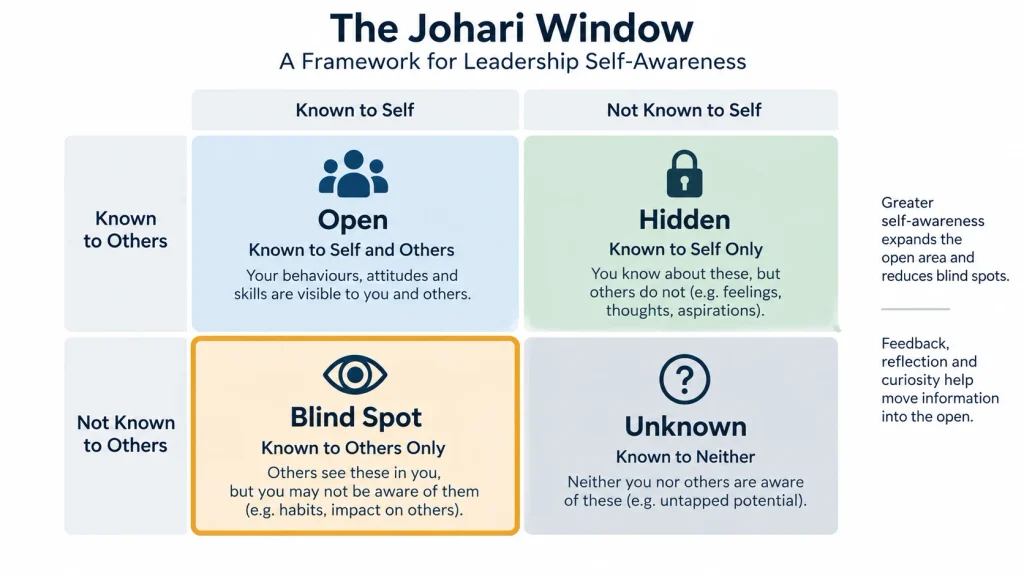
Use the Johari Window to Map Self-Perception.
Psychologists Joseph Luft and Harrington Ingham developed the Johari Window in 1955. It organizes self-knowledge into four categories. These are traits known to both the leader and others, traits known only to the leader, traits known only to others, and traits unknown to everyone. The “known to others, unknown to self” quadrant is where leadership blind spots sit.
The Center for Creative Leadership’s research validated this framework against real 360-degree assessment data from senior executives, confirming that the model accurately reflects how feedback naturally clusters. The practical value of the Johari Window is that it gives leaders a simple way to organize feedback rather than treating each comment as an isolated data point.
Gather Structured 360-Degree Feedback
A 360-degree feedback process collects input from people above, below, and alongside a leader, rather than relying on a single perspective. This structure matters because different groups often see different blind spots. A direct report may notice micromanagement that a peer never observes, while a peer may notice conflict avoidance in cross functional settings that a direct report never sees.
Structured, anonymous collection tends to surface more honest input than informal conversation, particularly for leaders who hold significant authority over the people giving feedback. Written, anonymous formats also reduce the social pressure that leads people to soften their answers in a face to face setting. This is part of why formal 360 processes tend to surface issues that everyday conversation misses.
The value of a 360 process depends heavily on what happens afterward. A report that gets read once and filed away provides little benefit. A report that becomes the basis for a specific, time bound development plan, reviewed again after a set period, is far more likely to produce lasting change.
Watch for Behavioral Patterns, Not Just Comments
Feedback is not the only signal. Patterns in team behavior often reveal blind spots before anyone states them directly. Rising turnover on a specific team, meetings where only one or two people speak, or silence around certain topics can all point toward an underlying blind spot. None of these signals require a single formal complaint to be meaningful.
Exit interviews deserve particular attention here. Departing employees often share observations they were unwilling to raise while still on the team, since the professional risk of candor has largely disappeared. A pattern that surfaces across multiple exit interviews, even when no single comment seems alarming on its own, is usually worth investigating directly.
How to Address and Reduce Leadership Blind Spots
Reducing a blind spot starts with treating feedback as data rather than as a personal verdict. Leaders who react defensively to feedback tend to shut down the very channel that revealed the blind spot in the first place.
Ask for specific, behavioral feedback rather than general impressions. A question such as “what is one thing I do that gets in the way of the team’s success” tends to produce more actionable answers than a broad request to “share any feedback.” Choosing one or two trusted colleagues for this kind of direct conversation often works better than polling an entire organization at once. A smaller, focused conversation tends to produce more candid and useful input.
Deliberately seek out dissenting views before major decisions. Since confirmation bias pulls attention toward supportive information, leaders benefit from assigning someone the explicit role of raising counterarguments, rather than hoping disagreement will surface naturally.
Close the loop after receiving feedback. Leaders who visibly act on feedback, even in small, specific ways, signal that raising concerns is safe and worthwhile. This visible follow-through does more to build a durable feedback culture than any single feedback collection exercise.
Treat blind spot reduction as ongoing rather than a one-time fix. A blind spot addressed once can resurface under stress, during a promotion, or after a long period without honest input. Periodic recalibration, not a single assessment, keeps the gap from reopening.
Why Blind Spots Grow With Seniority
Blind spots tend to intensify as leaders rise, and the mechanism behind this pattern is worth understanding on its own. Research from Merryck & Co. and the Barrett Values Centre tracked this gap directly, comparing self-assessments from 500 leaders against feedback from 10,000 of their peers, gathered over 15 years. In 80 percent of cases, none of the top three improvement areas a leader named for themselves matched the areas their colleagues named. Only 1 percent of leaders had a complete match between their own view and their colleagues’ view. Senior leaders were often confident about the accuracy of their own self-assessment, even though it diverged sharply from how their colleagues actually experienced them.
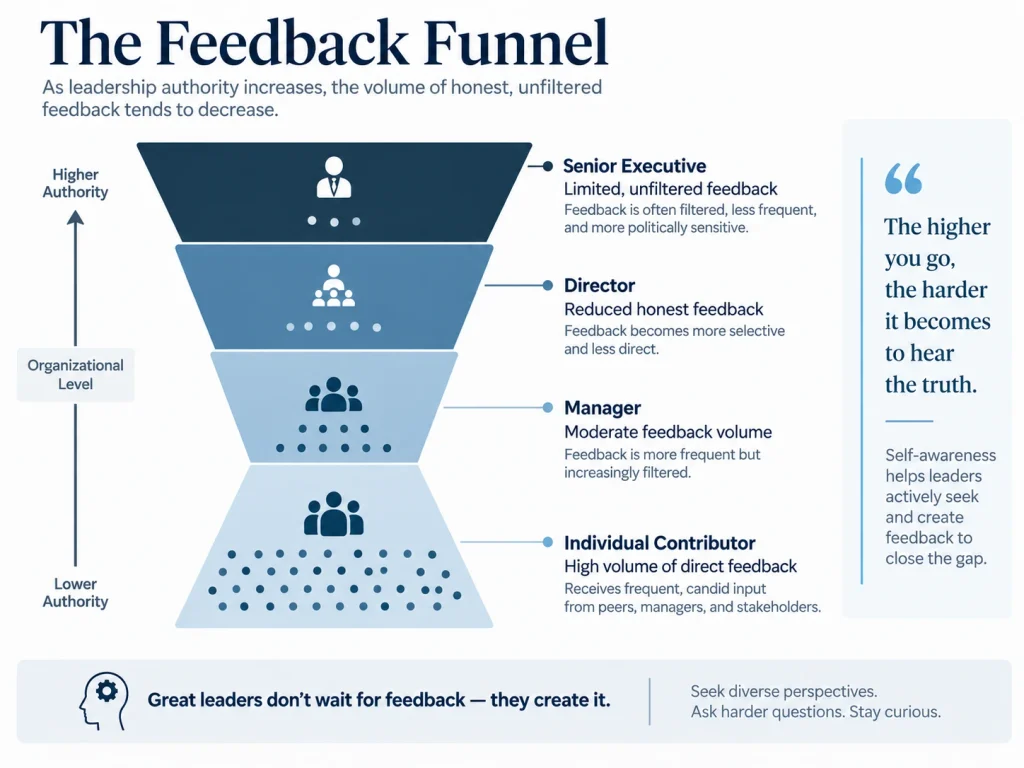
Several forces drive this widening gap. As authority increases, more people have a professional incentive to soften criticism before it reaches the leader. Fewer people above the leader remain positioned to offer candid, unfiltered feedback, since there are simply fewer peers at the top of an organization. Long tenure in a senior role can also entrench habits and assumptions that once worked well but no longer fit a changed environment.
Some researchers who study leadership derailment, including psychologist Robert Hogan, have offered estimates on how common this problem is. Hogan’s estimates suggest a substantial share of leaders, potentially a majority by some measures, carry some form of flawed or derailing pattern that limits their effectiveness. Estimates like this vary considerably depending on how researchers define derailment. They are best read as evidence of scale rather than as a precise figure. The consistent theme across this research is that seniority does not shrink blind spots. Left unmanaged, it tends to enlarge them.
Common Mistakes Leaders Make When Addressing Blind Spots
Leaders working to close blind spots often fall into a few predictable traps. Treating a single 360-degree assessment as a permanent, closed chapter is one common mistake, since behavior and context both change over time.
Asking only direct reports for feedback is another common gap. Direct reports face the strongest power imbalance and may still filter their answers, even in an anonymous process. Peer and upward feedback often surface different, equally important blind spots.
Reacting defensively to difficult feedback is perhaps the most damaging mistake, because it discourages the very people whose honesty made the feedback possible. A defensive reaction, even a subtle one, teaches colleagues that future candor carries a cost.
Finally, some leaders try to fix a blind spot alone, without any outside structure or accountability. A blind spot is, by definition, something the leader cannot fully see. Sustainable change usually requires an external perspective, whether from a trusted colleague, a manager, or a coach, to check progress over time.
A related mistake is announcing a blind spot publicly and treating the announcement itself as the fix. Telling a team “I know I talk too much in meetings” can feel like progress, but it does not change the underlying behavior. Teams tend to trust demonstrated changes in behavior far more than verbal acknowledgment, and a gap between the two can actually deepen skepticism rather than rebuild it.
Frequently Asked Questions
What are the four domains of leadership blind spots?
Consultant Robert Bruce Shaw’s research groups blind spots into four domains: blind spots about oneself, about one’s team, about the company, and about the external market. A leader can be well aware of their personal habits while still missing critical information in one of the other three domains.
Can a leadership blind spot ever be fully eliminated?
Not permanently, and there is a specific reason why. The bias blind spot, the tendency to spot flawed thinking in others but not in oneself, is a built-in feature of human cognition rather than a habit that can be unlearned once. A promotion, a new team, or a stretch of high stress can also reset what a leader notices about their own behavior, which is why new blind spots can appear even in leaders who have already closed earlier ones.
Is a blind spot the same thing as an unconscious bias?
They overlap but are not identical. An unconscious bias is one specific cause of a blind spot, involving a skewed judgment the person does not notice. A blind spot is the broader behavioral pattern that results, which can also stem from habit, positional power, or incomplete feedback rather than bias alone.
How many blind spots does the average leader have, according to research?
There is no single agreed number, since blind spots vary by person and by role. Zenger and Folkman’s analysis of 360-degree feedback data found that close to 30 percent of leaders had at least one significant flaw they were unaware of, which suggests at least one blind spot is common rather than rare.
What is the fastest way for a new manager to uncover blind spots?
Timing matters more than technique for someone brand new to a role. Asking within the first 60 to 90 days tends to work best, since a fresh working relationship makes candor easier and any pattern identified is still simple to adjust before it hardens into a habit. If a predecessor’s former peers are reachable, they can also point out patterns the new manager cannot yet see in themselves.
How should a peer or direct report raise a leader’s blind spot without damaging trust?
Frame the feedback around specific behavior and its observed impact, rather than around character or intent. Choosing a private setting, focusing on one clear example, and offering the feedback as useful information rather than criticism tends to keep the conversation constructive.
Conclusion
Leadership blind spots form naturally from the gap between self-perception and feedback, widened by cognitive biases and by the filtering effect of authority. They differ from ordinary weaknesses because the leader cannot see them without outside input. Common patterns, including approachability gaps, overconfidence, micromanagement, conflict avoidance, weak listening, and underdeveloped teams, appear across industries and leadership levels.
The organizations that manage this challenge best treat blind spot reduction as a continuous practice, not a single event. They build structured ways to gather honest feedback, they act visibly on what they learn, and they recognize that seniority makes this work more necessary, not less. A leader who commits to seeing themselves more clearly protects both their own effectiveness and the trust of everyone who depends on their judgment.
Closing a blind spot rarely happens through willpower alone. Once a leader has surfaced a pattern through feedback or a structured assessment, the next challenge is building a sustained process to work through it. Executive coaching provides that structure, pairing an outside perspective with ongoing accountability so that new awareness actually translates into changed behavior over time.