
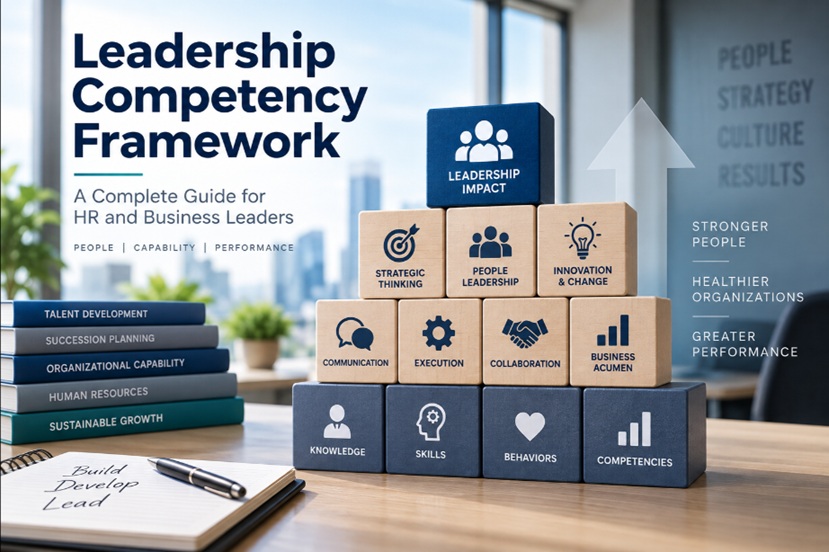
A leadership competency framework is a structured model. It defines the specific behaviors, skills, and knowledge effective leaders need at each level. It turns the abstract idea of good leadership into observable, measurable standards. Organizations use the framework to guide hiring, performance reviews, succession planning, and leadership development. It creates a shared language for what effective leadership looks like in practice. It replaces vague expectations with clear, testable criteria.
What Is a Leadership Competency Framework?
A leadership competency framework is a defined set of behaviors, skills, and attributes. Together, they describe effective leadership at different levels of an organization. Each competency breaks down into specific, observable actions.
It does not rely on broad personality traits. This makes the framework practical for hiring, coaching, and performance evaluation. It is not just theoretical discussion.
The framework is not a list of job duties. A job description explains what a role does. A leadership competency framework explains how a leader should approach that role. This includes the judgment, communication style, and decision-making behavior expected of them.
Two leaders can share the same title. They can still have very different day-to-day duties depending on their department. Even so, both can be measured against the same core leadership competencies.
Most frameworks organize competencies into a small number of categories. A common structure groups them as leading self, leading others, and leading the organization. Leading self covers personal effectiveness, integrity, and self-management. Leading others covers communication, coaching, and team building. Leading the organization covers strategic thinking, change leadership, and business acumen.
This structure keeps a framework usable. Without it, a framework can turn into an unfocused list of admirable qualities.
A well-built framework also serves as a diagnostic tool. It helps an organization see exactly where its current leaders are strong. It also shows where they fall short. That clarity is difficult to achieve through informal impressions alone.
Leadership Competencies vs Leadership Skills
People often use “skill” and “competency” as if they mean the same thing. They do not. A skill is a narrow, learnable ability, such as public speaking or financial analysis. A competency is a broader combination of skills, knowledge, and behaviors. It shows up consistently across many different situations.
Skills can often be taught relatively quickly, sometimes in a single training session. Competencies develop over time through experience, feedback, and repeated practice. A leader can attend a class on active listening, and that specific skill can improve quickly.
Building the broader competency of relationship management takes longer. It also requires judgment, self-awareness, and consistency under pressure.
| Dimension | Leadership Skill | Leadership Competency |
| Scope | Narrow and specific | Broad and integrated |
| Made up of | One capability | Multiple skills, knowledge, and behaviors |
| Timeframe to develop | Weeks to months | Months to years |
| Example | Active listening | People leadership |
| Assessed by | Direct demonstration | Behavioral patterns over time |
This distinction matters for framework design. A framework built from a list of isolated skills tends to feel like a training catalog. A framework built around true competencies gives leaders something more useful. It shows a clearer picture of what sustained effectiveness actually requires.
Why Organizations Use a Leadership Competency Framework
Organizations invest in a leadership competency framework for a practical reason. Inconsistent leadership standards create real business risk. Without shared criteria, one manager might promote based on tenure, while another promotes based purely on results. Neither approach reliably predicts leadership effectiveness on its own.
DDI’s 2023 Global Leadership Forecast surveyed more than 13,000 leaders. It also surveyed roughly 1,800 HR professionals worldwide. The research found that only 12 percent of organizations felt confident in their leadership bench strength.
The same research found that only 40 percent of leaders rated their organization’s leadership quality as high. That figure marked a 17 percent drop in two years, the steepest decline the study had recorded in a decade. These findings point to a structural problem, not simply a series of isolated bad hires.
The same research offers a clear reason to act. Companies with strong leadership benches saw measurable advantages. They were six times more likely to engage and retain top talent. They were five times more likely to prevent employee burnout.
They were also three times more likely to rank among the top financial performers in their industry. Leaders at these companies rated their company’s overall leadership quality far more highly. Their ratings were ten times higher than ratings given by leaders at companies with weak benches.
A leadership competency framework does not fix these problems on its own. It does give organizations a defined target. Hiring, coaching, and promotion decisions can then be built around that target. This replaces guesswork and instinct with a consistent standard.
This structure directly supports succession planning. It defines exactly which behaviors a future leader must demonstrate. Those behaviors must be in place before someone steps into a critical role.
The framework also gives leadership development programs a clear foundation. Training can be designed around specific, named gaps. It no longer needs to rely on generic leadership themes that may not fit.
Core Components of a Leadership Competency Framework
A working leadership competency framework is built from four connected parts. Each part depends on the one before it. Skipping a part weakens the whole system.
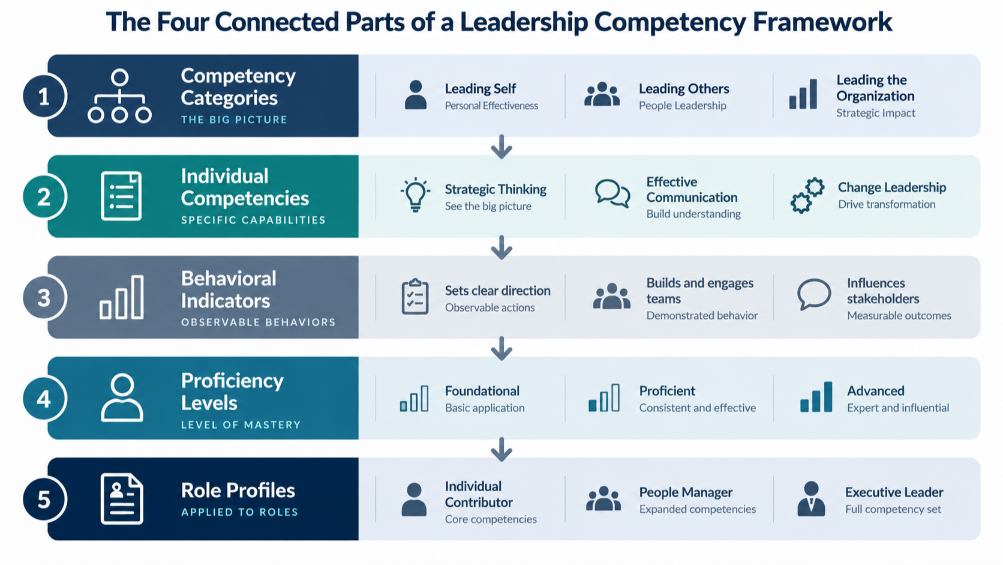
Competency categories. These are thematic groupings, such as strategic thinking, people leadership, and execution. Categories keep a long list of competencies organized. They sort competencies into a small number of manageable clusters. This makes the framework easier to communicate and remember across the organization.
Behavioral indicators. These describe what a competency actually looks like in action. A vague statement like “communicates well” is not useful on its own. A behavioral indicator gives managers something concrete instead. For example: “adjusts the level of technical detail based on the audience’s background.” That kind of statement is specific enough to observe and assess fairly.
Proficiency levels. Most frameworks use three to five levels. These range from foundational to expert. Each level should describe a meaningfully different standard of behavior. It should not just use a different adjective for the same behavior.
A foundational leader may identify problems and escalate them to others. An advanced leader independently resolves complex, cross-functional problems without escalation.
Role profiles. These map which competencies matter most for a given role. They also define the proficiency level expected at that role. A frontline supervisor and a vice president both need decision-making ability. The scope and complexity of their decisions differ sharply, though. Role profiles capture that difference clearly.
| Component | What It Defines | Example |
| Competency category | Broad theme | Leading Others |
| Competency | Specific capability | Coaching and Development |
| Behavioral indicator | Observable action | Gives specific, timely feedback after key moments |
| Proficiency level | Depth of mastery | Foundational, Developing, Proficient, Advanced |
| Role profile | Expected level by role | Directors expected at Advanced level |
Together, these components change how leadership gets discussed. They turn an abstract idea like “good leadership” into something concrete. An organization can measure it, teach it, and reward it directly.
Common Leadership Competencies Found in Most Frameworks
Leadership competency frameworks vary by industry and organization. Despite that variation, a consistent core set of competencies tends to appear. Research across multiple independent frameworks shows this pattern repeatedly.
| Competency | What It Means | Why It Matters |
| Strategic thinking | Seeing the bigger picture and planning for it | Gives direction and long-term focus to daily decisions |
| Emotional intelligence | Recognizing and managing emotions in yourself and others | Builds trust and improves how leaders influence people |
| Decision making | Analyzing information and choosing confidently among options | Keeps teams moving despite uncertainty or incomplete data |
| Communication | Conveying ideas clearly and listening actively | Aligns teams and reduces costly misunderstandings |
| Accountability | Taking ownership of outcomes, good or bad | Builds credibility and models integrity for the team |
| Change leadership | Guiding people through uncertainty and disruption | Reduces resistance and keeps performance stable during change |
| People development | Coaching others toward stronger performance | Builds organizational capacity beyond one leader’s own output |
| Collaboration | Working effectively across teams and functions | Prevents silos and supports cross-functional execution |
Strategic thinking tends to sit near the top of most frameworks. It separates leaders who react to problems from leaders who anticipate them. This competency grows more important at senior levels. Executives must weigh decisions against long-term market and organizational trends.
Emotional intelligence covers self-awareness, self-regulation, empathy, and social skill. A leader with strong emotional intelligence reads a room accurately. They adjust their approach without losing their own composure. This competency underpins many other leadership behaviors, including coaching and conflict resolution.
Decision making and accountability often work as a pair. A leader who decides quickly but never owns the outcome loses credibility fast. A leader who owns outcomes but decides too slowly creates a different kind of drag on the organization. Strong frameworks assess both competencies together, not in isolation.
Change leadership has grown more prominent in recent frameworks. Organizations face more frequent restructuring, technology shifts, and market disruption than in past decades. Leaders who can guide teams through that uncertainty protect performance during periods of stress.
These eight competencies are not exhaustive. Many organizations add role-specific or industry-specific competencies. Examples include safety leadership in manufacturing or clinical judgment in healthcare. The core list above tends to survive across contexts. Each competency addresses a leadership demand that rarely disappears, regardless of industry.
How to Build a Leadership Competency Framework
Building a leadership competency framework is a structured process. It is not a single workshop or a one-time exercise. Skipping steps tends to produce a framework that looks polished. In practice, that framework often gets ignored by the people meant to use it.
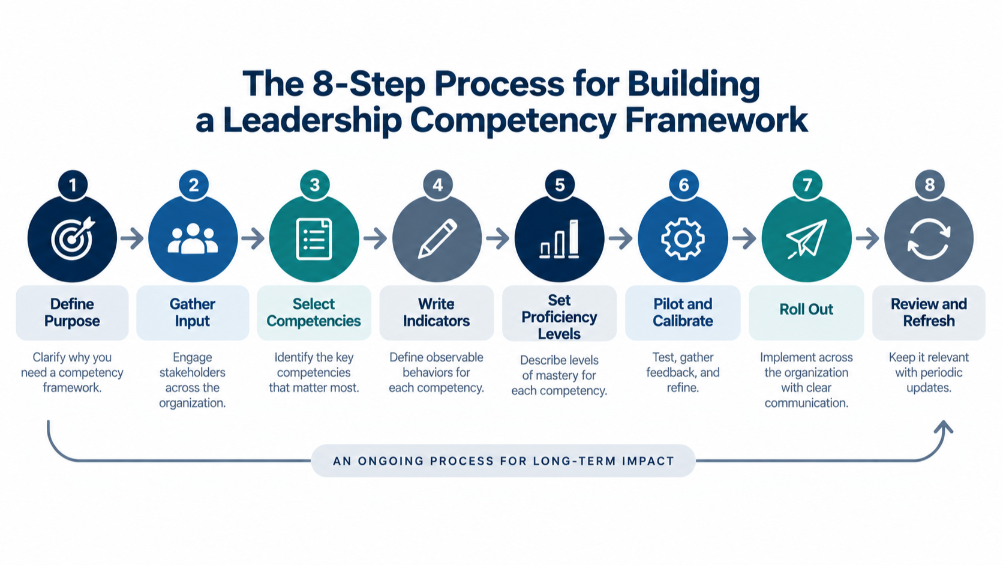
1. Define the business purpose first. Before naming a single competency, clarify why the framework exists. A framework meant to guide succession planning will look different from one meant to standardize performance reviews. Without this step, competency selection has no consistent basis to stand on.
2. Gather input from leaders across the organization. Interview strong performers about how they actually handle hard calls. Ask them about conflict, ambiguity, and high-pressure moments specifically.
Talk to leaders who struggled, too. Their experience often reveals which competencies matter most when they are missing. Use surveys and focus groups to validate what individual interviews reveal.
3. Select a manageable number of core competencies. Most well-used frameworks stay within a range of roughly eight to fifteen competencies. Frameworks with forty or fifty competencies usually run into a common problem. They confuse task-level detail with true leadership competency. That confusion makes the framework too complex to apply consistently.
4. Write behavioral indicators for each competency. For every competency, describe three to five specific, observable behaviors. Do this separately at each proficiency level. Avoid vague language wherever possible. A specific indicator, tied to a real action, is far easier to assess fairly than an abstract quality.
5. Build proficiency levels tied to career stages. Map expected proficiency to role level directly. A director should be expected to show strategic thinking at a more advanced level than a first-time manager. This keeps expectations realistic and fair across very different career stages.
6. Pilot and calibrate before full rollout. Test the framework with a representative group of managers and employees first. Run calibration sessions where different managers discuss the same behavior. This surfaces indicators that are ambiguous or inconsistently understood before the framework goes live everywhere.
7. Roll out with clear communication. Explain what the framework is for. Explain how it will be used, and just as importantly, how it will not be used. Leaders adopt frameworks faster when they understand one thing clearly. The framework is meant to support their development, not only judge their performance.
8. Review and refresh periodically. Business priorities shift over time. A framework built for one strategic period can grow outdated quickly. Revisit the framework on a regular cycle. Update it whenever strategy, structure, or market conditions change in a meaningful way.
Real-World Examples of Leadership Competency Frameworks
Several named leadership competency frameworks are widely referenced in HR practice. Reviewing them shows how the same core structure adapts to different organizational needs.
| Framework | Published By | Structure |
| SHRM Competency Model | Society for Human Resource Management | Behavioral competencies grouped into Leadership, Interpersonal, and Business clusters, plus technical HR knowledge |
| Korn Ferry Leadership Architect | Korn Ferry | A global framework covering 38 behavioral leadership competencies applicable across roles and industries |
| The Leadership Machine | Michael Lombardo and Robert Eichinger | A research-based catalog of 67 leadership competencies, built to cover the broad universe of leadership behavior |
| CalHR Leadership Competency Model | California Department of Human Resources | Competencies including business acumen, inspirational leadership, results orientation, and strategic thinking |
The SHRM Competency Model came from research involving thousands of HR professionals. It organizes behavioral competencies into three clusters. Those clusters sit alongside technical HR knowledge as a separate, fourth element. This structure reflects SHRM’s specific focus on the HR profession itself.
Korn Ferry’s Leadership Architect takes a different approach. It offers a large, standardized competency library organizations can draw from. This means teams do not need to build every competency from scratch. Instead, they select and adapt competencies that fit their specific context.
Lombardo and Eichinger’s Leadership Machine, published in 2001, remains widely cited today. It is one of the most extensively researched competency catalogs available. Its 67 competencies span from foundational qualities like ethics and integrity. They extend to more advanced differentiators like business acumen and decision quality.
These examples show there is no single correct number of competencies. There is no single fixed structure either. What they share is a consistent design logic.
Competencies tie to observable behavior. They organize into manageable categories. They connect to real organizational decisions such as hiring and promotion.
How to Assess Leaders Against the Framework
A framework only has value once it is used to actually evaluate people. Several assessment methods work well together, rather than relying on just one.
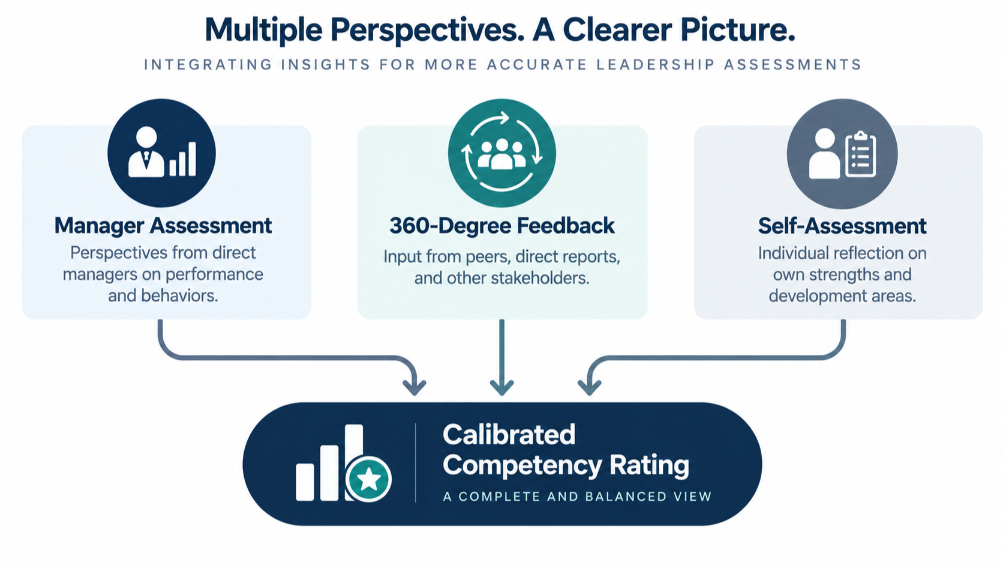
Manager assessment is the most common starting point. A direct manager observes a leader’s behavior over time. They then rate that behavior against the framework’s defined proficiency levels. This method is efficient, but it carries an obvious limitation. It reflects only one person’s perspective on the leader’s behavior.
360-degree feedback addresses that limitation directly. This method gathers input from peers, direct reports, and senior stakeholders. It builds a more complete, multi-angle picture of how a leader actually shows up. Someone’s direct reports often notice coaching behavior their own manager rarely sees firsthand.
Self-assessment adds a third useful perspective. Leaders rate themselves against the same competencies and indicators. Comparing self-ratings against manager and peer ratings often reveals blind spots. A leader might rate their own communication highly. Their team, meanwhile, may rate that same competency quite differently.
Calibration sessions keep ongoing ratings fair once the framework is live. Without them, one manager’s “advanced” can quietly become another manager’s “proficient.” Regular calibration, tied to each rating cycle, keeps standards steady as managers change and drift creeps in.
Embedding the Framework Into HR Processes
A leadership competency framework only creates value when actively used. It should not sit as a reference document nobody opens. Organizations that see real returns integrate the framework directly. It becomes part of daily HR decisions, not a separate initiative.
In recruitment, competencies shape interview questions and evaluation criteria. Instead of asking generic questions, interviewers take a more targeted approach. They ask leaders to describe specific past situations tied to a target competency. The response then gets assessed against defined behavioral indicators. This produces more consistent, more defensible hiring decisions overall.
In performance management systems, competencies give managers a shared standard. That standard evaluates how results were achieved, not just what was achieved. Consider two leaders who hit the same numeric targets.
One does it through fear-based pressure. The other does it through strong coaching and genuine team buy-in. Those two leaders are not equally effective, even though their results look identical on paper.
In learning and development, competency gaps point straight to where investment should go. Instead of sending every leader through the same generic program, teams can target specific needs. Assessment data shows exactly where the clearest gaps sit.
The framework also becomes the backbone of a broader talent management strategy. It connects recruitment, development, and succession planning into one coherent system. Without it, those three processes often operate as separate, disconnected efforts. This alignment is one of the most consistently cited benefits across independent HR research.
Common Mistakes When Building a Leadership Competency Framework
Even well-intentioned frameworks fail in fairly predictable ways. Recognizing these patterns early can prevent months of wasted effort later.
Including too many competencies. Frameworks with forty or more competencies overwhelm the managers meant to use them. Managers cannot realistically hold that many standards in mind day to day. A shorter, well-defined list is almost always more useful than an exhaustive one.
Confusing tasks with competencies. Tasks belong in a job description, not a competency framework. A framework that lists specific software steps as “competencies” causes real problems. It loses the behavioral focus that makes competency frameworks useful in the first place. Task lists also multiply quickly across different roles and departments.
Treating the framework only as an evaluation tool. Gallup’s workplace research has studied this pattern closely. Programs focused mainly on rating and ranking, rather than coaching and growth, create issues. They tend to confuse employees and fail to meaningfully improve performance. A framework used only to judge people rarely earns lasting buy-in from the people it judges.
Failing to connect the framework to real HR systems. A framework can live only in a PDF somewhere on a shared drive. If it stays disconnected from recruitment, reviews, or development planning, a pattern emerges. It gets mentioned once during onboarding, then quietly forgotten by everyone involved.
Skipping stakeholder input during design. A framework built entirely by HR, or by an outside consultant alone, often feels disconnected. It can feel disconnected from how work actually happens day to day. Early involvement from real leaders builds the trust needed for later adoption across the organization.
Leadership Competency Framework vs Job Description
These two documents are often confused, but they answer different questions. A job description answers “what does this role do.” It lists responsibilities, reporting lines, and required qualifications. Those details are specific to one particular position.
A leadership competency framework answers a different question: “how should this person lead.” It applies across multiple roles and departments at once. It describes the behaviors, judgment, and interpersonal approach expected of any leader.
A marketing director and an operations director illustrate this well. Their job descriptions can differ completely. Yet both can be held to the same core leadership competencies, such as accountability and strategic thinking.
Organizations get the most value when they use both documents together. The job description defines the scope of the role. The competency framework defines the standard of leadership expected within that scope. Neither document replaces the other.
Frequently Asked Questions
Should a leadership competency framework include technical skills or only behavioral competencies?
Most leadership competency frameworks focus on behavioral competencies, since these apply across roles and departments. Technical or functional skills are usually tracked in a separate, role-specific skills matrix rather than mixed into the core leadership framework.
What is the difference between a competency framework and a competency model?
The terms are often used interchangeably. In practice, a competency model usually refers to the specific set of competencies for one role or function, while a framework refers to the broader system, including proficiency levels and behavioral indicators, that applies across the organization.
How often should a leadership competency framework be reviewed?
There is no fixed rule, but many organizations review their framework every two to three years, or sooner if business strategy, structure, or market conditions change significantly. A framework that goes unreviewed for many years risks becoming disconnected from current leadership demands.
Do leadership competency frameworks apply to individual contributors or only people managers?
Many organizations build a separate track for individual contributors who lead through influence rather than direct authority. Competencies such as strategic thinking and accountability often still apply, though behavioral indicators are adjusted since the person may not manage a team directly.
Can a small business benefit from a leadership competency framework?
Yes, though the framework is usually simpler. A small business might define five or six core competencies rather than a full multi-level system, focusing on the behaviors that matter most for its size and stage of growth.
What is the difference between a leadership competency framework and a leadership development program?
A leadership competency framework defines the target behaviors and standards. A leadership development program is the set of training, coaching, and learning activities designed to help leaders reach those standards. The framework identifies the gap; the program addresses it.
Conclusion
A leadership competency framework turns the abstract idea of good leadership into something concrete. An organization can actually define it, assess it, and build toward it. It works by connecting competencies to specific behavioral indicators. Those indicators tie to proficiency levels set by career stage. Role profiles then make expectations clear for every position.
Research on leadership bench strength shows what happens without this structure. Standards become inconsistent. Promotions become unpredictable. Leadership quality quietly erodes over time as a result.
The organizations that benefit most treat the framework as a living system. They do not treat it as a one-time project that gets filed away.
They keep the competency list focused and manageable. They connect it to real hiring and development decisions. They revisit it as business priorities shift over time. Done well, a leadership competency framework becomes something lasting. It is the shared language an organization uses to describe, develop, and strengthen its leaders.
Once the framework identifies where a leader’s capabilities fall short, a natural next step follows. A leadership development plan turns those identified gaps into a structured path forward. It converts assessment directly into action, giving each leader a clear route toward the standard the framework defines.