
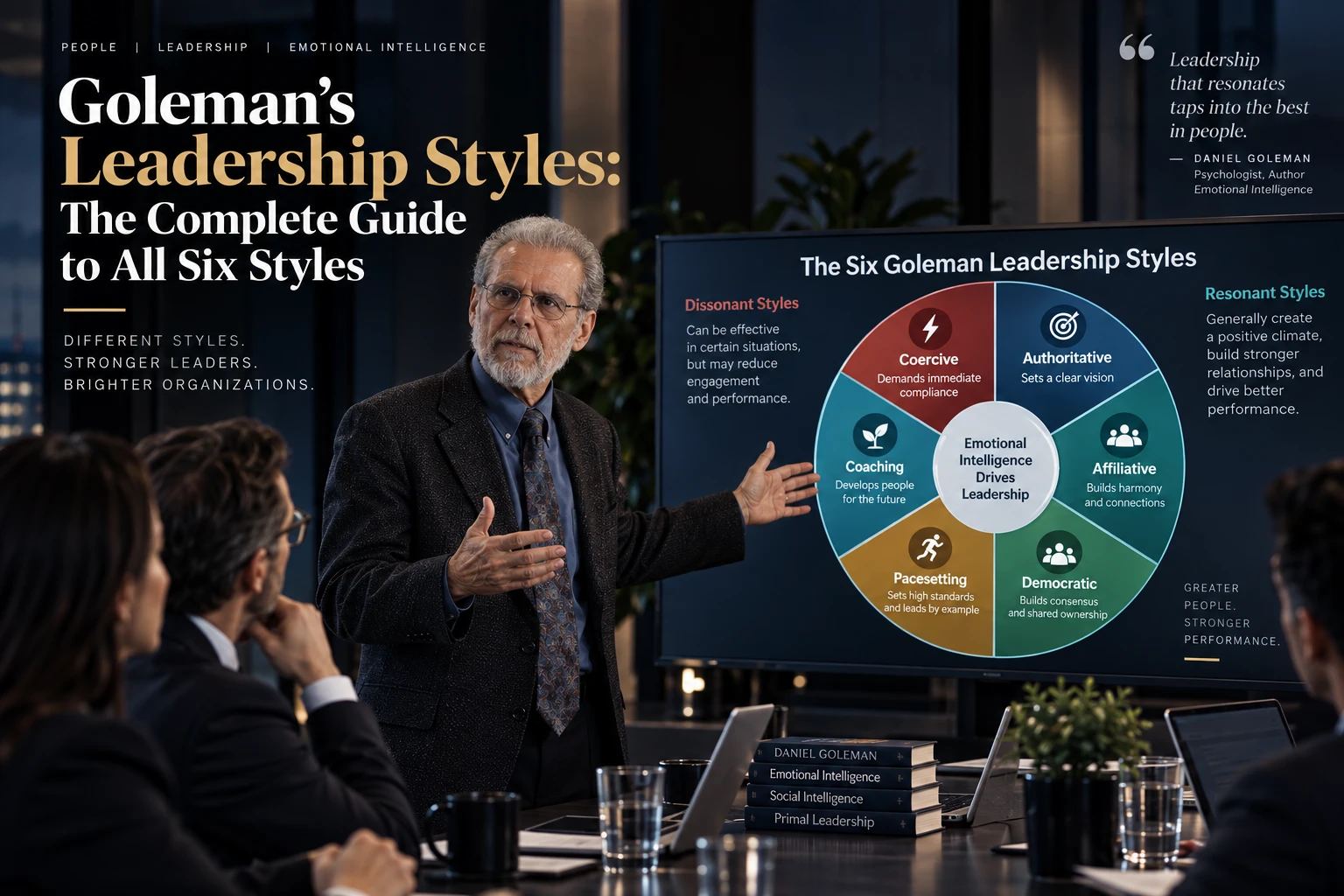
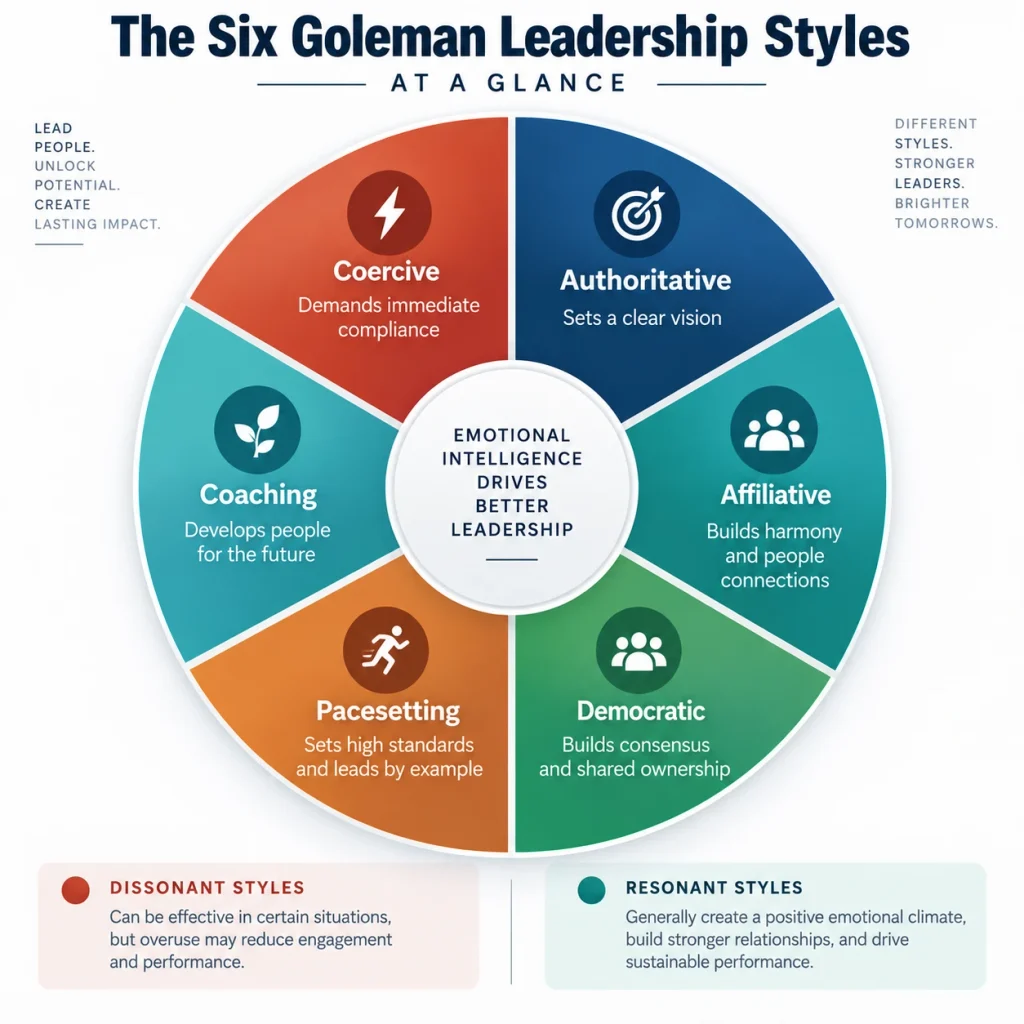
Goleman’s leadership styles are six approaches to leading people. Psychologist Daniel Goleman identified them as coercive, authoritative, affiliative, democratic, pacesetting, and coaching. Each style draws on different emotional intelligence competencies. Each one also produces a different effect on team climate. Effective leaders do not rely on one style. They learn to recognize the situation and switch between styles to get better results.
What Are Goleman’s Leadership Styles?
Goleman’s leadership styles are a practical framework, not a personality test. They describe six distinct behaviors a leader can use, depending on the situation, the team, and the desired outcome.
Each style connects to a different part of emotional intelligence. Coercive leadership draws on drive and initiative. Coaching leadership draws on empathy and developing others.
The styles are behaviors, not fixed traits. That means a leader can learn and practice styles that do not come naturally.
The framework treats leadership as a repertoire. A leader who only knows one style is limited to one kind of situation. A leader who can access several styles has more tools for more circumstances. This is the central idea behind the whole model: flexibility, not a single correct style, produces the best long-term results.
The model also connects leadership behavior directly to organizational outcomes. Goleman’s research links each style to its effect on organizational climate and climate to measurable business performance. That link is what separates this framework from a simple list of leadership personalities.
The framework rests on Goleman’s broader work on emotional intelligence. His earlier writing described five underlying competencies: self-awareness, self-regulation, motivation, empathy, and social skill. In Primal Leadership, these were consolidated into four broader domains: self-awareness, self-management, social awareness, and relationship management.
Each of the six leadership styles draws on a different combination of these domains. That is why building a wider style range usually starts with developing emotional intelligence itself.
The Origin of Goleman’s Leadership Styles Research
Daniel Goleman introduced the six leadership styles in his article “Leadership That Gets Results.” The article appeared in the March to April 2000 issue of Harvard Business Review. Goleman was already known for his earlier work on emotional intelligence, including his 1995 book of the same name.
The article drew on research conducted by the consulting firm Hay/McBer. The study used a random sample of 3,871 executives, selected from a database of more than 20,000 executives worldwide. Researchers examined each executive’s leadership behavior alongside measures of organizational climate and financial performance.
The central finding was direct. Organizational climate can account for nearly a third of financial performance. Climate itself is shaped by leadership style. That means how a manager motivates people, gathers information, makes decisions, manages change, and handles crises.
From this data, Goleman identified six distinct patterns of behavior. He later expanded the framework with co-authors Richard Boyatzis and Annie McKee. Their 2002 book, Primal Leadership, introduced the idea of resonance. It also grouped the six styles into two broader categories.
The Six Goleman Leadership Styles Explained
Each style below includes what it looks like in practice and why it matters. It also explains when the style tends to help or hurt team performance.
Coercive (Commanding) Leadership
The coercive style follows a simple pattern: the leader gives direct instructions and expects immediate compliance. It draws mainly on the emotional intelligence competencies of drive to achieve and initiative.
This style produces fast results in a narrow set of situations. During a genuine crisis, a safety emergency, or a turnaround where a team has lost direction, coercive leadership works well. It can restore order quickly.
Used outside these situations, coercive leadership tends to damage morale. Employees are given little room to contribute ideas or take ownership. Repeated use of this style over time is associated with a decline in flexibility, responsibility, and motivation across the team.
Coercive leadership works because it removes ambiguity in a moment when ambiguity is dangerous. It fails when it becomes the default. A constant coercive style does not build the trust or initiative a team needs to sustain performance on its own.
Authoritative (Visionary) Leadership
The authoritative style, sometimes called visionary leadership, mobilizes a team toward a clear long-term goal. The leader sets the destination but gives people freedom to choose their own path to get there.
This style draws heavily on self-confidence, empathy, and the ability to act as a catalyst for change. It tends to have one of the most positive effects on organizational climate among all six styles.
Authoritative leadership works particularly well when an organization needs new direction. This often happens during a strategic shift or a period of major change. By clearly explaining why a goal matters, the leader gives people a reason to commit rather than simply comply.
The style has limits. It can be less effective with a team of experts. Those experts may already know more than the leader does. In that case, dictating a vision without input can seem out of touch.
Affiliative Leadership
Affiliative leadership puts people first. The leader focuses on building emotional bonds, resolving conflict, and creating harmony within the team.
This style relies on empathy, building relationships, and communication skill. It is especially useful for healing rifts within a team. It also helps motivate people during stressful periods or rebuild connections after a difficult change.
Affiliative leadership generally has a positive effect on climate, particularly around trust and belonging. Used alone, however, it can leave performance problems unaddressed. Because the style avoids confrontation, mediocre performance sometimes goes uncorrected for too long.
The style works best combined with others, such as authoritative leadership for direction or coaching for individual growth. On its own, praise and harmony are not enough to sustain high performance indefinitely.
Democratic Leadership
Democratic leadership builds consensus through participation. The leader asks for input, listens to ideas, and involves the team in decisions.
This style draws on collaboration, team leadership, and communication. It works well when a leader is uncertain about the right direction. In that case, the team’s expertise and buy-in matter. It also helps when building commitment to a decision matters as much as the decision itself.
Democratic leadership has a moderate positive effect on climate, mainly through increased trust, respect, and commitment. It is less effective in a crisis, when there is no time for lengthy discussion. It also struggles when the team lacks the information needed to make a sound decision.
Overused, democratic leadership can create the impression of indecisiveness. Endless meetings without resolution frustrate teams as much as being excluded from decisions entirely.
Pacesetting Leadership
Pacesetting leadership sets a high bar and expects people to meet it, often by example. The leader models excellence and expects the team to keep pace without much guidance.
This style draws on conscientiousness, drive to achieve, and initiative. It can work in the short term with a highly skilled, highly motivated, and self-directed team that needs little coordination.
Pacesetting is one of the two styles most likely to damage climate when overused. Employees can feel overwhelmed by constant, unstated high expectations. The leader often steps in to do the work instead of explaining why performance fell short. Because of this, the team’s own capability and confidence can stall rather than grow.
Pacesetting differs from coercive leadership in tone rather than effect. Coercive leadership commands; pacesetting demonstrates. Both, used constantly, tend to erode trust and long-term engagement.
Coaching Leadership
Coaching leadership focuses on developing people for the future rather than solving today’s problem directly. The leader helps individuals identify strengths and weaknesses and connects daily work to longer-term career goals.
This style relies heavily on developing others, empathy, and self-awareness. It works particularly well when an employee shows potential and motivation to improve but needs guidance to get there.
Coaching leadership has a strong positive effect on climate over time, although it is frequently underused. Many leaders avoid it because it takes more time upfront than simply giving instructions.
The style is less useful in an urgent crisis, when there is no time for extended development conversations. It also struggles with an employee who resists feedback and is unwilling to change.
Resonant vs Dissonant Leadership Styles
In Primal Leadership, Goleman, Boyatzis, and McKee grouped the six styles into two broader categories. The grouping is based on each style’s typical emotional effect on a team.
Four styles are generally described as resonant: authoritative, affiliative, democratic, and coaching. Used well, these styles tend to build positive emotional energy, trust, and long-term engagement.
Two styles are described as dissonant and recommended for cautious, situational use: coercive and pacesetting. Both can be genuinely useful in narrow circumstances. Relied on too heavily, though, both tend to create tension, fear, or burnout.
| Style | Category | Primary Use Case | Risk if Overused |
| Coercive | Dissonant | Crisis, safety issue, turnaround | Damaged trust and motivation |
| Authoritative | Resonant | New direction, strategic change | Less effective with expert peers |
| Affiliative | Resonant | Team healing, morale support | Poor performance left unaddressed |
| Democratic | Resonant | Building buy-in, gathering expertise | Slower decisions, indecision |
| Pacesetting | Dissonant | Skilled, self-directed team | Burnout, stalled skill growth |
| Coaching | Resonant | Developing potential over time | Too slow for urgent problems |
This does not mean the dissonant styles are always wrong. Goleman’s own research found that coercive and pacesetting leadership can be appropriate at times. They can even be necessary in specific moments, such as a genuine emergency. The distinction is about default behavior, not occasional use.
How Leadership Style Shapes Organizational Climate and Performance
Organizational climate refers to how it feels to work somewhere. It covers whether people feel clear about expectations, free to innovate, responsible for outcomes, and fairly rewarded. Goleman’s research treats climate as the mechanism connecting leadership behavior to business results.
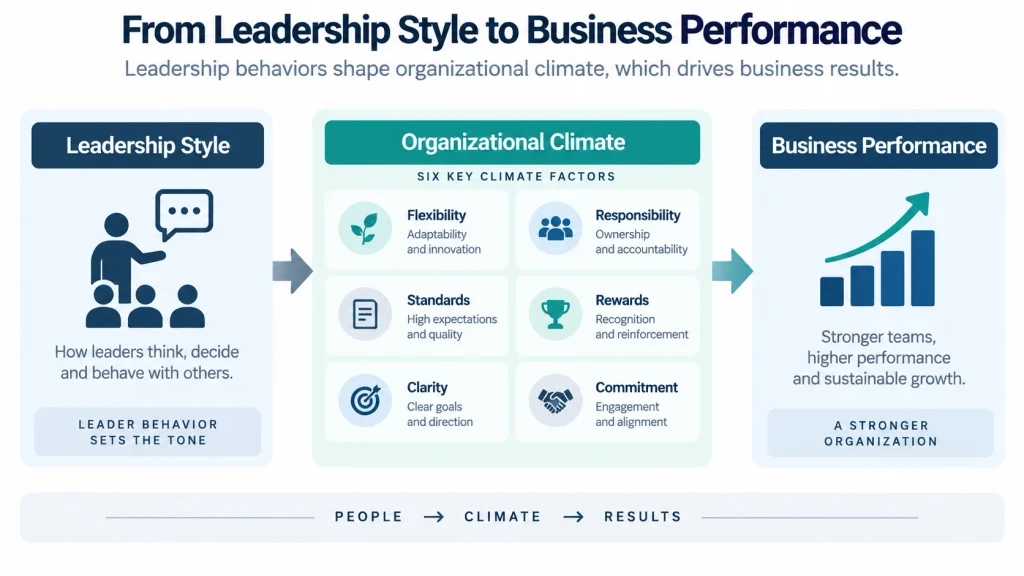
Goleman’s original research broke climate down into six measurable factors:
- Flexibility: how free employees feel to innovate without unnecessary red tape
- Responsibility: how accountable people feel toward the organization
- Standards: the level of performance people set for themselves
- Rewards: how accurate and fair feedback and recognition feel
- Clarity: how well people understand the mission and expectations
- Commitment: how dedicated people feel to a shared purpose
Leadership style shapes climate through everyday actions. How a manager gives feedback, makes decisions, and responds to mistakes accumulates into a pattern employees can feel. That pattern, repeated daily, becomes the climate of a team or department.
Climate in turn influences employee engagement, discretionary effort, and retention. Teams with a strong positive climate tend to show more initiative and are more willing to go beyond minimum requirements. Teams under a persistently negative climate are more likely to disengage or leave.
Climate in turn drives measurable results. This is why leadership style is more than a soft or secondary factor. It functions as a measurable driver of business performance, not merely a matter of personal management preference.
How to Identify Your Dominant Leadership Style
Most leaders default to one or two styles without realizing it. Identifying a dominant style starts with observing actual behavior rather than intention.
A useful starting point is reviewing recent decisions. A leader can consider how often they gave direct instructions versus asked for input. They can also notice how often they focused on immediate results versus longer-term development. Patterns tend to appear quickly once specific incidents are examined instead of general self-image.
360-degree feedback offers a more objective view. Colleagues and direct reports often notice patterns a leader cannot see in themselves. Feedback that repeatedly mentions the same behavior, whether positive or critical, is usually a signal of a dominant style.
It also helps to notice which situations feel most comfortable. A leader who feels at ease setting clear direction, but uncomfortable asking for open input, likely leans authoritative or coercive. That leader probably leans away from democratic leadership. Comfort is not the same as effectiveness, but it is a useful clue to habitual style.
Building a Flexible Leadership Repertoire
Goleman’s research consistently found that leaders who master multiple styles achieve better results than leaders who rely on just one. Building that range is a skill that can be developed deliberately.
The first step is awareness of the situation itself. Before choosing a response, a leader can ask what the moment actually requires: direction, participation, comfort, or growth. Matching the style to the situation, rather than defaulting to habit, is the core discipline behind the whole framework.
Practicing an unfamiliar style in low-stakes situations builds comfort before it is needed in a high-pressure moment. A leader who defaults to pacesetting can practice a different approach. For example, they can try coaching conversations during routine check-ins rather than only during a crisis.
Executive coaching and structured leadership development programs often help leaders build this range faster than self-study alone. They provide real-time feedback on blind spots that self-study cannot. Over time, the goal is not to master every style equally. Instead, it is to build enough range to avoid depending on a single default under pressure.
A useful discipline is a short weekly review. After a significant meeting or decision, a leader can note which style they used. They can also ask whether it matched what the situation actually required.
Over several weeks, this creates a record of habitual choices rather than a single impression. That record makes blind spots easier to spot and correct.
Peer leaders can also serve as a practical resource. Watching how a colleague handles a change management initiative or a difficult conversation can help. Asking what they were thinking in the moment often reveals options a leader would not have generated alone.
Common Mistakes Leaders Make With Goleman’s Styles
The most frequent mistake is defaulting to one style regardless of the situation. A leader who only knows how to command will struggle in some situations. The same is true for a leader who only knows how to build consensus.
A second common mistake is overusing the two dissonant styles. Coercive and pacesetting leadership can feel efficient in the moment, which makes them tempting defaults even outside genuine emergencies. The short-term speed often comes at the cost of long-term trust.
A third mistake is confusing affiliative leadership with an unwillingness to address performance issues. Building harmony is valuable, but it does not replace clear expectations. Leaders sometimes use affiliative behavior to avoid a difficult conversation rather than to genuinely support the team.
A fourth mistake is applying democratic leadership in a genuine crisis. In that moment, the team needs quick, clear direction rather than an open discussion. Style selection depends on reading the situation correctly, not applying a preferred style out of habit or comfort.
Goleman’s Leadership Styles vs Other Leadership Frameworks
Goleman’s model is one of several situational approaches to leadership. Understanding how it compares to related frameworks clarifies what makes it distinct.
Goleman’s Styles vs Situational Leadership
Paul Hersey and Ken Blanchard first introduced their situational model in 1969, under the name Life Cycle Theory of Leadership. It matches four leadership styles (telling, selling, participating, delegating) to an employee’s development level for a specific task. This differs from Goleman’s focus on broader organizational climate.
Goleman’s model instead matches six styles to the wider business situation. Each style connects to a distinct set of emotional intelligence competencies. Hersey and Blanchard emphasize follower readiness on a specific task. Goleman’s model instead emphasizes the leader’s internal skill set and its measurable effect on team climate and financial performance.
Both frameworks share a core assumption: no single leadership style works in every situation. A leader benefits from understanding both frameworks. Hersey and Blanchard’s model adds useful detail about matching style to individual task readiness.
Leadership Styles vs Management Style
Leadership style and management style are related but distinct. Management style typically describes how someone organizes tasks, allocates resources, and tracks performance management systems. Leadership style, as Goleman defines it, describes how someone influences people’s motivation and emotional engagement.
A manager can follow a consistent management process while still varying leadership style depending on the person and situation. The two operate on different layers: management structures the work, while leadership style shapes how people feel about doing it.
Goleman’s Styles vs Transformational and Transactional Leadership
Transformational and transactional leadership describe two broad orientations rather than six specific behaviors. Transactional leadership focuses on clear exchanges: meet a target, receive a reward. Transformational leadership focuses on inspiring people around a shared vision and encouraging them to exceed expectations.
Goleman’s authoritative style overlaps conceptually with transformational leadership, since both center on a compelling vision. His pacesetting style shares some ground with transactional leadership’s emphasis on performance and expectations. His democratic style does too, to a lesser degree.
The practical difference is the level of detail each framework offers. Transformational and transactional leadership describe a leader’s overall orientation. Goleman’s six styles describe specific, switchable behaviors a leader can apply within a single day. That makes the framework easier to translate into concrete action.
Limitations of Goleman’s Leadership Styles Framework
The framework has genuine limitations worth understanding before applying it uncritically.
The original research is over two decades old. Workplace norms, including expectations around remote work and transformational leadership, have shifted since then. The underlying mechanism, connecting behavior to climate to performance, remains broadly credible. Specific findings, though, may not translate perfectly to every modern workplace.
The six categories are also simplifications. Real leadership behavior rarely fits neatly into one box. Most experienced leaders blend elements of several styles within a single conversation, rather than switching between discrete, separate modes.
Finally, the framework describes what effective leaders tend to do. It offers less detail on how to build the underlying emotional intelligence competencies themselves. Style selection is only useful once a leader has developed enough self-awareness. Only then can they execute more than one style credibly.
The original study also relied heavily on self-reported and manager-assessed data rather than controlled experiments. This is a limitation common to most organizational climate research from this period. This does not invalidate the findings. It does mean the framework should be treated as a well-supported practical model, not an exact scientific formula.
Frequently Asked Questions
Can a leader’s dominant leadership style change over time?
Yes. A dominant style usually reflects habit and comfort rather than a fixed trait. With deliberate practice, feedback, and coaching, leaders regularly shift their default style, particularly moving away from coercive or pacesetting habits toward more resonant styles.
What is the best Goleman leadership style for a fast-growing startup?
There is no single correct style, but early-stage, fast-growing teams often benefit most from a mix of authoritative leadership for direction and coaching for developing people quickly into larger roles. Pacesetting can work briefly with a small, highly skilled founding team, but it tends to burn people out as the company scales.
Is authoritative leadership the same as authoritarian leadership?
No. The two terms sound alike but describe opposite approaches. Authoritative leadership sets a vision and then gives people freedom in how they get there. Authoritarian leadership, closer to Goleman’s coercive style, dictates both the goal and the method. Confusing the two often leads people to avoid a genuinely effective style out of a misplaced concern about being controlling.
Are there assessments or tests to identify your Goleman leadership style?
Some consulting firms and leadership development providers offer self-assessment questionnaires based on Goleman’s framework, often alongside 360-degree feedback. These tools can highlight a dominant style, but reviewing recent real decisions and asking colleagues for direct feedback is equally reliable and does not require a paid tool.
Does Goleman’s framework work well for remote or hybrid teams?
The core logic still applies, since climate is shaped by behavior rather than physical location. In practice, affiliative and coaching styles often need more deliberate effort in remote settings, because the informal, in-person cues that build trust are harder to replicate over video calls or chat.
Does using more leadership styles automatically guarantee better results?
Not automatically. Range matters less than judgment. A leader who can access several styles but applies the wrong one for the situation will still get weaker results than a leader with fewer styles who reads the situation accurately. Range is most valuable when paired with situational awareness.
Conclusion
Goleman’s six leadership styles are coercive, authoritative, affiliative, democratic, pacesetting, and coaching. Together they give leaders a practical vocabulary for a decision they make constantly. That decision is how to respond to the people in front of them right now.
No single style is correct in every situation. The research behind the framework points to a clear pattern instead. Leaders who can access several styles, and who read the situation before choosing one, tend to build stronger organizational climates. They also tend to sustain better results than leaders who rely on a single default behavior.
Building that range takes deliberate practice and honest feedback about a current default style. It also takes a willingness to use resonant styles, authoritative, affiliative, democratic, and coaching, more often than the dissonant ones. Used this way, the framework becomes less a personality label and more a working tool for everyday leadership decisions.
Understanding the six styles is only the starting point. The deeper skill they all depend on is the emotional intelligence behind them: self-awareness, self-regulation, empathy, and social skill.
Leaders who want to expand their range usually find the real work happens beneath the style itself. The deeper work is strengthening the underlying emotional intelligence competencies that make any style credible rather than performed. That is the natural next area to explore once the six styles themselves are understood.