
Decision rights in leadership define who recommends, advises, decides and acts on each important decision. They turn authority from an assumption into an agreement. Clear decision rights can reduce delay, duplicated work and repeated debate. They also show leaders which decisions to keep and which to hand to people with better information. Models such as RACI, RAPID and OVIS add structure. Practitioner evidence suggests behavior decides whether the structure works.
What Are Decision Rights in Leadership?
Decision rights settle three things. They name who may make a decision and who must contribute before it is made. They also name who carries it out afterward. Boston Consulting Group describes them as an open agreement about who makes which decisions and in what capacity.
In leadership, the idea covers two layers. The first layer is a leader’s own authority. The second is the authority a leader hands to others. A change in organizational design also changes decision rights, because structure decides where choices sit. Insigniam makes the same point.
Practitioners use the term in two ways. Role tools such as RAPID assign people to a decision. Mode tools, such as the seven options from the Conscious Leadership Group, set how a group reaches the call. This article treats both as parts of one system.
Academic usage is more precise. A 2018 review by Till Winkler and Michael Wessel separates decision rights into three classes: input, control and management. It also separates formal rights from practiced rights. The review covered 53 information systems studies from 1992 to 2018. It found that 38 percent mixed control rights with management rights. It also found that 68 percent examined formal rights only.
That gap matters for leaders. A chart records formal rights. Daily behavior shows the practiced ones.
Decision Rights vs Authority and Accountability
These terms overlap, and teams often use them as synonyms. The table gives working definitions for this article. They are analytical definitions, not quotations from one source, and the examples are illustrative.
| Term | Question it answers | Example |
|---|---|---|
| Decision right | Who may decide this specific choice? | The finance chief approves the annual headcount budget. |
| Formal authority | Who holds the right to decide? | A manager holds the title and the right. |
| Real authority | Who effectively controls the outcome? | A specialist whose recommendation is never overruled. |
| Accountability | Who answers for the result? | The executive who reports the outcome. |
| Responsibility | Who does the work? | The team that runs the change. |
| Reporting line | Who does a person answer to? | An engineer reports to an engineering manager. |
The formal-versus-real distinction comes from Philippe Aghion and Jean Tirole. They define formal authority as the right to decide. They define real authority as effective control over decisions.
Accountability without matching rights leaves a leader answerable for results the leader cannot steer. This is a reasoned inference, not a research finding. Strong leadership accountability depends on assigning rights and answerability together.
Decision Rights vs the Decision-Making Process
Decision rights answer who. The decision-making process answers how. Workpath draws the same line: rights cover who gives input, decides and executes, while process covers evidence, forums and follow-through.
A team can have clear rights and still decide badly. In McKinsey’s 2019 survey, high-quality debate was the factor most predictive of respondents reporting good, fast big-bet decisions. Rights set who decides. They do not create debate.
Why Decision Rights Matter for Leaders
Unclear decision rights waste leadership time. Decisions stall, get reopened or climb to levels that should not hold them. Each pattern also weakens delegation, because people stop deciding when they cannot tell whether the call is theirs.
What Unclear Rights Cost
McKinsey surveyed more than 1,200 managers and published the results in 2019. Fewer than half said decisions were timely. Sixty-one percent said at least half the time spent on decisions was ineffective. Respondents also listed unclear organizational roles among their complaints.
McKinsey also modeled the cost. For a typical Fortune 500 company, it estimated about 530,000 manager days a year, worth roughly $250 million in wages. The estimate rests on stated assumptions, including 56,400 employees of whom 20 percent are managers. Treat it as an order of magnitude, not a measurement.
Cross-cutting decisions show the effect most clearly. These include pricing choices and new-product launches. Only 34 percent of respondents said their organization made such decisions both well and on time. One healthcare executive sat through the same 90-minute proposal three times. Each committee met separately, because no one knew who could approve it.
Empowerment shows a link too. Respondents with empowered, coached employees were 3.2 times more likely to rate delegated decisions as high quality and fast. This is a survey association. It does not prove cause.
Centralizing can cost speed as well. Harvard Business School’s Working Knowledge describes a global conglomerate. The firm moved final pricing authority for foreign subsidiary bids to its headquarters. Moving information to headquarters and absorbing it slowed responses to bid requests. A European rival added a 24-hour limit to its own bids and won new business.
Why Decisions Climb the Hierarchy
McKinsey names two causes for decisions that bubble up. The first is process. Without clear decision rights or rules, little stops people from escalating decisions they dislike. One leader described a syndrome in which any leader can object and the only exit is escalation to the top.
The second cause is culture. A boss may say that an employee should decide but mean that the employee should decide as the boss would. In cultures that punish mistakes, escalating becomes the safe habit. A chemicals company CEO in the same article spent time on hiring decisions four levels down.
McKinsey suggests clear rules, meeting charters that define which decisions are in scope, and escalation criteria for lower-level decisions.
The Four Parts of a Decision Right
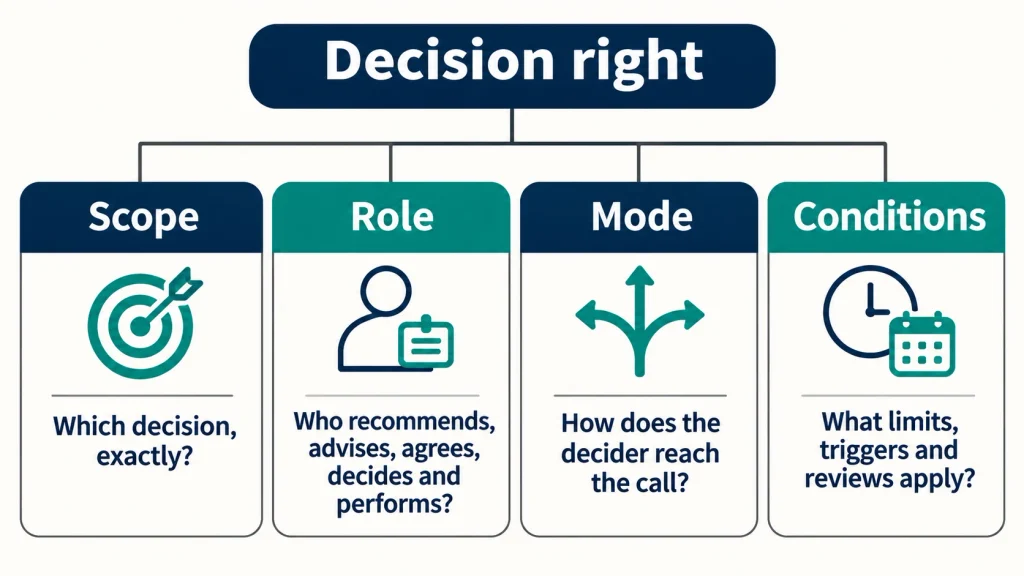
Published tools cover different parts of a decision right. A complete definition needs four parts: scope, role, mode and conditions. This four-part view is an analytical synthesis of the sources in this article. It is not a published framework.
| Part | Question it answers | Main evidence in this article |
|---|---|---|
| Scope | Which decision, exactly? | HBR 2026 headcount example |
| Role | Who recommends, advises, agrees, decides and performs? | Bain RAPID guidance |
| Mode | How does the decider reach the call? | Conscious Leadership Group |
| Conditions | What limits, triggers and review points apply? | Amazon 2015 letter, McKinsey 2019, HBS 2005 |
Scope comes first, because bundled decisions invite turf wars. Lindy Greer, Jennifer Jordan and Maxim Sytch describe a medical technology client they call MedTech. Its CEO, HR chief and business unit leads each believed they owned headcount decisions. Facilitated talks showed that several headcount decisions had never been separated.
The executives then split them. The CFO became accountable for approving the yearly headcount budget. The CHRO took the headcount proposal and urgent, unplanned requests above a set seniority level. C-suite hires went to the CEO. Business unit leaders became accountable for filling roles within pre-approved headcount below a set pay grade.
Role assigns people to a decision. Bain’s RAPID roles are Recommend, Agree, Perform, Input and Decide. Bain advises one decider and one recommender per decision.
Mode sets how the decider reaches the call. A decider can act alone, consult first, delegate to a subgroup, call a vote or seek consensus. Each choice trades speed against buy-in.
Conditions limit and time the right. They include reversibility, escalation triggers, guardrails and review points. Without conditions, deciders may overreach or escalate everything. This is a reasoned inference.
Where Should a Decision Right Sit?
Place a decision right where the relevant knowledge sits. Choose a place where a wrong call can be reversed cheaply. The decider’s goals should also match the organization’s. When these point to different people, split the decision instead of settling for one owner.
Put the Decision Where the Knowledge Sits
Michael Jensen and William Meckling argued that knowledge costly to transfer should shape where rights sit. In their paper, such knowledge encourages decentralizing decision rights. That creates two problems. The first is rights assignment: who should exercise each right. The second is control: how to make self-interested deciders serve the organization.
Harvard Business School’s Working Knowledge summarized this logic for managers in 2005. It named two costs. One is delegating to people whose goals differ from the company’s. The other is moving information to a distant decider. Rights belong where the combined costs are lowest. Raising a decision’s level also requires moving information upward, and companies often forget that step.
Delegation has a price. Aghion and Tirole show that more real authority for a subordinate promotes initiative. It also reduces the superior’s control.
Match the Process to Reversibility and Stakes
Amazon’s 2015 shareholder letter separates decisions by reversibility. Jeff Bezos called consequential, nearly irreversible decisions Type 1. He wrote that they need methodical, careful, slow work with deliberation and consultation. He called changeable, reversible decisions Type 2. The letter says high-judgment individuals or small groups can and should make them quickly.
Leaders often call these one-way and two-way door decisions. The letter warns that large organizations tend to apply the heavy Type 1 process to most decisions. It names the result: slowness, risk aversion, too little experimentation and less invention. A footnote adds that firms habitually treating Type 1 decisions as Type 2 decisions go extinct before growing large. It also concedes some survivorship bias.
McKinsey’s 2019 research groups decisions differently. Big bets are infrequent and high risk. Cross-cutting decisions are frequent, can be high risk and span functions. Delegated decisions are frequent and low risk. McKinsey found a different standout practice for each. Debate fits big bets, process fits cross-cutting decisions and empowerment fits delegated ones.
Reversibility is a judgment, not a fixed fact. A loss that one firm absorbs may threaten another.
A Four-Question Allocation Test
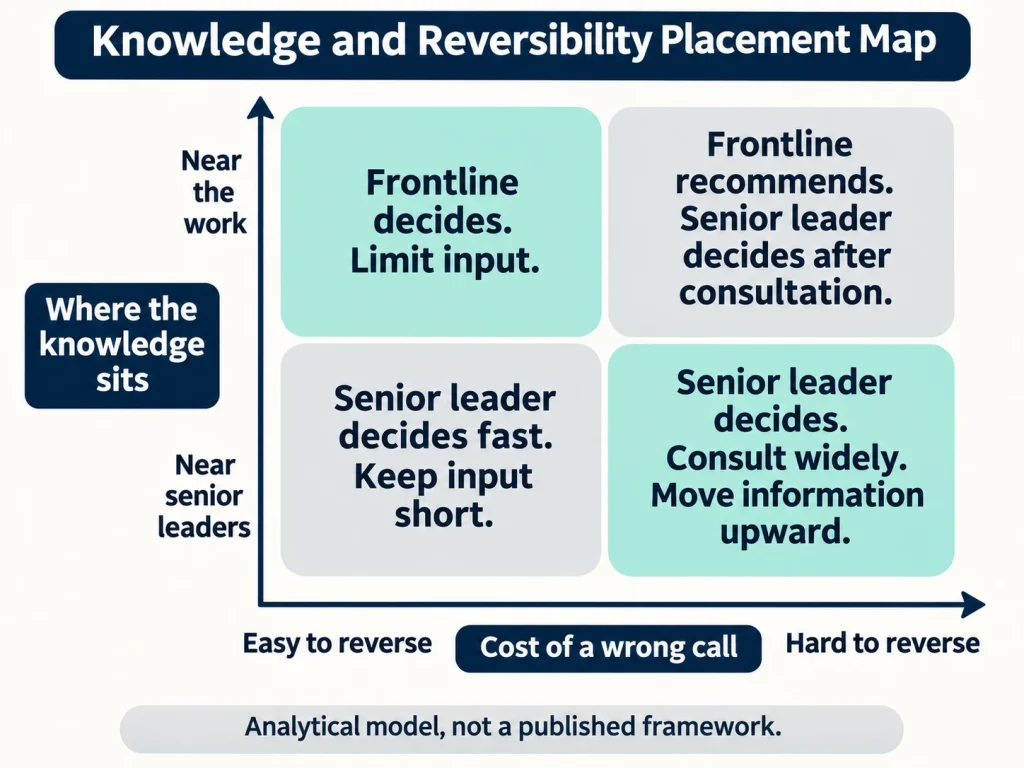
The sources above support a simple test. It is an analytical synthesis, not a validated instrument.
- Who holds the specific knowledge? Give that person or group the recommendation, and often the decision.
- Can a wrong call be undone cheaply? If yes, push the decision down and limit input. If no, add consultation and a more senior decider.
- Does the decision cut across functions? If yes, name one decider and keep the number of agreeing roles small.
- Do the decider’s incentives match the company’s? If not, add a guardrail or change the incentive.
The fourth question has a documented example. McKinsey describes operations managers whose bonuses depended only on cost targets. They rejected a new production line that the group’s growth plan needed. If the answers point to different people, split the decision into parts.
How Leaders Can Exercise Decision Rights
The Conscious Leadership Group lists seven modes, from leader-only to full alignment. The right mode depends on time, stakes, needed buy-in and expertise. Leaders can choose among the seven for each decision. The trade-off column below is an analytical reading, not Conscious Leadership Group text.
| Mode | Who decides | Main trade-off |
|---|---|---|
| 1. Leader decides | The leader alone, with no input | Fast, but buy-in is not guaranteed |
| 2. Leader decides with input | The leader, after chosen input | The leader sets the amount of input and the time |
| 3. Subgroup decides | Experts or stakeholder representatives | No one else gives input |
| 4. Subgroup decides with input | The subgroup, after hearing others | The subgroup keeps the call |
| 5. Majority vote | The group, by an agreed majority | The leader sets the time and the type of majority |
| 6. Consensus | The group, with no one opposed | Needs a fallback mode if it fails |
| 7. Alignment | The group, with everyone in favor | Slowest, with the strongest buy-in |
The group first asks whether a decision is needed at all. If not, it agrees to shelve the topic. If yes, the leader weighs time, importance and needed buy-in. The leader also weighs who holds the information and how experienced the deciders are. Both consensus decision-making and alignment need a fallback mode chosen in advance.
After the decision, everyone treats it as final. That excludes side conversations and back-door lobbying. The group also agrees how it will revisit the decision if needed.
Decision Rights Models Compared: RACI, RAPID and OVIS
Several tools assign roles within a decision. Bridgespan lists RAPID, RACI, ASICK, CAIRO, IMRN, LACTI and REDI. McKinsey’s DARE model is a further option. RACI, RAPID and OVIS appear most often on the pages reviewed for this guide.
| Model | Roles | Source | Best suited to | Main watch-out |
|---|---|---|---|---|
| RACI | Responsible, Accountable, Consulted, Informed | Widely used; HBR 2026 advises ARCI | Tasks, plus decisions with one named accountable owner | Confusing accountable with responsible |
| RAPID | Recommend, Agree, Perform, Input, Decide | Bain; Rogers and Blenko, HBR 2006 | Cross-functional decisions with required sign-offs | Too many Agree or Input roles |
| OVIS | Own, Veto, Influence, Support | BCG, 2021 | Decisions with few real blockers and a clear escalation path | Veto holders who block instead of negotiating |
The RACI matrix is a common starting point. BCG notes that RACI assigns responsibility for certain tasks within a process. OVIS focuses on key decisions. In the HBR 2026 article, the accountable person makes the final decision and leads the decision team. The authors recommend one accountable person per decision and two to four responsible people. They often advise ARCI, which lists the decision owner first.
The RAPID decision-making model came from Paul Rogers and Marcia Blenko. They introduced it in a 2006 Harvard Business Review article. Bain’s current guidance adds detail. The recommender typically does about 80 percent of the work. Agreement should come before the decision, not after it. Each decision should have one decider, placed as close to implementation as practical.
BCG’s OVIS framework names owners, veto holders, influencers and supporters. Owners hold final authority and accountability, and they run an inclusive process. Veto holders can block an owner’s decision, but BCG advises using that power sparingly. BCG says ideally no more than one veto holder per decision. Veto holders who cannot agree with the owner may escalate to a superior.
The Veto Question
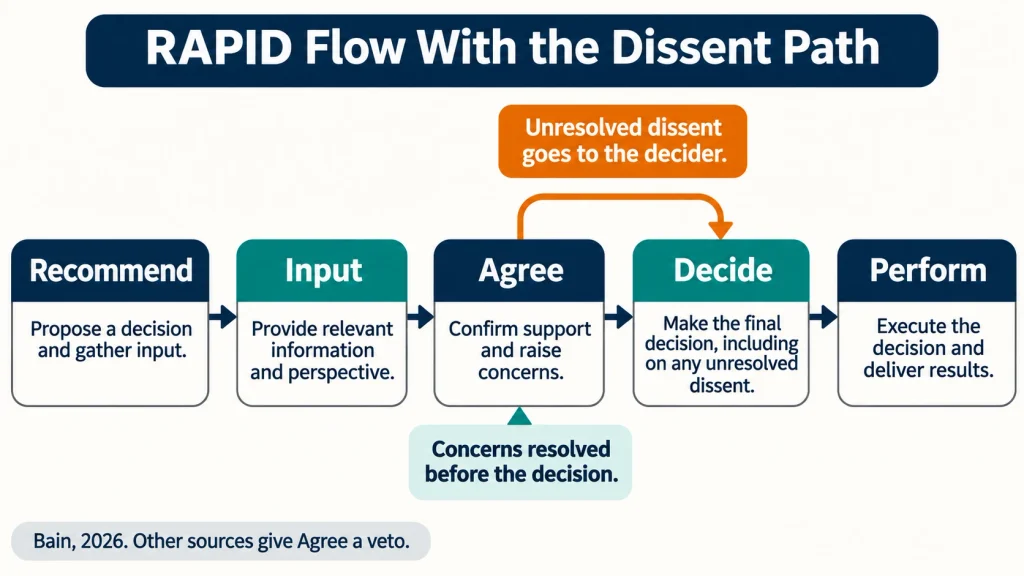
Sources disagree on whether an Agree role can block a decision. Bridgespan describes the A in RAPID as someone who must approve a recommendation or can veto it. BCG gives OVIS veto holders the power to block an owner’s decision. Bain’s 2026 guidance says people in the A role cannot block, undo or reject a decision. In Bain’s version, the recommender and the A resolve concerns before the decision. If they cannot, the recommender passes the A’s dissent to the decider.
This disagreement is practical. A role holder who believes the role carries a veto can stall a decision late in the process. Teams should state in writing whether any role can block a decision. They should also name who resolves a block and by when.
This guide takes a position. By default, only the decider decides, and an Agree holder cannot block. Agree holders raise concerns early. The recommender carries unresolved dissent to the decider.
Bain and HBR each advise one decider or accountable person per decision. McKinsey lists too many votes or vetoes as a RACI pitfall. The default is an editorial judgment, not a research finding.
A veto can still be a sound exception for narrow limits, such as safety or legal rules. Then name one veto holder and state the grounds. Add a deadline and an escalation path. BCG advises ideally no more than one veto holder per decision.
How to Choose a Model
The HBR 2026 authors say these tools fail because people misunderstand them, misuse them or disconnect them from behavior. They do not blame the tools. A company that swaps acronyms without changing behavior may keep its problems. The following guidance is analytical.
- Use a plain statement of who decides when the decision is local and clear.
- Use RAPID or OVIS when several functions must sign off and escalation needs a defined path.
- Keep RACI where it is embedded, but name one accountable person and describe each role’s behavior.
Why Decision Rights Fail in Practice
Formal Authority Is Not Real Authority
The gap between formal authority and real authority explains many failures. Aghion and Tirole’s theory says real authority depends on who holds the information. Their paper lists factors that raise a subordinate’s real authority: overload, lenient rules, urgency, reputation, performance measurement and multiple superiors.
Overload is easy to see in leadership teams. An executive with too many decisions cannot examine each one. The paper describes a principal who rubber-stamps a subordinate’s proposal for fear of picking a worse option. The author of the proposal then holds real authority.
A practical check follows. Compare the chart with the last three times a recurring decision was made. Note who recommended, who objected and who reopened it. The differences show where practiced rights depart from formal ones. This check is an analytical suggestion.
The Four Mistakes HBR Found
Greer, Jordan and Sytch draw on years of research and on work with more than 100 global companies. They report four recurring mistakes. These are practitioner observations from the authors’ work, not results of a controlled study.
- Roles before goals. When teams assign roles before defining goals, talks often turn into turf wars. Goals that are too broad make ownership impossible to allocate.
- The boss’s spreadsheet. A leader writes the list and expects compliance. A senior marketing leader who handed down decision rights found that several direct reports did not play their roles. A global e-commerce company built spreadsheets with thousands of rows that teams looked at once and never again.
- Misread roles. The authors polled 30 partners at a consultancy that had used RACI for years. Half said the accountable person had the final say. Half said the responsible person did. At MedTech, 12 executives attended a final meeting on a new chief innovation officer role. The agreed roles had limited the room to the CEO and the responsible executives. The meeting ended after 90 minutes without a decision.
- Stuck roles. Senior people stay accountable by habit, or act accountable when they are not. In one venture capital postmortem, a senior partner dominated the deal discussion and effectively made the call. The associate who had done the due diligence should have been accountable. The firm passed on a startup that later became a unicorn.
The authors’ fixes follow from the mistakes. Co-create roles with the people involved. Describe what each role does in behavior. Embed roles in everyday tools. Revisit roles as goals change.
How to Assign Decision Rights in a Leadership Team
The steps below combine Bridgespan’s rollout method, Bain’s role guidance and the HBR 2026 recommendations. The sequence is an analytical synthesis.
- Pick the decisions that cause pain. Choose a handful, as Bridgespan suggests, and diagnose what holds each back. Do not catalogue every decision.
- Split bundled decisions. Separate budget, proposal and approval decisions, as in the MedTech headcount example.
- State the goal each decision serves. HBR advises specific, measurable, time-bound goals before role assignment.
- Classify by stakes and reversibility. Use the four-question test and choose a mode.
- Name one decider and a small set of supporting roles. Bain advises one decider. HBR advises one accountable person and two to four responsible people. Build the map with the people who will live with it.
- Describe behaviors and conditions. Write how the decider gathers input, runs the debate, makes the call and explains it. Add guardrails, any named veto holder and escalation triggers.
- Pilot, then widen. Apply the map to a few key decisions, assess the results, and adjust the roles. Then extend it to other decisions.
- Build the roles into meetings. MedTech held a meeting about meetings. Each agenda item named its goal and its accountable person. One schedule gave five minutes to frame the decision, 20 minutes to debate and five minutes to decide.
The table shows an illustrative register. It is hypothetical and not a case study. The modes come from the Conscious Leadership Group.
| Decision | Decider | Input | Agree | Mode | Reversibility | Review trigger |
|---|---|---|---|---|---|---|
| Enter a new regional market | CEO | CFO, regional heads | Legal | Leader decides with input | Hard to reverse | Change in strategy |
| Approve a pricing exception inside the discount limit | Sales director | Finance partner | None | Leader decides | Easy to reverse | Quarterly exception review |
| Hire inside approved headcount | Hiring manager | HR partner | None | Leader decides with input | Moderate | New headcount plan |
| Change a safety procedure | Operations head | Frontline supervisors | Safety executive | Leader decides with input | Hard to reverse | Any incident |
The Agree column is mostly empty. Bain says many decisions need no Agree role. Under this guide’s default, an Agree holder raises concerns but cannot block. A company could name the safety executive as a veto holder for the safety row.
What Leaders Must Do Differently When They Give Up Decision Rights
Writing a decision right down is easier than giving one up. Experimental evidence suggests that people often value decision rights for their own sake. Leaders should expect that pull in themselves.
In a 2014 Econometrica paper, Björn Bartling, Ernst Fehr and Holger Herz ran experiments. Most participants valued decision rights beyond their practical benefits. The authors suggest this may explain why managers value power and why reallocating rights is often difficult. The results are experimental, and the workplace links are the authors’ suggestions.
HBR’s authors challenge senior leaders to name only four decisions a year. These are decisions where the leader is the only and best person to decide. Examples include enterprise-wide strategy, senior hires and company-shaping investments. For everything else, the authors ask how the leader can step out. That may mean moving to a responsible, consulted or informed role, or leaving the RACI altogether.
Effective delegation of authority needs three things, according to McKinsey. Leaders state the boundaries, including what is off-limits and how to escalate. They check that people have the skills to decide. They make people accountable for their own areas. McKinsey suggests starting with a small box of accountability and widening it. It warns against micromanagers, helicopter autocrats who swoop in and out, and laissez-faire executives who leave people alone.
McKinsey also separates agreement from commitment. It credits Jeff Bezos with the phrase disagree and commit and says leaders should seek commitment, not unanimity. Agreement voiced without shared responsibility can prove short-lived. One financial-services business-unit leader agreed in committee not to change a fee structure, then reversed course.
Keeping Decision Rights Current
Review decision rights whenever goals, structures or friction change. HBS Working Knowledge recommends routine review, because organizations and their environments keep changing. HBR’s authors add that roles should be revisited as goals evolve or friction arises.
A review asks where each type of decision is made and whether that point is still efficient. In the HBS article, a McKinsey partner described advising a client to remove a management layer after such a review. Those managers lacked information and made disruptive work-allocation decisions. The people they managed were better placed to decide.
Four signals suggest drift. The same decision gets reopened, and decisions escalate repeatedly. Meetings lack a stated purpose. People disagree about who decides. McKinsey’s 2019 and 2022 articles describe the second and third signals. The first and fourth are reasoned inferences.
A decision log makes the review concrete. A short record of each decision, its decider and the rationale lets a team compare practice with the chart. HBR’s authors suggest that teams routinely ask whether they played their assigned positions. Teams should also ask where the roles helped or hindered them. These reviews belong in the routine that tracks leadership team effectiveness.
Conclusion
Decision rights are an agreement about who decides, who contributes and how the call is reached. A complete agreement has four parts: scope, role, mode and conditions. Where a right sits should follow knowledge, reversibility, cross-functional reach and incentives.
Models such as RACI, RAPID and OVIS help, but sources disagree on veto power. This guide’s default is one decider, with any veto named in writing in advance. The failures HBR’s authors report come from how people apply the tools. Examples are unclear goals, imposed charts, misread roles and senior leaders who override the chart.
For leaders, the hard task is to step out of decisions that others can make better. They should keep only the few that need them. Practitioner sources favor rights that are specific, held by one decider and reviewed as goals change.
Clear decision rights tell a team who decides. They do not tell the decider how to reach a sound decision. That next need is the quality of the decision-making process, including evidence, debate and follow-through. Those elements determine whether a well-placed decider decides well.
FAQ
Is RACI outdated?
No reviewed source shows that RACI has been retired. McKinsey’s 2022 blog argues that RACI often makes the situation worse and recommends DARE instead. HBR’s 2026 authors blame misuse, not the tool, and advise ARCI. No reviewed source compares the models in a controlled test.
Can you have two people accountable in a RACI?
HBR’s 2026 authors advise one accountable person per decision. They say shared accountability invites power struggles and can cause delays. If a group must hold the decision, Bain says to agree in advance how it reaches the call. Its examples are a majority vote or a chair’s final say.
DARE model vs RACI: what is the difference?
DARE has four roles: deciders, advisors, recommenders and execution stakeholders. Only deciders vote, and often there is just one. Advisors have a voice but cannot delay a decision by demanding more data. McKinsey says RACI leaves no clear decider and gives too many people a vote or veto.
What is Jeff Bezos’ 70% rule?
A later Amazon shareholder letter makes the point. Bezos wrote that most decisions should be made with around 70 percent of the information you wish you had. Waiting for 90 percent usually means being slow. He added that leaders must correct bad decisions quickly, because being wrong may cost less than being slow. The rule fits reversible decisions best. That reading is analytical, not Bezos’s statement.
What is a decision rights matrix?
Reviewed sources give no single standard layout. One Umbrex framework page implies a grid of recurring decisions and roles, with RACI letters in the cells. The register in this guide is a variant with a decider, inputs and a review trigger. A decision matrix is a different tool that scores options against criteria.