
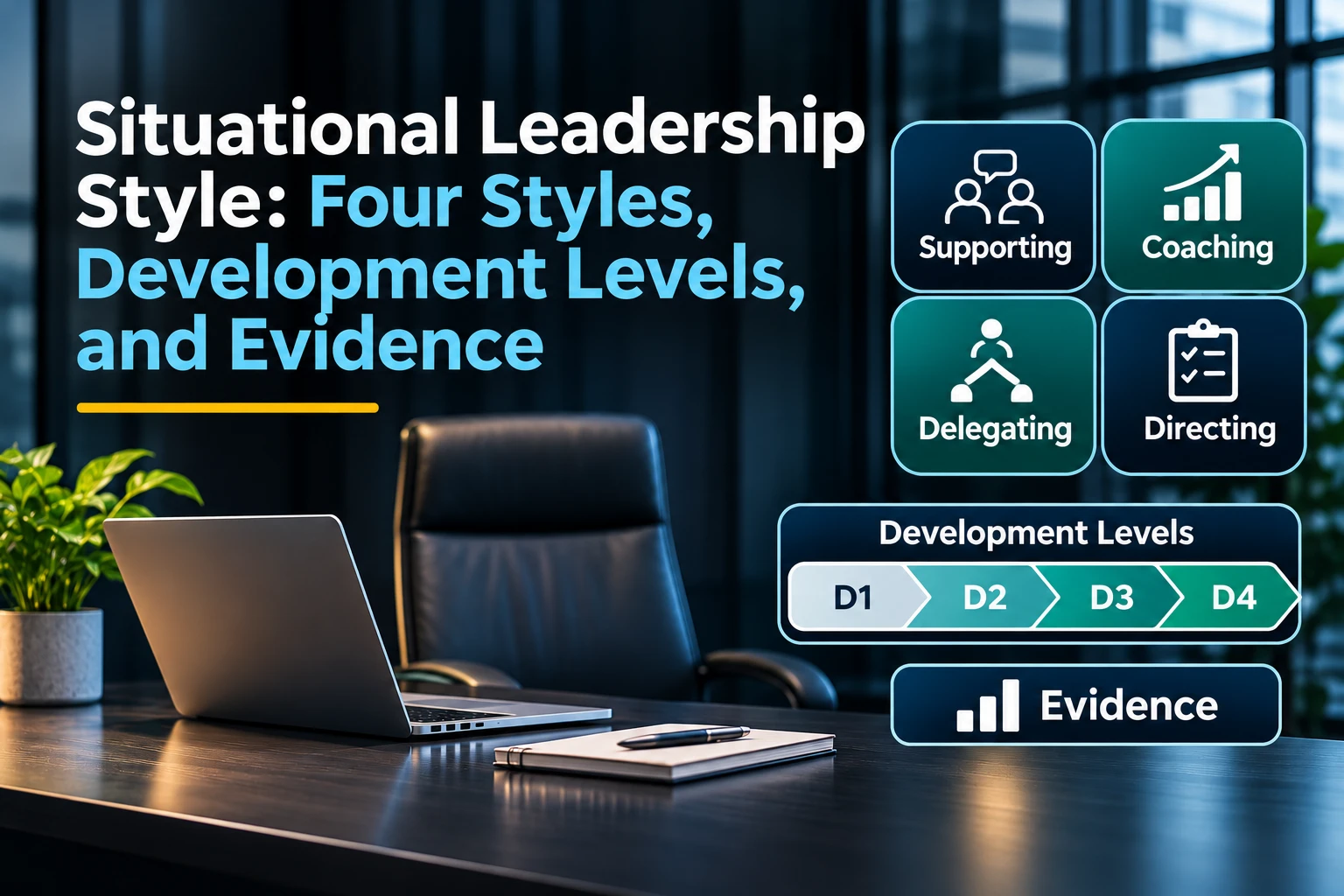
Situational leadership style is an approach where leaders adapt their behavior to what a person needs for a task. The model combines directive and supportive behavior into four styles: directing, coaching, supporting, and delegating. Leaders pick a style after judging the person’s competence and commitment. Research support is limited and mixed, so leaders should treat it as a diagnostic tool, not a formula.
This guide explains the situational leadership model: the four styles, the development levels, and the steps for using it. It also shows where research supports the model and where it does not.
What Is Situational Leadership Style?
Situational leadership style is an approach that matches leader behavior to a person’s readiness. The leader adjusts directive and supportive behavior for each specific task. No single style is best in every case. Leaders diagnose first, then choose how much direction and support to give.
Managers rarely lead people who are all at the same stage. A new hire, a struggling analyst, and a senior specialist need different things. One fixed style fits some of them and fails others. This model helps managers see those differences and respond to them.
The model belongs to the family of contingency theories of leadership. These theories hold that the best style depends on the situation. Among the many leadership styles in management, this one is defined by flexibility instead of a fixed personal approach.
Where the Model Comes From
Paul Hersey and Ken Blanchard presented the model in their 1969 book, Management of Organizational Behavior. They first called it the Life Cycle Theory of Leadership. In 1977, the two authors agreed to pursue separate paths, and each developed his own version.
Hersey’s version is Situational Leadership. The Center for Leadership Studies, which he founded, is its home. It uses the term performance readiness and the styles telling, selling, participating, and delegating.
Blanchard’s version is Situational Leadership II, or SLII. Blanchard and his co-authors introduced SLII in 1985 in Leadership and the One Minute Manager. It uses development levels and the styles directing, coaching, supporting, and delegating.
You will see both model and theory used. Hersey preferred model, because a model gives leaders a repeatable method to apply. This guide uses the SLII labels and notes the original names where they differ.
The Core Principle: Diagnose First, Then Lead
The Center for Leadership Studies describes the approach as leading by diagnosis. The leader first judges what the person needs for the task. Only then does the leader choose a behavior.
SLII rests on the belief that people can and want to develop. It also holds that no single style best encourages that development.
This shifts attention from the leader’s habits to the follower’s needs. Leaders can default to a preferred style. The model asks them to set that habit aside when it does not fit the person.
The Two Behaviors Behind Every Style
Every style combines two behaviors. Each behavior can be high or low.
Directive behavior, also called task behavior, means spelling out duties and closely supervising progress. In practice, directive leadership includes setting goals, giving instructions, defining standards, and checking work.
Supportive behavior, also called relationship behavior, means two-way communication, including listening, facilitating, and support. In practice, supportive leadership includes encouraging, asking questions, and involving the person in decisions.
The two behaviors solve different problems. Direction mainly addresses what a person cannot yet do. Support mainly addresses how confident and motivated the person feels. This is an analytical reading of the model, but it explains every pairing that follows.
The Four Situational Leadership Styles
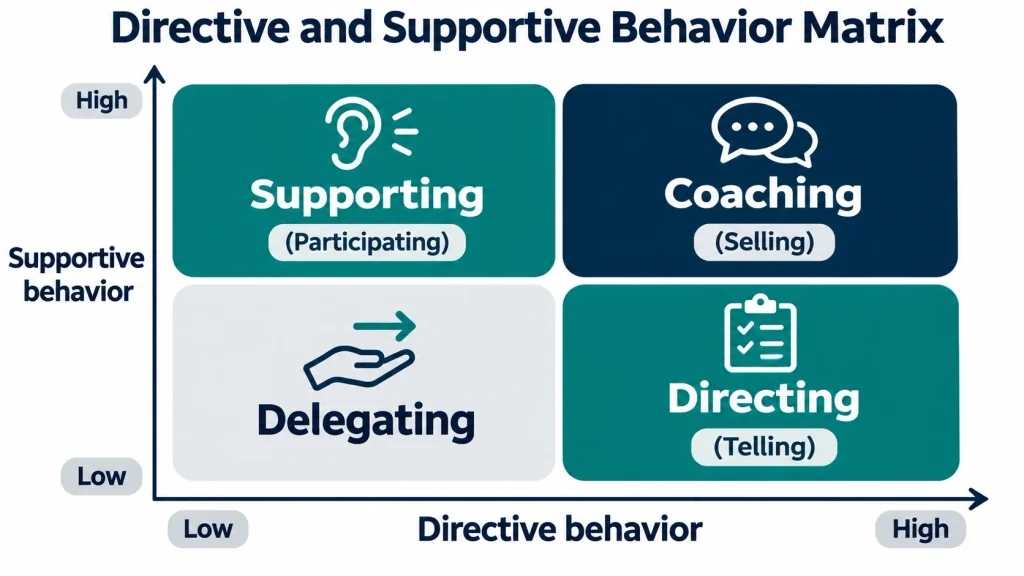
High and low levels of each behavior produce four styles. The table shows each style with its original name.
| Style (original name) | Directive behavior | Supportive behavior | What the leader does |
|---|---|---|---|
| Directing (Telling) | High | Low | Gives clear instructions and checks progress often |
| Coaching (Selling) | High | High | Keeps directing, explains reasons, and encourages |
| Supporting (Participating) | Low | High | Listens, asks questions, and shares decisions |
| Delegating | Low | Low | Agrees on outcomes and hands over decisions |
Hersey’s original labels for the first three styles are telling, selling, and participating.
Directing (Telling)
Directing pairs high direction with low support. It suits a person who lacks skill but is eager to start. High direction builds the needed knowledge and skills, and support can stay low because the person is already eager.
The leader explains what to do, how to do it, and how success is judged. Checklists, examples, and frequent checkpoints are common tools. Quick correction stops errors from becoming habits.
Directing often anchors the first weeks of employee onboarding. The risk is overuse. A capable person who receives step-by-step instructions can feel distrusted.
Coaching (Selling)
Coaching pairs high direction with high support. It suits a person who has some skill but has lost energy or confidence. The person still needs direction to build competence, and added support counters the drop in commitment. Model descriptions say these learners often feel discouraged or overwhelmed.
The leader keeps directing and explains the reasons behind each decision. The leader also asks for the person’s ideas and recognizes real progress.
Coaching here means high direction plus high support. It is narrower than the wider coaching leadership style, which can rely more on questions than on instruction.
Supporting (Participating)
Supporting pairs low direction with high support. It suits a person who has the skill but shows shaky confidence or variable motivation. High support helps reinforce fragile confidence and overcome motivation problems.
The leader stops supplying answers and starts asking questions. The leader uses active listening, asks for the person’s plan, and removes obstacles. Decisions become shared.
The main risk is taking control back too soon. A leader who rewrites the person’s plan signals distrust. That signal can deepen the doubt this style is meant to reduce.
Delegating
Delegating pairs low direction with low support. It suits a person who is both skilled and committed. The leader agrees on outcomes and limits, hands over planning and execution, and reviews progress at milestones.
Delegating is not abandonment. The person still needs clear outcomes, decision rights, and a way to raise problems. Thompson and Vecchio note that delegation involves deliberately moving decision power, not only lowering two behaviors. The goal is empowering leadership, where people own results without constant oversight.
Development Levels: How to Diagnose What a Person Needs
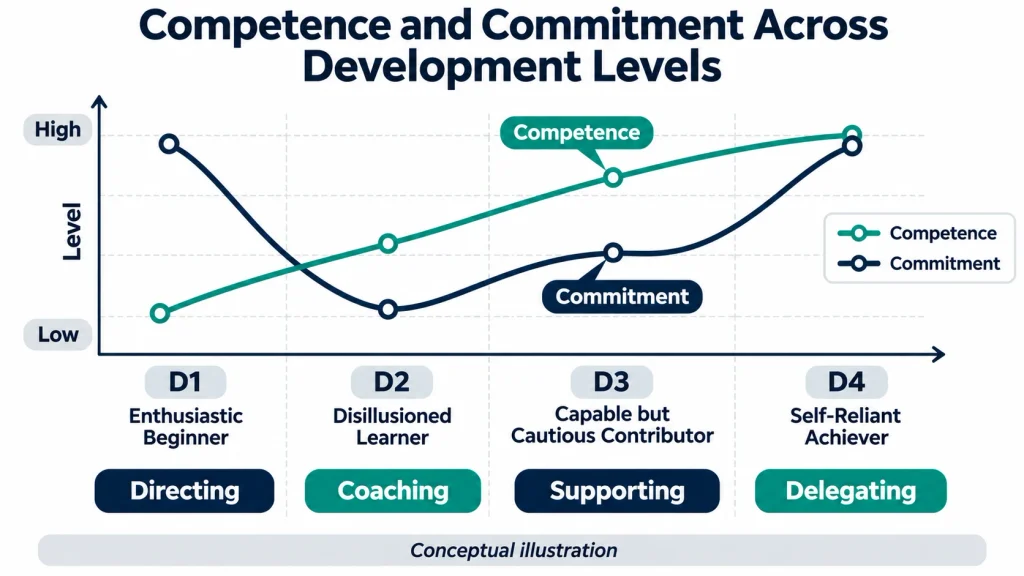
Development level describes a person’s competence and commitment on a specific task. Competence covers knowledge, skills, and experience. Commitment covers confidence and motivation. SLII defines four levels.
| Level | Name | Competence | Commitment | Matching style |
|---|---|---|---|---|
| D1 | Enthusiastic Beginner | Low | High | Directing |
| D2 | Disillusioned Learner | Low to some | Low | Coaching |
| D3 | Capable but Cautious Contributor | Moderate to high | Variable | Supporting |
| D4 | Self-Reliant Achiever | High | High | Delegating |
The level names come from Blanchard’s SLII framework. D1 people are new to the task and eager. D2 people have met the difficulty of the task and lost some energy. D3 people can do the work but sometimes doubt themselves. D4 people work independently and reliably.
At every level, employee motivation matters, but it changes shape. A D1 person has motivation without skill. A D3 person has skill with unstable motivation. Leaders who look only at skill will misjudge both.
Signals That Help You Diagnose
These signals are analytical prompts, not validated measures.
Competence signals:
- The person can explain the steps without help.
- Past work on this task met the standard.
- Errors are rare, and the person spots them alone.
Commitment signals:
- The person shows steady effort across days, not only at the start.
- The person speaks about the task with confidence and interest.
- The person takes on the task willingly.
Look for evidence in recent work, not in reputation. Then check your reading with the person.
Why Diagnosis Must Be Task Specific
Development level changes from one goal or task to another for the same person. The same holds in Hersey’s version, where readiness levels are also task specific.
For example, a senior engineer might be D4 on system design. The same engineer might be D1 on budget planning. Calling the person “a D4” hides that difference. Label the task, not the person.
Why Development Levels Change Over Time
Levels are stages, not a fixed ladder. Progression is not always linear. A reorganization, a new tool, or a setback can lower confidence on familiar work.
SLII implies that early enthusiasm meets real difficulty at D2, and commitment falls before competence catches up. The likely cause is a gap between expectations and the effort the task requires. This is an interpretation of the model, not a measured finding.
Leaders should re-diagnose whenever the task, the tools, or the person’s confidence changes.
How the Matching Logic Works
The model matches leader behavior to the main constraint on performance. When skill is the constraint, leaders add direction. When confidence or motivation is the constraint, leaders add support. When neither is a constraint, leaders step back. This is an analytical summary of the model’s logic.
Each level follows a chain of cause, mechanism, and effect:
- D1: The person lacks skill. Direction supplies steps and standards. Errors should fall and learning should speed up.
- D2: Skill is still low and commitment is falling. Direction continues while support keeps the person engaged.
- D3: Skill exists but confidence wavers. More instruction adds little. Support rebuilds ownership.
- D4: Skill and commitment are both present. Autonomy respects competence and frees the leader’s time.
What Happens When Style and Level Do Not Match
Two mismatches are common. Both are predictions from the model’s logic, not measured results.
Too much direction for a capable person can signal distrust. The person may lose ownership and commitment.
Too little direction for a beginner leaves knowledge gaps. The person must guess, and errors and anxiety can rise.
Studies reviewed by Thompson and Vecchio suggest that new recruits may benefit from more supervisor direction. That finding is consistent with the second mismatch.
The Three Skills of a Situational Leader
Blanchard’s SLII describes three skills: diagnosis, flexibility, and partnering for performance. Together they turn the model into a working habit.
Diagnosis means assessing competence and commitment for the specific task. It is the skill that shapes every other choice.
Flexibility means using all four styles comfortably. Leaders may favor one or two styles. Flexibility asks them to practice the styles they use least.
Partnering for performance means agreeing on goals with each person. It also means agreeing on which style the person needs and when.
Partnering makes the model two-way. The leader does not simply decide what the person needs. This matters because research covered below found more support for the model when leader and follower ratings agreed.
Situational Leadership vs. Situational Leadership II
Both versions share one central idea. They differ in labels, in how they define follower readiness, and in how levels map to styles.
| Feature | Situational Leadership (Hersey) | SLII (Blanchard) |
|---|---|---|
| Follower concept | Performance readiness | Development level |
| Levels | R1 to R4 | D1 to D4 |
| Style names | Telling, selling, participating, delegating | Directing, coaching, supporting, delegating |
| First level | Unable and insecure or unwilling | Low competence and high commitment |
| Fourth level | Able, confident, and willing | High competence and high commitment |
These definitions come from a scoping review that lists both models. The same review notes that the two models differ mainly in how they classify followers, not in the styles.
The first level differs in an important way. Hersey’s R1 describes a person who is unable and also insecure or unwilling. SLII’s D1 describes a person who lacks skill but is enthusiastic. The two sets of levels do not map one to one. Hersey’s R2, unable but confident or willing, is closer to SLII’s D1.
In a 2009 test, the revised 2007 version predicted outcomes worse than the original. Neither version has strong empirical support. Choose one set of labels and use it consistently across your organization.
How to Apply Situational Leadership Step by Step
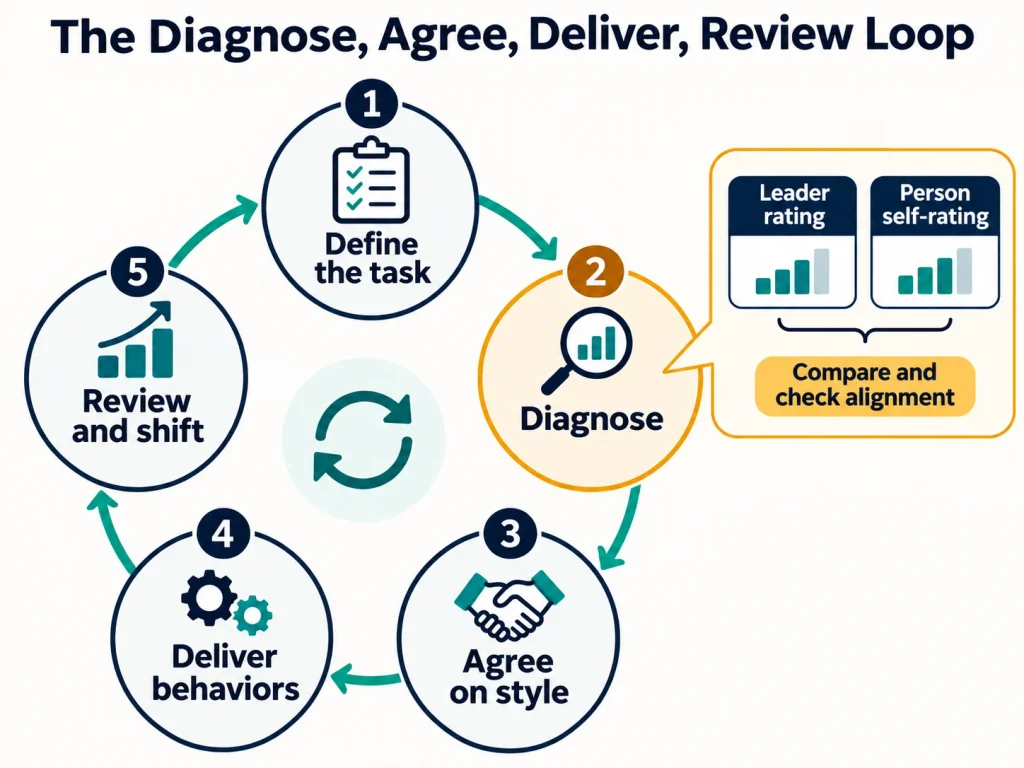
The steps below follow Blanchard’s three skills. Clear goals and agreement on style are both part of SLII. The fifth step makes explicit what the model implies, because development levels change.
- Define the task or goal. Good goal setting names one outcome and one date. Diagnosis only works when the task is clear.
- Diagnose competence and commitment. Review recent work for evidence of skill. Ask the person how confident and motivated they feel. Use one-on-one meetings for this conversation.
- Agree on the style. Tell the person what support you will give and why. For example: “I will review each draft with you for two weeks. Then we will reduce reviews.” Agreement makes a style change feel less arbitrary.
- Deliver the behaviors. Directing means checklists, examples, and quick correction. Coaching means instruction with reasons and questions. Supporting means asking for the person’s plan and removing obstacles. Delegating means agreeing on limits and reviewing at milestones.
- Review and shift. Set a review date. Reduce direction when evidence shows growth. Record the target level in an individual development plan.
A Worked Example
The example below is illustrative. It is not a real case.
A marketing manager leads three people on a product launch.
- Priya is a new analyst who has never built a launch report. She is excited. She is D1 on this task, so the manager uses directing. The manager gives her a template, two finished examples, and a daily check.
- Marcus has built two reports, and both had errors. Criticism has left him discouraged. He is D2 on the same task, so the manager uses coaching. She explains why the report matters, asks for his ideas, and names what he does well.
- Elena is an experienced strategist. She runs campaigns well but doubts her budget forecasts after a past error. She is D4 on campaign strategy and D3 on budgeting. The manager delegates the campaign and uses supporting for the budget.
One manager uses three styles in one week. Each choice follows the person and the task, not the manager’s mood.
Leading a Team With Mixed Development Levels
Most teams contain several development levels at once. The model is described as applying to an individual or a group. In practice, treat a mixed team as several one-to-one relationships.
Set shared standards for the team task. Then adjust direction and support for each person. Explain your criteria openly so that different treatment does not look like favoritism. This is a practical suggestion, not a research finding.
Common Mistakes
Many problems begin with the diagnosis, not the style choice. The causes and effects below are analytical, based on the model’s logic.
| Mistake | Why it happens | Likely consequence | Better practice |
|---|---|---|---|
| Delegating too early | The leader is busy or mistakes enthusiasm for skill | Errors, stress, and missed deadlines | Look for evidence of skill before handing over authority |
| Over-directing capable people | Habit or anxiety about results | Frustration and lost ownership | Ask for the person’s plan before giving instructions |
| Labeling people, not tasks | Labels feel simple | Wrong style on new tasks | Diagnose each person for each task |
| Diagnosing once | The first judgment feels final | Style lags behind growth | Set review dates and re-diagnose after changes |
| Ignoring the person’s own view | The leader trusts personal judgment | Ratings differ and the style misses the need | Compare your view with the person’s self-assessment |
| Changing style without explanation | Adaptation seems obvious to the leader | Followers see inconsistency | State the reason and the plan to reduce support |
A 2024 nursing review also warns against changing style too often. Frequent changes may affect team stability and follower trust.
Strengths and Limitations
Reviewers acknowledge real strengths and real weaknesses.
The model is easy to understand and intuitively appealing. It gives prescriptive guidance. It accepts that no single style fits every case. It also values developing followers.
The limitations are just as clear:
- A major criticism is the unclear definition of follower development level, including how continuous scores become four categories.
- Diagnosis depends on judgment. Thompson and Glasø identified accurate measurement of development level as the model’s main challenge. A 2024 review adds that subjective bias can distort the leader’s judgment.
- Thompson and Vecchio note that SLII may leave some combinations of competence and commitment without a specific prescription.
- The model focuses on the leader, the person, and the task. It says little about resources, role design, or culture.
What Research Says About This Leadership style
Popular, but Thinly Supported
Thompson and Vecchio call the model one of the best-known leadership theories and also one of the less well-substantiated. A 1997 review by Graeff challenged its theoretical strength, citing inconsistencies, conceptual ambiguity, incompleteness, and confusion across versions. A 2024 teaching article calls it a popular training tool with conflicted empirical support. The authors of a 2024 nursing scoping review knew of no earlier published systematic review of the model.
What Direct Tests Found
Four earlier full tests found minimal support, often only directional, and mainly at lower maturity levels. In 2009, Thompson and Vecchio tested three versions. They used survey data from 357 bank employees and 80 supervisors in ten Norwegian financial institutions. The revised 2007 version predicted performance and attitudes worse than the original, and no version received clear support.
Why Diagnosis Quality Matters
Later work by Thompson and Glasø found support for the model’s principles when leader ratings and follower self-ratings agreed. This points to diagnosis as a key issue. If leader and follower disagree about readiness, the leader may match a style to the wrong level. This is an analytical inference from the pattern, not a direct finding.
Fit Evidence From SLII-Linked Researchers
A 2017 study tested three SLII assumptions. The fit analysis used 573 followers. Reports of the study describe better results for followers who received the style they needed. Those followers showed more positive affect, greater trust in the leader, and more favorable work intentions.
Two cautions apply. The measures came from questionnaires, so the results show association, not cause. One author, Drea Zigarmi, has also co-authored SLII publications with Ken Blanchard, so the study is not fully independent.
Newer Applied Evidence From Nursing
A 2024 scoping review examined 19 studies of the model in nursing management. Most were quasi-experimental or cross-sectional, and most came from Asia. The studies generally reported positive outcomes for nurses, managers, and patients.
The review also found serious weaknesses. Reporting was often incomplete, and studies did not follow reporting guidelines. Many did not use validated tools to measure nurse maturity. The studies did not state which version of the model they used.
Nine of the 19 studies used a one-group pretest and posttest design. That design cannot show that the style match caused the results. These studies show the model is widely used, not that it works.
Related Evidence on Direction and Support
Some research tests the two behaviors without testing the full model. A meta-analysis combined 163 and 159 correlations. Consideration (.48) and initiating structure (.29) both related to leadership outcomes. Consideration related more strongly to follower satisfaction, motivation, and leader effectiveness. Initiating structure related slightly more strongly to leader performance and group performance.
These two dimensions resemble supportive and directive behavior. The results suggest leaders need both. The study did not test whether leaders should match them to follower level.
Team research points the same way. In a study of 60 teams, directive leadership produced higher early performance. Empowering leadership produced larger gains over time, linked to team learning, coordination, empowerment, and shared mental models. A later paper links the early gain to greater role clarity.
This pattern resembles the model’s movement from directing toward delegating. The authors also warn that empowered teams may pay an early performance cost before gains appear. The study did not test SLII, and one study cannot settle the question.
What This Means in Practice
Taken together, the evidence supports a cautious reading. Situational leadership is a useful structure for development conversations. It is not a validated formula that guarantees better results.
Three practices are consistent with the evidence. Verify your diagnosis with the person. Give beginners structure. Move toward autonomy as evidence of skill grows. This is an analytical conclusion, not a research finding.
How this style Compares With Other Approaches
Fiedler’s contingency model treats a leader’s style as fairly stable. It argues that effectiveness comes from matching the leader’s natural style to the situation, not from changing style. It judges the situation by leader-member relations, task structure, and position power. Situational leadership assumes the leader can and should adapt.
Under path-goal theory, leaders also adapt. It focuses on observable leader behavior and on giving followers a path to valued goals. It stresses motivation and obstacles. Situational leadership stresses follower development on a task.
The third approach, transformational leadership, works at a different level. It focuses on inspiring people through a shared vision. Meta-analytic work found it significantly related to consideration (.74) and initiating structure (.50). The approaches can be combined. A leader can inspire with vision and still adjust direction and support person by person.
| Approach | Main question | Does the leader change style? |
|---|---|---|
| Fiedler’s model | Which situations suit this leader? | Little. The situation or placement changes. |
| Path-goal | How can the leader clear the path to valued goals? | Yes |
| Situational (SLII) | What does this person need on this task? | Yes, guided by diagnosis |
| Transformational | How does the leader inspire commitment to a vision? | It is not a style-matching model |
When the Model Fits and When It Does Not
These criteria are analytical guidance, not research findings.
The model fits best when:
- Performance depends mainly on skill or confidence.
- The task is clear enough to assess.
- The leader sees the person’s work often.
- The leader has time to develop people.
It is less suitable as a stand-alone tool when:
- The main barrier is structural, such as tools, staffing, or unclear roles.
- The task has fixed safety or compliance rules that apply to everyone.
- The problem is conflict or ethics, not readiness.
- The span of control is too wide for individual diagnosis.
Even in these cases, the model can still guide the development side of the leader’s work.
Building Situational Leadership Capability in an Organization
HR and business leaders can build this skill inside wider leadership development programs. The recommendations below are analytical.
- Teach diagnosis before style names. Labels are easy to learn. Accurate diagnosis is the harder skill. Practice it on real cases.
- Build leadership self-awareness. Leaders should know their default style and when it fails. Reflection and coaching help.
- Use multi-source feedback. 360-degree feedback shows how followers experience direction and support.
- Compare leader and follower ratings. Ask people to rate their own competence and commitment on a task. Then compare. Agreement is where the research shows support.
- Keep levels out of performance ratings. Levels describe a person-task match at one moment. They do not describe potential.
Conclusion
Situational leadership style asks leaders to match direction and support to a person’s development level on a specific task. The four styles are directing, coaching, supporting, and delegating. The four levels run from enthusiastic beginner to self-reliant achiever.
The model’s value lies in diagnosis. Leaders must judge each task, involve the person, and re-diagnose as conditions change. Research shows the model is popular but thinly tested. Support is strongest for beginners and when leader and follower agree on readiness. Studies of related behaviors show that leaders need both structure and support.
Over the long term, the goal is not to perfect a style. The goal is to build people who can own their work. Used as a diagnostic conversation tool, situational leadership helps leaders guide that growth with care and evidence.
Situational leadership ends with delegating, where a capable person owns the outcome. That step often fails when authority moves without clear limits. The next skill is a repeatable method for handing over work, setting guardrails, and reviewing results. Mastering effective delegation turns a D4 diagnosis into a dependable practice.
FAQ
How long does it take to move someone from D1 to D4?
The model gives no fixed timeline, and I found no research that sets one. The time depends on task complexity, prior experience, and feedback quality. Judge progress by evidence of independent, reliable work.
Does situational leadership work for remote or hybrid teams?
The model does not depend on location. What changes is how leaders gather evidence for diagnosis. Remote leaders may need scheduled check-ins, written expectations, and reviews of work samples. This is an analytical suggestion, not a tested finding.
How should you lead an experienced person who is new to your team?
Do not assume a high level on every task. Observe early work and ask about confidence with your tools and standards. Delegate where skill is proven, and add direction only where gaps appear. This is analytical guidance.
Is situational leadership a good fit for first-time managers?
It can help because it gives a simple structure for development conversations. The risk is treating labels as facts. New managers should confirm each diagnosis by asking the person and reviewing recent work.
In which settings has situational leadership been tested?
Researchers tested it with teachers, nurses, university employees, military academy squads, and bank employees. Results in those tests were mixed, with the most support for low-readiness employees. A 2024 scoping review found 19 nursing studies. Their reported outcomes were positive, but the authors flagged weak reporting and unvalidated tools.
Do you need a license or certification to use the model?
Using the general idea in your own management practice differs from reproducing branded materials or assessments. Hersey and Blanchard each registered their own version of the model. The Center for Leadership Studies publishes intellectual property guidelines for its Situational Leadership materials. Check the owner’s guidelines before reusing branded content. This is not legal advice.