
Leadership decision-making is the process leaders use to choose a course of action that commits people, money, or time. A sound process frames the decision, gathers evidence, compares options, assigns ownership, and reviews results. No single process fits every decision. Leaders adjust how deeply they analyze, how many people they involve, and how fast they act.
What Leadership Decision-Making Is
What Makes a Leadership Decision Different
A leadership decision commits other people. It allocates budget, attention, or authority, and others usually carry it out. Often they had no part in shaping it.
That creates two goals. The decision must be sound, and the people who execute it must accept it. Vroom and Yetton’s 1973 model weighs both: the quality of the decision and the team’s commitment to carry it out.
The pairing explains why a strong decision can still fail. A leader may choose well and explain poorly. Implementers then resist the choice or reinterpret it. A good process serves both goals.
Why the Process Matters
Decisions take up a large share of working time. In McKinsey’s 2019 survey, just over half of respondents report spending more than 30 percent of working time on decisions. The online survey ran in February 2018 and drew 1,259 participants from 91 countries.
Most respondents doubted that time was well spent. On average, 61 percent said most of their decision-making time is used ineffectively. Only 20 percent said their organizations excel at decision making.
McKinsey called that 20 percent the winners. Respondents at those organizations were twice as likely as others to report superior returns from their latest decision. McKinsey defined superior as a financial return of 20 percent or more on a recent big-bet or cross-cutting decision. All of this is self-reported survey data. It shows an association, not a cause.
An earlier McKinsey study points the same way. It covered 1,048 major decisions, and process mattered more than analysis by a factor of six. McKinsey estimated a 6.9 point ROI gain from moving the process from the bottom to the top quartile. That estimate used the 673 decisions with ROI data. This study also relied on managers’ own reports.
The practical point is narrower. Process is the part of decision-making that leaders can inspect and improve. Outcomes also depend on factors outside the process, such as timing and chance.
The Leadership Decision-Making Process, Stage by Stage
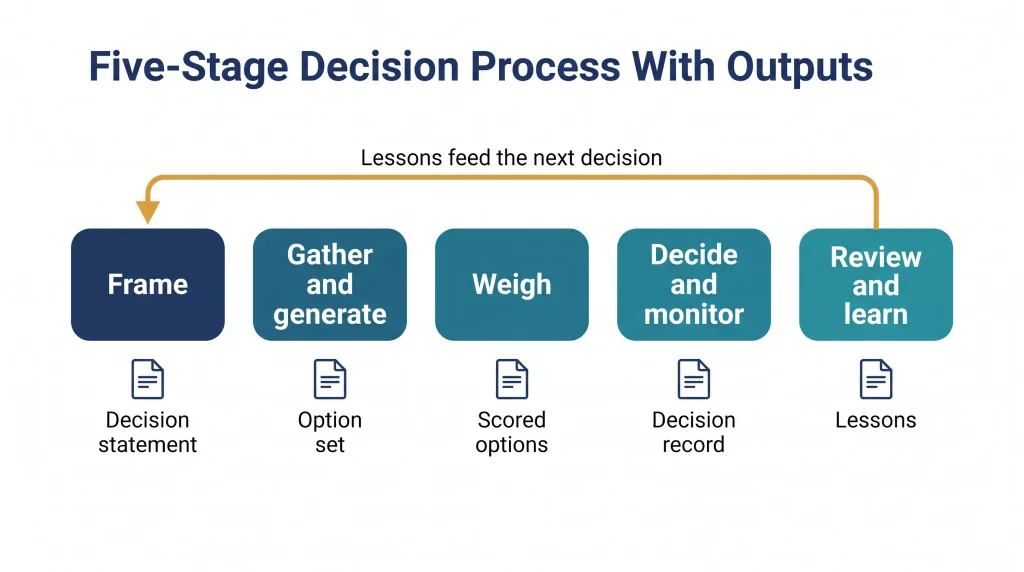
The process has five stages. Each should leave behind an output that someone else can inspect. The table lists the key question, the output, and the typical failure at each stage.
| Stage | Key question | Output to produce | Typical failure |
| 1. Frame | What exactly must be decided, and by when? | One-sentence decision statement, owner, deadline, success measures | Solving a symptom; scope creep |
| 2. Gather and generate | What do we know, and what else could we do? | Evidence summary and more than two distinct options | Seeking only supporting evidence; two-option framing |
| 3. Weigh | Which option best meets the criteria, and what could go wrong? | Scored options, risks, and a recommendation | Criteria bent to fit a favorite |
| 4. Decide and monitor | Who decides, and how will others learn why? | Decision, rationale, owners, indicators, checkpoints | Silent decisions; launch and forget |
| 5. Review | Did it work, and was the process sound? | Updated decision record and lessons | Judging only by outcome |
Stage 1: Frame the Decision
Name the decision in one sentence. State what will be chosen, who owns the choice, and when it is due. Then list the measures that will show success.
Framing prevents two common failures. One is solving a symptom instead of the underlying problem. The other is scope creep, where a decision grows beyond its original boundaries. Asana’s decision-making guide lists scope creep among its main pitfalls.
A stakeholder analysis shows who is affected and who holds relevant knowledge. It also flags who can block execution. Agree on success metrics before debating options. Measures set early make it harder to bend the criteria toward a favorite option.
Stage 2: Gather Evidence and Generate Options
Gather evidence from data and from people close to the work. Include people likely to disagree. Dissenters often hold information that the leader’s usual network lacks.
Then generate more than two distinct options, including the option to keep the current course. Kepner-Tregoe’s method treats the current course as an alternative like any other. A two-option framing also hides middle paths. Asana notes that the best answer is sometimes a blend of several alternatives.
The search needs a stopping rule. More information improves a decision only while it can still change the choice. Set a deadline and a threshold before the search begins.
Stage 3: Weigh the Options
For simple choices, a pros and cons list is enough. Choices with several criteria call for a decision matrix. List the criteria and weight them. Then score each option against each one.
Kepner-Tregoe adds a useful distinction. Musts are mandatory objectives, and an option that fails one is eliminated. Wants are desirable objectives that rank the options that remain. The method also asks leaders to identify adverse consequences before they choose.
Risk deserves its own column. For each leading option, estimate how likely each failure is and how costly it would be.
A sensitivity check adds rigor. Change one key assumption at a time and watch whether the ranking flips. If a small change reverses the ranking, the choice depends on that assumption. Test it before committing, or choose an option that tolerates being wrong.
Then compare the scores with your instinct. A gap between them is a signal. It may point to a missing criterion or an unspoken concern. Resolve the gap before committing.
Stage 4: Decide, Communicate, and Monitor
A decision is complete only when the right people know what was decided and why. They also need to know who owns each action. State the rationale openly. People who understand the reasoning can adapt the decision when conditions change.
If the decision changes how people work, treat adoption as a separate task. A change management plan covers how people hear about the change and how they learn to work differently. Without one, a sound decision can stall during execution.
Monitoring starts at launch. Choose early indicators that would show the decision is failing, and set checkpoints. Agree in advance what result would trigger a change of course.
Stage 5: Review the Decision and the Process
Review asks two questions. Did the decision achieve its aims? Was the process sound, given what was known at the time?
The second question matters because outcomes mislead. A careful process can produce a poor result through chance. A careless process can succeed by luck. Judging only the outcome teaches the wrong lessons. This is analytical reasoning, not a measured finding.
Professor Hew Gill of Sunway University suggests a specific check. Evaluate how the problem was identified, how information was gathered, and how options were analyzed. Weaknesses found there can be addressed in future decisions. A written record, described at the end of this guide, makes that review possible.
Match the Process to the Decision
Heavy analysis wastes time on simple choices. Light analysis exposes the organization on complex ones. Leaders need a way to match the process to the situation.
Use the Cynefin Framework to Read the Situation
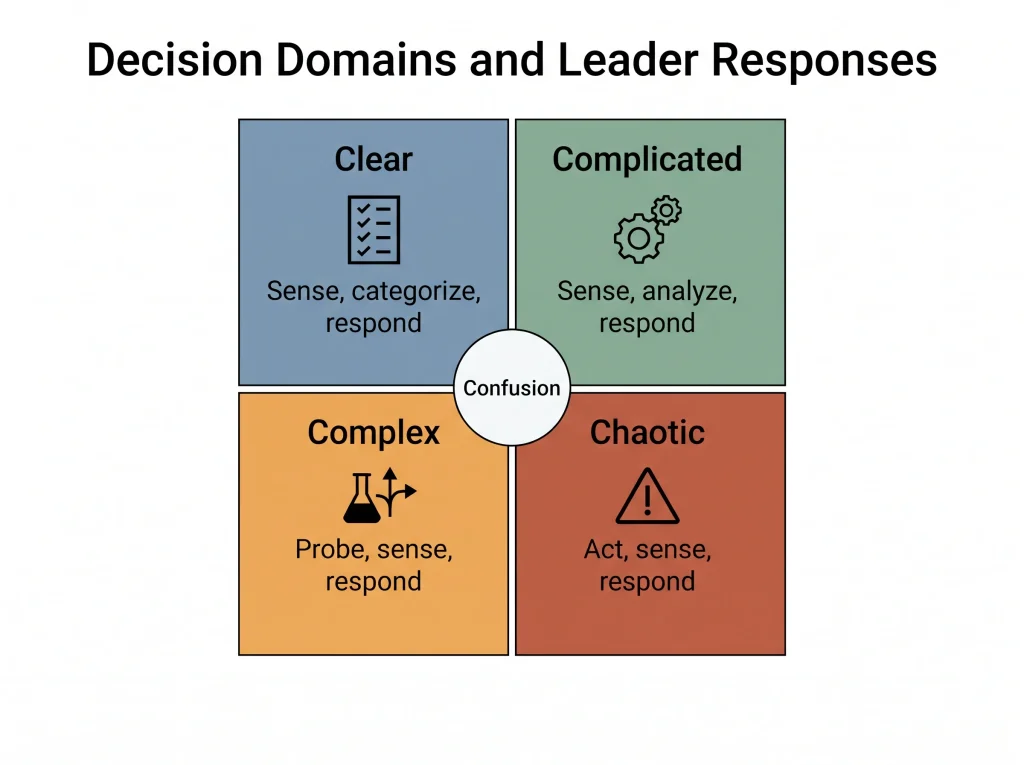
Dave Snowden and Mary Boone presented the Cynefin framework to leaders in a 2007 Harvard Business Review article. It sorts situations into domains and recommends a different response in each. The Center for Creative Leadership applies the same idea. Its guide sorts challenges into ordered, complex, and chaotic systems.
| Domain | Illustrative example | Response sequence | Implication for the process |
| Clear | Approving a routine expense | Sense, categorize, respond | Apply the standard rule. Skip extended debate. |
| Complicated | Choosing an enterprise software vendor | Sense, analyze, respond | Use expert analysis and a full option comparison. |
| Complex | Redesigning how several teams collaborate | Probe, sense, respond | Run small, safe experiments. Learn before scaling. |
| Chaotic | Responding to a major service outage | Act, sense, respond | Stabilize first. Analyze afterward. |
| Confusion | Unclear which domain applies | Break the situation into parts | Assign each part to a domain. |
The examples are illustrative and are not taken from the sources. The response sequences follow Snowden and Boone (2007) as described in secondary sources.
Analysis has limits. In complicated situations, expert analysis can predict results. In complex ones, results emerge only as events unfold. A leader who demands a full forecast there may wait for certainty that analysis cannot supply.
A Decision Weight Check
The domain is one input. Four more questions set how heavy the process should be. Can the decision be undone cheaply if it proves wrong? Who holds the information the choice depends on, and is the leader one of them? How much does execution depend on others accepting the decision? Is the situation stable enough for analysis to predict what happens?
This check is an analytical synthesis. It combines Vroom’s focus on quality and commitment with Simon’s limits on information. It also borrows the Cynefin domains. The check is not a published model or a research finding.
Reversible decisions that need little buy-in can move fast with a light process. Irreversible decisions that need broad commitment justify wider input, written options, and a pre-mortem. Complex situations call for experiments that make decisions reversible by design.
The check also exposes mismatches. An exhaustive process for a reversible choice wastes effort. A rushed process for an irreversible one invites error.
Consider three hypothetical decisions. They illustrate the check and are not real cases.
- Changing the day of a weekly team meeting is reversible and low in stakes. Commitment matters little. A short consultation and a quick decision are enough.
- Choosing a new customer data platform is costly to undo. Technical staff hold key knowledge, and adoption depends on users. This calls for wide input, written options, a scored comparison, and a pre-mortem, which a later section explains.
- Entering an unfamiliar market is uncertain and hard to forecast. A limited pilot makes the decision reversible in stages before full commitment.
Deciding Under Time Pressure
Urgency compresses the stages. It should not remove them. A fast decision still needs a framed question and a named owner. It also needs a stated rationale.
Cut the work with the lowest value per hour. Ask only for facts that could change the choice. Generate fewer options, but keep the current course and one real alternative. Replace a full matrix with two or three decisive criteria.
Keep the protections that cost little. A short, explicit request for objections surfaces information the leader may lack. Ask one person to argue against the leading option. Record the decision in a few lines so a later review is possible.
If the decision is reversible, set a checkpoint instead of seeking certainty. If it is not, protect the time for a pre-mortem. These are analytical recommendations drawn from the stages above, not findings from a study.
Leadership Decision-Making Models Compared
Models describe how leaders should decide or how they actually decide. Four matter most here, and each fits different conditions.
| Model | Core idea | Works best when | Main limitation |
| Rational model | Define the problem, set criteria, compare alternatives, choose the best | Time, data, and clear criteria are available | Assumes complete information and ample time |
| Bounded rationality | Information, time, and mental capacity are limited, so people accept a good enough option | Information or time is limited | The “good enough” threshold may be set too low |
| Recognition-primed decision | Experts recognize a familiar pattern and act on the first workable option | The leader has deep experience and time is short | Weak in unfamiliar situations; hard to audit |
| Vroom-Yetton-Jago | The situation determines how much the team takes part | Commitment and information are spread across the team | Diagnosis is subjective; less suited to crises |
The rational model is the standard behind most step-by-step guides. Asana calls it the most common model and describes it as logical and sequential.
Herbert Simon challenged its assumptions in 1955. His paper, “A Behavioral Model of Rational Choice,” appeared in The Quarterly Journal of Economics. He argued that people decide within limits. Information, time, and mental capacity are all finite. Simon described decision makers as satisficing, meaning they accept a good enough option instead of the best one. Simon’s idea of bounded rationality permits leaders to stop searching. It also demands a clear definition of good enough.
Gary Klein’s research on experts such as firefighters, summarized in Sources of Power (MIT Press, 1998), points the other way. Experts often skip comparison. They recognize a situation as familiar and act on the first workable option. The recognition-primed decision model explains how experience can make fast decisions sound. It depends on expertise, so it suits familiar situations better than novel ones.
Paralysis and premature closure are opposite failures. Bounded rationality guards against paralysis. Checklists and pre-mortems guard against premature closure. This pairing is analytical synthesis.
Who Decides: Involvement and Decision Rights
The Vroom-Yetton-Jago Spectrum
The Vroom-Yetton-Jago model answers one question: how much should the leader involve others? Vroom and Yetton introduced it in 1973. Vroom and Arthur Jago refined it in 1988. Vroom’s later versions describe five methods: decide, consult individually, consult as a group, facilitate, and delegate.
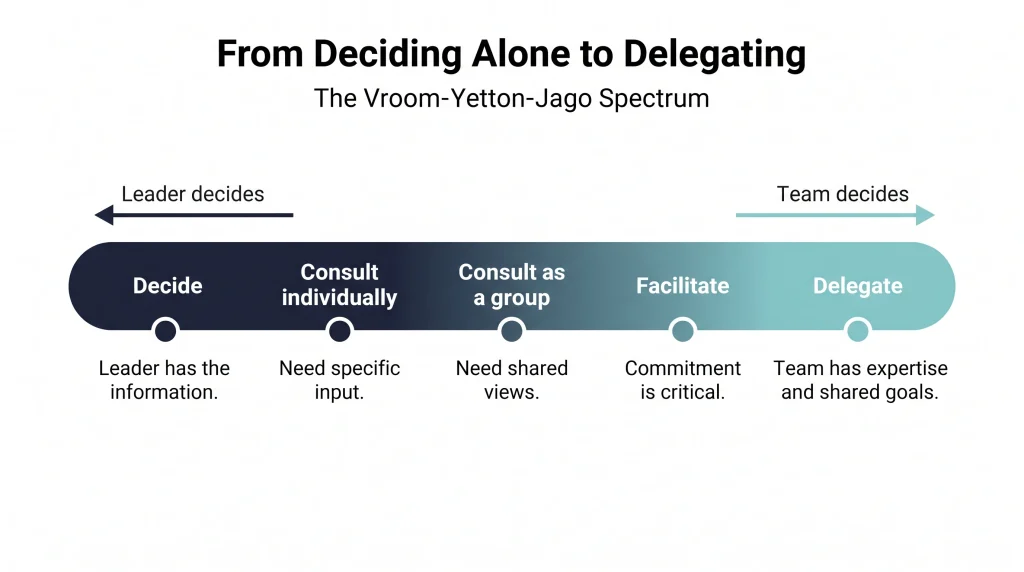
Those versions ask about seven factors. Four concern the decision and the leader. These are significance, the importance of commitment, the leader’s expertise, and the odds of commitment if the leader decides alone. Three concern the team: its support for the objectives, its expertise, and its competence at working together.
The logic is direct. When the leader lacks key information, consulting adds it. Involvement builds commitment that a solo decision would not earn. Delegation is risky if the team does not share the organization’s goals.
The model has limits. Leaders must judge their own expertise and the team’s likely reaction, and both judgments can be wrong. A poorly run group process can also produce worse results than a well-run consultation. Umbrex notes that the model is less suitable in crises that demand immediate action.
A 2019 chapter by Morozova and colleagues reaches a related conclusion. Leadership shapes only certain characteristics of the decision process. No type of leadership guarantees optimal decisions.
Clarify Decision Roles With RAPID
Involvement raises a second question: who owns the final call? Paul Rogers and Marcia Blenko of Bain & Company wrote about this in Harvard Business Review in January 2006. They argued that decisions stall when accountability is unclear. Their RAPID framework assigns five roles: Recommend, Agree, Perform, Input, and Decide.
The recommender proposes a course of action. Those who agree must approve it before it moves forward. Those who give input supply information on feasibility. The decider makes the final call and commits the organization. The performers carry out the decision.
Roles remove a hidden source of delay. Without them, a proposal can circulate between groups while each assumes another will decide. Every extra agree role adds a possible gate, so keep that role narrow.
RAPID complements the Vroom-Yetton-Jago model. One tells the leader how much to involve others. The other tells everyone who does what.
Consensus Has a Cost
Consensus feels safe but carries risk. HBS Online lists defaulting to consensus as a common leadership pitfall. Irving Janis defined groupthink as a mode of thinking in cohesive groups. In it, concurrence-seeking becomes so dominant that it overrides realistic appraisal of alternatives.
Janis proposed practical countermeasures. Leaders can assign each member the role of critical evaluator and avoid stating their own opinion when assigning a task. Groups can invite outside experts and assign a devil’s advocate, a different person at each meeting. Each measure makes dissent routine instead of personal.
The Vroom-Yetton-Jago factors can help a leader judge when a group decision is worth its slower pace.
Protecting Decisions From Bias
Review the Process, Not Only the Proposal
Biases can distort the proposals that teams bring to leaders. Daniel Kahneman, Dan Lovallo, and Olivier Sibony described this in Harvard Business Review in June 2011. HBR’s summary of the article describes the risks. A team attached to its recommendation may ignore contrary evidence, overweight one data point, or draw weak comparisons. These patterns are examples of cognitive biases.
The authors argue that leaders should review the quality of the decision process, not only the content of the proposal. They offer a 12-question checklist to catch these flaws.
A process checklist shifts scrutiny from the person to the process. This framing may let a leader raise hard questions without questioning a colleague’s integrity. That is an analytical inference, not a finding.
Run a Pre-Mortem
Gary Klein described the pre-mortem in Harvard Business Review in 2007. The team first reviews the plan. The leader then announces that the project has failed badly. Each member silently writes down reasons for the failure. The team reads the reasons aloud, and the plan is revised to address them.
Klein cites a 1989 study by Deborah Mitchell, Jay Russo, and Nancy Pennington. It found that imagining an event had already occurred improved the ability to identify reasons for outcomes by 30 percent. That is a single study as reported by Klein, so treat the figure as indicative.
A pre-mortem analysis makes it safer for knowledgeable skeptics to speak. It still depends on psychological safety in the team. Without it, people may write cautious reasons and hold back real doubts.
A Case in Process Failure: The Challenger Launch Decision
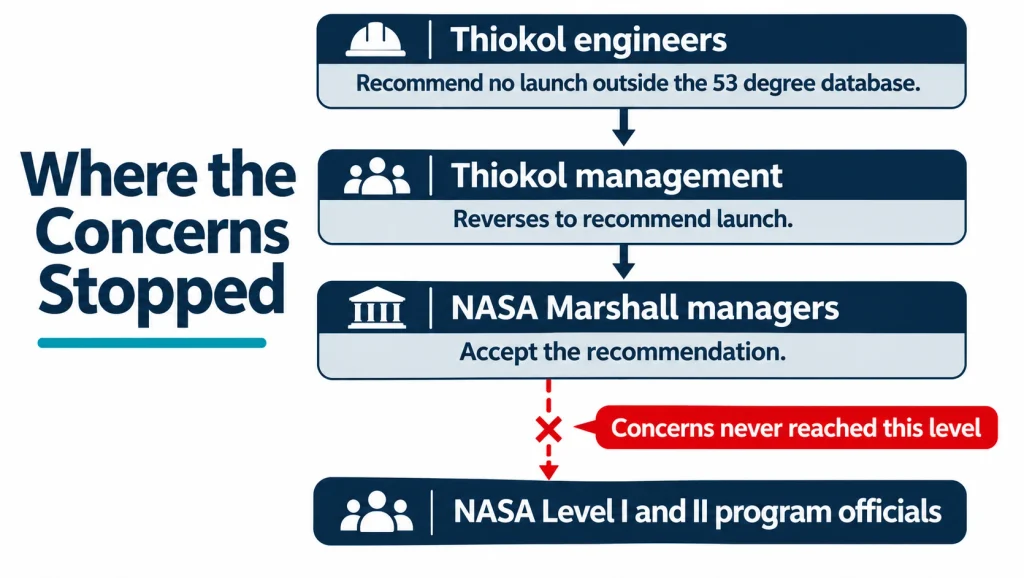
The 1986 Challenger launch decision shows how the stages interact when one of them fails. The account below follows Chapter V of the Rogers Commission report.
On the evening of January 27, 1986, engineers at Morton Thiokol, the booster manufacturer, joined a teleconference with NASA. Thiokol’s engineers recommended against launching outside their flight database. That database reached down to 53 degrees Fahrenheit.
Thiokol then held an off-line caucus that lasted about 30 minutes. When the call resumed, Thiokol recommended launch. Testimony records no dissenting responses at that point.
The Commission concluded that Thiokol management reversed its position at Marshall’s urging. It did so to accommodate a major customer.
Engineer Roger Boisjoly testified about the burden of proof. The engineers, he said, had to prove beyond a shadow of a doubt that launching was not safe.
The Commission found a serious flaw in the decision-making process. Crucial information never reached Jesse Moore or Arnold Aldrich, the Level I and Level II program officials. The Commission also stated that waiving launch constraints appears to have been at the expense of flight safety. No system required every management level to consider such waivers.
Three process lessons follow. They are analytical interpretations, not Commission findings.
- Framing. The burden of proof flipped, so the engineers had to prove danger instead of managers proving safety. Decide in advance who must prove what, and what evidence ends the debate.
- Decision rights. Information did not reach the people with authority. Define how unresolved safety objections escalate.
- Dissent. Engineers objected, yet the process gave their view no protected route. Ask for dissent before the decision, from people who face no customer pressure.
A single case cannot establish a general rule. It does show how quickly a decision degrades when several stages fail at once.
Record the Decision: A One-Page Template
A written record turns the process into a repeatable practice. It preserves what was known at the time, which makes fair review possible. A decision log that stores these records also shows new leaders how past choices were made.
The template below is an analytical tool that combines the stages and safeguards in this guide. It is not a published standard. Keep it to one page so people will fill it in.
| Field | What to record |
| Decision statement | What will be chosen, and by when |
| Owner and decider | Who recommends, who decides, and who must agree |
| Reversibility | How costly it would be to undo |
| Success measures | How results will be judged |
| Options considered | Including the option to keep the current course |
| Evidence and assumptions | What the choice depends on |
| Dissenting views | Who disagreed, and why |
| Pre-mortem findings | The likeliest failure reasons and the planned responses |
| Decision and rationale | What was chosen, and why |
| Communication and monitoring | Who is told, which indicators, which checkpoints |
| Review date | When the decision and the process will be assessed |
How the Pieces Fit Together
A leadership decision succeeds on two measures: soundness and acceptance. The five stages serve both, because each one leaves an output that others can inspect and challenge.
How much process a decision needs depends on the situation. Reversibility and stability set the depth of analysis. The need for commitment sets how many people to involve. The models mark the trade-offs. Rational analysis offers rigor, and bounded rationality offers speed. Recognition-primed judgment offers experience, but only experts have it.
Ownership and dissent protect the process. RAPID roles settle who decides. Checklists, pre-mortems, and assigned critics counter bias and conformity. The Challenger case shows how fast a decision degrades without them. The evidence that better process yields better results is observational, so treat it as a strong association and not proof.
Over time, a written record lets leaders judge their process separately from outcomes. That separation is where decision skill improves.
A process cannot compensate for a leader who never studies how decisions turn out. The review stage and the decision log produce feedback, and feedback is the raw material for better judgment. Developing decision-making skills is therefore the next topic. It moves from how a decision should be made to how a leader gets better at making them.
Frequently Asked Questions
What are the 5 C’s of decision-making?
The label has more than one use. Brené Brown’s version lists Context, Color, Connective Tissue, Cost, and Consequence, each with a guiding question. They cover the wider situation, the goal and its urgency, and links to other plans. They also cover resource cost and the risks of inaction.
What is the 10-10-10 rule for decisions?
Suzy Welch’s 10-10-10 method asks what a decision’s consequences will be in 10 minutes, 10 months, and 10 years. Welch uses it when no option seems to please everyone. It adds a time perspective but does not replace evidence, criteria, or stakeholder input.
What is the 30-60-90 rule in leadership?
It is a phased plan for a new leader’s first 90 days. In Jeff Clark’s version for Ivy Exec, the first 30 days are for learning people, roles, and culture. Days 31 to 60 add team conversations and information gathering, still without changes. Days 61 to 90 bring a shared plan and the first changes. Other 30-60-90 plans exist.
What is the 37% rule in decision-making?
The rule comes from the secretary problem in probability. Reject the first 37 percent of candidates, then pick the first one better than all those seen. This gives about a 37 percent chance of choosing the best candidate, whatever the pool size. It assumes a known number of candidates, one look at each, and no way to recall a rejected one. Most leadership decisions break those assumptions, so treat the rule as a thinking aid and not a procedure.
What is the 80/20 rule in decision-making?
It is the Pareto principle: roughly 80 percent of consequences come from 20 percent of causes. Vilfredo Pareto noted the pattern in Italian land ownership, and Joseph Juran applied it to quality management in 1941. The split is a rule of thumb, and real distributions can be closer to 90:10 or 70:30. In decisions, it prompts leaders to find the few factors that drive most of the result before gathering more data.
How many steps are in the leadership decision-making process?
Sources split the same work at different points. Corporate Education Group lists five steps, the Center for Creative Leadership six, and Asana seven. The Wise Decision Maker podcast lists eight. Google’s People Also Ask box shows the same spread, with questions about five, six, seven, and eight steps.
What are the types of decision-making?
Sources group decisions in several ways, so counts differ. By structure, OpenStax defines programmed decisions as repeated choices guided by existing rules. Nonprogrammed decisions are novel and unstructured, with criteria that are not well defined. By management level, GeeksforGeeks separates strategic, tactical, and operational decisions. Strategic decisions shape the organization’s future, tactical decisions carry out strategy, and operational decisions cover daily routines.
What are the four main styles of decision-making?
Rowe and Boulgarides’ decision style theory names directive, analytical, conceptual, and behavioral styles. Two dimensions define them: tolerance for ambiguity, and orientation toward tasks or people. Directive deciders favor speed. Analytical deciders want all the data. Conceptual deciders think in options. Behavioral deciders optimize for acceptance. These are individual preferences. They differ from Vroom’s methods, which describe how much a leader involves others.