
Participative leadership is a style in which the leader involves team members in decisions. The leader gathers input, weighs it, and then chooses. Final authority stays with the leader. Studies link the style to job satisfaction and engagement, mostly through correlational designs. It can also slow decisions and expose sensitive information. This article covers the definition, origins, mechanism, evidence, drawbacks, and the situations where the style fits.
What Is Participative Leadership?
Participative leadership asks team members for ideas and expertise before a decision is made. The leader weighs that input against goals, risks, and constraints. Then the leader decides. A 2022 literature review by Wang, Hou and Li describes this same pattern.
Many sources call the style democratic leadership. The label traces back to Kurt Lewin’s early group research. The same review credits Rensis Likert, in 1961, with formally introducing participative leadership as a concept.
Kahai and colleagues (1997), as summarized in the review, describe leaders who ask for opinions before deciding. Those leaders also encourage active participation. The review names two core traits. Employees are consulted before decisions. They also receive resources that support their work.
This article uses a narrow sense. Participative means the leader consults the group and keeps the final decision.
Core Characteristics of a Participative Leader
Practitioner sources and the research literature describe these common traits:
- Listening to input and treating it as usable, not symbolic.
- Sharing relevant information so people can contribute.
- Explaining how the decision was reached, even after overruling the majority.
- Making disagreement safe to voice.
- Keeping accountability for the outcome instead of passing it to the group.
Two contrasts clarify the style. In autocratic leadership, the leader decides alone. In a full consensus model, the group itself holds decision rights. Participative leadership sits between them.
Where Participative Leadership Comes From
Four research traditions shaped how organizations understand the style. Each answers a different question. Lewin asked what climate a leader creates. Likert asked how management systems differ. House and Vroom asked when participation fits.
Kurt Lewin’s Leadership Climates (1939)
Kurt Lewin, Ronald Lippitt and Ralph White published a study in the Journal of Social Psychology in 1939. Trained adult leaders ran clubs of ten-year-old boys in Iowa. Each club worked under an autocratic, democratic, or laissez-faire climate.
White and Lippitt later described the democratic leader as active in stimulating group discussion and group decisions. The laissez-faire leader played a passive, hands-off role.
Billig quotes Forsyth (2009) on the observers’ notes. The democratically led groups kept working when the leader left. The boys in the autocratic groups stopped working.
This is a secondhand account of the original study. Billig also cites Forsyth and Burnette (2005). They say autocratic groups worked longer, but hostility and aggression were highest.
The study has clear limits. It observed small clubs of boys, not adult employees. Social psychologist Michael Billig has argued that its labels carried value judgments, with democracy treated as the good condition. The results describe a historical experiment. They do not show that participative leadership works best.
Likert’s Participative Management (1961)
Rensis Likert’s 1961 book, New Patterns of Management, is credited in the 2022 review with introducing participative leadership. The review lists three principles from his work: mutual support, group decision, and high standards.
House’s Path-Goal Theory
Robert House developed path-goal theory in a 1971 paper in Administrative Science Quarterly. It built on earlier work by Martin Evans in 1970. In 1974, House and Terence Mitchell described four leader behaviors. They are directive, supportive, participative, and achievement-oriented.
The theory predicts that the best behavior depends on the followers and the work. Businessballs’ summary says participative behavior suits experienced, confident followers who reject close control. It also lists unstructured, complex tasks as a fit.
The theory is a framework for matching behavior to context. This article treats it as a source of conditions to check, not as proof of outcomes.
The Vroom-Yetton-Jago Decision Model
Victor Vroom and Philip Yetton published Leadership and Decision-Making in 1973. Vroom and Arthur Jago revised the model in their 1988 book, The New Leadership. The model gives leaders a decision tree for choosing how much to involve the team. Some sources call it the Leader Participation Model. Mind Tools describes the 1988 version as more complex, with additional questions and a mathematical formula.
It defines five decision processes. Two are autocratic. In the first, the leader decides alone. In the second, the leader collects facts from the team, then decides alone. Two are consultative. The leader shares the problem with individuals or with the group, then decides alone. One is a group process. The group discusses the problem, and its decision stands.
The model treats participation as a dial, not a fixed identity. A leader can be highly participative on one decision and autocratic on the next.
How Participative Leadership Works
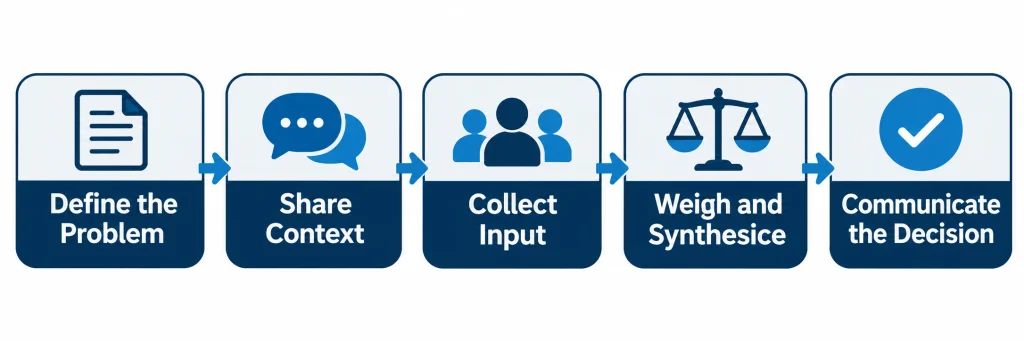
The practice follows a sequence. The leader defines the problem and shares context. The leader collects input and weighs it against organizational constraints. Finally, the leader communicates the decision and the reasoning behind it. This sequence is a practical synthesis, not a single validated model.
Core Components
| Component | What It Does | Why It Matters |
|---|---|---|
| Information sharing | Gives the team enough context to contribute | Without context, input becomes guesswork |
| Structured input collection | Asks specific questions rather than open ended ones | Focused questions produce usable answers faster |
| Weighing and synthesis | Tests input against goals, risk, and feasibility | Keeps the process from becoming a popularity contest |
| Transparent communication | Explains the decision and how input shaped it | Preserves trust when the leader overrules the majority |
Each component builds on the last. Weak information sharing lowers the quality of input. A missing explanation can damage trust, even when the leader listened closely.
Research supports the first component. Lam, Huang and Chan (2015), summarized in the review, found that leader information sharing shapes how participative leadership affects performance. They also found that employees respond only when participative behavior reaches a certain level.
Cause, Mechanism, and Effect
The likely mechanism is simple, though this is analysis rather than a proven pathway. People who contribute to a decision understand its reasoning. That understanding can raise employee engagement, because employees see themselves as part of the outcome.
Some research fits this pattern. A 2023 survey of small, medium and micro enterprises linked participative leadership to job satisfaction. Psychological empowerment and work engagement statistically mediated the link. The design was cross-sectional. It shows association, not cause.
The 2022 review lists further mechanisms from other studies. Zou and colleagues (2020) reported greater self-efficacy and psychological security. Other studies point to social exchange between leaders and employees.
What Shapes a Leader’s Use of Participation
Why do some leaders consult more than others? The review summarizes several factors.
- Experienced leaders may lean toward participation (Somech, 2002).
- Higher self-awareness went with a more participative style in one study (Black, 2020).
- Leaders focused on finding the best solution lean participative. Leaders focused on changing the state of affairs lean directive (Li and colleagues, 2018).
Context also matters. The review cites Huang and colleagues (2011) for the point that a supportive organizational culture helps the style develop. It also cites Lonati (2020), who argues that larger groups and greater social complexity historically favored directive leadership.
Participative Leadership Compared to Other Styles
Styles differ mainly in who holds decision rights. The table is an editorial summary of typical patterns. It is not measured data.
| Style | Who Decides | Typical Speed | Typical Best Fit |
|---|---|---|---|
| Autocratic | Leader alone | Fast | Emergencies, highly structured tasks |
| Participative | Leader, informed by team input | Moderate | Complex problems, experienced teams |
| Group vote (collective) | Group majority vote | Moderate to slow | Low stakes decisions, community settings |
| Laissez-faire | Team members individually | Varies | Highly skilled, self-directed experts |
Sources disagree on terms. Many treat participative and democratic leadership as one style. Lewin’s democratic climate involved group discussion and group decisions. Many practitioner pages use “democratic” for leader-decides-after-input. The table keeps votes as a separate row.
The 2022 review also separates participative from empowering leadership. Participative leadership shares decision making. Empowering leadership delegates personal authority and job responsibilities, so employees choose how they work.
Types of Participative Leadership and Why Sources Disagree
Several practitioner pages split participative leadership into four types. They are autocratic, consensus, collective, and democratic. TopResume, MasterClass, Personio, and MTD Training all use versions of this list.
The pages agree on rough meanings. Autocratic participative means the leader gathers input but keeps the final say. Consensus means the group must agree. Collective means the group decides, often by majority vote. Democratic means the team gives input and the leader decides.
The labels create a conflict. Lewin’s democratic climate involved group discussion and group decisions. These pages use “democratic” for leader-decides-after-input. Readers meet both meanings.
None of these four-type lists cites research. Treat them as practitioner shorthand. The Vroom-Yetton-Jago levels below are a clearer way to describe the same range.
Where Participative Leadership Fits Best
This section applies the path-goal and Vroom-Yetton-Jago conditions. It is analysis. It is not data on how common the style is in any industry.
The style fits when problems are ambiguous and expertise is spread across the team. Research groups and cross-functional product teams may meet those conditions. So may any group whose members know things the leader does not.
It fits less well when work follows fixed procedures. Assembly lines and emergency response are examples. Speed and consistency matter more there than new ideas. Leaders can still consult the team when planning those procedures in advance.
Culture matters too. The review notes that cultural values shape how employees respond. It says participation may have an especially strong effect in high power distance cultures. That is a claim from the review, not a tested rule for any one firm.
Levels of Participation: A Spectrum, Not a Switch
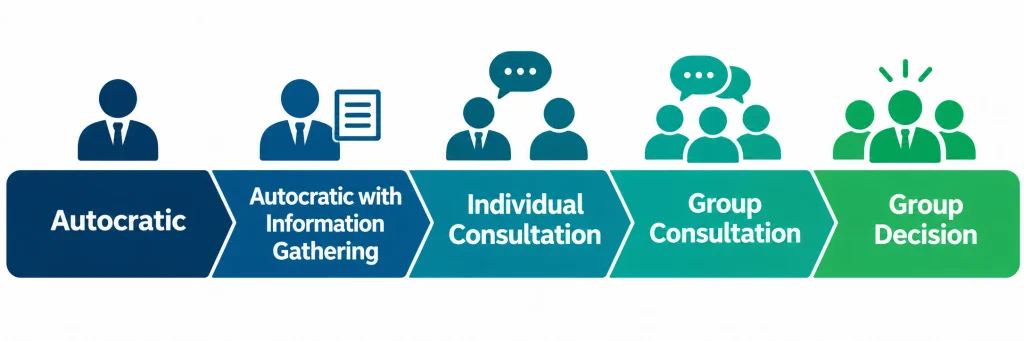
Participation is not all or nothing. The Vroom-Yetton-Jago model describes five levels. They run from minimal involvement to group decision.
- Autocratic (AI): the leader decides with information already available.
- Autocratic with information gathering (AII): the leader collects facts from the team, then decides alone.
- Individual consultation (CI): the leader shares the problem with people separately, gathers ideas, then decides alone.
- Group consultation (CII): the leader brings the problem to the team. Ideas are gathered, then the leader decides alone.
- Group decision (GII): the leader chairs the discussion and accepts the group’s decision.
This article treats levels three and four as the core of participative leadership. That is an interpretation. The leader keeps the final decision at both levels.
Knowing the levels prevents a common error. Leaders consult on every choice, large or small. The model pushes them to match the level to the decision.
Benefits of Participative Leadership
Research links participative leadership to several positive outcomes. Most of the evidence is correlational. Read these as associations, not guarantees.
Higher Employee Engagement and Job Satisfaction
Fatoki (2023) surveyed small, medium and micro enterprises. Participative leadership was positively related to job satisfaction. Psychological empowerment and work engagement helped explain the link. Chan (2019), cited in the 2022 review, also examined work engagement as a mediator between the two.
The study used a cross-sectional survey and partial least squares modeling. Its published abstract gives no sample size. Treat the finding as one cross-sectional result.
Better Use of Team Knowledge and Creativity
Pooling perspectives can surface information that one leader would miss. That is a logical benefit, not a measured one.
The 2022 review compares participative and directive leadership. It argues that participative leadership suits creativity better. Its reasoning: autonomy, collaboration, and openness encourage employees to offer new ideas. This is the reviewers’ conceptual argument, drawing on Lam and colleagues (2015). It is not a new test.
The review adds that directive leadership helps employees focus on set tasks. That suits routine work.
Stronger Voice and Speaking Up
The review cites several studies linking participative leadership to employee voice. Voice means speaking up with ideas or concerns. The same studies connect it to creativity and mental health. They are Somech (2010), Fatima and colleagues (2017), and Usman and colleagues (2021).
Zou and colleagues (2020) reported gains in psychological security. This is a close relative of psychological safety.
One caution applies. A study the review summarizes found no significant effect on perceived trust. Participation does not automatically build trust.
Commitment and Organizational Outcomes
The review reports links between participative leadership and organizational commitment for some employees, citing Miao and colleagues (2014). Some studies also link the style to organizational performance and innovation, such as Kahai and colleagues (2004) and Yan (2011).
There is a counterpoint. Li and colleagues (2018) found that participative leadership raised organizational creativity but lowered effectiveness to a degree.
Effects on large organizational change remain under-researched. The review says employees may worry about career risks during big changes. Leaders planning change management should not assume that participation will ease resistance.
Drawbacks and Limitations of Participative Leadership
Practitioner pages, including Harvard’s Program on Negotiation, Dovetail, Personio, and MTD Training, stress speed, confidentiality, and expertise. Most cite no research for these points. The research review adds concerns about workload and effectiveness.
Slower Decision-Making
Gathering and weighing input takes time. Autocratic decisions skip that step. Practitioner guidance advises against the style under tight deadlines. In a real crisis, full consultation can cost more than it returns.
Confidentiality and Security Risk
Some decisions involve sensitive information. Workforce reductions, financial details, security matters, and legal issues are examples. Broad consultation can expose these details to more people than necessary.
Risk of Diluted Expertise
Group input is not automatically expert input. Some decisions need knowledge that most team members lack. Heavy consultation can add noise instead of insight. Leaders must judge which decisions need broad input and which need narrow technical review.
Added Workload and Employee Stress
Participation asks more of employees. The review notes that added responsibility can feel burdensome and reports stress for some employees, citing Benoliel and Somech (2014). It also raises a too-much-of-a-good-thing effect. Peng and colleagues (2021) are cited for the idea that extra decision work can reduce well-being.
Difficulty With Large Groups
Dovetail, Personio, and MTD Training say the style works poorly with large teams. Their reasoning is practical: more people means slower input and harder agreement. None offers data. The 2022 review cites Lonati (2020), who argues that larger groups historically favored directive leadership. Both views point the same way, but neither is a tested threshold.
Social Pressure on Honest Input
Several pages note that people may follow the group instead of voicing their own view. TopResume, MasterClass, Personio, and MTD Training mention it, often tied to voting formats. A fear of retaliation can make the problem worse. Written, individual input before a discussion reduces the pressure. It does not remove it.
Potential for Conflict
More voices raise the odds of disagreement. Unmanaged, that friction slows the group. Leaders need facilitation skill to keep discussion productive.
How Strong Is the Evidence?
The evidence is useful but thin. Five limits matter most.
First, most findings are associations. Fatoki’s survey was cross-sectional, so it cannot show that participation caused satisfaction. Satisfied teams may also invite more participation.
Second, the 2022 review is a narrative synthesis. It reports no pooled effect sizes. It tells readers what studies found, not how large the effects are.
Third, some claims are reasoning, not tests. The creativity argument is an example. The studies it cites are not reviewed here, so those claims appear as the review states them.
Fourth, the foundational frameworks are not outcome studies. Lewin’s club experiment used children. Path-goal theory and the Vroom-Yetton-Jago model are decision frameworks. They tell leaders what to check. They do not report how much participation improves results.
Fifth, the practitioner drawbacks are reasoned, not tested. Most of the practitioner pages reviewed cite no studies. Their claims about speed, large teams, and leaks are plausible, but they are not measured effects.
A reasonable reading follows. Participation has plausible mechanisms and some supporting associations. Leaders should treat it as a tool to test in their own team, not a proven formula.
When to Use Participative Leadership, and When to Avoid It
The Vroom-Yetton model offers a practical filter. The original 1973 version asks seven yes or no questions about the decision. They cover decision quality, available information, problem structure, and team acceptance. They also cover shared goals and likely conflict.
The lists below combine these models with practitioner guidance.
Participative leadership tends to work well when:
- The task is complex or unstructured, with no single obvious answer.
- Team members hold expertise or firsthand knowledge the leader lacks.
- Commitment to implementation matters as much as the decision itself.
- There is time to gather and weigh input.
- The information involved is not restricted.
Participative leadership tends to work poorly when:
- The situation is an emergency.
- The task is simple, repetitive, or governed by a clear procedure.
- The team is new or lacks context on the decision.
- The decision involves confidential or legally sensitive information.
- Consultation would raise expectations the leader cannot meet.
Five of the model’s questions translate into plain language:
- Does this decision need a high quality answer, or would any reasonable answer do?
- Do I have enough information to decide well alone?
- Does the team’s acceptance decide whether this succeeds?
- If I decide alone, will the team accept it?
- Does the team share the organization’s goals for this problem?
Leaders who read the situation and adjust are likely to fit style to circumstance. Leaders who use one style everywhere are less likely to. That is the shared premise of path-goal theory and the Vroom-Yetton-Jago model. No single style wins everywhere.
How to Implement Participative Leadership
The steps below are practical suggestions drawn from the frameworks above. They are not a tested protocol.
Decide Which Decisions Are Participative
Not every choice needs group input. Sort decisions by stakes, urgency, and required expertise before defaulting to consultation. Routine or urgent matters can stay with the leader. Complex decisions that need commitment are better candidates. Writing the rule down tells the team what to expect.
Share Context Before Asking for Input
Input is only as good as the information behind it. Explain the problem, the constraints, and what a good outcome looks like. Then open the floor. Research supports this step: Lam and colleagues (2015) found that leader information sharing changes how participative leadership affects performance.
Use Structured Input Methods
Open brainstorming can favor the loudest voices. Structured methods spread participation more evenly. Collect written input before the discussion. Or use a round robin, where each person speaks in turn. Both give quieter experts room. Ground rules help too, such as one speaker at a time.
Explain the Final Decision
After deciding, say how the input was used. Do this even when the call differs from the majority view. People often accept a disliked decision more readily when they understand the reasoning. That is a practical expectation, not a tested finding.
Build the Underlying Culture
The review notes that a supportive organizational culture helps participative leadership develop. In practice, that culture rests on open communication. Leadership development programs can teach listening, facilitation, and structured decision-making. The 2023 study also recommends leadership training for small-firm owners.
Common Mistakes When Applying Participative Leadership
- Asking, then ignoring. If opinions never shape decisions, employees may read the process as symbolic. That can erode trust faster than never asking.
- Consulting on everything. Low stakes, urgent choices do not need a group. Over-consulting wastes time and blurs which decisions matter.
- Applying no framework. Without a model such as Vroom-Yetton-Jago, participation becomes inconsistent. The team cannot predict when input counts.
- Letting the loudest voices lead. Without facilitation, discussion defaults to whoever speaks first. Quieter members often hold the relevant expertise.
Conclusion
Participative leadership involves the team in decisions while the leader keeps final authority. Its roots include Lewin’s leadership climates, House’s path-goal theory, and the Vroom-Yetton-Jago model. Studies link it to job satisfaction, engagement, and voice. Most of that evidence is correlational.
The style costs time, risks confidentiality, and can burden employees. Fit depends on stakes, urgency, and where expertise sits.
Over the long term, the useful skill is calibration. A leader who can move between the five levels of participation gets the benefits. Explaining each choice limits the costs.
What to Read Next
Participative leadership answers how much to involve a team. It does not say how the right approach changes with each team member’s readiness. That question belongs to situational leadership, associated with Hersey and Blanchard. It matches leader behavior to the follower’s development. Once a leader knows who needs direction and who needs room, the choice between consulting and deciding gets easier.
Frequently Asked Questions
Can you give me an example of participative leadership?
This is a hypothetical illustration, not a real case. A manager must redesign shift schedules. She explains the coverage rules and the budget, collects written preferences, and meets the team to discuss trade-offs. She then sets the schedule herself and explains how the input shaped it. In Vroom-Yetton-Jago terms, this is group consultation (CII). This article cites no verified company case study.
How is participative leadership different from transformational leadership?
Participative leadership is defined by how decisions are made. The leader gathers input, then decides. A Fiveable study guide summarizes Burns and Bass as defining transformational leadership as inspiring followers beyond self-interest. The two describe different things, so a leader could use both. That combination is an inference, not a tested finding.
How does participative leadership work in remote or hybrid teams?
The research cited in this article does not test this directly. Dovetail says the style can keep remote employees engaged but cites no study. The principles may transfer, but that is an inference. Structure matters more. Collecting written input before a meeting is one practical way to give everyone a voice.
Is participative leadership suitable for small businesses and startups?
Research includes small firms. The 2023 study surveyed small, medium, and micro enterprises and linked the style to job satisfaction. MTD Training lists smaller teams as a good fit but cites no research. The main risk is over-consulting on routine choices.
How is participative leadership different from consensus decision-making?
Several practitioner pages list consensus as a participative type. This article uses a narrower definition. In consensus, the group must agree before the organization moves. In participative leadership, the leader gathers input and can decide without full agreement. Only the group decision level of the Vroom-Yetton-Jago model resembles consensus.