
Leadership capability is a leader’s reliable ability to produce results through other people in a given context. It combines knowledge, skills, behaviors, and judgment. Organizations use it to define good leadership. They assess leaders against that definition and decide where to invest in development. Capability differs from skills, competencies, and capacity, and the difference changes how organizations assess and build it.
What Is Leadership Capability?
Leadership capability is what a leader can do reliably, across different situations, to direct people toward results. It draws on knowledge, skills, behaviors, tools, and judgment. Sources define the term in slightly different ways. Some describe a personal mix of skills and behaviors. Others describe an organization’s ability to produce capable leaders consistently.
The Access Group describes capability as a mix of knowledge, skills, behaviors, and tools that supports leadership across contexts. Skillsoft takes the organizational view. It defines capability as an organization’s ability to develop leaders who decide well, guide teams through change, and execute strategy.
Context matters in both views. Rothaizer and Hill (Training Industry, 2021) argue that two leaders with identical competencies and capacity can differ in capability. One has a large budget and the right people in the right roles. The other faces a hiring freeze and a team promoted for tenure. Capability describes what each leader can actually deliver in that setting.
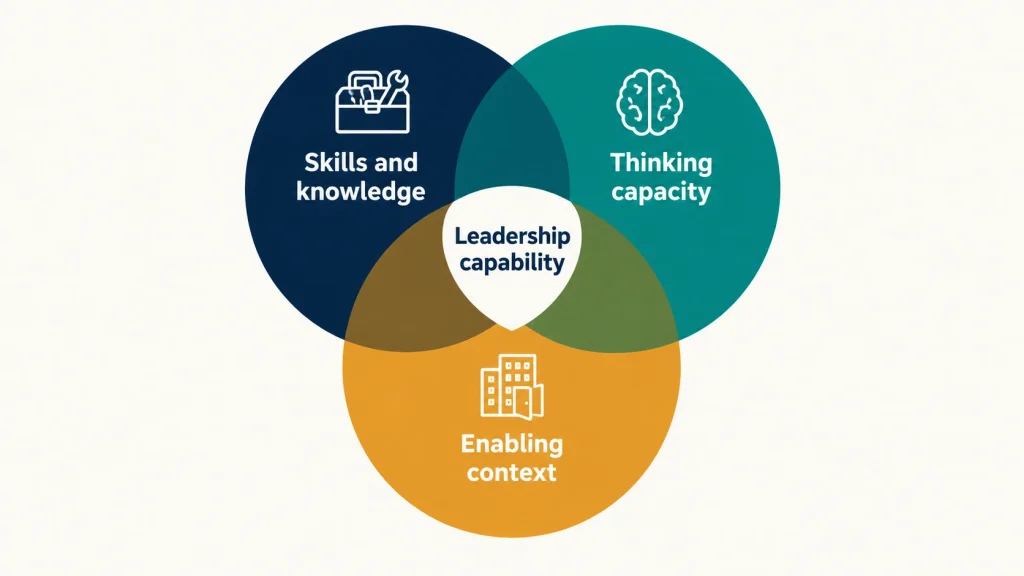
This article uses a working definition that combines both views. A leader shows capability when three conditions hold:
- The leader has the skills and knowledge for the task.
- The leader can think clearly under complexity.
- The setting allows the leader to act.
This three-part test is an analytical synthesis, not a published model.
How Leadership Capability Differs From Skills, Competencies, and Capacity
The four terms overlap, and sources use them loosely. The skill and competency rows are my plain-language definitions. The capacity and capability rows draw on Rothaizer and Hill. Usage varies by author.
| Term | What it describes | Question it answers |
| Skill | A specific, learnable behavior, such as running a feedback conversation | Can the leader do this task? |
| Competency | A bundle of skills, knowledge, and behaviors tied to a role or standard | Does the leader meet the standard for this role? |
| Capacity | The quality of thinking under complexity, uncertainty, and pressure | Can the leader handle ambiguity without oversimplifying? |
| Capability | Reliable leadership performance in real conditions | Can this leader deliver here, repeatedly? |
The distinction changes what an organization does. Training builds leadership skills. Frameworks set leadership competencies for roles. Neither guarantees capability.
A leader can pass a skills course and still fail under pressure. The same leader may also fail in a setting that rewards other behavior.
Capacity is the least settled term. Rothaizer and Hill use it for the structure of a leader’s thinking and tie it to adult development. Learning Everest uses it for a leader’s ability to handle the demands of a position, including time management and stress. Check how a source defines capacity before comparing claims.
Core Leadership Capabilities
No universal list exists. Frameworks differ in labels and in how many capabilities they name.
Ancona, Malone, Orlikowski, and Senge proposed four capabilities in Harvard Business Review in 2007. They are sensemaking, relating, visioning, and inventing.
Ancona and Bresman later placed building credibility at the center of that model. They describe it as both a condition and a result of the other four.
Blanchard names six abilities, such as adapting to change, strategic thinking, and inspiring others. Acorn names seven, including communication, integrity, decisiveness, and collaboration.
The table below groups these into six capability areas. The grouping is my synthesis. The behaviors are illustrative examples, not findings.
| Capability area | What it covers | Observable behavior | Where sources place it |
| Sensing and direction | Reading the environment and setting a direction people can act on | Explains what is changing, why it matters, and what the team will do | Sensemaking and visioning (Ancona et al.); thinking strategically (Blanchard) |
| Decisions and execution | Turning direction into structures, decisions, and results | Sets measures, removes blockers, and decides with incomplete information | Inventing (Ancona et al.); decisive and problem-solving (Acorn) |
| Relating and collaboration | Building trust and influence inside and outside the team | Listens before advocating and builds support across functions | Relating (Ancona et al.); collaborative (Acorn); communicate and collaborate (Blanchard) |
| Developing others | Growing people and sustaining motivation | Gives specific feedback, assigns stretch work, and recognizes progress | Encourage growth and motivation (Acorn); inspire and motivate (Blanchard) |
| Credibility and integrity | Earning trust through consistency | Keeps commitments, and actions match words | Building credibility (Ancona and Bresman); integrity (Acorn) |
| Self-leadership and learning | Managing oneself and improving over time | Seeks feedback, adjusts approach, and admits limits | Learn and improve continuously (Blanchard); leading yourself (Quarterdeck) |
No Leader Needs All Six
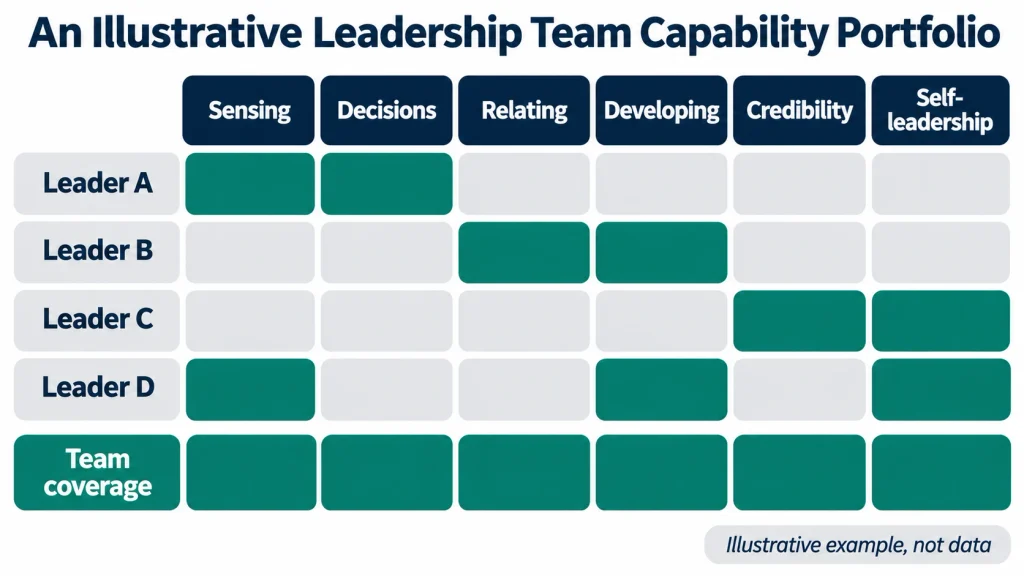
Ancona and Bresman make a point that the lists reviewed here do not state. They say it is rare to see a leader exhibit more than two or three of the capabilities. They advise leaders to find people who complement their strengths.
The idea resembles distributed leadership, a model in which leadership is spread across a team. I did not find the authors using that term, so the link is mine. Their claim is a judgment from their research, not a measured statistic.
The implication is practical. Set capability expectations by role and by team. Ask which capabilities the whole leadership team covers, not whether one person covers all six.
Why Leadership Capability Matters
Leadership capability matters because leaders shape the conditions teams work in, and many organizations doubt that their leaders are ready.
Gallup reports that managers account for at least 70% of the variance in employee engagement scores across business units. Gallup reported this estimate in 2015, drawing on its State of the American Manager research. Variance means the spread between units.
The figure does not mean managers cause 70% of any one person’s engagement. It does suggest that differences between units trace largely to who manages them. Gallup argues that managers address individual needs for morale, motivation, and clarity.
Deloitte’s 2023 Global Human Capital Trends survey polled 10,000 business and HR leaders in 105 countries. Ninety-four percent of respondents said leadership capabilities and effectiveness are important or very important. Only 23% believed their leaders had the capabilities to manage in a disrupted world. These are perceptions of business and HR leaders, not measured performance. Deloitte’s authors suggest the gap may reflect outdated assumptions about leadership more than missing skills.
Capability also changes how leadership behavior lands. A 2022 study by Huang and colleagues examined authoritarian leadership, which means asserting strong control and demanding obedience. The study used multi-source, three-wave data from 99 supervisors and 341 subordinates.
High leader capability weakened the harm linked to this style. The harm ran through evaluations of how effective the leader was. The outcomes were employees’ task performance and their emotional commitment to the organization. The abstract does not define capability, so the measure is unclear without the full paper.
This is one study, and the abstract does not show how capability was measured. One reasonable reading is that employees judge controlling behavior less harshly when the leader is capable.
How Capability Turns Into Results
The sources above report associations, not a complete causal chain. The chain below is my analytical synthesis of them.
A leader’s capabilities shape three things that teams can observe. They shape the clarity of direction, the quality of decisions, and the level of trust. Clear direction lets people prioritize without asking permission for each choice. Good decisions reduce rework and reversals. Trust makes people more willing to raise problems early.
These conditions then change team behavior. People may coordinate faster, report problems sooner, and put effort into the right work. Engagement and delivery may follow from that behavior. The Huang study offers partial support. Evaluations of leader effectiveness carried the effect of authoritarian leadership to employee outcomes.
Context sets the limits. A capable leader with no budget, no authority, or a hostile culture can still produce weak results. This is why the working definition includes the setting.
Leadership Capability Frameworks
A leadership capability framework defines the capabilities leaders need. It describes the behaviors expected at each level. It also links them to hiring, development, and promotion. INTOO describes frameworks as tools for consistent standards, strategic alignment, and leadership pipelines.
Many organizations publish a leadership capability framework for internal use. The University of Queensland, for example, describes seven key capabilities for leaders at all levels, from emerging leaders to executives.
What a Framework Contains
True Colors reports that credible frameworks share three components. A capability statement names the behavior domain. Level descriptors show how the behavior scales with seniority. Observable behaviors make assessment concrete. This is one vendor’s view, but it matches the structure of the examples reviewed.
Choosing the Right Size
| Model size | Best for | Trade-off |
| Lean (4 to 6 capabilities) | Smaller organizations, flatter hierarchies, and early-stage work | Easy to remember and use, but less precise for promotion decisions |
| Mid-range (6 to 8 capabilities) | Mid-sized organizations | Needs calibration so raters read each term alike |
| Detailed matrix (often 15 or 16 capabilities, with knowledge, skills, attitudes, and behaviors) | Complex roles and high-stakes succession | Heavy to maintain, and may go unused |
The sizing ranges come from True Colors, a vendor. The trade-offs are reasoned inferences, not tested findings.
Levels From Self to Organization
Frameworks scale expectations by level. Quarterdeck’s framework runs from leading yourself to leading others to leading the organization. True Colors describes the UN System Staff College model as moving from self-leadership to team leadership to organizational leadership. Both orders start with the individual.
The illustration below is hypothetical. It shows how one capability, sensing and direction, might scale across the three levels.
- A self-leader notices changes in workload and priorities, and explains them to a manager.
- A leader of others explains what is changing, why it matters, and which tasks come first.
- A leader of the business reads shifts in customers and competitors, then sets a direction several teams can follow.
In this illustration, the core behavior stays constant. The scope, time horizon, and number of people affected grow with each level.
How to Build a Framework
Teams usually build a framework in five steps.
- Start from strategy. Identify the capabilities the business strategy requires.
- Pick a size that matches the organization.
- Write behaviors in active terms. Describe what leaders do, not traits they have.
- Define levels. Show how each behavior changes with scope and seniority.
- Connect the framework to hiring, development, and promotion, and review it on a schedule.
Common Framework Mistakes
This section is my analysis, drawing on the sources above.
Trait language invites guesswork. A statement such as “is a visionary” cannot be observed or rated consistently. Raters fill the gap with personal impressions. Behavior-first statements, which True Colors links to less rating ambiguity, address this problem.
Long frameworks risk neglect. A framework with dozens of items is hard to remember, so managers may stop using it. Fewer capabilities, with clear level descriptors, are easier to apply.
A framework with no link to talent decisions remains a poster. Leaders tend to follow what the organization actually rewards.
Borrowed lists carry a different risk. They may omit the capabilities that the local strategy needs. Start from strategy, as the build steps above suggest.
How to Assess Leadership Capability
Assess capability by comparing observed behavior with the framework’s descriptors. Use several sources of evidence, and repeat the assessment over time.
Acorn and True Colors list the main methods. The limits in the table are my analysis.
| Method | What it shows | Main limit |
| 360-degree feedback | How peers, direct reports, and managers experience the leader | Ratings reflect perception, and raters need calibration |
| Behavioral interviews | Past behavior in situations like the target role | Depends on the quality of the account and the interviewer |
| Work samples and simulations | Behavior under realistic pressure | Costly, and may not match the real setting |
| Outcome data such as engagement, retention, and delivery | Results of the leader’s team over time | Confounded by context, resources, and team history |
| Self-assessment | The leader’s own view and development priorities | Limited accuracy on its own |
Use 360-degree feedback with care. Fleenor and colleagues reviewed self-other rating agreement in 2010. A later paper that summarizes the review says neither self-ratings nor others’ ratings are presumed more accurate. It adds that rating gaps may reflect personality and gender, not only low self-awareness.
Some vendor guides claim that smaller gaps predict greater leader success. Researchers describe the effect of agreement on outcomes as debated. Atwater and colleagues called it a controversy in 1998. Treat a rating gap as a prompt for discussion, not a verdict.
Calibration matters as much as method. Define proficiency levels with behavior anchors, and train raters to apply them alike. True Colors reports that behavior-first statements reduce rating ambiguity. Without anchors, two raters may read “strategic thinking” in very different ways.
Repeat assessments to see change. The Access Group suggests tracking change over 18 to 24 months to separate lasting change from short-term enthusiasm. That figure is a vendor suggestion with no cited evidence. Treat it as a planning assumption.
Match the Method to the Decision
Different decisions need different evidence. The matching below is my reasoning and has not been tested.
Development decisions need rich detail about behavior. Multi-source ratings and coaching conversations suit this purpose, because the aim is learning. Selection and promotion decisions carry higher stakes. They call for evidence that is harder to inflate, such as work samples, behavioral interviews, and outcome data. Program evaluation needs repeated measures on the same anchors, so that changes can be compared over time.
Using one method for every purpose causes trouble. Ratings collected for development may shift if people learn that the ratings will affect pay or promotion. Raters may then rate the consequence, not the behavior.
Read Results as Skill, Capacity, or Context Gaps
An assessment score does not say why a capability is weak. The cause decides the remedy. The diagnosis below applies the three-part test from the first section. It is an analytical tool and has not been validated.
| Pattern in the data | Likely gap | Typical response |
| The leader cannot describe or demonstrate the behavior | Skill or knowledge gap | Targeted training with practice and feedback |
| The leader knows the behavior but oversimplifies complex problems | Capacity gap | Stretch assignments, coaching, and structured reflection |
| The leader performs well in some teams but not in others | Context gap | Fix resources, role design, or team makeup before developing the leader |
Context gaps are easy to miss. When several leaders in one unit score low on the same capability, suspect the setting first. A shared cause such as unclear authority, a hiring freeze, or conflicting targets will not respond to training. Training may even raise frustration, because leaders learn behaviors they cannot use.
How to Build Leadership Capability
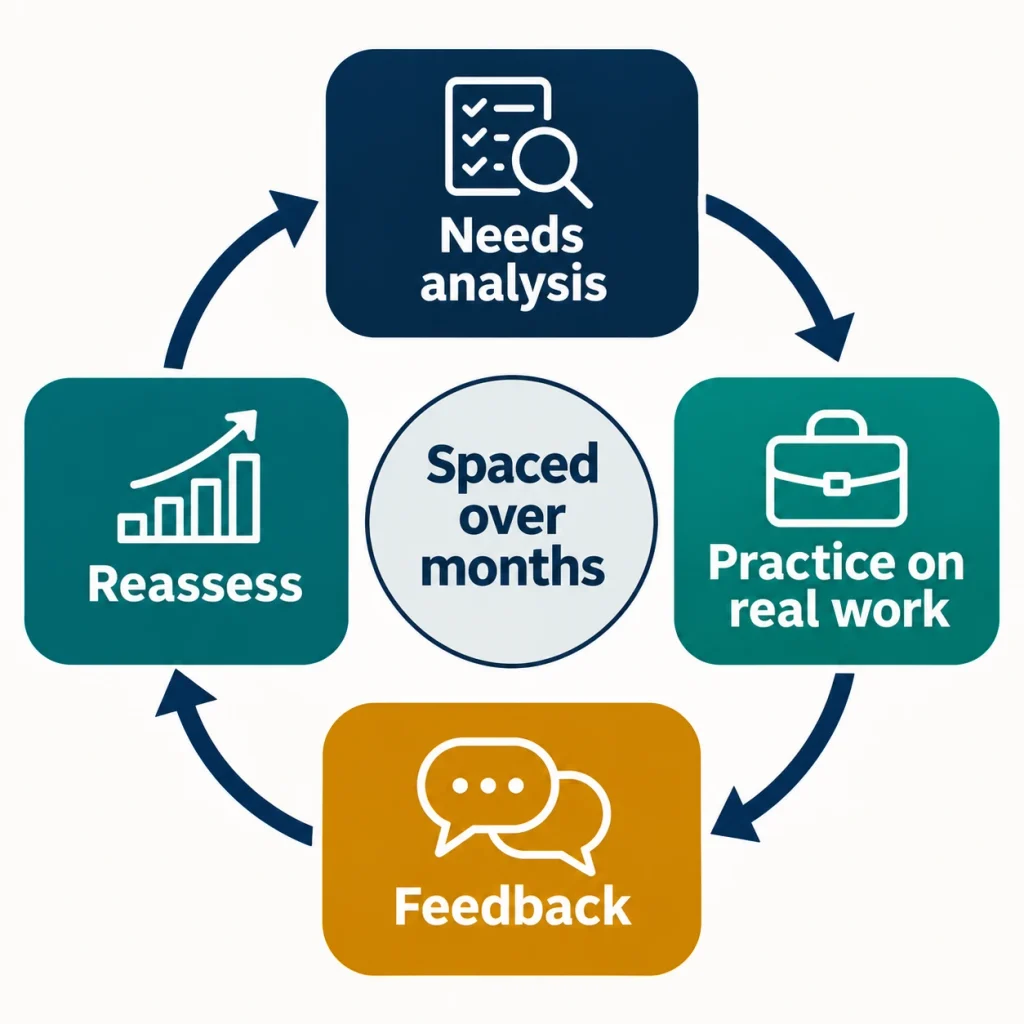
Build capability through a repeating loop. Diagnose needs, practice on real work, get feedback, and reassess. The strongest quantitative evidence concerns formal leadership training, and it points to design features, not only content.
What the Evidence Says About Leadership Training
A 2017 meta-analysis by Lacerenza and colleagues pooled 335 independent samples. Leadership training improved reactions, learning, on-the-job transfer, and results. Standardized effect sizes ranged from 0.63 to 0.82.
Training worked better when it began with a needs analysis and included feedback. Practice through several delivery methods helped. So did spaced sessions, on-site delivery, and face-to-face formats that were not self-administered. These are averages across many program types. They show that well-designed training can work, not that any given program will.
Learning From Experience, With a Caveat
Many guides cite the 70-20-10 ratio. The ratio says 70% of learning comes from tough jobs. Another 20% comes from people, and 10% from courses and reading.
People often trace it to Center for Creative Leadership studies, which Lombardo and Eichinger summarized in 1996. A 2014 ATD post called it a conceptual model based on retrospective accounts by executives. The post cites a 2012 review that found a lack of empirical data. Treat it as an unproven rule of thumb, not a budget formula.
Practice, Feedback, and Reflection
Skillsoft names moments that build capability. They include deciding with incomplete information, resolving conflict between priorities, guiding teams through uncertainty, and adjusting direction from feedback. Skillsoft adds that repetition without coaching can reinforce poor habits as easily as good ones. This is a practitioner claim, but it fits the meta-analytic finding that feedback matters. Executive coaching is one way to supply feedback and reflection, especially for senior leaders.
Rothaizer and Hill argue that changing how leaders think takes repeated cycles of action and reflection, not only new knowledge. They call this vertical development and say a single workshop cannot produce it. The article describes the approach but reports no test of it. The idea fits the evidence on practice and spacing, but it remains a practitioner interpretation.
A Practical Sequence
This sequence is my synthesis of the evidence above.
- Run a needs analysis against the framework to find the few capabilities that matter most.
- Choose work assignments that require those capabilities.
- Pair each assignment with feedback from managers, peers, or a coach.
- Space learning over months instead of concentrating it in one event.
- Reassess against the same behavior anchors, then adjust.
Building Leadership Capability Across the Organization
Organizational leadership capability is the ability to produce capable leaders consistently. Training one strong leader does not create it. Skillsoft draws this distinction, and it changes what an organization measures.
Start with a capability gap analysis. Compare the capabilities the strategy requires with the capabilities leaders show today. Do this by team and level, not only by individual. Patterns across teams show where the organization is exposed.
Use the portfolio view from the earlier section. Suppose a leadership team is strong in execution but weak in sensemaking. This is a hypothetical case. The team could add an adviser, change who leads market analysis, or hire for that gap.
The same logic applies to succession planning. Map which capabilities each successor covers and which remain uncovered.
Build, Promote, or Hire
Organizations often choose between developing leaders, promoting from within, and hiring externally. The evidence points in two directions.
Gallup argues that management talent is rare. It reports that about one in ten people have high talent to manage. It also reports that companies miss that talent in 82% of hiring decisions. Gallup’s article gives no method for the 82% figure, so treat it as an estimate.
Gallup treats talent as largely innate and favors careful selection. It also says people with some managerial talent can improve with coaching. The Lacerenza meta-analysis shows that leadership training improves outcomes on average. Both can hold, because selection and development address different parts of the problem.
A reasonable decision rule follows. Select carefully for capabilities that take long to build or that the role needs immediately. Develop for gaps that are specific, teachable, and tied to defined behaviors. This is an analytical suggestion.
Track Whether Capability Is Improving
Progress at organization level needs both leading and lagging evidence. This approach is my own suggestion.
Leading evidence shows change in capability itself. Examples include reassessment scores on the same behavior anchors and the share of critical roles with a ready successor. Another example is the number of capabilities each leadership team covers.
Lagging evidence shows results. Engagement, retention, and delivery data belong here. These measures move slowly, and many factors besides leadership affect them.
Compare the two over time. If assessment scores rise but results stay flat, test the framework. It may describe the wrong behaviors, or the context may block them. If results improve but scores do not, something else may explain the change.
Limits of the Evidence and Where Capability Models Fall Short
Evidence quality varies. Many widely repeated figures could not be traced to a primary source and are not used here. Several guides on this topic come from vendors that sell assessment or learning products. Their advice may be sound, but it is rarely tested. Capability is also inferred from behavior, so no single instrument measures it directly.
Context changes what leadership behavior does. A 2024 Asia Pacific Journal of Management study sampled 402 Chinese chain restaurant managers and 369 UK police officers. It found that authoritarian leadership had both positive and negative effects on performance. A 2025 study of 176 employees at an Indonesian water utility found a negative effect. Power distance moderated some of the links in that study.
These studies concern one leadership style, not capability lists. They suggest that a behavior’s effect varies by setting. A capability list built in one culture may therefore need local testing. That last step is my inference.
Culture can override a framework. If an organization punishes dissent, a framework that prizes collaboration may not take root. True Colors makes this point, and Rothaizer and Hill’s context argument supports it.
Frameworks also decay. True Colors reports that CISL’s 2025 leadership research recommends treating frameworks as living documents. Schedule reviews so the model keeps pace with strategy.
Conclusion
Leadership capability is a leader’s reliable delivery of results through others in a given context. It sits above skills and competencies, and it depends on thinking quality and on the setting.
No single tool settles capability. A framework names the behaviors. Assessment shows where they are missing. Development builds them, and the setting decides whether leaders can use them.
Capability work therefore shifts from the individual leader to the leadership team. Few leaders cover every capability, so teams need complementary strengths. Organizations that compare reassessment scores with business results can tell whether a framework still describes the behaviors that matter.
Meta-analytic evidence supports well-designed training. The six-area grouping, the gap diagnosis, and the decision rules here are my syntheses. Test them against local data before relying on them.
Assessment and gap analysis end with a list of capabilities to strengthen. The next need is a structured way to close those gaps. A leadership development program turns gap data into sequenced learning, practice, and feedback for specific groups of leaders.
Frequently Asked Questions
What are the six leadership capabilities?
No single list of six exists, and sources name different sets. Spencer Stuart assesses executives on strategic thinking, driving results, leading change, leading people, collaborating and influencing, and building people capability. Its page says research supports these six but cites no study. Blanchard also names six abilities, with different labels.
Is leadership capability the same as leadership potential?
No, they measure different things. Capability is what a leader delivers reliably now. Potential is the likelihood of growing into larger or different roles.
Do people without direct reports need leadership capability?
Yes, in a narrower form. Frameworks such as the UN System Staff College model, as True Colors describes it, begin with self-leadership. At that level, the relevant capabilities include behaviors such as seeking feedback and adjusting approach.
What is leadership capability maturity?
It describes an organization’s overall leadership capability, not an individual leader’s. An Acorn excerpt describes maturity levels, and one level is reactive, where capability performance is unpredictable and ad hoc. Use maturity to judge how consistently the organization produces capable leaders.
Who is responsible for building leadership capability, HR or line managers?
Responsibility is usually shared, and the split is a design choice. HR typically owns the framework, assessment process, and programs, while line managers provide assignments and feedback in daily work. Acorn’s six-step process starts with securing leadership buy-in, which points to senior sponsorship as a third role. This division is a reasoned suggestion, not a research finding.
How does leadership style relate to leadership capability?
Style describes how a leader tends to behave. Capability describes whether that behavior produces results in a given setting. The same style can succeed in one setting and fail in another. A style label alone does not show capability.