
Leadership team effectiveness is the capacity of a company’s top leaders to reach shared goals together. Effective teams share a clear direction, defined roles, trust, and sound decision habits. Leaders can measure these conditions and improve them with targeted changes. Published models use different labels but overlap on direction, roles, and interaction quality.
The Center for Creative Leadership (CCL) surveyed senior executives. Fewer than 1 in 5 rated their executive teams “very effective”. CCL’s page, dated November 2020, does not describe the sample. Treat the figure as a signal, not a benchmark.
Much of the evidence here comes from consultancies, and several studies cover other kinds of teams. Each source’s limits are stated where it appears. Sentences that begin with “Analysis:” are the author’s inference, not research findings.
What Is Leadership Team Effectiveness?
A leadership team is effective when it achieves enterprise goals together. CCL gives an executive team two roles. One is strategic and operational leadership. The other is acting as the organizational and cultural model. How members interact sets the pattern for teams across the company.
Leadership Team vs. Group of Direct Reports
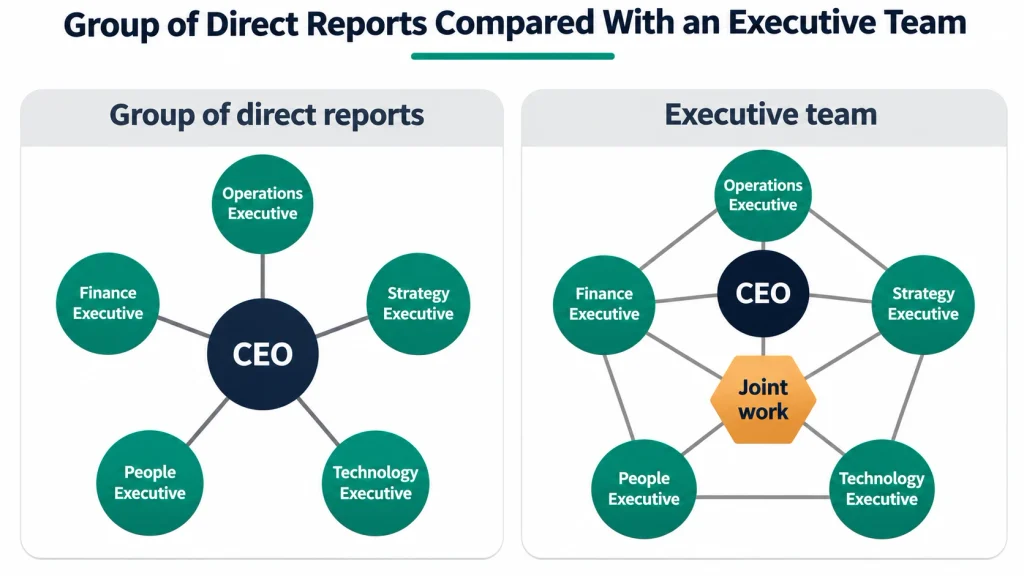
Not every senior group is a team. A group of direct reports is a set of leaders who report to the same person. Such a group may share updates and receive decisions without working together. An executive team takes on work that stands apart from members’ departmental roles. It shapes organization-wide decisions and shares responsibility for the organization’s results.
Analysis: this changes how to judge effectiveness. A group of direct reports can succeed if each leader runs a function well. An executive team must also succeed at its joint work.
What “Effective” Means
A National Academies report defines team effectiveness as a team’s capacity to achieve its goals and objectives. McKinsey’s definition is close: the collective capacity to sustainably deliver results. Both focus on capacity rather than a single result.
Researchers have long modeled effectiveness as inputs, processes, and outcomes. A 2008 review of team research described a shift to time-sensitive models with inputs, mediators, and outcomes. Mediators sit between inputs and outcomes and carry the effect of one to the other.
Analysis: the definition used in this article is a synthesis, not a published standard. An effective leadership team delivers enterprise results and works well together. It also stays able to do both as conditions change.
Why Leadership Team Effectiveness Matters
The best numbers on team health come with caveats. McKinsey identified 17 behaviors it calls health drivers. Together they explain 69% to 76% of the difference between low- and high-performing teams on efficiency, results, and innovation.
The data cover teams at many levels, not only leadership teams. McKinsey’s article does not publish the underlying data, so outsiders cannot check them.
The headline ratios compare teams above and below average. Teams with above-average trust were 3.3 times more efficient than teams with below-average trust. They were also 5.1 times more likely to produce results. Teams with above-average decision making were 2.8 times more innovative. These figures describe associations, not proven causes.
Academic studies offer related evidence from top management teams. Carmeli and Schaubroeck surveyed 116 of them. Teams whose members reported closer collaboration also reported better strategic decisions and showed less organizational decline. The decision-quality measure is perceived, not objective.
McKinsey also reports a link between top team vision and financial results. Companies were almost twice as likely to show above-median financial performance with a shared, meaningful top team vision. The main text of the 2024 article does not describe the data behind that figure. A 2020 note repeats the claim. It bases its framework on a literature review, expert interviews, and a survey of 37 teams with about 430 respondents. McKinsey calls those survey insights directional.
Executives expect a payoff. Nearly all CCL respondents agreed that a more effective executive team would improve organizational results. That is an expectation, not a measured effect.
Taken together, the evidence supports a cautious claim: healthier leadership teams tend to produce better results. No source here can predict how large a given company’s gain will be.
The Work Only the Leadership Team Should Do
Some leadership teams have improved by focusing on the work only they can do and delegating the rest. Bridgespan, drawing on Bain & Company and Wageman and colleagues, offers two tests for that work: interdependence and stakes.
Interdependence and Stakes
Interdependence means an issue involves several units and needs cross-leader discussion. Stakes mean the issue strongly affects the organization’s strategic clarity, effectiveness, and sustainability. Analysis: work that scores high on both belongs on the leadership team agenda. Work that scores low on interdependence can go to one executive.
Many teams do not agree on how interdependent they are. McKinsey separates two types. Outcome interdependence is the extent to which each member’s success depends on the success of others and of the team. Task interdependence is the extent to which members must interact to reach their goals.
In McKinsey’s data, only 46% of teams agreed on both types. The other 54% disagreed on at least one. McKinsey compares such a mismatch to members playing different sports.
A hypothetical mismatch looks like this. One executive expects joint decisions while another brings status updates. Meetings then satisfy neither.
McKinsey also argues that no single playbook fits every team. It describes three archetypes, cycling, relay, and rowing, that differ in how much members depend on each other. Higher-performing relay teams emphasized goals, commitment, and recognition. Higher-performing rowing teams emphasized belonging and role definition.
A simple exercise can surface the gap. Ask each member to rate how much the team depends on joint work. Differing answers show where the team needs to talk.
Bridgespan’s survey shows why the question matters. Only 19% of its 362 nonprofit executive team respondents strongly agreed that their team focuses on the right work. The sample is nonprofit and from 2018. Even so, one measure travels well. It is the share of agenda time spent on work that only this team can do.
The Dual-Hat Problem
Each executive wears two hats. One is leading a function. The other is leading the enterprise as a member of the team. In CCL’s survey, 65% of senior executives reported a clash between functional and enterprise accountabilities. The page does not describe the sample.
Analysis: the clash probably has a structural cause. Budgets, targets, and reporting lines usually attach to functions. In a trade-off, the function hat can win by default.
CCL says the qualities that earn executives a place on the team are necessary but not sufficient. Functional excellence does not guarantee enterprise thinking. CCL recommends explicit agreement on what it means to lead at the enterprise level.
What Drives Leadership Team Effectiveness
Researchers and consultants group the drivers into a team effectiveness model. Four models appear in the sources reviewed here, and their labels differ.
Hackman’s Five Conditions
J. Richard Hackman’s 2002 book Leading Teams names five conditions that support team effectiveness. They are a real team, a compelling direction, an enabling structure, a supportive organizational context, and competent coaching.
Wageman, Nunes, Burruss, and Hackman later wrote a 2008 book on senior leadership teams. Its publisher describes a study of more than 100 top teams worldwide.
Analysis: the model points leaders toward design choices they control, such as membership, purpose, structure, support, and coaching. Most of those choices fall to the CEO.
McKinsey’s Health Drivers
McKinsey groups its 17 drivers into four areas. Configuration (clear roles, a mix of perspectives) and alignment (clear direction, commitment to it) set the design. Execution covers how the team carries out its work. Renewal covers an environment set up for long-term sustainability.
Four drivers had the greatest impact: trust, communication, innovative thinking, and decision making. Well-performing teams were very good at only 11 of the 17 behaviors on average. That suggests priorities matter more than perfection.
A 2020 note described 22 behaviors condensed into four characteristics: configure, align, execute, and renew. Both versions rest on McKinsey’s own survey-based research.
How the Frameworks Fit Together
The table below is the author’s synthesis of four sources. Matches are approximate because each source defines its terms differently.
| Theme | Hackman | McKinsey | CCL | |
| Direction and purpose | Compelling direction | Purpose and goals | Meaning and impact | Strategic focus |
| Roles and structure | Real team; enabling structure | Role definition; decision making | Structure and clarity | Not among the three threads |
| Trust and interaction | Not a named condition | Trust, psychological safety, communication | Psychological safety; dependability | Team interaction |
| Support and renewal | Supportive context; competent coaching | Renewal drivers | Not named | Not among the three threads |
| Enterprise orientation | Not named | Commitment to the team | Not named | Collective approach |
Every model names direction or purpose. Interaction quality appears in three of the four, under labels such as trust, safety, or interaction. Only Hackman and McKinsey address support or renewal.
A Harvard Business Review tip lists five traits of effective leadership teams: direction, discipline, drive, dynamism, and collaboration. Only the introduction and the five labels were accessible for this article. Direction and collaboration echo themes in the table.
Analysis: direction, roles, and interaction quality are the themes most sources share. A weak score on any of them deserves attention first.
Behaviors That Make the Conditions Work
Conditions describe design. Behavior shows whether the design works in daily practice.
Trust and Psychological Safety
Trust comes in two kinds, according to McKinsey. Cognitive trust is the belief that colleagues are competent, reliable, and have integrity. Affective trust rests on care and personal connection.
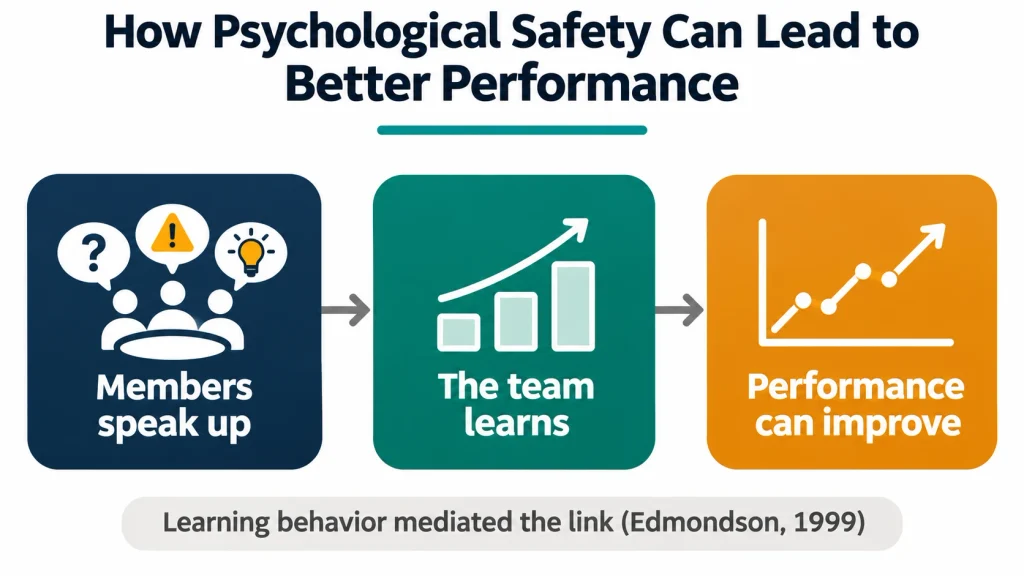
Edmondson defines psychological safety as a shared belief that the team is safe for interpersonal risk-taking. She studied 51 work teams in one manufacturing company. Team psychological safety was associated with learning behavior, and learning behavior mediated the link between safety and team performance.
In a safe team, members can admit mistakes, ask questions, and offer new ideas without punishment. Analysis: the team then learns faster, and faster learning can improve performance. Edmondson’s mediation result fits that sequence.
Frazier and colleagues pooled 136 samples covering over 22,000 individuals and nearly 5,000 groups. Their meta-analysis examines the antecedents and outcomes of psychological safety. Google’s Project Aristotle ranked psychological safety first among five dynamics in 180 teams. The others were dependability, structure and clarity, meaning, and impact. Team size, tenure, seniority, and colocation were not significantly connected to effectiveness there.
Neither Edmondson’s teams nor Google’s were leadership teams. Google studied engineering and sales teams. Senior teams may face added pressure. Hambrick’s interviews with 23 CEOs describe harmful internal rivalries in top teams. Analysis: rivalry can make candor costly.
Clear Decision Rights
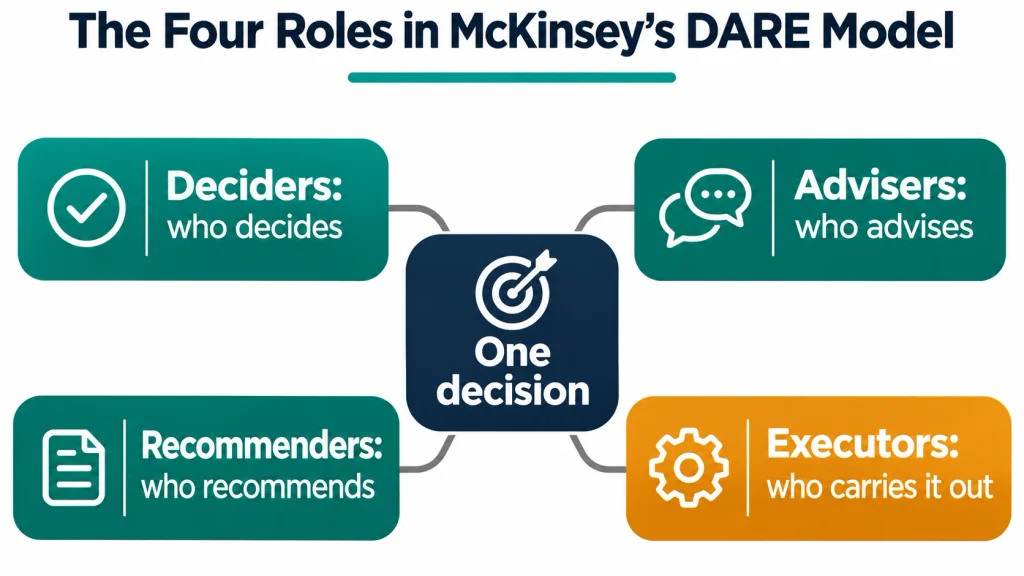
Teams need clear decision rights. These specify who decides, who advises, who recommends, and who carries out a decision. The DARE model, from McKinsey, assigns four roles: deciders, advisers, recommenders, and executors. McKinsey found that teams are often unclear about their decision-making roles.
One case involves the top team of a North American health insurer. It faced a strategic choice about where to invest and how to allocate funding. The team used DARE to clarify roles. At first the group believed the CEO should be the sole decider. After several conversations, the CEO moved to an advisory role and other leaders became the deciders.
The discussions revealed two more problems. Several members did not need to be involved. The leaders most affected by the funding decisions were not in the room. The team vowed to address that. This is one consultancy-reported case, not evidence that DARE works.
Decision-making is among the four most impactful drivers in McKinsey’s data. Google found no significant link between consensus-driven decision making and team effectiveness. It cautions that such results may not hold elsewhere. Analysis: consensus is not clarity. A team can reach agreement slowly and still leave ownership unclear.
Productive Conflict
Eisenhardt and colleagues studied how top management teams disagree. They found that many teams fail to debate enough, and they describe four levers for productive conflict. Teams can build a heterogeneous team and create frequent interactions. They can cultivate distinct roles and use multiple-lens tactics such as role-playing a competitor.
The health drivers point the same way. They include conflict management, meaning that members address conflicts in ways that improve relationships. They also include innovative thinking, which covers seeking opposing perspectives.
Analysis: managed disagreement can improve the options on the table, while unmanaged disagreement can damage relationships and slow decisions. The goal is to manage conflict, not remove it.
Behavioral Integration and Meetings
Hambrick (1994) defined behavioral integration as the degree to which a top team engages in mutual and collaborative interaction. The 116-team survey described earlier measured this idea.
Meetings are where integration happens or fails. Beer recommends that leadership teams meet at least weekly. That is professional opinion, not an empirical finding. Eisenhardt and colleagues also list frequent interaction among their levers.
Quality is a separate question from frequency. In Bridgespan’s nonprofit survey, only 17% of respondents strongly agreed that their team used meeting time well. McKinsey’s definition of meeting effectiveness has three parts. Members focus on actionable items and involve the right people at the right time. They also follow through on next steps. Leaders can audit their own leadership team meetings against those parts.
Some teams hold fewer core meetings and use committees for topics that do not need the full team.
How the CEO Shapes Team Effectiveness
The CEO sits at the center of the leadership team’s design. CCL says building a world-class executive team should be part of every CEO’s job description. The coaches Bridgespan interviewed agreed that CEO leadership was the single most important factor in making teams highly effective. That is expert opinion from a nonprofit setting.
The research evidence is suggestive. Carmeli, Schaubroeck, and Tishler surveyed 82 top management teams and tested a mediation model. CEO empowering leadership was associated with higher behavioral integration. Behavioral integration, in turn, was associated with team potency and firm performance. Team potency is the collective belief within a group that it can be effective.
The effect of potency on firm performance was stronger when members perceived high environmental uncertainty. The data are survey based. They show consistency with the model, not proof.
Practitioner sources also point to the leader’s role. Only 25% of nonprofit executive team respondents strongly agreed that their CEO addresses team dynamics. Beer names leaders who do not want to lead a team as a root cause of ineffective top teams. McKinsey warns that improvement drops sharply when the team leader resists change. It names coaching as one way to help a stuck leader.
The CEO is also a member of the team being designed. Honest feedback to the CEO can be hard to give. Analysis: a neutral facilitator or an anonymous survey can help. Beer describes interviews led by a consultant or an internal lead, and Google gave team leads anonymized scores.
Why Leadership Teams Fail
Hambrick interviewed 23 CEOs and identified five problems with their top teams. The problems are inadequate capabilities of one executive and a shortcoming common to the whole team. They also include harmful internal rivalries, groupthink, and fragmentation. In plain terms, groupthink means pressure to agree. Fragmentation means members work as separate units.
The study dates from 1995 and reflects CEOs’ views. Still, the problems relate to the conditions above. Analysis: inadequate capabilities point to membership, rivalries and groupthink point to interaction, and fragmentation points to direction and structure.
Teams also misjudge their own gaps. McKinsey found a gap between what teams think matters and what drives performance. Teams ranked trust and communication among their top five drivers. They ranked innovative thinking and decision-making much lower, despite those drivers’ links to performance. Position shapes perception too: team leaders rated team effectiveness more favorably than other members did on most drivers.
Other surveys show similar gaps. In McKinsey’s 2020 survey of 37 organizations, only 60% of team members reported alignment on purpose. Fewer than 40% of teams reported consistent communication. About half of Bridgespan’s nonprofit respondents rated team performance as good. Yet only 19% strongly agreed that the team focuses on the right work.
Analysis: an overall rating can hide specific gaps, so measurement has to be specific.
How to Measure Leadership Team Effectiveness
Measure Outcomes, Conditions, and Behaviors
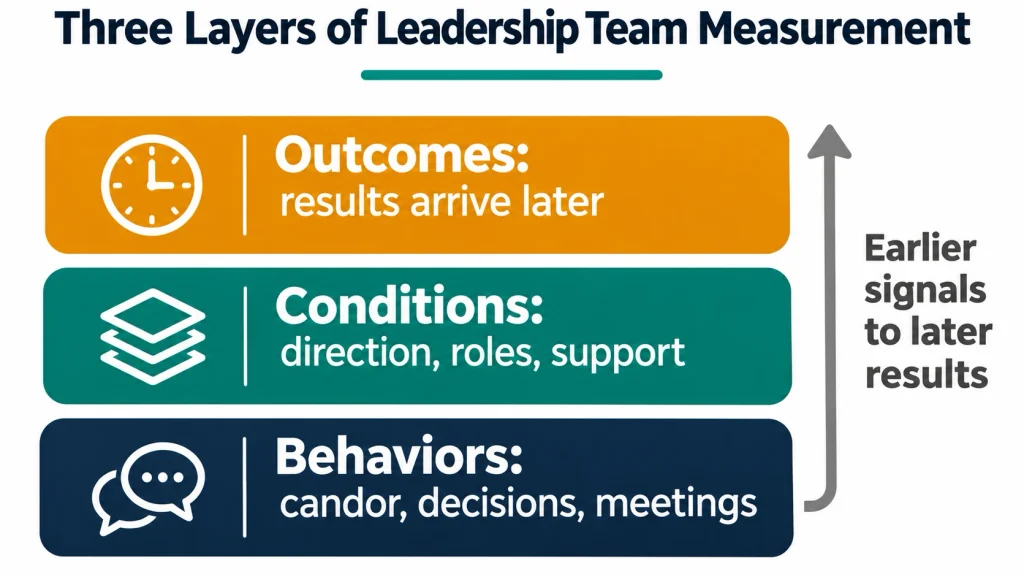
A sound measurement design uses three layers. The framework below is the author’s, built from the sources above.
| Layer | What it tells you | Example indicators | Main limit |
| Outcomes | Whether the team reaches the goals it owns | Progress on enterprise goals; follow-through on decisions | Results lag and have many causes |
| Conditions | Whether the team’s design supports performance | Agreement on purpose; clear roles; share of agenda on work only the team can do | Ratings are subjective |
| Behaviors | Whether daily practice matches the design | Candor in meetings; clarity on who decides; use of meeting time | Members may rate themselves generously |
Outcome measures answer the central question of whether the team is achieving its goals. They lag, though. A team can deliver results this year while weakening the conditions for next year. Condition and behavior measures give earlier signals.
Bridgespan’s survey items offer a starting template. They ask about focus on the right work, use of meeting time, and the CEO’s handling of team dynamics. McKinsey’s 17 drivers offer a longer list. Beer cautions that effectiveness declines without continued investment. Repeated measurement therefore tells more than a single score.
Diagnostic Tools
A team diagnostic survey asks members to rate the team on defined conditions or behaviors. Wageman, Hackman, and Lehman tested their Team Diagnostic Survey on 2,474 members of 321 teams. It assesses how well a team is structured, supported, and led. The authors also discuss its appropriate uses.
McKinsey’s approach rests on ratings of its 17 drivers. Teams pick the drivers they think matter most and least, then compare those picks with their actual scores. The comparison exposes blind spots. McKinsey suggests using the results to write a charter. The charter sets how members will work together and which behaviors to prioritize.
Whose Ratings to Trust
Ratings differ by position. McKinsey found that team leaders viewed team effectiveness more favorably than other members did. Google’s researchers found that perspectives differ in another way. Executives focused on results, members on team culture, and leads on ownership, vision, and goals.
In a leadership team, the CEO is the team leader. Analysis: CEO ratings alone may therefore overstate team health.
A practical design collects anonymous ratings from every member, reports the CEO’s ratings separately, and compares the gaps. Outcome data should come from records, not opinions. Input from people one level down can show how decisions land. Beer also suggests interviewing members as part of the diagnosis.
How to Improve Leadership Team Effectiveness
Diagnose Before You Intervene
CCL’s first key is to get the diagnosis right. McKinsey’s first action is to take a hard look in the mirror with a diagnostic baseline. Beer’s steps include assessing members’ interdependence.
CCL lists five keys. They are diagnosis, a shared leadership mental model, and a growth mindset. They also include explicit interaction rules and diffusion rules, which spread the team’s behavior through the organization.
Individual awareness also matters. McKinsey notes tools such as 360-degree feedback and one-on-one coaching for building self-awareness.
Analysis: one workable order of work is:
- Clarify the work only this team should do.
- Check direction and membership.
- Define roles and decision rights.
- Address interaction: trust, conflict, and meetings.
- Secure support and coaching.
- Measure again.
The order follows dependency, because later steps assume earlier ones. A team cannot debate well about decisions it does not own. The sources reviewed here do not test this sequence.
Match the Intervention to the Cause
The symptom and cause columns are the author’s analysis. The interventions come from the cited sources.
| Symptom | Likely cause | Intervention from the sources |
| Agendas full of updates, few joint decisions | Unclear work only the team can do | Apply interdependence and stakes tests to each item; delegate the rest. |
| Decisions stall or reopen | Unclear decision rights | Run the DARE exercise on one major decision. |
| Members agree in the room, dissent afterward | Low safety or rivalry | Set interaction rules ; track safety ratings. |
| Debates turn personal or never happen | Weak conflict management | Use the four levers for productive conflict. |
| Members defend functions over the enterprise | Dual-hat clash | Agree on what enterprise leadership means. |
| CEO and members rate the team very differently | Leader’s rosier view; blind spots | Collect every member’s view; use anonymized scores. |
| Gains fade after a few months | No follow-through mechanism | Commitments, governance, and retrospectives; continued investment. |
Treat each row as a hypothesis, and test it with data from your own team before choosing an intervention.
Sustain the Gains
McKinsey recommends clear commitments with specific actions, plus governance and processes that ensure follow-through. A charter can record agreed team norms and priority behaviors. Instilling new behaviors is not a linear process, McKinsey notes. Regular retrospective check-ins help new behaviors become the default. Beer’s warning about decline without continued investment points the same way.
Coaching can support the team and its leader. Hackman and Wageman’s 2005 theory addresses the functions, timing, and conditions of team coaching. McKinsey also notes that upskilling team leaders is helpful but not sufficient. Individual leadership development complements team-level work and does not replace it.
Limits of the Evidence
- McKinsey and CCL figures are proprietary. Outsiders cannot check them, and CCL’s page gives no sample details.
- Google, Edmondson, and many survey samples cover teams below the top, so leadership teams may behave differently.
- Surveys show conditions moving together with results. They do not show that one causes the other.
- Hambrick’s study dates from 1995 and Bridgespan’s survey from 2018. Google’s page was first published in 2015 and describes research released in 2016.
- None of the sources reviewed here reports a controlled test of a leadership team intervention.
Treat the frameworks as hypotheses. Measure first, change one thing at a time, and measure again.
Conclusion
Direction, roles, and interaction quality recur across the four models. Trust, clear decision rights, and productive disagreement are how those conditions show up in meetings.
The conditions depend on each other. A team that has not settled its purpose cannot assign decision rights. Without decision rights, it has little to debate.
Effectiveness also decays. Beer warns that it declines without continued investment. McKinsey describes behavior change as slow and uneven. Measurement works best as a recurring habit, with ratings from every member and not only the CEO.
The evidence is strongest as a guide to diagnosis. Most of it is associational, and much comes from consultancies or from teams below the top.
A diagnostic usually ends with a short list of gaps, such as unclear decision roles or guarded debate. Closing them takes targeted development for the team and its leader. Applied to the team as a unit, that development is executive team coaching. Hackman counts coaching among his five conditions.