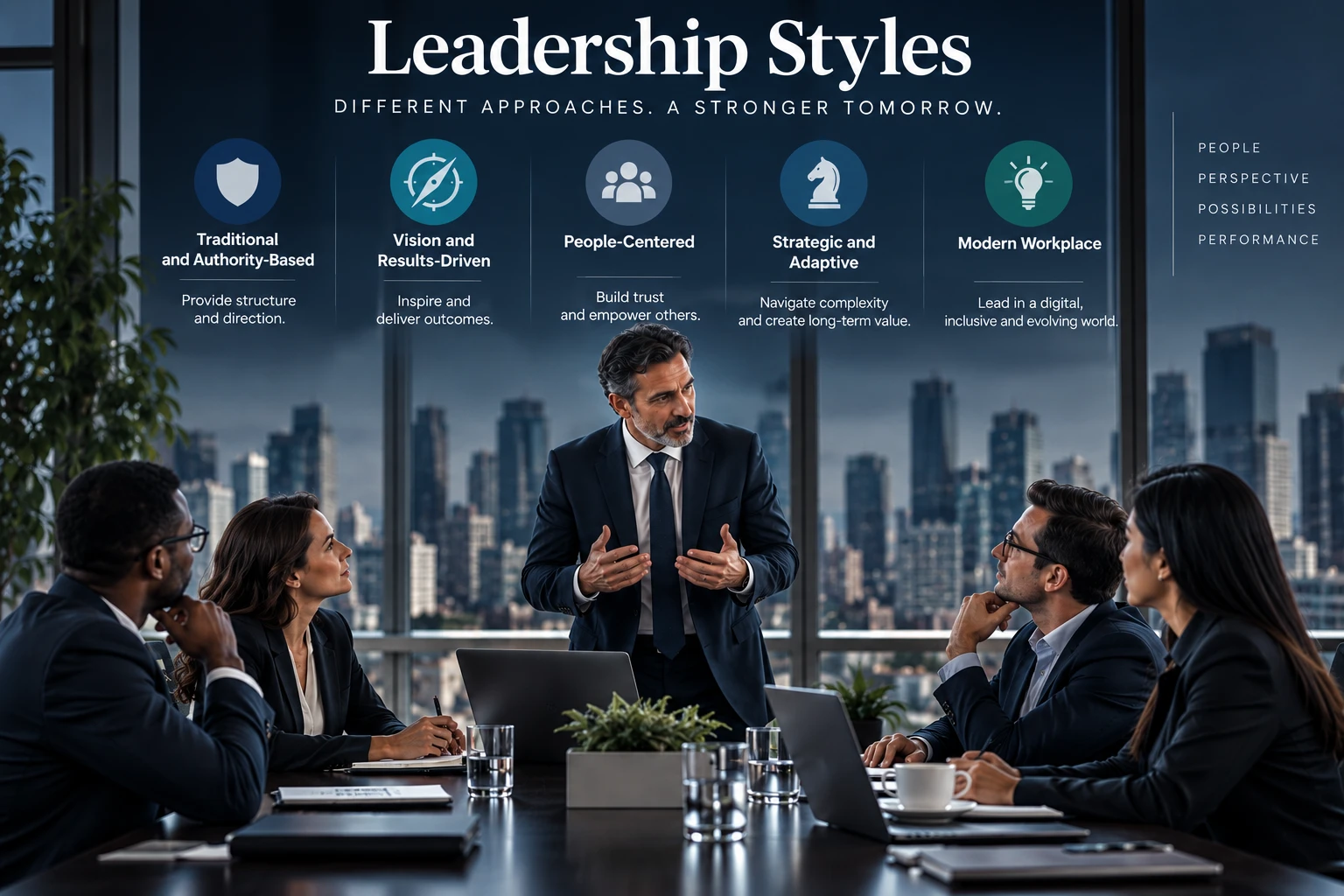
Leadership Styles
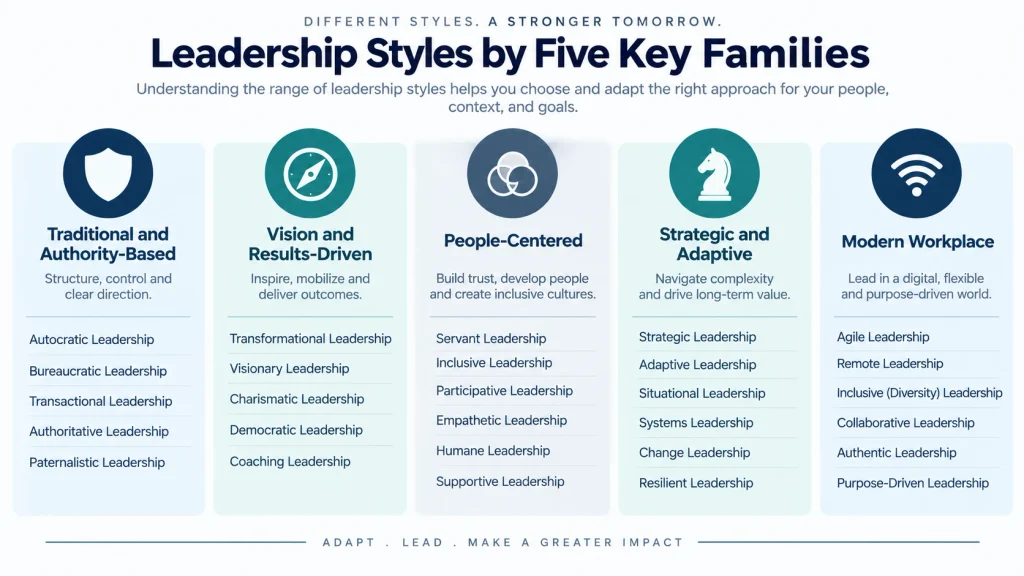
Leadership styles are the distinct patterns of behavior, decision-making, communication, and influence that leaders use to guide individuals, teams, and organizations toward shared goals. Each leadership style reflects a different approach to authority, employee relationships, motivation, and organizational performance.
Understanding leadership styles helps leaders choose the most effective approach for their teams, organizational environment, and strategic objectives. Leaders who adapt their leadership style to changing situations are better positioned to improve employee engagement, strengthen collaboration, and achieve sustainable organizational success.
What Are Leadership Styles
Leadership styles are the characteristic methods leaders use to influence people, make decisions, allocate authority, manage performance, and achieve organizational goals. They describe not what a leader believes about leadership in theory but how leadership is actually exercised in observable daily behavior, how authority is held or distributed, how relationships are built or neglected, and how strategic direction is translated into team action.
Leadership styles differ from leadership traits, which are relatively stable personality characteristics, and from leadership qualities, which are character attributes. Styles are behavioral; they are what leaders consistently do in their interactions with teams, stakeholders, and organizational systems. This distinction matters because behavioral styles are more directly developable, more precisely evaluable, and more readily adaptable to situational demands than trait-based models of leadership.
Research from Harvard Business Review, McKinsey, Gallup, and the Center for Creative Leadership consistently demonstrates that leadership effectiveness depends more on behavioral flexibility than on any single preferred style. Leaders who develop a range of styles and the situational intelligence to deploy them appropriately consistently outperform those with deep expertise in one approach alone.
Why It Matters
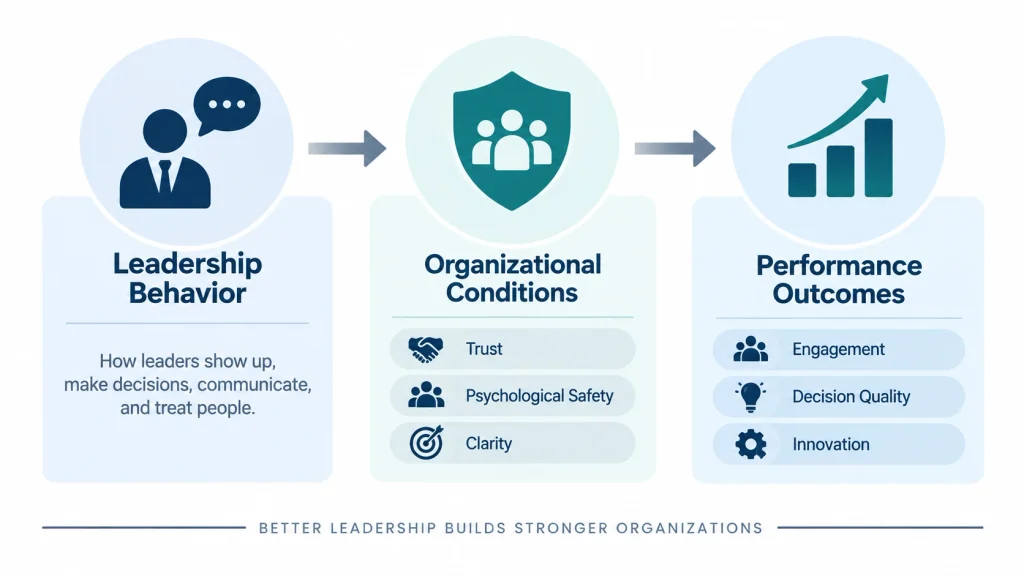
Leadership behavior directly influences employee motivation, collaboration, trust, and organizational performance. The same team can produce dramatically different outcomes depending entirely on how leadership is exercised because leadership style determines the organizational conditions in which performance either reaches its potential or systematically falls short of it.
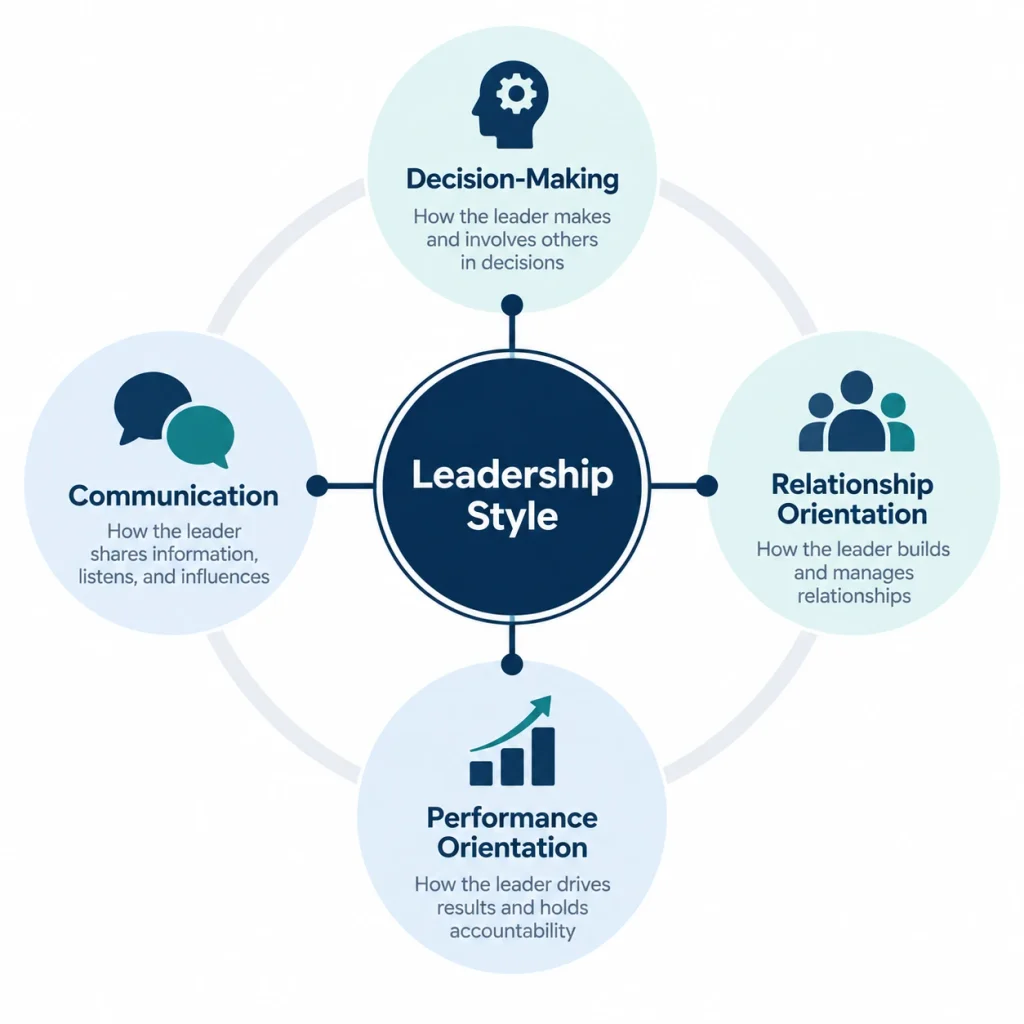
Core Components
Decision-making style determines who participates in organizational decisions, how much deliberation is invested, and how authority is exercised. Leaders who centralize decisions create fundamentally different organizational environments than those who distribute decision authority shaping accountability, execution speed, and employee engagement in ways that compound over time.
Communication style is the pattern through which a leader shares information, conveys expectations, and establishes organizational alignment. Communication patterns determine how effectively strategic priorities move through an organization and how clearly employees understand what is expected, what is valued, and where the organization is heading.
Relationship orientation is the degree to which a leader invests in building trust, psychological safety, and genuine interpersonal connection with team members. Relationship-centered leadership strengthens commitment, reduces voluntary attrition, and creates the interpersonal conditions under which collaboration and honest communication become natural organizational behaviors.
Performance Orientation is the dimension of leadership behavior concerned with how standards are set, how performance is monitored, and how accountability is established and maintained. Different leadership styles prioritize performance through fundamentally different mechanisms, from strict procedural oversight to autonomous empowerment, each producing different organizational performance cultures.
How It Works
Leadership styles influence employee perceptions, behaviors, and expectations by creating the interpretive environment through which organizational signals are read. Employees observe how leaders communicate, make decisions, handle challenges, and treat people, then calibrate their own behavior accordingly. When leadership behavior consistently signals that autonomy is trusted, employees take initiative. When leadership behavior signals that compliance is monitored, employees wait for direction. The behavioral environment that leadership creates determines which organizational capabilities are activated and which are suppressed.
Organizational Impact
Gallup research linking leadership quality to engagement demonstrates that teams in the top engagement quartile generate 23 percent higher profitability and 17 percent higher productivity than those in the bottom quartile, outcomes produced not by strategy or technology but by the leadership behavior that determines how people experience organizational life.
Real-World Example
Satya Nadella’s shift toward empathy, collaboration, and growth mindset leadership at Microsoft transformed an organizational culture characterized by internal competition and innovation stagnation into one of the most innovative enterprise technology organizations in the world. The style shift produced measurable market outcomes because the leadership behavior changed the organizational conditions through which strategy was executed.
Leadership styles function as behavioral operating systems that shape organizational culture, employee experience, and business performance, making style development among the highest-leverage investments available to organizational leaders.
Importance of Leadership Styles
Leadership styles matter because they determine how leaders translate organizational strategy into human action, and the quality of that translation determines the gap between what an organization is capable of and what it actually achieves. Poor leadership style alignment is not a secondary organizational concern; it is the primary mechanism through which capable strategies, talented teams, and sound organizational structures consistently fail to produce their potential performance.
Organizations invest heavily in strategy, technology, and talent, yet leadership behavior often determines whether those investments generate meaningful results. A talented team managed with the wrong leadership approach consistently underperforms a less talented team managed well because motivation, communication, and psychological safety are more powerful performance determinants than raw capability.
Core Components
Trust is the organizational resource that reduces friction in every interaction, decision, and collaborative effort. Leaders who build trust through consistent, integrity-aligned behavior create organizations where people communicate honestly, raise problems early, and commit to collective objectives without self-protective reservation.
Alignment is the leadership-created condition in which individual effort, team priorities, and organizational strategy are coherently connected. Strong alignment reduces the confusion, duplicated effort, and priority fragmentation that consume organizational energy when employees do not clearly understand how their work connects to organizational direction.
Motivation is the leadership-influenced dimension of employee experience that determines whether people bring discretionary effort to their work or perform at the minimum required level. Different leadership approaches activate intrinsic and extrinsic motivation differently, and the degree to which a leadership style sustains genuine motivational engagement determines the gap between adequate and exceptional organizational performance.
Adaptability is the organizational capability that allows enterprises to navigate uncertainty, respond to disruption, and sustain performance through change. Leadership styles that build adaptability, through psychological safety, learning investment, and distributed decision-making, create organizations capable of absorbing environmental disruption that would destabilize more rigidly managed enterprises.
How It Works
Leadership styles create behavioral norms that cascade through organizational levels. Employees observe how leaders communicate, make decisions, and handle challenges, then adjust their own behaviors to align with the implicit organizational signals those leadership behaviors send. This cascading effect means that leadership style choice at the senior level eventually determines the behavioral culture that organizational members inhabit at every level.
The importance of leadership styles extends beyond individual leaders because leadership behavior becomes embedded in organizational culture and shapes long-term performance outcomes well beyond the tenure of any single leader.
How Leadership Styles Influence Performance
Leadership styles influence organizational performance by shaping employee motivation, decision quality, cross-functional collaboration, accountability culture, innovation capacity, and execution effectiveness, operating through the behavioral environment that leadership creates rather than through direct personal performance contribution. The mechanism is cultural: leadership style determines the conditions in which performance either reaches its potential or falls systematically short of it.
Core Components
Motivation is the performance dimension most directly shaped by leadership behavior. Leaders who recognize individual contribution, provide meaningful feedback, connect work to organizational purpose, and demonstrate genuine investment in employee development consistently produce higher levels of discretionary effort than those whose motivation approach relies primarily on compliance incentives alone.
Decision Quality improves when leadership style creates the conditions for better information to reach decision-makers. Collaborative and participative leadership styles consistently produce higher-quality decisions in complex environments because they incorporate diverse perspectives and surface relevant information that hierarchical styles suppress.
Accountability is the performance dimension shaped by how clearly leadership communicates expectations, how consistently it addresses performance gaps, and how equitably it applies standards across the organizational community.
Innovation is the performance dimension most sensitive to the psychological safety conditions that leadership behavior creates or destroys. Amy Edmondson’s research at Harvard Business School demonstrates that psychological safety, the collective belief that one can speak up without fear, is the strongest single predictor of team innovation and learning. Leadership behavior is the primary determinant of whether psychological safety exists.
Collaboration is the cross-functional organizational capability that leadership styles either enable or constrain. Leaders who model information sharing, create cross-boundary relationships, and reward collaborative achievement build organizations where complex multi-function challenges can be met with the full intelligence of the collective.
Real-World Example
Indra Nooyi’s strategic leadership at PepsiCo combined visionary direction with deep stakeholder engagement, producing the organizational commitment required to sustain PepsiCo’s ambitious transformation agenda through the resistance and short-term performance pressure that all major organizational transformation generates.
Leadership styles influence performance because they shape the human systems through which organizational objectives are either achieved or frustrated.
Foundations of Leadership Styles
Leadership Style vs Leadership Approach
Leadership style refers to a leader’s consistent behavioral pattern in organizational interactions, the observable, repeatable ways a leader makes decisions, communicates, builds relationships, and directs effort. A leadership approach refers to the broader philosophy, mindset, and strategic orientation that guides those behavioral choices. Style is what leadership looks like in practice; approach is the underlying intent and value framework from which those observable behaviors emerge.
| Dimension | Leadership Style | Leadership Approach |
| Focus | Observable behavior in interactions | Underlying philosophy and mindset |
| Scope | Day-to-day behavioral choices | Overall leadership orientation |
| Stability | Situationally adaptive | Relatively consistent across contexts |
| Example | Coaching leadership | People-centered leadership philosophy |
| Purpose | Guides specific interactions | Guides strategic decision-making |
A leadership approach is shaped by values, formative experiences, and beliefs about what leadership exists to accomplish. It changes slowly and through deep developmental work. Leadership style is shaped by skill, feedback, and deliberate practice and can be expanded more rapidly through structured development. Leaders who improve their approaches without developing their styles become better intentioned but not more effective. Leaders who develop style range without clarifying approach become technically versatile but directionally inconsistent.
Factors That Shape Leadership Style
Leadership styles are shaped by the interaction of personal characteristics, professional experiences, organizational culture, team dynamics, industry requirements, and situational complexity rather than by any single determinant. They are behavioral responses to an accumulated developmental context, not fixed personality outputs that arrive unchanged from traits and remain static through organizational experience.
Personal characteristics, including personality dimensions, cognitive style, and emotional intelligence, create natural behavioral inclinations that shape initial leadership style tendencies. Professional experience refines those tendencies through the feedback, success, failure, and growing situational judgment that direct organizational experience generates. Leaders who receive honest, specific feedback about the impact of their leadership behavior and who actively incorporate that feedback into deliberate behavioral adjustment develop significantly more sophisticated leadership repertoires than those who accumulate experience without reflective processing.
Organizational culture creates the most powerful external shaping force on leadership style by establishing the behavioral norms that are rewarded, tolerated, and penalized within a specific organizational environment. This dynamic explains why organizational culture change requires leadership style change at the executive level and why leadership style change at the executive level eventually reshapes organizational culture. The relationship between leadership and culture is bidirectional and recursive.
Historical Development of Leadership Styles
The history of leadership style theory reflects the progressive expansion of understanding about what leadership is, how it works, and what makes it effective moving from the trait-focused theories of the early twentieth century through behavioral, contingency, and transformational models to the integrated, adaptive, and human-centered frameworks that characterize contemporary leadership scholarship. Each theoretical era produced insights that the next built on rather than replaced.
The Great Man Theory proposed that leadership effectiveness derived from innate personal qualities that distinguished natural leaders from everyone else. Trait theory refined this concept by identifying specific characteristics, such as intelligence, confidence, and decisiveness, that were associated with leadership effectiveness while retaining the dispositional orientation that located leadership capacity within the individual.
The behavioral theory revolution of the 1940s and 1950s, produced by foundational research at Ohio State and the University of Michigan, shifted attention from who leaders were to what leaders did, making leadership effectiveness a behavioral rather than dispositional question and, critically, making it teachable and developable. This shift became the intellectual foundation on which all subsequent leadership development practice rested. Contingency theories added situational context as a variable, establishing that behavioral effectiveness depended on contextual fit. Contemporary theories integrated behavior, situation, relational dynamics, and continuous development into the sophisticated adaptive models that modern organizational leadership demanded.
Peter Drucker’s management philosophy contributed significantly to this evolution, shifting leadership thinking from authority-based control toward effectiveness, knowledge work stewardship, and organizational contribution.
Evolution of Traditional and Modern Leadership Styles
The evolution from traditional to modern leadership styles represents a fundamental shift in organizational assumptions: from the belief that authority, hierarchy, and control are the primary leadership mechanisms to the recognition that collaboration, empowerment, adaptability, and genuine human development are the most powerful drivers of sustainable organizational performance.
| Dimension | Traditional Leadership | Modern Leadership |
| Authority | Centralized in leadership role | Distributed across organizational levels |
| Communication | Top-down directive | Multi-directional and collaborative |
| Decision Making | Leader-driven | Participative and contextually calibrated |
| Employee Role | Follower executing direction | Active contributor and co-creator |
| Innovation | Constrained by hierarchy | Enabled by psychological safety |
| Adaptability | Lower; style applied uniformly | Higher; style calibrated to context |
| Performance Driver | Compliance and oversight | Commitment and ownership |
The evolution is not a simple replacement of traditional approaches with modern ones. The most effective organizational leaders understand that different conditions call for different leadership style orientations. Crisis environments often require the decisive clarity of traditional authority-based approaches. Innovation challenges require the collaborative, psychologically safe environments of modern empowerment approaches. Developing teams require structured guidance, while high-capability expert teams require autonomy. Sophisticated leadership development builds the full range of leadership capabilities and the situational intelligence to deploy each appropriately.
Why Leadership Style Matters
Why It Is Important to Know Your Leadership Style
Knowing your leadership style provides the self-awareness foundation from which deliberate, effective leadership development becomes possible. Without accurate self-knowledge of behavioral tendencies, decision-making patterns, and relationship management defaults, leaders cannot recognize the gap between their intended and actual organizational impact. As a result, they cannot identify the style gaps that limit their effectiveness or make the intentional behavioral adjustments that situational leadership demands.
Tasha Eurich’s research on leadership self-awareness, published in Harvard Business Review, found that while 95 percent of leaders believe they are self-aware, only 10 to 15 percent demonstrate the behavioral indicators of genuine self-awareness. The organizational cost is significant: leaders operating from inaccurate self-models make systematic behavioral errors they cannot detect or correct, misread organizational responses to their leadership, and fail to adapt when their default style is producing suboptimal outcomes.
Practical knowledge of one’s leadership style also provides a development foundation. Leaders who understand their style tendencies can identify which situations are most challenging, seek targeted feedback, deliberately practice underutilized style dimensions, and communicate more accurately with coaches and developmental partners about the specific growth investments they are making.
Benefits of Understanding Leadership Styles
Understanding leadership styles produces organizational and personal benefits that compound over time: improved decision quality, more effective communication, stronger team performance, faster situational adaptation, and accelerated leadership capability development. Each benefit operates through a specific mechanism that genuine behavioral self-knowledge makes available.
The decision quality benefit operates through reduced cognitive bias. Leaders who understand their decision-making tendencies can compensate for the biases those tendencies create by seeking broader input when their default is directive and applying more rigorous analysis when their default favors speed over thoroughness.
The communication benefit operates through audience calibration. Leaders who understand their communication style can adapt message delivery, the level of detail, and emotional register to different audiences rather than defaulting to a single approach regardless of what each audience requires.
The most significant organizational benefit of understanding leadership styles is the shift it enables: from instinctive, default-driven leadership behavior to deliberate, contextually calibrated leadership behavior. This shift separates leaders who are effective in the specific contexts that suit their natural style from leaders who are consistently effective across the full diversity of organizational situations that complex leadership roles generate.
Can Leadership Styles Be Learned or Developed
Leadership styles can be learned, refined, and deliberately expanded through experience, structured feedback, coaching, education, and reflective practice. While personality characteristics create natural inclinations toward specific style dimensions, the behavioral competencies associated with every major leadership style are developable through appropriate developmental investment, making continuous style development both possible and professionally essential.
The developmental mechanism operates through three phases. Awareness is the accurate perception of current style tendencies, their organizational impact, and the gap between the current style range and what different organizational situations require. Skill-building is the acquisition of behavioral competencies associated with less-used styles through structured practice in lower-stakes contexts before high-stakes deployment. Integration is the development of situational intelligence to recognize which style is most appropriate in each context and the behavioral flexibility to shift between styles with genuine fluency.
Alan Mulally’s leadership transformation at Ford Motor Company between 2006 and 2014 demonstrates the organizational impact of deliberate leadership style development at the highest organizational level. He intentionally developed the specific behavioral capabilities that Ford’s transformation required, including radical transparency, cross-functional alignment disciplines, and the communication practices that made organizational performance information visible across a historically siloed executive team, producing one of the most studied organizational turnarounds in modern business history.
Leadership styles are developmental capabilities rather than fixed characteristics, making continuous style development both possible and essential for sustained effectiveness across the full complexity of organizational challenges that leadership careers generate.
Traditional Leadership Styles
Autocratic Leadership Style
Autocratic leadership is a leadership style in which decision-making authority remains highly centralized, with leaders making decisions independently and expecting compliance from team members. This approach emphasizes control, structure, speed, and direct accountability, making it particularly effective in high-risk, regulated, or crisis environments where rapid decisions and clear operational direction are required.
Why It Matters
Autocratic leadership provides the clarity, consistency, and execution speed that organizational environments characterized by urgency, operational risk, or tight compliance requirements demand. While frequently criticized in leadership development contexts dominated by modern collaborative ideals, its effectiveness in specific organizational conditions is well-supported by research and organizational experience.
Core Components
Centralized authority concentrates decision-making within the leader. It enables rapid action without the delays that consultative approaches often require. This approach is highly effective when decision speed directly affects organizational safety, regulatory compliance, or competitive outcomes. Examples include military operations, emergency response, and manufacturing environments with immediate safety risks.
Clear Direction provides employees with precise and unambiguous guidance on objectives, responsibilities, procedures, and performance standards. It reduces interpretive variation and promotes consistent execution. This is especially important in environments where standardized performance is essential.
Strong accountability establishes direct leader responsibility for organizational outcomes. It also maintains close oversight of execution quality. High standards of procedural compliance require this level of accountability. It reduces performance variation and improves operational consistency.
Structured communication ensures that information moves through clearly defined channels. It reduces conflicting interpretations and minimizes communication errors. This approach is especially valuable in organizations where coordination and consistency are critical.
How It Works
Autocratic leadership operates through the centralization of information, evaluation, and decision-making authority within the leader. Leaders assess available information. They make decisions based on their judgment and expertise. They communicate those decisions through clear directives. They also monitor execution against defined standards. The effectiveness of this model depends on the quality of the leader’s judgment. Under capable leadership, it becomes a strength. Under poor leadership, it becomes a vulnerability.
Organizational Impact
Benefits include faster decision-making, higher procedural consistency, stronger compliance outcomes, and more effective crisis response. Limitations include lower employee engagement over sustained periods, reduced organizational innovation, limited knowledge sharing, and organizational dependency concentrated in a single point of failure.
Common Mistakes
The most consequential error with autocratic leadership is applying it by default in every situation. Leaders who use an autocratic approach across innovation challenges, developmental situations, or strategic environments often limit organizational performance. These situations require psychological safety, coaching, or collective intelligence. Leaders who apply the style selectively achieve better results because they match their approach to the context.
Autocratic leadership succeeds when organizational conditions support its use. Urgency, high risk, compliance requirements, or capability constraints make speed, control, and clear direction more valuable than participation and autonomy.
Democratic Leadership Style
Democratic leadership is a participative leadership style that encourages employee involvement in decision-making while maintaining leader accountability for final outcomes. This approach uses collective intelligence, diverse perspectives, and shared ownership to improve decision quality, strengthen organizational engagement, and build commitment through meaningful participation in decisions that affect employees’ work.
Why It Matters
Knowledge-intensive organizations depend on the expertise distributed across their workforce. Directive leadership often fails to access that expertise. Democratic leadership creates opportunities for employees to contribute to organizational decisions. This improves decision quality and builds stronger commitment to implementation.
Core Components
Shared decision-making expands the information available for organizational decisions. It creates processes that allow employees to contribute their expertise, perspectives, and organizational knowledge. Employees with direct operational experience often provide valuable insights that leadership-only decision models overlook.
Employee engagement grows through genuine participation. Research from Gallup shows that employees who have meaningful influence over decisions affecting their work demonstrate higher engagement, lower voluntary attrition, and stronger organizational commitment than employees who only execute decisions made by leaders.
Knowledge utilization turns the expertise distributed across the workforce into a competitive advantage. It allows organizations to use employee knowledge in decision-making instead of limiting employees to execution roles.
Trust building strengthens the relationship between leaders and employees over time. Leaders who consistently act on employee input build trust. This trust supports commitment, collaboration, and organizational resilience during challenging periods.
How It Works
Democratic leaders create structured opportunities for employees to participate in decision-making. These frameworks allow employee knowledge and expertise to inform important decisions while keeping final accountability with the leader. Leaders facilitate discussions, gather diverse perspectives, and evaluate the available information. They then make decisions that balance employee input with strategic leadership responsibility.
Common Mistakes
The most common mistake in democratic leadership is confusing participation with consensus. Some leaders involve too many people in every decision. As a result, decision-making becomes slow, and leadership accountability is reduced. Not every organizational decision requires the same level of participation. Routine operational decisions often need quick action, while complex strategic decisions benefit from broader discussion.
Democratic leadership strengthens organizational intelligence by combining leadership direction with employee expertise. This approach produces better-informed decisions, increases employee support, and improves implementation.
Bureaucratic Leadership Style
Bureaucratic leadership is a leadership style that emphasizes rules, procedures, policies, and standardized processes to ensure consistency, compliance, and operational reliability. Leaders using this style prioritize structure, documentation, risk reduction, and strict adherence to established protocols. This approach is particularly effective in highly regulated industries where procedural deviations create significant legal, safety, or organizational risks.
Why It Matters
Highly regulated industries require strict compliance with rules and procedures. Examples include financial services, healthcare, aviation, nuclear energy, and pharmaceutical manufacturing. In these environments, procedural compliance is essential. Process deviations can lead to regulatory penalties, reputational damage, patient harm, or serious safety failures.
Core Components
Standardization creates consistent processes across the organization. It ensures that tasks are performed the same way by different employees and across different situations. This consistency improves quality, reliability, and operational performance.
Compliance is the primary performance requirement in regulated environments. Organizations must follow established rules, policies, and legal requirements. Compliance is both a legal obligation and an ethical responsibility.
Documentation provides a clear record of activities, decisions, and procedures. It supports accountability, governance, audits, performance evaluation, and continuous improvement.
Risk management reduces organizational risk through procedural discipline. Established systems identify deviations early and help prevent small issues from developing into major operational, legal, or safety problems.
Organizational Impact
Bureaucratic leadership provides consistency, compliance, predictability, and operational stability. These strengths make it effective in the environments for which it is designed. However, it can also reduce organizational agility, slow innovation, and increase administrative complexity. These limitations become more significant in dynamic environments where success depends on speed, flexibility, and adaptation.
Bureaucratic leadership creates reliability and operational control through standardized processes and procedural discipline. It is most effective in environments where consistency, compliance, and risk management are the primary organizational priorities.
Laissez-Faire Leadership Style
Laissez-faire leadership is a highly decentralized leadership style that gives employees substantial autonomy, minimal supervision, and significant responsibility for decision-making and execution. Leaders provide resources and support while allowing individuals and teams the freedom to decide how work is completed. This style is most effective with highly skilled, self-motivated professionals whose expertise reduces the need for close supervision.
Why It Matters
Laissez-faire leadership is most effective in environments where employee expertise, intrinsic motivation, and professional autonomy are high. Examples include research laboratories, creative agencies, and highly specialized professional practices. In these settings, greater autonomy encourages innovation, initiative, and ownership. Excessive supervision can limit these outcomes.
Core Components
Autonomy is the defining characteristic of laissez-faire leadership. Leaders give employees genuine decision-making authority within clearly defined goals. Employees choose how to complete their work. When they have the necessary capability and accountability, autonomy increases ownership, initiative, and responsibility.
Trust is another core component. Leaders demonstrate confidence in their teams’ abilities and judgment. When that trust is supported by genuine capability, it creates the conditions for high individual performance.
Innovation benefits from the freedom that laissez-faire leadership provides. Creative and knowledge-based work often requires flexibility and independent thinking. Greater autonomy allows employees to explore new ideas without unnecessary constraints. Many breakthrough innovations result from this type of environment.
Expertise Utilization recognizes the value of specialized knowledge. Subject matter experts often make better decisions within their areas of expertise than supervisors with less technical knowledge. Organizations achieve better outcomes when leaders trust that expertise and give employees the authority to apply it.
Common Mistakes
The most common mistake in laissez-faire leadership is using it with teams or individuals who are not ready for a high level of autonomy. Some employees need guidance, structure, and regular feedback to perform effectively. Without these elements, laissez-faire leadership can become leadership avoidance instead of effective delegation. This often results in lower performance, unclear priorities, and reduced accountability.
Laissez-faire leadership is most effective with highly capable and self-directed professionals. Its success depends on employee expertise, intrinsic motivation, and strong self-management. When these qualities are present, autonomy creates significant organizational value. Without them, it can lead to confusion, inconsistency, and organizational drift.
Directive Leadership Style
Directive leadership is a task-oriented leadership style that provides employees with clear instructions, specific expectations, detailed procedural guidance, and appropriate supervisory oversight. This approach helps employees understand their responsibilities and complete their work correctly. It is particularly effective when employees are developing new capabilities, tasks are highly complex, or operational consistency is essential.
Core Components
Clarity is the primary value of directive leadership. Leaders remove ambiguity by providing clear task expectations, procedural guidance, and performance standards. When employees understand what is expected and how success is measured, they perform more consistently.
Structure organizes work into clear and manageable steps. It helps employees complete complex tasks with confidence and improves consistency across the organization.
Supervision gives leaders visibility into employee performance. Leaders monitor progress, identify execution gaps, provide guidance, and ensure that quality standards are consistently achieved.
Goal Focus keeps attention on defined objectives and expected outcomes. It ensures that procedures support organizational performance rather than becoming an end in themselves.
Organizational Impact
Directive leadership is particularly effective when employees are new to their roles. It also works well when tasks involve significant complexity or risk, when operational consistency is essential, or when time pressure limits opportunities for broader participation. However, this style is less effective when applied to highly capable employees or in creative and innovative environments. These settings depend more on autonomy, collaboration, and psychological safety.
Directive leadership is different from autocratic leadership. Directive leaders focus on providing task guidance, building capability, and supporting successful execution. Autocratic leaders focus on centralized authority and decision-making. This distinction influences both the employee experience and the organizational outcomes each style produces.
Modern Leadership Styles
Transformational Leadership Style
Transformational leadership is a leadership style that inspires individuals and teams to exceed conventional performance expectations. Leaders create a compelling vision, foster psychological safety, encourage personal growth, and align individual purpose with organizational objectives. They focus on long-term organizational change, collective capability development, and shared achievement rather than short-term task completion alone.
Why It Matters
Organizations facing disruption, competitive pressure, rapid technological change, or the need for fundamental cultural evolution require leaders who can inspire transformation rather than simply maintain operations. Transactional management sustains existing performance; transformational leadership builds the organizational commitment required to deliver performance that exceeds what current systems and expectations would otherwise produce.
Core Components
Vision is the primary source of influence in transformational leadership. Leaders communicate a clear, compelling, and meaningful picture of the future. Employees understand where the organization is going, why it matters, and how their contributions support that vision. This creates motivation to achieve more than expected.
Inspiration turns vision into personal commitment. Transformational leaders motivate employees to give their best effort, think creatively, and contribute beyond their formal responsibilities. They build commitment through purpose rather than relying only on rewards.
Individual Development is a defining feature of transformational leadership. Leaders invest in the growth of each team member. They develop employees’ skills, confidence, and potential because organizational transformation depends on individual development.
Innovation grows in an environment of psychological safety. Employees feel comfortable sharing ideas, experimenting with new approaches, and learning from mistakes. This encourages creativity and supports continuous improvement.
How It Works
Transformational leadership operates through four key elements: inspirational motivation, idealized influence, intellectual stimulation, and individualized consideration. These dimensions, identified by Bass and Avolio, are consistently associated with strong organizational outcomes. Employees are motivated by a shared sense of purpose, opportunities for growth, and the vision their leaders communicate.
Common Mistakes
The most common mistake in transformational leadership is focusing on vision without creating a clear plan for execution. A compelling vision alone does not produce results. Leaders must also establish the processes, resources, and accountability needed to turn that vision into action. Leaders who combine inspiration with strong operational discipline achieve better outcomes.
Transformational leadership supports sustainable organizational growth by aligning vision, innovation, and employee development around a shared purpose. This approach builds the commitment and capability needed to achieve lasting organizational transformation.
Transactional Leadership Style
Transactional leadership is a performance-focused leadership style built around clear expectations, structured accountability, performance monitoring, and reward systems. Leaders establish specific objectives, evaluate performance against defined standards, and recognize successful performance. They also address performance gaps through structured corrective action. This approach creates the consistency and reliability needed for effective organizational execution.
Core Components
Goal clarity establishes clear performance expectations. Employees understand what successful performance looks like, the timeline for achieving it, and the resources available to support their work.
Performance monitoring gives leaders visibility into employee progress. It helps them identify performance gaps early and provide timely guidance before problems become more serious.
Rewards reinforce the behaviors and results that support organizational objectives. Well-designed reward systems clearly recognize desired performance and encourage employees to maintain high standards.
Corrective Action ensures that performance standards are consistently maintained. Leaders address performance gaps with timely and constructive feedback. Consistent corrective action strengthens accountability and reinforces organizational expectations.
| Dimension | Transformational | Transactional |
| Focus | Change and growth | Performance and consistency |
| Motivation | Purpose and vision | Rewards and consequences |
| Innovation | High emphasis | Moderate |
| Adaptability | High | Moderate |
| Employee Development | Strong emphasis | Secondary |
| Time Horizon | Long-term | Short-to-medium term |
The most effective leaders integrate transformational and transactional leadership rather than choosing exclusively between them. Vision and inspiration drive aspiration; structure and accountability ensure execution.
Transactional leadership strengthens organizational performance through the accountability, structure, and performance management systems that operational reliability requires.
Servant Leadership Style
Servant leadership is a people-centered leadership philosophy and practice that prioritizes employee growth, well-being, empowerment, and service to others. Leaders use their authority to develop people, strengthen their capabilities, and create the conditions that help them contribute fully. Rather than advancing their own status or agenda, servant leaders focus on supporting the success of others.
Core Components
Empathy is the foundation of servant leadership. Servant leaders seek to understand employees’ experiences, challenges, and aspirations. They respond with genuine care and support. This approach builds trust and strengthens long-term organizational commitment.
Empowerment focuses on developing employees’ capabilities, confidence, and decision-making authority. Servant leaders help people grow and succeed. They measure their own success by the growth and achievements of the people they lead.
Listening is a core leadership practice. Servant leaders actively listen to employee concerns, ideas, and feedback. This helps them understand workplace challenges and uncover valuable insights that support better decisions.
Community building creates a workplace where people feel valued, supported, and connected. Servant leaders encourage collaboration, mutual respect, and shared purpose. These qualities strengthen organizational resilience and long-term performance.
Common Mistakes
A common misconception is that servant leadership is incompatible with high performance standards. Effective servant leaders maintain clear expectations and hold employees accountable for their performance. They also provide honest feedback and support continuous improvement. Accountability is exercised through coaching, development, and genuine care rather than fear or punishment.
Servant leadership creates sustainable organizational effectiveness by investing in employee growth while supporting organizational performance goals. As employees develop their capabilities, they contribute more effectively to long-term organizational success.
Charismatic Leadership Style
Charismatic leadership is a leadership style in which leaders influence others through effective communication, personal conviction, a clear vision, and emotional connection. This approach inspires commitment that cannot be achieved through logical arguments or formal authority alone.
Core Components
Communication is the primary strength of charismatic leadership. Leaders communicate a clear vision, organizational purpose, and strategic direction. They use clarity, authenticity, and emotional connection to inspire others and build commitment.
Confidence provides a sense of stability during uncertainty. Confident leaders help teams stay focused, maintain direction, and continue working toward organizational goals despite changing conditions.
Inspiration turns organizational goals into personal commitment. Charismatic leaders motivate employees to contribute their best effort by creating enthusiasm, purpose, and belief in a shared vision.
Visibility allows leaders to build strong relationships with employees. Charismatic leaders maintain an active presence, communicate directly with their teams, and engage regularly with the organization. This visibility strengthens trust, influence, and commitment.
Organizational Impact
Charismatic leadership creates strong organizational alignment, high employee commitment, and effective support for change. However, organizations that depend too heavily on one charismatic leader often face challenges during leadership transitions. Long-term success depends on building organizational capability, shared purpose, and strong leadership at every level rather than relying on a single individual.
Charismatic leadership strengthens commitment through influence, inspiration, and emotional connection. However, sustainable success requires systems, processes, and leadership capabilities that maintain commitment across the entire organization.
Identity Leadership Style
Identity leadership is a leadership approach that builds organizational influence by creating a shared sense of purpose, collective belonging, and group identity. Leaders help employees see themselves as valued members of a meaningful team working toward shared goals rather than as individuals pursuing separate objectives within the organization.
Core Components
Shared identity helps employees see their work as a contribution to a larger purpose. Instead of focusing only on individual achievement, they develop a sense of belonging and commitment to the team and the organization.
Purpose gives meaning to the organization’s work. It helps employees understand why their collective efforts matter and why contributing to shared goals is valuable.
Inclusion ensures that every employee feels like a valued member of the organization. Leaders encourage participation, respect different perspectives, and recognize each person’s contribution. This strengthens trust and reinforces a sense of belonging.
Cultural alignment builds a shared foundation of values, behaviors, and organizational standards. It creates consistency across the organization and strengthens the collective identity.
Identity leadership builds organizational commitment by turning individual work into a shared effort. Employees pursue organizational goals because they identify with the team, believe in the organization’s purpose, and value their role within the collective.
Strategic and Developmental Leadership Styles
Visionary Leadership Style
Visionary leadership is a future-focused leadership style that creates a compelling long-term direction, communicates strategic possibilities, and aligns organizational efforts and resources with transformational goals. It helps employees see their current efforts as meaningful contributions to a shared future that the organization is actively building.
Core Components
Strategic Vision is the ability to identify future opportunities, anticipate challenges, and establish a clear long-term direction. It guides decision-making across the organization and helps align actions with strategic priorities.
Purpose Alignment connects employees’ daily work to the organization’s mission and long-term goals. This helps employees understand the value of their contributions and increases motivation and commitment.
Innovation Focus encourages future-oriented thinking and continuous improvement. Visionary leaders create an environment where new ideas, experimentation, and learning support long-term organizational success.
Change leadership helps organizations move toward their vision. Leaders communicate the purpose behind change, reduce uncertainty, and build commitment to transformation. A clear vision helps employees understand why change is necessary and how it supports future success.
Real-World Example
Jeff Bezos demonstrated visionary leadership by consistently communicating Amazon’s long-term focus on customer obsession. He encouraged the organization to accept short-term losses in support of long-term competitive advantage. This vision required employees to believe in the future the organization was building. Amazon’s current market position reflects decades of consistent strategic execution guided by that long-term vision.
Visionary leadership turns uncertainty into strategic direction. It helps organizations understand where they are going, why the future matters, and how they can achieve their long-term goals.
Strategic Leadership Style
Strategic leadership is a leadership style focused on balancing long-term vision with short-term execution by aligning organizational resources, capabilities, decisions, and priorities to achieve sustainable competitive advantage. Strategic leaders evaluate complex environmental conditions, manage organizational trade-offs, and guide enterprises through the dynamic tension between present performance demands and future positioning requirements.
Core Components
Systems thinking helps strategic leaders understand how different parts of the organization are connected. They recognize how decisions affect multiple functions and anticipate the broader impact of organizational and environmental changes.
Resource allocation translates strategic priorities into action. Strategic leaders allocate financial, human, and organizational resources to the initiatives that create the greatest long-term value. Resource allocation also communicates organizational priorities by showing what the organization chooses to invest in.
Risk Management helps leaders identify potential threats and opportunities before they have a major impact. This allows the organization to respond proactively instead of reacting after problems arise.
Competitive positioning focuses on creating and sustaining value that differentiates the organization from its competitors. Strategic leaders invest in the capabilities that strengthen long-term competitiveness and market relevance.
Real-World Example
Indra Nooyi demonstrated strategic leadership during her tenure at PepsiCo. She transformed the company’s product portfolio, invested in innovation, and focused on long-term growth. Her decisions aligned current resource allocation with the organization’s future competitive position.
Strategic leadership connects long-term vision with day-to-day execution. It ensures that decisions, investments, and capability development support sustainable competitive advantage.
Authoritative Leadership Style
Authoritative leadership is a leadership style that combines clear direction with a compelling vision. Leaders establish well-defined goals while giving employees the flexibility to decide how to achieve them. This approach encourages people to apply their judgment, expertise, and initiative while remaining aligned with organizational objectives.
Core Components
Direction is the primary strength of authoritative leadership. Leaders establish clear goals and provide the strategic context needed to achieve them. They define what the organization should accomplish without prescribing every step of the process.
Vision Communication explains why decisions are made and how they support the organization’s long-term direction. When employees understand the purpose behind organizational goals, they are more likely to support them with commitment rather than simple compliance.
Empowerment gives employees the flexibility to decide how goals are achieved. Leaders trust employees to apply their knowledge, skills, and judgment while working within a clear strategic direction.
Confidence strengthens leadership credibility. Confident leaders communicate direction with clarity and conviction. This helps employees remain focused and committed, even during periods of uncertainty.
Authoritative leadership balances clear strategic direction with employee autonomy. It creates organizational alignment while giving employees the flexibility to determine the best way to achieve shared goals.
Coaching Leadership Style
Coaching leadership is a developmental leadership style focused on improving employee capabilities, performance quality, and long-term professional potential through structured guidance, honest feedback, deliberate mentoring, and the continuous learning investment that transforms current capability into future organizational strength.
Core Components
Development Focus is the foundation of coaching leadership. Leaders prioritize long-term employee growth while supporting current performance. They understand that developing people today leads to stronger organizational performance in the future.
Feedback helps employees improve their skills and performance. Effective feedback is specific, timely, and focused on development. It highlights observable behaviors and provides clear guidance for improvement.
Mentorship supports employee development by sharing knowledge, experience, and practical insights. Leaders help employees learn more quickly by providing guidance that would otherwise take years of experience to gain.
Empowerment is the outcome of successful coaching. As employees build their skills and confidence, leaders gradually give them greater responsibility, decision-making authority, and opportunities to contribute at a higher level.
Organizational Impact
Organizations with coaching leadership cultures consistently demonstrate stronger talent pipelines, higher leadership development ROI, better succession readiness, and lower voluntary attrition among high-potential employees than those where developmental leadership is episodic rather than embedded in daily leadership practice.
Coaching leadership develops organizational capability by transforming the latent potential in every employee relationship into the compound performance and talent advantage that sustained developmental investment creates.
Pacesetting Leadership Style
Pacesetting leadership is a high-performance leadership style in which leaders set ambitious performance standards and lead by example. They demonstrate exceptional execution and maintain high expectations across the team. This style is most effective with highly skilled, self-motivated employees when the primary goal is to achieve outstanding performance rather than develop new capabilities.
Core Components
High Standards are the foundation of pacesetting leadership. Leaders set ambitious performance expectations and communicate them clearly. They maintain these standards consistently, helping them become part of the organization’s culture.
Personal Example builds leadership credibility. Pacesetting leaders demonstrate the level of performance they expect from others. They hold themselves to the same standards they establish for their teams.
Speed emphasizes timely execution without compromising quality. Leaders encourage employees to deliver high-quality work efficiently to meet organizational and competitive demands.
Accountability ensures that commitments are fulfilled and performance standards are maintained. Leaders address performance gaps promptly and encourage continuous improvement through consistent expectations.
Organizational Impact
Pacesetting leadership can increase productivity, accelerate execution, and strengthen a high-performance culture. However, it also carries risks when applied without considering the team’s capabilities and workload. If employees lack the skills, support, or motivation to sustain a demanding pace, they may experience burnout, disengagement, or increased turnover.
Pacesetting leadership drives exceptional performance through high expectations and disciplined execution. It is most effective when leaders apply it in situations where employees have the capability and support to succeed without becoming overwhelmed.
Situational Leadership Style
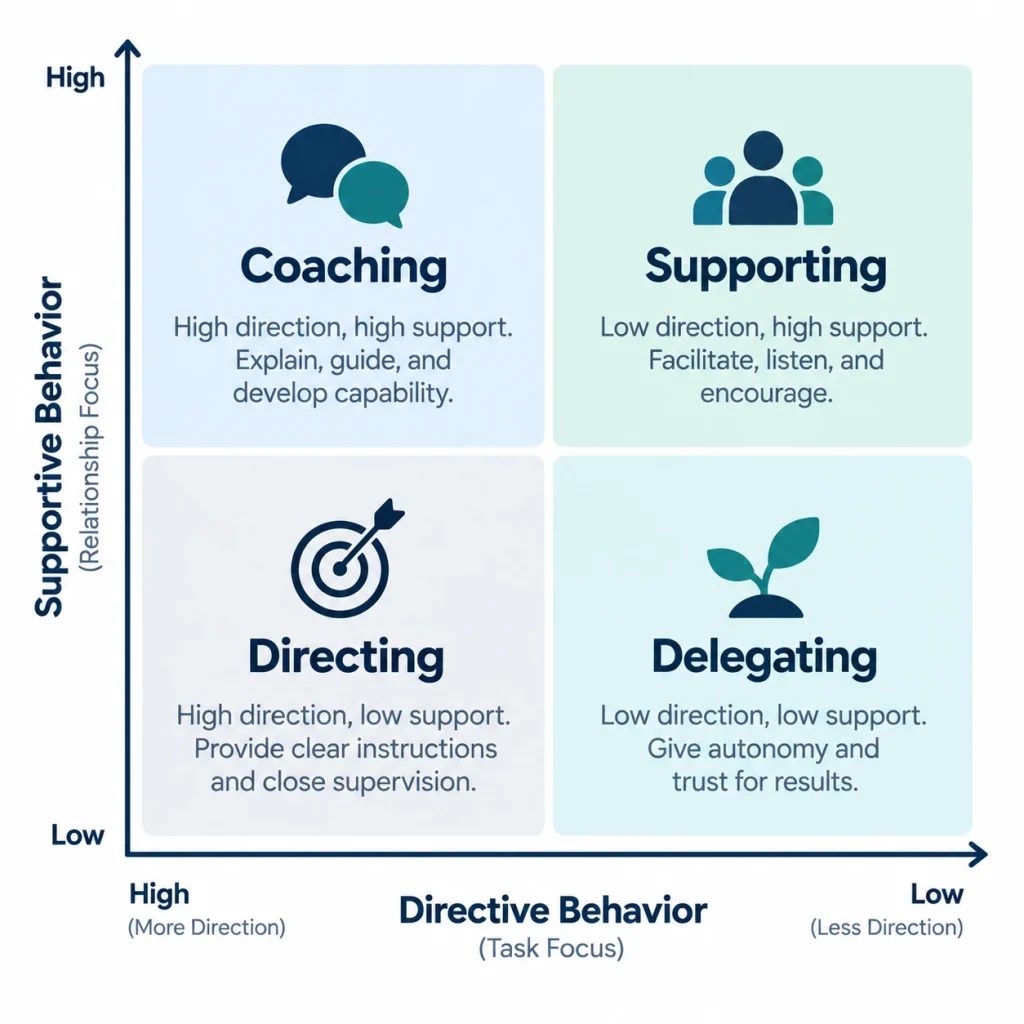
Situational leadership is a flexible leadership model that adapts leadership behavior to the competence, confidence, and motivation of individual employees for specific tasks. Leaders adjust their level of direction and support based on each employee’s needs. This approach provides the guidance and autonomy required for effective performance in different situations.
Core Components
Directing provides high guidance and low support. It is appropriate for employees who are new to a task and need clear instructions to build the knowledge and skills required for successful performance.
Coaching provides both high guidance and high support. It is suitable for employees who are developing their competence but still need direction, encouragement, and regular feedback to build confidence.
Supporting provides low guidance and high support. It is appropriate for employees who have the necessary skills but need encouragement or confidence to perform effectively in complex or challenging situations.
Delegating provides low guidance and low support. It is appropriate for employees who have developed both the competence and confidence to work independently. In these situations, greater autonomy improves engagement and allows employees to perform at their best.
How It Works
Situational leaders continuously assess each team member’s readiness for specific tasks. They distinguish between an employee’s overall capability and their readiness for a particular responsibility. Based on this assessment, leaders select the leadership style that best fits the situation. This approach improves the alignment between the leader, the employee, and the task, leading to stronger performance across diverse teams.
Situational leadership improves organizational effectiveness by matching leadership behavior to each employee’s needs. It provides the level of direction and support that helps employees perform at their best instead of relying on the leader’s preferred leadership style.
People-Focused Leadership Styles
Participative Leadership Style
Participative leadership is a collaborative leadership style that involves employees in decision-making, problem-solving, and organizational improvement. Leaders encourage employees to share their knowledge, ideas, and expertise while maintaining accountability for final decisions and outcomes. This approach builds shared ownership, strengthens engagement, and improves the quality of organizational decisions.
Core Components
Employee involvement gives employees meaningful opportunities to contribute to decision-making. Leaders create structured ways for frontline knowledge, operational experience, and diverse perspectives to inform organizational decisions.
Shared ownership develops when employees participate in decisions that affect their work. People are more committed to implementing decisions they helped create. This increases engagement and improves execution.
Collaboration brings together knowledge and expertise from different teams and functions. By encouraging collaboration, participative leadership supports better decisions and stronger organizational performance.
Innovation grows when employees feel safe to share ideas and challenge existing assumptions. Participative leadership creates an environment where people are encouraged to contribute new perspectives and improve the way the organization works.
How It Works
Participative leaders create clear processes for employee involvement in decision-making. They define which decisions require employee input, how that input is collected, and how it influences the final decision. This approach ensures that participation is meaningful rather than symbolic.
Participative leadership improves organizational performance by combining leadership direction with employee expertise. It leads to better decisions, stronger implementation, and higher employee engagement through meaningful participation.
Affiliative Leadership Style
Affiliative leadership is a relationship-centered leadership style that prioritizes employee well-being, team harmony, interpersonal trust, and strong workplace relationships. Leaders strengthen human connections and create a supportive work environment. They use these relationships to build collaboration, cohesion, and long-term organizational commitment.
Core Components
Relationship building is the foundation of affiliative leadership. Leaders invest in strong interpersonal relationships and encourage meaningful connections across the organization. These relationships strengthen collaboration, trust, and a sense of belonging.
Emotional support focuses on employee well-being. Leaders show genuine care for employees’ experiences, challenges, and professional development. This creates a supportive work environment where people feel valued and respected.
Conflict Reduction improves teamwork by reducing unnecessary tension and workplace conflict. Strong relationships encourage cooperation, open communication, and mutual respect. This creates a more positive and productive work environment.
Trust Development builds psychological safety across the organization. Employees feel comfortable sharing ideas, raising concerns, and supporting one another. High levels of trust strengthen collaboration and help teams perform effectively during challenges.
Organizational Impact
Affiliative leadership is most effective when combined with performance-oriented leadership that maintains clear standards and accountability alongside the relationship investment. When relationship preservation becomes the dominant priority without performance discipline as a counterbalance, affiliative leadership can produce the organizational comfort that inhibits honest feedback and the performance accountability that sustained excellence requires.
Affiliative leadership strengthens organizational culture by creating trust-based relationships that support genuine collaboration and the human belonging that sustains organizational commitment through adversity.
Collaborative Leadership Style
Collaborative leadership is a leadership style that promotes cooperation across individuals, teams, departments, and organizational stakeholders to achieve shared goals. Leaders create the systems, relationships, and ways of working that encourage people to share knowledge, solve problems together, and make better decisions. This approach combines diverse expertise into stronger collective outcomes than any individual or team could achieve alone.
Core Components
Cross-Functional Cooperation brings people from different teams and departments together to achieve shared goals. Leaders encourage coordination, information sharing, and aligned priorities instead of isolated decision-making.
Knowledge Sharing enables employees to exchange expertise, experience, and organizational learning. This helps organizations turn individual knowledge into collective capability and supports better decision-making.
Stakeholder Engagement involves employees, leaders, and other stakeholders in important initiatives and decisions. Including different perspectives improves decision quality and increases commitment to implementation.
Collective Accountability encourages teams to share responsibility for organizational outcomes. Employees work together to solve problems, support one another, and achieve common objectives instead of focusing only on individual results.
Organizational Impact
Collaborative leadership is most effective in complex, knowledge-intensive environments where success depends on teamwork across functions and disciplines. However, collaboration must be supported by clear decision-making authority and accountability. Without these elements, decision-making can become slow and responsibilities may become unclear.
Collaborative leadership improves organizational effectiveness by creating the structures, relationships, and practices that help people combine their expertise, resources, and perspectives to achieve shared organizational goals.
Inclusive Leadership Style
Inclusive leadership is a leadership style that creates an environment where people from diverse backgrounds, identities, and perspectives feel valued, respected, and empowered to contribute. Leaders encourage equal participation and ensure that every employee has the opportunity to share ideas and perform at their best. This approach treats diversity as a source of organizational strength and innovation rather than simply a compliance requirement.
Core Components
Diversity Recognition values the different perspectives, experiences, and ideas that employees bring to the organization. Inclusive leaders recognize that diverse thinking improves decision-making, innovation, and organizational adaptability.
Psychological Safety creates an environment where employees feel comfortable sharing ideas, asking questions, raising concerns, and challenging existing assumptions. People contribute more openly when they know their views will be respected.
Equity ensures that employees have fair access to opportunities, resources, development, and career advancement. Inclusive leaders identify and reduce barriers that prevent people from reaching their full potential.
Belonging creates a workplace where employees feel accepted, respected, and valued. Leaders foster an environment where everyone feels like an important part of the organization and can contribute with confidence.
Organizational Impact
Research from Deloitte, McKinsey, and Harvard Business Review consistently demonstrates that organizations with inclusive leadership cultures demonstrate stronger innovation, better decision quality, higher employee engagement, and superior performance outcomes than those where inclusion is nominal rather than genuine.
Inclusive leadership strengthens organizational effectiveness by ensuring that the full value of organizational diversity is realized through the consistent, deliberate practice of genuine inclusion at every level of organizational life.
Delegative Leadership Style
Delegative leadership is a leadership style that gives qualified employees the authority, responsibility, and decision-making power to manage their work. Leaders maintain overall accountability for organizational outcomes while giving individuals and teams the autonomy to apply their skills, experience, and professional judgment.
Core Components
Authority Transfer gives qualified employees genuine decision-making authority, not just responsibility for completing tasks. Leaders define clear boundaries and allow employees to make decisions within their area of responsibility without seeking approval for every action.
Capability Utilization ensures that decisions are made by the people with the most relevant knowledge and expertise. This improves decision quality and allows organizations to benefit from specialized skills.
Leadership Scalability allows leaders to spend less time on routine operational decisions and more time on strategic priorities, organizational relationships, and complex challenges that require leadership attention.
Accountability ensures that delegation includes clear expectations and measurable outcomes. Leaders remain available to provide guidance and support while allowing employees to exercise their authority and work independently.
Common Mistakes
A common mistake is assigning responsibility without giving employees the authority to make decisions. This creates confusion and limits autonomy because employees must still seek approval for routine decisions. As a result, organizations lose the benefits of effective delegation.
Delegative leadership improves organizational agility and employee engagement by giving capable employees the authority to make decisions and manage their work within clear accountability frameworks.
Adaptive Leadership Styles
Adaptive Leadership Style
Adaptive leadership is a leadership model that helps individuals and organizations respond to uncertainty, disruption, and complex challenges. It encourages continuous learning, experimentation, collaborative problem-solving, and ongoing adaptation. Adaptive leaders distinguish between technical problems, which can be solved using existing knowledge and expertise, and adaptive challenges, which require changes in behavior, values, and organizational thinking.
Core Components
Learning Orientation encourages continuous learning across the organization. Adaptive leaders create an environment where experimentation is encouraged and mistakes become opportunities for learning. They make learning part of everyday work rather than limiting it to formal training.
Flexibility allows leaders to adjust their approach as new information becomes available. Adaptive leaders update their thinking, revise strategies, and respond to changing conditions instead of relying on fixed plans.
Distributed Problem-Solving brings employees from different roles and functions together to solve complex challenges. This approach uses diverse perspectives and expertise to develop better solutions.
Stakeholder Engagement involves the people most affected by change in the problem-solving process. Their input improves decision quality and increases commitment to implementation.
How It Works
Adaptive leaders first determine whether a challenge is technical or adaptive. Technical problems can be solved with existing knowledge and established methods. Adaptive challenges require learning, collaboration, and changes in behavior. Leaders create the conditions that support experimentation, shared problem-solving, and continuous learning so the organization can adapt successfully.
Adaptive leadership helps organizations remain effective in changing environments. It supports continuous improvement by adapting behaviors, systems, and strategies to meet new challenges and opportunities.
Agile Leadership Style
Agile leadership is a leadership style that emphasizes adaptability, collaboration, iterative learning, and responsiveness to changing conditions. Leaders create an environment where teams can adjust strategies, reprioritize work, and respond quickly to feedback from customers, markets, and operational experience. This approach supports continuous improvement and helps organizations remain effective in a changing environment.
Core Components
Adaptability enables organizations to respond quickly to changing conditions. Agile leaders encourage teams to adjust priorities, reallocate resources, and revise strategies as new information becomes available.
Iterative Learning uses short feedback cycles to improve performance. Teams learn from experience, apply lessons quickly, and make continuous improvements before small issues become larger problems.
Team Empowerment gives decision-making authority to the teams closest to the work and the customer. This allows faster responses and better decisions based on real-time information.
Customer Focus keeps organizational decisions aligned with customer needs. Agile leaders encourage teams to use customer feedback to improve products, services, and processes.
Organizational Impact
Agile leadership reduces the time between recognizing a change and responding to it. Faster decision-making and quicker adaptation help organizations remain competitive in rapidly changing environments.
Agile leadership strengthens organizational responsiveness by combining adaptability, continuous learning, team empowerment, and customer focus. This approach helps organizations perform effectively in environments where change is constant.
Change-Oriented Leadership Style
Change-oriented leadership is a leadership style that focuses on identifying opportunities for organizational improvement and leading strategic and cultural transformation. Leaders guide individuals and teams through change by addressing concerns, encouraging engagement, and building commitment. They recognize that successful organizational change depends as much on people as it does on processes and systems.
Core Components
Change Vision provides a clear direction for organizational transformation. Leaders explain why change is necessary, what the organization is working toward, and how the change will create long-term value. A clear vision helps employees understand the purpose behind the transition.
Stakeholder engagement involves employees and other stakeholders throughout the change process. Leaders encourage participation, gather feedback, and include different perspectives when planning and implementing change. This improves the quality of decisions and increases commitment to the transformation.
Communication reduces uncertainty during periods of change. Leaders communicate openly about what is changing, what remains uncertain, and how the changes will affect employees. Clear and consistent communication helps reduce confusion and builds trust.
Resilience building helps employees adapt to change. Leaders provide the support, resources, and encouragement people need to manage uncertainty, develop new capabilities, and remain engaged throughout the transition.
Real-World Example
John Kotter’s eight-step change model provides a practical framework for leading organizational transformation. It outlines structured actions that help leaders address the human and organizational challenges associated with change.
Change-oriented leadership supports successful organizational transformation by aligning people, communication, and organizational systems with a shared vision for the future.
Innovation-Driven Leadership Style
Innovation-driven leadership is a leadership style that creates the conditions needed for creativity and continuous improvement. Leaders foster psychological safety, encourage diverse thinking, support experimentation, and accept productive failure as part of the learning process. This approach helps organizations develop new products, services, processes, and business models that strengthen long-term competitive advantage.
Core Components
Creativity Support creates an environment where employees feel comfortable sharing ideas and exploring new approaches. Leaders encourage creative thinking and demonstrate that innovation is genuinely valued across the organization.
Risk Tolerance supports experimentation and learning. Innovation-driven leaders understand that not every idea will succeed. They treat well-managed failures as learning opportunities that improve future decisions and outcomes.
Knowledge Sharing encourages employees to exchange ideas, expertise, and experience across teams and functions. This collaboration helps generate new insights and supports innovation throughout the organization.
Continuous Improvement focuses on making products, services, processes, and ways of working better over time. Leaders encourage both incremental improvements and larger innovations to strengthen long-term organizational performance.
Organizational Impact
Innovation leadership succeeds not because leaders generate innovative ideas themselves, but because they create the organizational systems, cultural conditions, and psychological safety through which innovation capacity is distributed across the entire organization rather than concentrated in designated innovation functions.
Innovation-driven leadership transforms organizational creativity into competitive advantage by building the conditions under which experimentation, learning, and continuous improvement become embedded organizational capabilities rather than periodic initiatives.
Leadership Styles in Practice
Leadership Styles Based on Decision Making
Leadership styles can be categorized by how decision-making authority is shared between leaders and employees. Decision-making is one of the most visible aspects of leadership. It influences execution speed, employee engagement, accountability, and the quality of organizational decisions.
Centralized decision-making gives leaders greater control but limits access to frontline knowledge and diverse perspectives. Distributed decision-making draws on broader expertise but requires clear governance and accountability. Effective organizations choose the decision-making approach that best fits the situation rather than relying on a single model.
Core Components
Centralized Decision Making concentrates authority with leaders. This approach supports fast decisions and works well when speed, risk management, or specialized expertise is critical. It is commonly associated with autocratic and directive leadership. However, leaders may miss valuable insights from employees who are closest to the work.
Consultative Decision Making allows leaders to gather employee input before making final decisions. This approach improves decision quality while maintaining clear leadership accountability. It is commonly used in democratic leadership.
Collaborative Decision Making involves employees in developing and evaluating solutions. Leaders and employees work together to reach better decisions by combining different perspectives and expertise. This approach is common in participative and collaborative leadership and is especially effective for complex or high-impact decisions.
Delegated Decision Making gives employees the authority to make decisions within clearly defined boundaries. It places decision-making closer to the people with the most relevant knowledge and experience. This approach is common in delegative and agile leadership. It improves responsiveness while maintaining accountability through clear governance.
Organizational Impact
Organizations achieve better results when they match their decision-making approach to the situation. They centralize decisions that require speed, risk control, or specialized expertise, and they distribute decisions when employee knowledge and collaboration add greater value. Choosing the right decision-making structure improves organizational performance, adaptability, and long-term success.
Leadership Styles Based on Team Relationships
Leadership styles differ in how leaders build relationships, establish trust, manage conflict, communicate expectations, and engage with their teams. These behaviors shape the work environment and influence whether employees feel supported, valued, and connected to their work or simply managed through tasks and performance expectations.
The quality of leader-employee relationships is one of the strongest drivers of employee engagement and organizational performance. Research from Gallup consistently shows that the relationship between employees and their managers has a greater influence on engagement than compensation, job design, or organizational strategy.
Core Components
Authority-Based Relationships are built on formal roles, hierarchy, and clear lines of authority. They provide structure, role clarity, and predictable decision-making. This approach is common in traditional leadership styles. However, it may limit open communication and psychological safety.
Trust-Based Relationships develop through consistent integrity, competence, transparency, and genuine care. Leaders build trust over time by acting fairly and keeping their commitments. Trust encourages honest communication, early problem identification, and stronger organizational commitment. This approach is common in servant and affiliative leadership.
Development-Based Relationships focus on helping employees grow professionally. Leaders invest in building skills, increasing confidence, and creating development opportunities. This approach is common in coaching leadership and supports stronger capability, employee loyalty, and long-term organizational performance.
Partnership-Based Relationships encourage employees to contribute as active partners in achieving organizational goals. Leaders value employee expertise, involve people in decision-making, and share responsibility for outcomes. This approach is common in participative and collaborative leadership and strengthens engagement, ownership, and teamwork.
Strong team relationships improve leadership effectiveness. Trust, communication, and collaboration help employees work together more effectively and support better organizational performance.
Leadership Styles Based on Results and Procedures
Leadership styles can also be differentiated by whether leaders prioritize organizational results, procedural adherence, or a balance of both. This distinction influences innovation, compliance, execution efficiency, and the organization’s ability to adapt to changing conditions while sustaining long-term performance.
Core Components
Results-Oriented Leadership focuses on achieving defined goals and measurable outcomes. Leaders set clear performance expectations, hold employees accountable, and allocate resources to the initiatives that create the greatest organizational value. This approach is common in pacesetting and transactional leadership.
Procedure-Oriented Leadership emphasizes compliance, standardized processes, and operational consistency. Leaders ensure that work follows established procedures to reduce risk and maintain quality. This approach is common in bureaucratic leadership and is especially valuable in highly regulated environments.
Balanced leadership combines strong performance expectations with procedural discipline. Leaders focus on achieving results while maintaining the standards, controls, and governance needed for reliable execution. This approach is effective when organizations must balance performance with compliance.
Adaptive leadership adjusts the emphasis on results or procedures according to the situation. Leaders prioritize innovation and performance when flexibility is needed. They place greater emphasis on procedures when safety, compliance, or risk management becomes more important.
Results and procedures are not competing priorities. Effective leaders know when to emphasize each approach and create systems that support both organizational performance and operational reliability.
Leadership Styles in Business
Business environments require leadership styles that align organizational strategy, employee performance, operational execution, and long-term competitiveness. Effective business leaders use multiple leadership styles because no single approach is suitable for every organizational challenge.
Strategic growth often requires the vision and inspiration provided by transformational leadership. Operational excellence depends on the accountability and execution discipline of transactional and directive leadership. Innovation benefits from the psychological safety and collaboration created by participative and coaching leadership. Talent development is strengthened through the employee growth and relationship focus of coaching and servant leadership.
Organizations that develop leaders with a broad range of leadership capabilities are better prepared for changing business conditions. Leadership versatility helps organizations respond effectively to different challenges and sustain long-term competitive performance throughout the organizational lifecycle.
Leadership Styles in Team Management
Team management requires leadership approaches that balance performance accountability, effective communication, employee development, and collaboration. Leaders should adapt their approach to the team’s maturity, capabilities, and organizational context instead of using the same leadership style in every situation.
Effective team leaders combine different leadership styles to meet different needs. They use coaching leadership to develop employee capabilities, participative leadership when team expertise improves decision quality, situational leadership for teams with varying levels of experience, and delegative leadership for highly capable employees who perform best with greater autonomy. The ability to choose the right leadership style for each person and situation is a key leadership competency.
Gallup research shows that manager behavior accounts for approximately 70 percent of the variation in team engagement. This makes leadership behavior one of the most important factors influencing team performance and overall organizational success.
Leadership Styles in Project Leadership
Project leadership requires leaders to coordinate resources, manage stakeholder relationships, maintain project timelines, control risks, and achieve defined objectives. Project teams often include people with different expertise, reporting relationships, and responsibilities. As projects progress, leaders must adapt their approach to meet the changing demands of each phase.
Planning phases benefit from the strategic direction and alignment provided by authoritative and visionary leadership. Execution phases rely on the coordination and engagement supported by collaborative and participative leadership. Risk events and schedule pressures require the clear direction and accountability of directive and authoritative leadership. Throughout the project lifecycle, coaching leadership helps employees build skills, solve problems, and improve performance.
Project leadership requires a high degree of leadership flexibility. Stakeholder expectations, timeline pressures, resource constraints, and project priorities can change quickly. Effective project leaders adjust their leadership style to meet these changing conditions and keep the project moving toward its objectives.
Leadership Styles in Crisis Management
Crisis management requires leadership styles that support rapid decision-making, clear communication, emotional stability, stakeholder confidence, and organizational resilience. Effective leaders help organizations respond quickly and maintain performance during periods of uncertainty and disruption.
Decisiveness provides clear direction when uncertainty could delay action. Leaders make timely decisions that help teams stay focused, even when all the information is not yet available.
Clear communication reduces uncertainty and prevents misinformation. Leaders provide honest, timely updates about what is known, what remains uncertain, and what actions employees should take.
Accountability builds trust during a crisis. Leaders keep their commitments, report progress honestly, and take responsibility for organizational decisions and outcomes.
Adaptability allows leaders to adjust strategies as new information becomes available. They respond to changing conditions without becoming attached to their initial assumptions or plans.
Crisis leadership is most effective when leaders balance speed, clarity, accountability, and adaptability. This approach strengthens stakeholder confidence and helps organizations remain resilient during challenging situations.
Leadership Styles and Organizational Impact
Influence on Workplace Culture
Leadership styles shape workplace culture by influencing organizational values, communication patterns, behavioral expectations, decision-making practices, and interpersonal relationships. These leadership behaviors affect how employees experience their daily work environment and how they interact with one another.
Over time, leadership behavior becomes part of the organization’s culture. Employees learn what the organization values by observing how leaders communicate, make decisions, respond to challenges, and recognize performance. As these behaviors are repeated, they shape the culture more effectively than formal values statements or culture initiatives alone.
Core Components
Leadership Behavior sets the standard for how people work and interact. Employees observe their leaders and often model their behavior. Leadership actions show what the organization truly values, rewards, and expects, regardless of what policies or values statements say.
Communication Patterns shape how information flows throughout the organization. Leaders influence whether communication is open and transparent or limited and inconsistent. Strong communication also creates psychological safety and encourages honest dialogue.
Accountability Systems reinforce organizational expectations. Leaders who address performance issues fairly and consistently create a culture of accountability. Leaders who avoid difficult conversations often weaken performance standards and reduce organizational discipline.
Trust Environment develops through consistent leadership behavior. Leaders build trust by acting with integrity, demonstrating competence, and showing genuine care for employees. High-trust environments encourage collaboration, honest feedback, and effective problem-solving.
Organizational Impact
Leadership-driven cultures influence employee retention, innovation, collaboration, performance, and organizational adaptability. The effects of leadership behavior continue long after individual leaders leave because their actions shape the organization’s culture over time.
Workplace culture reflects leadership behavior at every level of the organization. The way leaders communicate, make decisions, and interact with employees becomes the standard that others follow.
Influence on Employee Behavior
Leadership styles influence employee behavior by shaping motivation, accountability, communication, initiative, decision-making confidence, and workplace relationships. These leadership behaviors create an environment where employees either contribute their full capability and commitment or become disengaged and self-protective in response to the leadership they experience.
Employees interpret leadership behavior as a signal of what the organization values, expects, rewards, and considers acceptable. These signals influence whether employees speak openly about concerns or withhold information, take thoughtful risks or avoid them, and contribute discretionary effort or do only what is required to avoid negative consequences.
Research by Amy Edmondson, Teresa Amabile, and other leadership scholars shows that employees respond more strongly to observed leadership behavior than to formal policies. As a result, the daily actions of leaders have a greater influence on team culture than official organizational values or written guidelines.
Leadership styles shape employee behavior because people look to their leaders for clear signals about organizational priorities, psychological safety, and performance expectations. Employees then adjust their behavior based on those signals.
Influence on Organizational Performance
Leadership styles affect organizational performance by influencing strategy execution, employee engagement, decision quality, innovation, productivity, and organizational adaptability. These leadership behaviors determine how effectively people, processes, and resources align to achieve business objectives.
Core Components
Strategic Alignment connects individual efforts, team priorities, and organizational goals. Leaders who communicate a clear direction help employees understand how their work supports the organization’s strategy and performance objectives.
Employee Engagement reflects the level of commitment and effort employees bring to their work. Leadership behavior influences motivation, collaboration, creativity, and the willingness to contribute beyond minimum job requirements.
Innovation depends on a workplace where employees feel safe to share ideas, experiment, and solve problems. Leadership styles that encourage openness and learning strengthen innovation and long-term competitiveness.
Adaptability enables organizations to respond effectively to change. Leaders who support learning, flexibility, and continuous improvement help teams maintain performance during disruptions, strategic shifts, and organizational transitions.
Gallup research shows that leadership quality has a significant impact on employee engagement and organizational performance. Organizations in the top quartile of engagement achieve approximately 23 percent higher profitability than those in the bottom quartile, highlighting the business value of effective leadership.
Organizational performance depends on more than strategy and resources. It also reflects how effectively leadership aligns people, builds commitment, encourages collaboration, and directs organizational capability toward achieving business goals.
Impact on Motivation
Leadership styles influence employee motivation by shaping how employees connect their work to a sense of purpose, how their contributions are recognized, how much autonomy they experience, and how much support they receive for learning and development. Different leadership styles encourage different sources of motivation, making leadership behavior a key factor in sustaining employee engagement and performance.
Core Components
Purpose helps employees understand why their work matters. Leaders who explain how individual contributions support organizational goals and values create stronger commitment than leaders who focus only on tasks and processes.
Recognition reinforces positive performance and motivates continued contribution. Specific, timely, and genuine recognition has a greater impact than general praise or infrequent acknowledgment. It also shows employees which behaviors and achievements the organization values.
Autonomy gives employees the freedom to make decisions within clear expectations. Leadership styles that provide appropriate independence encourage greater ownership, creativity, and intrinsic motivation while maintaining accountability for results.
Development demonstrates a long-term investment in employee growth. Leaders who provide coaching, learning opportunities, and constructive feedback help employees build new skills and strengthen their commitment to the organization.
Employee motivation increases when leadership behaviors align organizational goals with employee needs, values, and career aspirations. Leaders who support purpose, recognition, autonomy, and development create an environment where employees remain engaged and motivated over the long term.
Impact on Productivity
Leadership styles influence organizational productivity by shaping goal clarity, accountability, resource utilization, communication, and execution quality. Effective leaders create the conditions that help employees work efficiently, collaborate effectively, and achieve organizational objectives.
Leadership improves productivity through several connected factors. Clear communication ensures employees understand priorities and performance expectations, reducing confusion and improving focus. Consistent accountability reinforces performance standards and encourages responsibility. Strategic resource allocation directs people, time, and resources toward the activities that create the greatest value. Clear decision-making authority reduces delays and helps teams respond more efficiently.
Research consistently shows that engaged employees are more productive than disengaged employees. Leadership behaviors that strengthen motivation, trust, collaboration, and employee development contribute directly to higher individual and organizational performance.
Productivity improves when leaders provide clear direction, remove obstacles to execution, and create an environment where employees have the support, accountability, and motivation to perform at their best.
Impact on Team Engagement
Leadership styles influence team engagement by shaping trust, communication, recognition, employee development, and inclusion. Employees are more engaged when leaders show that their contributions are valued, their opinions are respected, their growth is supported, and they are an important part of the team.
Trust is the foundation of team engagement. Leaders build trust through consistent actions, integrity, fairness, and genuine concern for employees. Trust encourages open communication, collaboration, and stronger commitment.
Recognition reinforces positive performance and strengthens engagement. Leaders who acknowledge specific contributions help employees feel valued and understand how their work supports organizational success.
Development keeps employees engaged by investing in their future. Coaching, learning opportunities, and constructive feedback show that leaders are committed to employee growth beyond current responsibilities.
Inclusion creates a sense of belonging for every team member. Leaders who encourage participation, value different perspectives, and treat employees fairly help build an environment where everyone can contribute with confidence.
Team engagement increases when leadership consistently builds trust, recognizes contributions, supports development, and creates an inclusive workplace where employees feel valued and motivated to perform at their best.
Organizational Impact
High team engagement improves employee retention, productivity, execution quality, cross-functional collaboration, attendance, and customer satisfaction. Engaged employees are more committed to their work, contribute discretionary effort, and consistently deliver better outcomes for both the organization and its customers.
Team engagement reflects the quality of leadership that employees experience every day. The way leaders communicate, recognize contributions, support development, and build trust has a direct influence on engagement, making leadership behavior one of the most effective drivers of organizational performance.
Leadership Style and Trust
Trust develops when leaders consistently demonstrate competence, integrity, transparency, and genuine care. Employees build confidence in their leaders when these behaviors remain consistent in both everyday situations and high-pressure circumstances. While different leadership styles build trust in different ways, all effective leadership depends on consistent behavior over time.
Competence builds trust when leaders demonstrate sound judgment, expertise, and effective decision-making. Employees are more confident when they believe their leaders can guide the organization successfully.
Integrity develops trust through consistency between words and actions. Leaders who keep their commitments and act according to their values create confidence and reliability.
Transparency strengthens trust through honest communication. Leaders who openly share what is known, what is uncertain, and what challenges the organization faces encourage openness and reduce uncertainty.
Care builds trust by showing genuine concern for employee well-being, development, and long-term success. Employees are more likely to trust leaders who invest in them as people, not only as contributors to organizational performance.
Research published by Harvard Business Review identifies organizational trust as a key factor in leadership effectiveness, employee engagement, and business performance. Trust reduces uncertainty, encourages collaboration, improves communication, and enables employees to focus their energy on achieving organizational goals rather than protecting themselves.
Leadership Style and Empowerment
Leadership styles determine how much genuine empowerment employees experience. Empowerment includes the authority, resources, information, and support employees need to make decisions and use their skills to achieve organizational goals. It is not simply about encouraging employees. It requires leaders to intentionally distribute decision-making authority and accountability throughout the organization.
Effective empowerment requires leaders to give employees real decision-making authority instead of maintaining approval processes that limit independent action. Leaders must also provide the resources, information, and organizational support needed to make sound decisions. As employees gain experience and capability, leaders should gradually expand their responsibilities to match their readiness.
Empowered employees often demonstrate stronger ownership, greater innovation, higher accountability, and deeper commitment than employees working under highly directive leadership. When leaders combine empowerment with clear expectations and appropriate support, they create an environment where employees can contribute more effectively and improve organizational performance.
Leadership Style and Collaboration
Leadership styles have a significant influence on collaboration because leaders establish communication norms, relationship expectations, conflict management practices, decision-making processes, and psychological safety. These behaviors determine whether employees work together as trusted partners or operate in isolation across organizational boundaries.
Leadership shapes collaboration through several connected factors. Psychological safety encourages employees to share ideas, ask questions, and discuss concerns without fear of negative consequences. Inclusive decision-making ensures that different perspectives are considered and contribute to better outcomes. Effective conflict management helps teams address disagreements constructively and use diverse viewpoints to improve decisions rather than avoid difficult conversations.
Collaborative leadership creates stronger teamwork, encourages innovation, improves problem-solving, and strengthens coordination across departments and functions. These outcomes help organizations respond more effectively to complex business challenges.
Leadership styles influence collaboration by shaping how people communicate, build relationships, and work toward shared goals. As a result, leadership behavior is one of the most important factors in developing an organization’s collaborative capability.
Leadership Styles in Modern Workplaces
Remote Leadership Style
Remote leadership is the practice of building and maintaining team connection, performance accountability, trust, and collaboration across distributed workplaces. Effective remote leaders create intentional communication and engagement that replace the informal interactions naturally found in shared physical work environments.
Successful remote leadership depends more on communication quality than on technology. Effective leaders communicate with purpose, set clear expectations, invest in individual relationships, and create regular opportunities for team connection. Rather than simply transferring in-person leadership practices to virtual settings, they adapt their approach to meet the needs of remote teams.
Core Competencies
Communication Clarity ensures employees receive clear, consistent, and well-structured information. Remote leaders reduce misunderstandings by providing precise instructions, clear expectations, and regular updates through appropriate communication channels.
Trust Building requires deliberate relationship development. Leaders strengthen trust through frequent communication, transparency, reliability, and genuine interest in employee well-being and success.
Performance Visibility focuses on outcomes instead of activity. Remote leaders evaluate employees based on results, provide regular feedback, and establish clear performance measures rather than relying on direct observation.
Remote leadership is most effective when leaders communicate intentionally, invest in strong relationships, and maintain clear, outcome-based accountability despite the challenges of physical distance.
Hybrid Leadership Style
Hybrid leadership manages teams that work across both physical and virtual environments. Leaders maintain consistent engagement, inclusion, collaboration, and performance while ensuring employees receive equal opportunities regardless of where they work.
The primary challenge of hybrid leadership is creating an equitable employee experience. Employees working in the office often have greater visibility, more informal networking opportunities, and easier access to communication. Effective hybrid leaders prevent these differences from affecting career opportunities, collaboration, or performance evaluations. They design work processes that ensure contribution and results, rather than physical presence, determine organizational outcomes.
Core Competencies
Flexibility requires leadership that establishes consistent performance standards while accommodating the diverse physical and temporal working conditions that hybrid environments create. Inclusion requires deliberate communication design that provides remote participants in hybrid meetings with genuine visibility and contribution opportunity rather than technically present but practically marginal participation. Collaboration requires meeting design, documentation discipline, and communication cadence that ensures organizational decisions, conversations, and knowledge are accessible to all team members regardless of physical location.
Hybrid leadership requires intentional coordination to ensure consistent employee experiences, equivalent organizational access, and performance fairness across the diverse working conditions that hybrid organizational environments create.
Digital Leadership Style
Digital leadership is the ability to lead organizations through technological change while maintaining a strong focus on people. It combines technology adoption, data-informed decision-making, digital transformation, and human-centered leadership to improve organizational performance and long-term competitiveness.
Effective digital leaders combine technology knowledge with leadership capability. They use data to support better decisions, develop digital strategies that strengthen organizational performance, and ensure technology improves the way people work rather than replacing the value employees bring to the organization.
Core Competencies
Technology Adoption helps employees embrace new digital tools and processes. Leaders support successful adoption through clear communication, skill development, and an environment where employees feel confident learning new technologies.
Data Literacy enables leaders to interpret information accurately and make evidence-based decisions. They use data to monitor performance, identify opportunities, and support strategic planning without relying on metrics alone.
Innovation Management encourages continuous improvement and digital innovation. Leaders create opportunities for experimentation, learning, and the development of new capabilities that strengthen the organization’s competitive position.
Digital leadership enables organizations to adapt to technological change while maintaining the trust, engagement, collaboration, and people-focused leadership practices that drive long-term success.
Employee-Centric Leadership Style
Employee-centric leadership places employee well-being, development, and long-term success at the center of leadership decisions. It recognizes that a positive employee experience supports stronger organizational performance and that investing in people is a key driver of sustainable business success.
Employee-centric leaders create a workplace where employees feel valued, supported, and able to perform at their best. They build psychological safety, encourage meaningful work, recognize contributions, promote fair treatment, and provide opportunities for continuous learning and career growth.
Core Components
Employee Experience focuses on creating a positive and supportive work environment. Leaders improve engagement by building trust, encouraging open communication, recognizing achievements, and ensuring employees feel respected and included.
Well-Being supports employees’ physical, mental, and emotional health. Leaders promote healthy work practices, manage workloads effectively, and create conditions that help employees sustain high performance over time.
Development emphasizes continuous learning and career growth. Leaders invest in coaching, training, mentoring, and new opportunities that strengthen employee capabilities while preparing future organizational leaders
Benefits
Organizations with employee-centric leadership often achieve higher employee engagement, stronger talent retention, greater innovation, better customer experiences, and improved long-term business performance. Research from Gallup, Deloitte, and McKinsey consistently shows that organizations investing in employee experience and development are better positioned for sustainable success.
Sustainability and Social Responsibility in Leadership
Modern leadership integrates sustainability, ethical governance, stakeholder responsibility, and long-term value creation into organizational decision-making. Effective leaders recognize that lasting business success depends on more than short-term financial results. Environmental, social, and governance considerations also influence organizational resilience, stakeholder trust, and long-term competitiveness.
Environmental Responsibility requires leaders to consider the environmental impact of organizational decisions alongside financial performance. They promote sustainable operations, improve resource efficiency, and manage environmental risks that support long-term business success.
Ethical Decision-Making ensures leaders make decisions with integrity, fairness, and accountability. They consider stakeholder interests, organizational values, and long-term consequences instead of focusing only on short-term financial outcomes.
Stakeholder Value Creation expands organizational success beyond shareholder returns. Leaders create value for employees, customers, communities, business partners, and other stakeholders who contribute to organizational performance.
Long-Term Sustainability focuses on building resilience for the future. Leaders invest in people, innovation, responsible business practices, and strong stakeholder relationships while avoiding short-term decisions that weaken long-term organizational capability.
Leadership that integrates sustainability and social responsibility strengthens organizational performance, builds stakeholder confidence, and supports long-term competitive advantage.
Comparing Leadership Styles
Transformational vs Transactional Leadership
| Dimension | Transformational | Transactional |
| Focus | Change, innovation, and growth | Performance, consistency, and control |
| Motivation Mechanism | Purpose, vision, and shared meaning | Rewards, consequences, and accountability |
| Innovation | High emphasis; psychologically safe | Moderate; structured within systems |
| Employee Development | Strong emphasis; individualized | Secondary to performance management |
| Time Horizon | Long-term organizational change | Short-to-medium term execution |
| Adaptability | High; designed for transformation | Moderate; optimizes existing systems |
| Leadership Influence | Inspirational and personal | Transactional and positional |
Transformational leadership drives change and organizational renewal by inspiring commitment that goes beyond financial rewards. It motivates employees with a shared vision, encourages innovation, and helps organizations adapt to new challenges.
Transactional leadership strengthens execution, accountability, and operational consistency. It establishes clear expectations, reinforces performance standards, and ensures employees understand their responsibilities and organizational goals.
The most effective leaders develop strengths in both leadership styles. They combine the vision and inspiration of transformational leadership with the structure and accountability of transactional leadership. This balance creates organizations that are motivated to innovate while maintaining the discipline needed for consistent performance.
Autocratic vs Democratic Leadership
| Dimension | Autocratic | Democratic |
| Decision Making | Centralized in leader | Participative with employee input |
| Execution Speed | High | Moderate |
| Decision Quality | Dependent on leader expertise | Enhanced by diverse perspective |
| Employee Engagement | Generally lower | Generally higher |
| Innovation | Limited by single-perspective decisions | Enhanced by collective intelligence |
| Control | Strong and direct | Shared and distributed |
| Best Application | Crisis, compliance, operational urgency | Complex decisions, knowledge work, innovation |
Autocratic leadership emphasizes fast decision-making and clear direction. It is most effective when leaders have the necessary expertise, decisions must be made quickly, and delays could negatively affect organizational performance.
Democratic leadership emphasizes participation, collaboration, and shared decision-making. It is most effective in knowledge-based environments where diverse perspectives improve decision quality and where employee involvement increases commitment to successful implementation.
Servant vs Charismatic Leadership
| Dimension | Servant | Charismatic |
| Primary Focus | Employee growth and organizational service | Leader influence and inspirational vision |
| Trust Building | Service, empathy, and developmental care | Inspiration, vision, and personal conviction |
| Long-term Sustainability | High; distributed capability | Dependent on supporting systems |
| Employee Development | Strong, consistent emphasis | Moderate; secondary to vision alignment |
| Organizational Dependency | Distributed; builds self-sustaining capability | Risk of concentrated dependency on leader |
| Cultural Impact | Psychologically safe, development-oriented | High energy, vision-aligned |
Servant leadership builds long-term organizational capability by investing in employee development, empowerment, and well-being. It creates a supportive work environment where employees grow, contribute with confidence, and strengthen the organization’s long-term performance.
Charismatic leadership inspires commitment through a compelling vision and strong personal influence. It builds enthusiasm, aligns employees around shared goals, and motivates action. To sustain long-term success, organizations should support charismatic leadership with strong systems, clear processes, and effective governance so performance does not depend on a single leader.
Coaching vs Situational Leadership
| Dimension | Coaching | Situational |
| Primary Focus | Long-term capability development | Contextual leadership effectiveness |
| Flexibility | Moderate; development-centered | High; style varies by employee and task |
| Goal | Build individual and organizational capability | Maximize performance in each specific context |
| Employee Readiness | Development-oriented regardless of level | Readiness-dependent; style matches readiness |
| Leadership Philosophy | Investment in people as primary strategy | Adaptation as primary effectiveness mechanism |
| Best Application | Talent development, succession readiness | Diverse teams, varying capability levels |
Coaching leadership focuses on developing employee capability through continuous learning, feedback, and guidance. It strengthens individual skills, builds future leaders, and creates the talent needed to support long-term organizational performance.
Situational leadership focuses on achieving the best results by adapting leadership behavior to each employee and situation. Leaders adjust their approach based on employee capability, experience, and the demands of the task, helping teams perform effectively across different circumstances.
There Is No Single Best Leadership Style
Situational Leadership Effectiveness
Leadership effectiveness depends on how well leaders understand the demands of each situation and adapt their behavior accordingly. It is not determined by a leader’s preferred style or expertise in a single leadership approach. Research consistently shows that leadership flexibility is a stronger predictor of effectiveness than relying on one leadership style in every situation.
The most effective leadership approach depends on several factors, including team capability and experience, task complexity, organizational culture, governance requirements, strategic priorities, and the specific performance challenge. Because these conditions differ across organizations and situations, no single leadership style is effective in every context. Successful leaders assess each situation carefully and adjust their leadership approach to achieve the best possible outcomes.
Matching Leadership Styles to Scenarios
| Organizational Scenario | Most Effective Leadership Approach |
| Organizational crisis or emergency | Directive, Authoritative |
| Innovation and new product development | Transformational, Collaborative, Participative |
| New employee onboarding and development | Coaching, Directive |
| High-capability expert team | Delegative, Situational |
| Major organizational transformation | Transformational, Change-Oriented, Adaptive |
| Regulatory compliance environment | Bureaucratic, Authoritative |
| High-growth scaling phase | Visionary, Strategic, Transactional |
| Team conflict and relationship repair | Affiliative, Coaching, Collaborative |
| Strategic planning process | Democratic, Strategic, Participative |
| Performance management and accountability | Transactional, Directive |
Matching leadership behavior to the organizational situation is the practical application of situational leadership. Effective leaders assess what the organization, team, and employees need, then adjust their approach to meet those specific requirements. They focus on choosing the leadership style that best supports performance instead of relying only on the style they are most comfortable using.
Leadership Style Flexibility
Leadership style flexibility is the ability to adapt leadership behavior to different situations with confidence, credibility, and effectiveness. Flexible leaders choose the leadership approach that best fits the needs of the organization, team, and task instead of relying on a single preferred style.
Leadership flexibility does not mean changing personal values or leadership principles. Consistent values build trust. Flexibility means expanding behavioral range. Effective leaders provide clear direction when quick decisions are needed, encourage collaboration when team input improves outcomes, support employee development through coaching, and grant greater autonomy to capable employees when appropriate.
Developing leadership flexibility begins with self-awareness. Leaders first understand their natural leadership strengths and identify areas for improvement. They then build skills in leadership styles they use less often and apply those skills in real situations. With consistent practice, leaders expand their leadership capability and respond more effectively to changing organizational needs.
Successful Leadership Beyond Style
Long-term leadership success depends on more than choosing the right leadership style. It also requires trust, effective communication, emotional intelligence, integrity, and self-awareness. These qualities help leaders build strong relationships, respond to changing organizational needs, and create lasting positive outcomes.
Leadership character is the foundation of effective leadership. Integrity, accountability, genuine care, and self-awareness determine whether employees see a leader as authentic and trustworthy. Even leaders with strong leadership skills struggle to build lasting trust if their character lacks consistency and credibility.
At the same time, strong character alone is not enough. Leaders also need the flexibility to apply different leadership styles as situations change. A trusted leader with a limited leadership approach may not meet every organizational challenge effectively.
Sustained leadership success comes from combining strong character with broad leadership capability. Leaders who demonstrate integrity while adapting their behavior to different situations are better equipped to build trust, develop people, and achieve long-term organizational success.
How to Choose the Right Leadership Style
Assessing Personal Values and Goals
Choosing the right leadership style begins with honest self-assessment. Effective leaders understand their values, beliefs, strengths, and long-term goals while recognizing the needs of their organization. Leadership style should reflect both personal authenticity and the demands of the situation rather than temporary trends or external expectations.
Values Assessment helps leaders identify the behaviors and principles that align with their character. Understanding these values allows leaders to develop leadership styles that feel authentic and build trust with employees.
Goal Assessment clarifies what leaders want to achieve. Whether the priority is improving performance, developing employees, driving innovation, or building a strong organizational culture, leadership style should support these objectives.
Leadership Philosophy reflects a leader’s beliefs about people, performance, authority, and organizational purpose. These beliefs influence how leaders make decisions, communicate, motivate employees, and build relationships. A clear leadership philosophy helps leaders apply leadership styles consistently while remaining true to their values.
Evaluating Leadership Strengths and Weaknesses
Developing an effective leadership style begins with understanding your current strengths and areas for improvement. Self-assessment is valuable, but it should be combined with feedback from others because leaders may not recognize their own blind spots. A balanced evaluation provides a more accurate view of leadership effectiveness.
360-Degree Feedback gathers insights from direct reports, peers, and supervisors. These different perspectives help leaders understand how their behavior affects others and identify strengths as well as opportunities for development.
Leadership Assessments use structured frameworks and psychometric tools to evaluate leadership preferences, personality traits, decision-making styles, and behavioral tendencies. These assessments help leaders understand which leadership styles come naturally and which skills require further development.
Coaching provides personalized guidance for leadership growth. Leadership coaches help leaders interpret assessment results, identify behavioral patterns, set development priorities, and apply new leadership skills in real organizational situations.
Combining self-reflection, feedback, formal assessments, and coaching helps leaders build greater self-awareness and develop the leadership flexibility needed to succeed in different organizational contexts.
Matching Leadership Style to Team Needs
Choosing the right leadership style starts with understanding the needs of the team. Effective leaders focus on what the team requires to succeed rather than relying only on their preferred leadership style or past experience. They adjust their approach based on the team’s development, capabilities, and the challenges it faces.
Team Maturity Assessment evaluates the team’s overall competence, confidence, motivation, and ability to work together. This helps leaders determine the right balance between providing direction and offering support.
Capability Assessment identifies the skills, experience, and development needs of individual team members. Leaders use this information to adapt their leadership approach so it supports both experienced employees and those who require additional guidance.
Motivational Assessment helps leaders understand what drives individual employees and the team as a whole. By recognizing different sources of motivation, leaders can create an environment that encourages engagement, commitment, and high performance.
Leaders who understand their team’s needs and adjust their leadership style accordingly are better equipped to improve collaboration, employee development, and organizational performance.
Adapting Leadership Style to Different Situations
Effective leaders adapt their leadership style to meet the needs of different situations. They assess the challenges, people, and organizational context before deciding how to lead. This flexibility helps leaders respond effectively while supporting both performance and employee needs.
Situational Assessment involves evaluating team readiness, task complexity, organizational priorities, and external pressures. These factors help leaders determine which leadership style or combination of styles is most appropriate.
Behavioral Flexibility enables leaders to adjust their communication, decision-making, and management approach as circumstances change. Rather than relying on one preferred style, they use the leadership behaviors that best support the situation.
Feedback Integration helps leaders improve their effectiveness over time. Leaders gather feedback, reflect on the results of their leadership decisions, and refine their approach based on what works best in different organizational contexts.
Leaders who consistently assess situations, adapt their behavior, and learn from feedback are better prepared to lead diverse teams and achieve successful organizational outcomes.
How to Identify Your Leadership Style
Leadership Style Assessment Methods
Identifying your leadership style requires using multiple assessment methods. Each method provides a different perspective on your leadership behavior, decision-making, and communication style. Combining these insights creates a more complete and accurate understanding of your leadership strengths and development opportunities.
Behavioral Assessments use scenario-based questions to identify leadership preferences, decision-making patterns, and relationship management approaches. These assessments help leaders understand the leadership styles they naturally use in different situations.
Personality Assessments such as the Big Five, MBTI, and Hogan assessments provide insights into personality traits that influence leadership behavior. They help leaders recognize natural tendencies, communication preferences, and areas for development.
Leadership Feedback Tools include 360-degree feedback, direct report surveys, and peer evaluations. These tools provide valuable perspectives from people who work closely with the leader and help identify strengths and blind spots that self-assessment may not reveal.
Executive Coaching helps leaders interpret assessment results and turn insights into practical development plans. Coaches provide guidance, encourage self-reflection, and support leaders as they strengthen their leadership skills and expand their leadership style.
Using multiple assessment methods gives leaders a well-rounded understanding of their leadership style and provides a strong foundation for continuous leadership development.
Developing Leadership Self-Awareness
Leadership self-awareness develops through continuous self-reflection, constructive feedback, formal assessments, and practical leadership experience. Leaders who understand their strengths, limitations, values, and behaviors are better prepared to adapt their leadership style and improve their effectiveness.
Self-Reflection helps leaders evaluate their decisions, interactions, and leadership experiences. Regular reflection, such as reviewing important conversations, analyzing decision-making patterns, or keeping a leadership journal, increases awareness of strengths, biases, and areas for improvement.
Feedback Seeking provides valuable insights from direct reports, peers, managers, and other colleagues. Asking for honest, specific feedback helps leaders understand how their behavior affects others and identify development opportunities that self-assessment may overlook.
Coaching supports deeper leadership development through guided reflection and professional feedback. Leadership coaches help leaders interpret their experiences, challenge limiting assumptions, and create practical plans for improving leadership behavior.
Developing self-awareness is an ongoing process. Leaders who regularly reflect, seek feedback, and apply what they learn build greater confidence, adaptability, and long-term leadership effectiveness.
Leadership Style Self-Reflection
Leadership self-reflection is the process of evaluating your leadership behavior, decision-making, communication, and organizational impact. Regular self-reflection helps leaders better understand their strengths, identify areas for improvement, and apply leadership styles more effectively in different situations.
Decision-Making Reflection helps leaders review how they make decisions. They consider whether they seek meaningful input, balance speed with decision quality, and manage risk based on organizational needs rather than personal preferences.
Communication Reflection focuses on how leaders share information, provide feedback, and manage difficult conversations. Effective reflection helps leaders determine whether their communication creates clarity, alignment, and mutual understanding.
Relationship Reflection examines the quality of interactions with team members. Leaders evaluate whether they provide regular coaching, recognize employee contributions, build trust, and address conflicts promptly and constructively.
Consistent self-reflection helps leaders strengthen self-awareness, improve leadership effectiveness, and adapt their leadership style to better support employees and organizational goals.
Finding Your Leadership Style
Finding your leadership style is an ongoing development process rather than a one-time discovery. It helps you understand your natural leadership tendencies, identify areas for growth, and build the flexibility needed to lead effectively in different situations.
The most effective approach combines formal assessments with real workplace experience. Leaders evaluate which leadership styles feel natural while also observing how different leadership behaviors affect team performance, communication, and organizational outcomes. This practical understanding helps leaders choose the approaches that are both authentic and effective.
Leadership style development also involves recognizing the difference between authentic leadership and simply copying leadership behaviors that do not match your values or strengths. Effective leaders expand their leadership skills while remaining consistent with their character and principles.
The goal is not to assign yourself a single leadership label. It is to understand your current leadership strengths, identify the styles you need to develop, and continuously build the leadership capability required to succeed in different organizational contexts.
Developing Effective Leadership Styles
Building Leadership Competencies
Building leadership competencies is the continuous process of developing the knowledge, skills, and behaviors needed for effective leadership. It requires ongoing learning, self-awareness, and practical experience to strengthen leadership capability and improve organizational performance.
Communication Competency enables leaders to communicate clearly, listen actively, provide constructive feedback, and adapt their message to different audiences. Strong communication builds trust, improves collaboration, and aligns employees with organizational goals.
Strategic Thinking helps leaders evaluate complex situations, identify opportunities and risks, and make decisions that support long-term organizational success. Strategic leaders connect daily activities with broader business objectives.
Emotional Intelligence includes self-awareness, self-management, empathy, motivation, and relationship management. These skills help leaders build trust, manage challenges effectively, and create positive working relationships.
Decision-Making Competency combines critical thinking, problem-solving, risk assessment, and sound judgment. Effective leaders make informed decisions, take responsibility for outcomes, and guide teams with confidence.
Adaptability enables leaders to respond effectively to changing business conditions, diverse teams, and new challenges. Flexible leaders adjust their leadership style while maintaining consistent values and organizational objectives.
Developing these leadership competencies helps leaders expand their leadership style, improve their effectiveness, and succeed across a wide range of organizational situations.
Leadership Style Development
Leadership style development is the ongoing process of expanding leadership capability and increasing behavioral flexibility. Leaders strengthen existing skills, develop new leadership approaches, and build the judgment needed to select the most effective style for different situations.
Leadership styles develop through a combination of learning and practical experience. Workplace experience helps leaders understand which behaviors produce positive results, while intentional development broadens their ability to lead effectively in unfamiliar situations.
Coaching accelerates leadership development by providing personalized feedback, guided reflection, and practical support. Coaches help leaders identify development priorities, strengthen leadership behaviors, and apply new skills with confidence.
Training introduces leadership frameworks, communication techniques, and management practices that expand leadership knowledge and improve decision-making. Formal learning provides the foundation for developing a broader range of leadership styles.
Reflection turns experience into learning. Leaders who regularly evaluate their decisions, interactions, and outcomes gain valuable insights that help them refine their leadership approach and improve future performance.
Leadership style development is most effective when learning, coaching, experience, and reflection work together. This continuous process helps leaders adapt to changing organizational needs and lead with greater confidence and effectiveness.
Improving Leadership Flexibility
Leadership flexibility improves through continuous learning, practical experience, and deliberate practice. Leaders expand their leadership capability by developing leadership styles they use less often and applying them in different organizational situations. With consistent practice, these behaviors become more natural and effective.
Diverse Experiences expose leaders to different teams, business challenges, organizational cultures, and strategic priorities. Working in a variety of situations helps leaders build the confidence and experience needed to apply different leadership styles effectively.
Continuous Learning strengthens leadership knowledge through reading, professional development programs, coaching, mentoring, and peer learning. Ongoing learning introduces new leadership frameworks and practical techniques that expand leadership capability.
Feedback Integration helps leaders understand how their behavior affects others. Regular feedback from employees, peers, and mentors provides practical insights that support continuous improvement and more effective leadership.
Situational Awareness enables leaders to assess team needs, organizational priorities, and business conditions before selecting a leadership approach. Strong situational awareness improves leadership decisions and helps leaders apply the most effective style for each circumstance.
Leadership flexibility develops over time through experience, learning, reflection, and feedback. Leaders who continually expand their behavioral range are better prepared to lead effectively across diverse teams and changing organizational environments.
Continuous Leadership Development
Effective leaders view leadership development as a lifelong commitment rather than a one-time achievement. As organizations, technology, and workforce expectations continue to change, leaders must continually expand their knowledge, skills, and leadership capabilities to remain effective.
The leadership skills that are successful in one role or organizational context may not be enough in another. As leaders take on greater responsibilities and face new challenges, they need to develop new competencies, strengthen existing skills, and broaden their leadership approach. Continuous development helps leaders remain adaptable and effective throughout their careers.
A growth mindset, a concept developed through the research of Carol Dweck, supports continuous leadership development. Leaders with a growth mindset believe that leadership capabilities can be strengthened through learning, practice, and feedback. They view challenges as opportunities to grow and use feedback to improve rather than as criticism.
Continuous leadership development helps leaders adapt to changing business environments, build stronger teams, improve decision-making, and sustain long-term leadership effectiveness. Leaders who commit to ongoing learning are better prepared to meet future organizational challenges and create lasting value.
Advantages and Challenges of Leadership Styles
Benefits of Different Leadership Styles
Each leadership style offers unique benefits when applied in the right organizational context. Effective leaders understand the strengths of different leadership styles and choose the approach that best matches the situation, team needs, and organizational objectives.
Transformational Leadership increases employee engagement, encourages innovation, supports organizational change, and develops future leaders. It is especially effective in organizations that rely on creativity, continuous improvement, and talent development.
Servant Leadership strengthens employee trust, improves retention, creates psychological safety, and supports long-term employee development. It helps build a positive organizational culture and a strong leadership pipeline.
Democratic and Participative Leadership improve decision quality by encouraging employee involvement and diverse perspectives. These leadership styles also increase employee commitment, strengthen collaboration, and promote innovation.
Coaching Leadership develops employee capabilities through guidance, feedback, and continuous learning. It builds future leaders, improves succession readiness, and helps retain high-potential employees.
Directive and Autocratic Leadership provide clear direction, improve execution speed, strengthen compliance, and support effective decision-making during emergencies, high-risk situations, and time-sensitive operations.
The greatest benefit comes from understanding when each leadership style is most effective. Leaders who adapt their approach to organizational needs are better positioned to improve performance, develop employees, and achieve long-term success.
Limitations of Leadership Styles
Every leadership style has limitations. A leadership style becomes less effective when it is applied in situations where its strengths no longer match the needs of the team, task, or organization. Effective leadership depends on selecting the right approach for the right context.
Autocratic Leadership can reduce creativity, collaboration, and employee engagement when teams need innovation, shared decision-making, or greater autonomy. Excessive control may discourage initiative and open communication.
Laissez-Faire Leadership can lead to unclear expectations, inconsistent performance, and weak accountability when employees need guidance, coordination, or regular feedback. Without sufficient leadership support, team performance may decline.
Pacesetting Leadership can create stress and burnout if high performance expectations continue for long periods or if employees need more coaching and support. This approach is most effective with experienced, highly motivated teams.
Bureaucratic Leadership may slow decision-making and limit innovation in fast-changing environments. Strict procedures and rigid processes can reduce flexibility and make it difficult for organizations to respond quickly to new challenges.
The effectiveness of any leadership style depends on the situation. Leaders who understand both the strengths and limitations of different leadership styles can adapt their approach to improve employee performance, engagement, and organizational success.
Common Leadership Style Challenges
The most common leadership style challenges arise when leaders rely on familiar leadership behaviors instead of adapting to the needs of the situation. Effective leadership requires sound judgment, self-awareness, and the flexibility to adjust leadership styles as organizational conditions change.
Resistance to Change is a common challenge because leaders often prefer leadership styles that have worked well in the past. However, relying on the same approach in every situation can reduce effectiveness when team needs or business conditions change.
Managing Diverse Teams requires leaders to adapt their leadership style to employees with different experience levels, skills, motivations, and work preferences. A single leadership approach may not meet the needs of every team member.
Leading Through Uncertainty becomes challenging when organizations face rapid change, limited information, or unpredictable conditions. Leaders must make informed decisions, remain adaptable, and adjust their leadership approach as new information becomes available.
Successful leaders overcome these challenges by developing self-awareness, expanding their leadership flexibility, seeking feedback, and continually adapting their behavior to support both employees and organizational goals.
Future Trends in Leadership Styles
Empathy-Driven Leadership
Empathy-driven leadership is becoming an essential leadership approach in modern organizations. It emphasizes emotional intelligence, genuine care, and strong relationships to build trust, improve collaboration, and strengthen organizational performance. As employee expectations continue to evolve, empathy has become a core leadership competency rather than an optional interpersonal skill.
Core Components
Emotional Intelligence enables leaders to understand and manage their own emotions while recognizing and responding to the emotions of others. This improves communication, strengthens relationships, and supports better decision-making.
Trust Building creates an environment where employees feel safe to share ideas, raise concerns, and collaborate openly. Leaders who demonstrate empathy, honesty, and consistency build stronger trust and long-term commitment.
Employee Well-Being reflects a leadership commitment to supporting employees’ professional, mental, and emotional well-being. Leaders who promote healthy work environments help employees maintain engagement, resilience, and sustainable performance.
Relationship Quality strengthens collaboration and organizational culture. Leaders who build genuine relationships create stronger teamwork, improve communication, and increase employee commitment.
Research from McKinsey, Deloitte, and Catalyst shows that empathetic leadership is associated with higher employee trust, stronger engagement, better collaboration, and improved organizational performance.
As organizations continue to evolve, empathy-driven leadership will become increasingly important. Leaders who combine emotional intelligence with genuine care for people will be better prepared to build resilient teams, support employee well-being, and achieve long-term organizational success.
Data-Driven Leadership
Data-driven leadership is an emerging leadership approach that integrates data, analytics, and evidence-based decision-making into everyday leadership practice. It helps leaders improve decision quality, strengthen performance management, accelerate organizational learning, and make better use of business intelligence while balancing data with professional judgment and organizational context.
Core Components
Analytics Integration enables leaders to collect, interpret, and apply organizational data to support informed decisions. Effective leaders combine analytical insights with business knowledge and contextual understanding instead of relying only on intuition or metrics.
Evidence-Based Decision-Making improves leadership decisions by using reliable data, research, and measurable outcomes. This approach reduces the influence of bias, assumptions, and organizational politics while increasing decision accuracy.
Predictive Intelligence helps leaders identify emerging trends and potential challenges before they become significant problems. By analyzing performance data, leaders can anticipate talent needs, employee engagement issues, operational risks, and strategic opportunities.
Performance Measurement provides continuous feedback on organizational and leadership performance. Leaders use measurable outcomes to evaluate progress, improve leadership effectiveness, and refine strategies based on evidence.
Organizations with data-literate leaders often achieve faster learning, stronger talent management, more effective strategy execution, and better resource allocation. Data-driven leadership combines analytical insight with human judgment, ethical decision-making, and organizational experience to support sustainable business performance.
AI-Assisted Leadership
AI-assisted leadership is an emerging leadership approach that integrates artificial intelligence into decision-making, workforce management, and organizational performance. It uses AI to improve efficiency and provide deeper insights while relying on human judgment, ethical responsibility, and strong relationships to guide final decisions.
Why It Matters
AI helps leaders analyze large amounts of organizational data, identify trends, predict potential risks, and provide personalized insights more quickly than traditional methods. However, AI cannot replace the judgment, empathy, ethical reasoning, and contextual understanding that effective leadership requires. Leaders remain responsible for interpreting AI-generated insights and making decisions that support both organizational goals and employee well-being.
Core Components
Augmented Decision-Making combines AI-generated insights with human judgment. Leaders use AI to support decision-making while considering organizational context, ethical implications, and business priorities before taking action.
Workforce Intelligence provides real-time insights into employee performance, engagement, skills, workforce trends, and succession planning. These insights help leaders identify opportunities and address challenges proactively.
Ethical Oversight ensures AI is used responsibly and fairly. Leaders evaluate AI recommendations, identify potential bias, protect employee privacy, and ensure that important people-related decisions remain guided by human judgment and organizational values.
AI-assisted leadership expands a leader’s ability to analyze information, solve problems, and make informed decisions. When combined with ethical leadership, emotional intelligence, and professional experience, AI becomes a valuable tool for improving organizational performance without replacing the human qualities that define effective leadership.
Human-Centered Leadership
Human-centered leadership is a leadership approach that places people, well-being, development, and dignity at the center of organizational decision-making. It recognizes that long-term business success depends on investing in employees and creating an environment where people can perform, grow, and contribute at their best.
Why It Matters
As automation and artificial intelligence take over more routine tasks, human capabilities such as trust, creativity, ethical judgment, emotional intelligence, and collaboration become even more valuable. Human-centered leadership creates the conditions that help employees develop these strengths and contribute to sustainable organizational performance.
Core Components
Technology-Human Integration ensures technology supports employees instead of replacing the value they bring. Leaders adopt digital tools that improve productivity while protecting employee well-being, collaboration, and meaningful work.
Performance With Purpose connects organizational goals with meaningful employee experiences. Leaders create workplaces where employees feel valued, supported, and motivated to achieve high performance while contributing to a shared purpose.
Ethical Leadership guides leaders to make fair, transparent, and responsible decisions. They consider the impact of business decisions on employees, customers, communities, and other stakeholders alongside financial outcomes.
Employee Experience focuses on creating a positive workplace where employees feel respected, included, and supported. Leaders build psychological safety, encourage continuous learning, strengthen trust, and provide opportunities for meaningful contribution.
Research from Gallup, McKinsey, and Deloitte consistently shows that organizations with human-centered leadership achieve stronger employee retention, higher innovation, better customer experiences, and more sustainable long-term business performance.
Human-centered leadership is not an alternative to high performance. It is a leadership approach that creates the conditions where people and organizations can achieve lasting success together.
Best Practices for Effective Leadership Styles
Aligning Leadership Style With Organizational Goals
Aligning leadership style with organizational goals means ensuring that leadership behaviors support the organization’s strategy, culture, and performance objectives. Effective leaders adapt their approach so that the way they lead helps employees achieve the outcomes the organization is working toward.
Leadership style and organizational strategy should reinforce each other. For example, organizations focused on innovation benefit from leadership styles that encourage collaboration, creativity, and employee involvement. Organizations operating in high-risk or time-sensitive environments may require more directive leadership to support fast decision-making and consistent execution. When leadership behavior does not match organizational priorities, strategy execution becomes more difficult.
Effective alignment begins with a clear understanding of the organization’s goals and the leadership behaviors needed to achieve them. Leaders should evaluate whether their current leadership style supports these objectives, identify areas for improvement, and adjust their approach as business priorities change. Different stages of organizational growth, transformation, or crisis may require different leadership styles to achieve the best results.
Leaders who align their leadership style with organizational goals improve strategy execution, strengthen employee engagement, and increase the organization’s ability to achieve sustainable success.
Building Trust and Credibility Through Leadership
Trust and credibility are the foundation of effective leadership. Leaders who earn the trust of their employees create stronger relationships, encourage open communication, and build greater commitment to organizational goals. Trust is developed through consistent actions, ethical behavior, and demonstrated competence rather than positional authority alone.
Integrity means acting in ways that reflect stated values and commitments. Leaders build trust when their decisions and actions consistently match what they communicate to employees and stakeholders.
Consistency strengthens credibility through reliable behavior over time. Employees gain confidence in leaders who make fair decisions, follow through on commitments, and respond predictably across different situations.
Transparency involves sharing relevant information honestly and openly. Leaders who communicate organizational priorities, challenges, and decisions clearly reduce uncertainty, encourage trust, and promote employee engagement.
Competence reflects the knowledge, skills, and judgment needed to lead effectively. Competent leaders make informed decisions, solve problems, and provide clear direction, giving employees confidence in their leadership.
Leaders who demonstrate integrity, consistency, transparency, and competence build lasting trust and credibility. These qualities strengthen collaboration, improve employee engagement, and create a culture where people are confident in both their leaders and the organization’s direction.
Empowering Teams Through Leadership
Empowering teams is the leadership practice of giving employees the authority, resources, and support they need to make decisions and contribute confidently. Empowered teams take greater ownership of their work, solve problems more effectively, and respond more quickly to changing organizational needs.
Autonomy gives team members the authority to make decisions within clearly defined responsibilities. Leaders build trust by allowing employees to use their knowledge and judgment without unnecessary approval for routine decisions.
Resources provide employees with the tools, information, technology, and organizational support needed to perform effectively. Leaders ensure teams have what they need to achieve their objectives and make informed decisions.
Development strengthens employee skills, knowledge, and confidence through continuous learning, coaching, and practical experience. As employees develop, leaders can gradually expand their responsibilities and decision-making authority.
Support creates an environment where employees feel confident to take initiative and ask for guidance when needed. Leaders remove barriers, provide constructive feedback, and maintain psychological safety while encouraging independent problem-solving.
Leaders who empower their teams build greater accountability, innovation, collaboration, and employee engagement. By combining autonomy with the right resources, development, and support, organizations create high-performing teams that can adapt and succeed in changing business environments.
Creating Long-Term Leadership Success
Long-term leadership success comes from continuous growth, adaptability, strategic thinking, and strong relationships. Effective leaders develop new skills, respond to changing business conditions, and build trust over time. These qualities help leaders remain effective as organizations, teams, and markets evolve.
Adaptability enables leaders to adjust their leadership style, communication, and decision-making as organizational needs change. Flexible leaders respond effectively to new challenges, changing priorities, and evolving workforce expectations.
Continuous Learning supports ongoing leadership development through feedback, training, experience, and self-improvement. Leaders who continue learning strengthen their capabilities and remain prepared for future challenges.
Strategic Thinking helps leaders make decisions with a long-term perspective. They evaluate opportunities, anticipate future challenges, align resources with organizational goals, and balance short-term priorities with sustainable growth.
Relationship Management focuses on building strong, trust-based relationships with employees, peers, stakeholders, and mentors. These relationships improve collaboration, strengthen communication, and provide the support needed for lasting leadership effectiveness.
Leaders who remain adaptable, invest in continuous learning, think strategically, and build strong relationships are better prepared to achieve long-term success. These practices strengthen leadership effectiveness and support sustainable organizational performance.
Conclusion
Key Takeaways on Leadership Styles
Leadership styles are the different ways leaders influence people, make decisions, manage teams, and achieve organizational goals. No single leadership style is effective in every situation. The best approach depends on factors such as organizational strategy, team capability, workplace culture, and the challenges leaders face.
Research consistently shows that leadership flexibility is more valuable than relying on one leadership style. Effective leaders understand multiple leadership approaches and adapt their behavior to meet changing organizational needs while remaining consistent in their values and purpose.
Core Insights
- Leadership style influences organizational culture through everyday actions, communication, and decision-making.
- Different business situations require different leadership styles to achieve the best results.
- Leadership flexibility enables leaders to respond effectively to change, uncertainty, and evolving organizational priorities.
- Modern organizations value adaptability, collaboration, emotional intelligence, and people-centered leadership alongside strong business performance.
- Sustainable organizational success depends on balancing employee development with strategic and operational objectives.
Successful leaders continue to learn, adapt, and refine their leadership style throughout their careers. By combining strategic thinking, strong relationships, ethical decision-making, and behavioral flexibility, leaders create high-performing organizations that achieve lasting success.
Adapting Leadership Styles for Long-Term Effectiveness
Long-term leadership effectiveness requires continuous learning, self-awareness, adaptability, strategic thinking, and strong relationships. Effective leaders regularly refine their leadership style to meet changing organizational needs while maintaining the values and behaviors that build trust and credibility.
Leadership development is an ongoing process rather than a one-time achievement. Successful leaders seek feedback, develop new skills, expand their perspectives, and prepare for future challenges instead of relying only on past experience or a single leadership approach.
Leaders who achieve lasting success view leadership as a continuous practice of improvement. They invest in their own development while helping others grow. By building capable, confident, and engaged teams, they strengthen both individual and organizational performance.
Leadership styles should be used as flexible tools rather than fixed identities. Effective leaders know when to provide clear direction, encourage collaboration, coach employee development, or empower teams to make decisions. They adapt their approach based on organizational goals, team needs, and the situation they face.
Sustainable leadership success is built through the consistent alignment of leadership behavior with business strategy, employee development, and changing organizational conditions. Leaders who combine strong character, professional competence, and adaptability create resilient organizations, develop future leaders, and achieve long-term organizational success.