

Leadership vision is a leader’s clear picture of the future they want to create for their team or organization. It defines the direction, purpose, and long term outcome that guides decisions. A strong leadership vision gives employees a clear direction and a purpose for their work. When people understand both, they stay motivated, make better decisions, and move in the same direction.
What Is Leadership Vision?
Leadership vision is the forward looking picture a leader holds of what their organization, team, or department should become. It is not a task list or a quarterly target. It is a description of a future state that is meaningful enough to guide choices today.
A leadership vision typically answers one core question: where are we going, and why does that destination matter? The answer should be specific enough to guide real decisions, but broad enough to remain relevant as strategies and tactics change over time.
Three groups depend on a clear leadership vision. Employees use it to understand how their daily work connects to a larger purpose. Executives and boards use it to evaluate whether strategic choices move the organization closer to or further from its intended future. Customers and partners use it to understand what the organization stands for beyond its current products or services.
A leader creates a real vision, rather than mere wishful thinking, by anchoring it in the organization’s true capabilities, market position, and values. Strategic planning later translates this future picture into the specific initiatives, budgets, and timelines needed to reach it.
Leadership vision also applies below the level of an entire company. A department head can hold a vision for what their function should look like in three years. A team lead can hold a vision for how their group works together and what it delivers. The scale changes, but the underlying function stays the same: a clear picture of a better future state that shapes how people prioritize their time and effort today.
Leadership Vision vs Mission, Values, and Goals
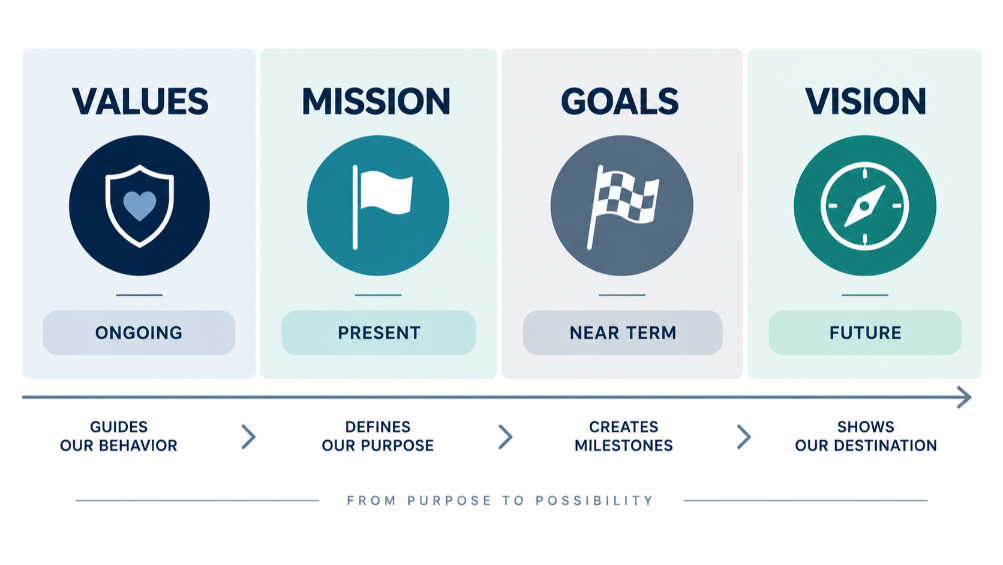
Leaders and organizations often use vision, mission, values, and goals interchangeably. This creates confusion and weakens each concept. Each term serves a distinct purpose, and understanding the difference helps a leader communicate more precisely.
A mission describes what the organization does right now and why it exists. A vision describes what the organization wants to become in the future. Values describe the principles that guide behavior along the way. Goals are the specific, measurable milestones that mark progress toward the vision.
| Element | Primary Question | Time Orientation | Function |
| Vision | What do we want to become? | Future | Inspires direction and long term alignment |
| Mission | What do we do and why? | Present | Guides daily operations and purpose |
| Values | How do we behave? | Ongoing | Shapes culture and decision standards |
| Goals | What will we achieve, and by when? | Near term | Measures progress toward the vision |
A useful way to see the relationship is that mission explains the present, vision describes the destination, values describe the road rules, and goals mark the distance covered. When these four elements line up, employees see a clear, united direction instead of a set of disconnected statements. Organizational culture develops most strongly when a leader’s stated values consistently match daily behavior in pursuit of the vision.
Why Leadership Vision Matters for Organizations
A clear leadership vision matters because it directly shapes how people interpret their work and how leaders make decisions under uncertainty. Without it, teams tend to focus only on immediate tasks and lose sight of long term priorities.
Research on visionary leadership supports this connection. A study published in the Journal of Global Responsibility found that visionary and organic leadership styles were linked to stronger employee engagement, while classical and transactional styles showed a negative association. A 2025 systematic review of 41 academic studies on visionary leadership similarly concluded that visionary leaders tend to improve organizational outcomes by connecting employee aspirations to strategic goals and by fostering a more collaborative work environment.
The mechanism behind this effect is straightforward. When a leader articulates a clear vision, employees gain a reference point for prioritizing their own decisions without needing constant direction. This reduces ambiguity, which in turn reduces the friction and hesitation that often slow down execution.
Vision also affects decision quality at the leadership level. When executives evaluate a new opportunity, a partnership, or a resource allocation decision, a clear vision acts as a sharp filter. They easily prioritize choices that push the organization toward its target future while turning down distractions that fail to serve the goal.
The absence of a vision does not usually cause immediate failure. Instead, it produces a slower erosion of focus, as different teams and leaders pursue reasonable but disconnected priorities. Over time, this fragmentation can be more damaging than a single bad strategic decision, because it compounds across every part of the organization. Leadership communication becomes the mechanism through which this shared reference point actually reaches employees.
A clear vision can also support innovation and adaptability, though the relationship is indirect rather than automatic. When employees understand the outcome a leader is trying to create, they have more room to propose new approaches for reaching it, rather than waiting for detailed instructions on every task. This does not guarantee creative output on its own, but it removes one common barrier: the uncertainty about whether a new idea actually serves the organization’s larger direction.
Characteristics of an Effective Leadership Vision
Not every statement that describes the future functions as an effective leadership vision. Several characteristics distinguish a vision that genuinely guides behavior from one that exists only on paper.
- Clarity: An effective vision can be understood immediately, without requiring further explanation. If employees cannot repeat the core idea in their own words, the vision is too abstract to guide action.
- Aspiration: A vision should describe a future that is meaningfully better than the present. A vision that simply restates current performance targets does not inspire additional effort or commitment.
- Feasibility: An inspiring vision must still rest on the organization’s realistic capabilities and market position. People tend to dismiss a vision that feels impossible rather than pursue it.
- Alignment with values: The vision should reflect the organization’s stated values. When a vision contradicts how the organization actually behaves, employees notice the gap quickly, and trust in leadership declines.
- Durability: A strong vision remains relevant even as specific strategies and tactics evolve. It should describe an enduring direction rather than a single project or short term initiative.
- Relevance to stakeholders: The vision should matter to the people who must act on it, including employees, customers, and investors, not only to the leader who created it.
- Distinctiveness: An effective vision reflects something specific about the organization’s chosen path, rather than a generic aspiration that could apply to almost any competitor in the same industry. A vision that could be copied word for word by a rival company usually has not defined a meaningful destination.
These characteristics work together rather than in isolation. A vision that is clear but not aspirational will not motivate anyone. If it is aspirational but not feasible, people will simply ignore it. When a distinctive vision lacks a connection to real values, it feels hollow the moment a difficult decision tests it. The strongest leadership visions balance all of these qualities at once, which is why building one carefully matters more than writing one quickly.
How to Develop a Leadership Vision
Building a leadership vision is a structured process rather than a single moment of inspiration. The following stages provide a repeatable approach that leaders at any level can apply.
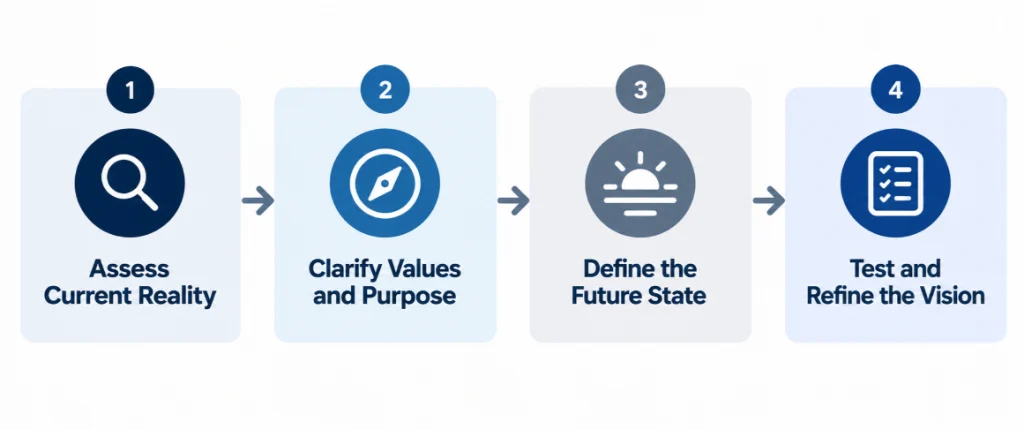
Assess the Current Reality
Before defining a future state, a leader needs an honest picture of the present one. This includes the organization’s current capabilities, market position, culture, and the gap between where it stands and where it could realistically go.
This assessment should draw on multiple perspectives rather than the leader’s view alone. Employee feedback, customer insight, and competitive analysis all reveal blind spots that a single leader is unlikely to see independently. Skipping this step often produces a vision that sounds appealing but does not account for real constraints.
Clarify Values and Purpose
A vision should be anchored in the organization’s core values and the deeper purpose behind its work. Leaders should ask what change they want to create and why that change matters beyond financial performance alone.
This step often benefits from connecting the vision to a personal or organizational story. A vision grounded in a genuine sense of purpose is more resilient during setbacks than one built purely around growth targets, because it gives people a reason to persist when short term results are disappointing.
Define the Future State
With a clear picture of the present and a grounded sense of purpose, the leader can describe the specific future state the organization is working toward. This description should be concrete enough to picture, even if the exact path to reach it is not yet fully defined.
Effective visions at this stage focus on the outcome and impact, not on the internal process used to achieve it. A vision centered on the value created for customers or the world tends to be more motivating than one centered only on internal metrics such as revenue or market share.
Test and Refine the Vision
A draft vision should be tested with a small group of trusted colleagues or team members before it is finalized. Leaders should ask whether the vision is easy to understand, whether it feels genuinely aspirational, and whether it accurately reflects the organization’s values.
Feedback at this stage often reveals whether the vision is too vague, too narrow, or disconnected from what employees actually care about. Refining the vision based on this input increases the likelihood that it will resonate once it is shared more broadly.
How to Communicate and Embed a Leadership Vision
Creating a vision is only the first half of the work. A vision has little impact on how people actually work unless leaders communicate it consistently and back it up with their behavior.
Communicate with Consistency
A vision needs repeated communication across multiple channels before it becomes part of how people think about their work. A single announcement, no matter how well delivered, is rarely enough to shift daily behavior across an organization.
Leaders should reinforce the vision in team meetings, written updates, onboarding materials, and individual conversations. Repetition should not feel mechanical. Framing the vision differently depending on the audience, while keeping the core message consistent, helps it stay relevant to different roles within the organization.
Model the Vision Through Behavior
Employees judge a vision by watching what leaders do, not only by what they say. If a vision emphasizes innovation, but leadership consistently rejects new ideas, the vision loses credibility quickly.
Consistent behavior from leadership signals that the vision is a genuine priority rather than a communication exercise. This is often the difference between a vision that shapes culture and one that becomes an ignored slogan on a wall or a slide deck.
Connect Individual Roles to the Vision
A vision becomes actionable when employees can see how their specific role contributes to it. Leaders should help individuals and teams translate the broader vision into goals that are relevant to their own work.
This connection is particularly important during performance conversations and goal setting cycles, when it is easy for day to day priorities to drift away from the larger direction. Employee engagement tends to be strongest when people can clearly explain how their daily tasks support the organization’s broader vision.
Reinforce the Vision Through Systems and Incentives
Communication alone cannot sustain a vision if the organization’s formal systems point in a different direction. Hiring criteria, performance reviews, promotion decisions, and budget approvals all send signals about what the organization actually values, regardless of what the vision statement says.
Leaders should periodically check whether these systems reward behavior that supports the vision or, unintentionally, behavior that undermines it. For example, a vision built around long term customer relationships loses credibility quickly if performance incentives only reward short term sales volume. Aligning formal systems with the stated vision is often what separates organizations where the vision genuinely shapes decisions from those where it remains a well written but largely symbolic statement.
Common Mistakes That Weaken Leadership Vision
Several recurring mistakes prevent a leadership vision from producing real impact, even when the underlying idea is sound.
- Treating vision as a one time announcement: Leaders sometimes share a vision once during a launch event and assume the message will persist on its own. Without ongoing reinforcement, the vision fades from daily attention within weeks.
- Writing a vision that is too vague to guide decisions: Statements built entirely from generic language, such as being a global leader or delivering excellence, do not help anyone decide between competing priorities. A vision needs enough specificity to actually inform choices.
- Imposing the vision without input: A vision created entirely in isolation, without any input from the people expected to pursue it, often feels disconnected from their daily reality. This reduces genuine buy in, even if employees comply outwardly.
- Allowing the vision to diverge from daily operations: When resource allocation, hiring decisions, and incentive structures do not reflect the stated vision, employees reasonably conclude that the vision is not a real priority.
- Never revisiting the vision: Markets, technology, and organizational capabilities change. A vision that is never reviewed can quietly become outdated, even though it continues to be repeated in official communications.
Each of these mistakes shares a common root cause. Leaders make these mistakes when they treat a vision like a one-time announcement instead of a daily habit. Spotting the real problem in your company is the first step to fixing it. Making a vague vision clearer takes a totally different fix than building daily routines to support it.
Leadership Vision in Practice
Publicly stated corporate vision language offers a useful illustration of how these principles appear in practice, even though the underlying leadership process behind each statement is rarely visible from the outside.
Microsoft has described its vision in terms of empowering people and organizations to achieve more, a framing that centers on the outcome for customers rather than on Microsoft’s own internal operations. This outward focus reflects the characteristic of relevance to stakeholders discussed earlier, since the vision speaks directly to the value customers receive.
Amazon has similarly framed its vision around being the most customer centric company, with an emphasis on selection, discovery, and value for the people who shop there. This vision has remained stable over a long period even as Amazon’s specific business lines have expanded significantly, which illustrates the durability characteristic of an effective vision.
Both examples share a pattern worth noting. Neither vision describes a specific product, technology, or short term target. Instead, each describes a lasting outcome that can guide many different strategic decisions over time, which is precisely the function a leadership vision is meant to serve.
The same pattern holds at a smaller scale. A regional operations leader might hold a vision of becoming the most reliable service provider in their market, without specifying which particular process improvements will get them there. A department head in a hospital might envision a unit where patients feel heard at every stage of care, independent of the specific staffing model used in a given year. In both cases, the vision describes an enduring outcome, while the strategy and tactics used to reach it are expected to evolve as conditions change.
Sustaining and Evolving a Leadership Vision Over Time
A leadership vision is not a static document. Organizations change, markets shift, and leadership itself may change hands, all of which can affect whether a vision remains relevant.
Leaders should periodically evaluate whether the vision still reflects the organization’s realistic future and whether it continues to resonate with employees and customers. This does not require constant rewriting. Most organizations benefit from a stable vision that is reviewed rather than replaced, since frequent changes can create the impression that leadership lacks a consistent direction.
A useful practice is to distinguish between the core of the vision, which should remain stable, and the language or emphasis used to communicate it, which can be refreshed as circumstances change. This allows a vision to stay current without appearing to abandon its underlying purpose every time conditions shift.
Leaders should also watch for signs that a vision is losing traction, such as employees who can no longer articulate it clearly, or strategic decisions that seem disconnected from the stated direction. These signals suggest that the vision needs reinforcement, clarification, or in some cases a genuine update rather than simply more repetition of the existing language.
Leadership transitions deserve particular attention. When a new leader takes over a team or organization, employees often want to know whether the existing vision still holds or whether priorities are about to shift. A new leader who inherits a sound vision does not need to discard it simply to establish their own authority. In many cases, the more credible move is to affirm the parts of the vision that remain valid while being transparent about what will change and why, which preserves continuity for employees during an otherwise uncertain period. This kind of transition is one of the clearest situations where deliberate change management determines whether the existing vision survives the handover intact.
Frequently Asked Questions
How often should a leader revisit their vision? Most organizations benefit from reviewing their vision every few years, or sooner if the market, strategy, or leadership changes significantly. The core direction should remain stable, while the language used to express it can be refreshed as needed.
What is the difference between a vision and a goal? A vision describes a long term future state that a leader wants to create, while a goal is a specific, measurable milestone that marks progress toward that vision. Goals typically have a defined timeline, while a vision does not.
Who should be involved in creating a leadership vision? While a senior leader often initiates the vision, input from employees, customers, and other stakeholders improves its accuracy and increases buy in. A vision created in complete isolation is more likely to feel disconnected from daily reality.
Can a leader be effective without a formal vision statement? A leader can operate without a written statement, but sustained effectiveness usually requires some clear internal sense of direction that guides decisions. Without this, teams tend to default to short term, reactive priorities.
How is a personal leadership vision different from an organizational vision? A personal leadership vision reflects the kind of leader an individual wants to become and the impact they want to have, while an organizational vision describes the future state of the business or team as a whole. Personal vision often shapes how a leader defines and pursues the organizational one.
What should a leader do if the team does not buy into the vision? Leaders should first check whether the vision was communicated clearly and whether it reflects realistic, valued outcomes for the team. Gathering direct feedback often reveals whether the issue is a lack of clarity, a lack of trust, or a genuine disagreement about direction that needs to be addressed before moving forward.
Conclusion
Leadership vision gives an organization a clear sense of direction that guides decisions, motivates effort, and distinguishes meaningful progress from simple activity. It differs from mission, values, and goals, even though all four work together to create a coherent sense of purpose. A vision only produces real impact when it is developed thoughtfully, communicated consistently, modeled through leadership behavior, and revisited as circumstances change. Leaders who treat vision as an ongoing discipline, rather than a one time statement, are better positioned to keep their teams aligned and motivated over the long term.
A clear vision explains where an organization is going. Turning that direction into results depends on how well leaders translate it into daily priorities and resource decisions. That translation is the core work of strategic planning, which converts a compelling picture of the future into a practical sequence of initiatives, budgets, and milestones for getting there.