
Introduction
A charismatic leadership style is an approach where a leader inspires followers through personal charm and vision. The leader relies on confidence and persuasive communication rather than formal authority. This creates a strong emotional bond between the leader and followers.
Charismatic leadership often emerges during change or crisis. In these moments, people look for clarity and hope. A leader who can offer both tends to gain fast, strong support.
This style sits within a broader group of leadership approaches. It overlaps closely with transformational leadership and visionary leadership. Yet it has its own distinct roots, mechanisms, and risks.
This article explains where charismatic leadership comes from. It covers Max Weber’s original concept and Robert House’s later organizational theory. It also explains the traits behind charisma and how the style compares to others. Finally, it covers what leaders can do to develop it responsibly.
Origins and Theoretical Foundations of Charismatic Leadership
The concept of charismatic leadership did not start in business schools. It started in sociology, over a century ago.
Max Weber and the Concept of Charismatic Authority
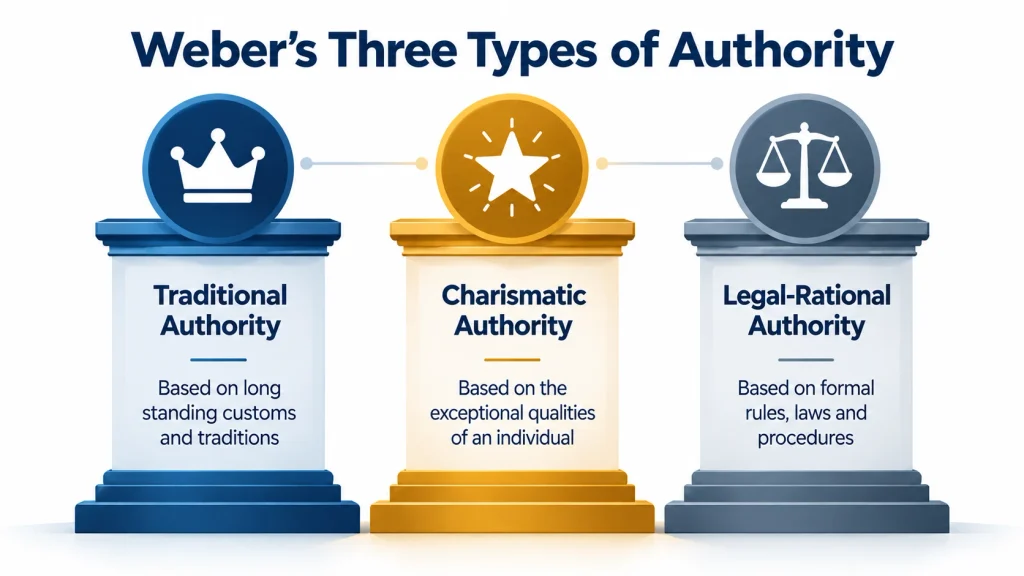
German sociologist Max Weber first described charismatic authority in the early twentieth century. He identified it as one of three types of legitimate authority. The other two are traditional authority and legal-rational authority.
Traditional authority comes from long-standing custom. A hereditary monarchy is a clear example. Legal-rational authority comes from formal rules and offices. A corporate title or an elected position both fit this pattern.
Charismatic authority works differently from both. It comes from a leader’s perceived exceptional personal qualities. It does not depend on tradition or written law.
Weber observed that charismatic leaders tend to emerge during crisis. Social upheaval creates the conditions charisma needs to take hold. Followers grant these leaders authority because they see something the existing order cannot offer.
This is why charismatic leadership often appears alongside major organizational change. New leaders can gain fast trust when an old system has clearly failed. Their personal conviction becomes more persuasive than formal credentials.
Robert House’s 1976 Theory of Charismatic Leadership
Weber’s concept stayed largely sociological for decades. In 1976, management scholar Robert House changed that. He introduced a formal theory of charismatic leadership for organizational settings.
House’s theory identified specific leader traits. These include a strong need for power and high self-confidence. It also includes strong conviction in the moral rightness of their beliefs.
House also described charismatic leader behaviors. These include role modeling, demonstrated competence, and clearly articulating an appealing vision. He connected these behaviors to specific effects on followers.
Those effects include trust in the leader and unquestioning acceptance of the mission. They also include strong emotional involvement in the leader’s goals.
House’s work moved the concept forward in an important way. It took charismatic leadership out of political and religious history. It turned the idea into a testable framework researchers could study inside real organizations.
Core Characteristics of Charismatic Leaders
Charismatic leaders share a recognizable set of traits. These traits explain why followers respond to them so strongly.
Confidence stands out first. Charismatic leaders project strong self-belief. This reassures followers during periods of uncertainty. Vision follows closely behind it. These leaders describe a compelling future. That future feels both ambitious and achievable.
Communication skill is another defining trait. Charismatic leaders are often skilled public speakers. They can make complex ideas feel simple and urgent. Emotional expressiveness supports this skill. They convey genuine passion for their cause. This passion helps followers connect on a personal level.
Sensitivity to others rounds out the picture. Charismatic leaders notice what their followers need. They build trust through this attentiveness, not just charm alone.
The Conger-Kanungo Behavioral Model
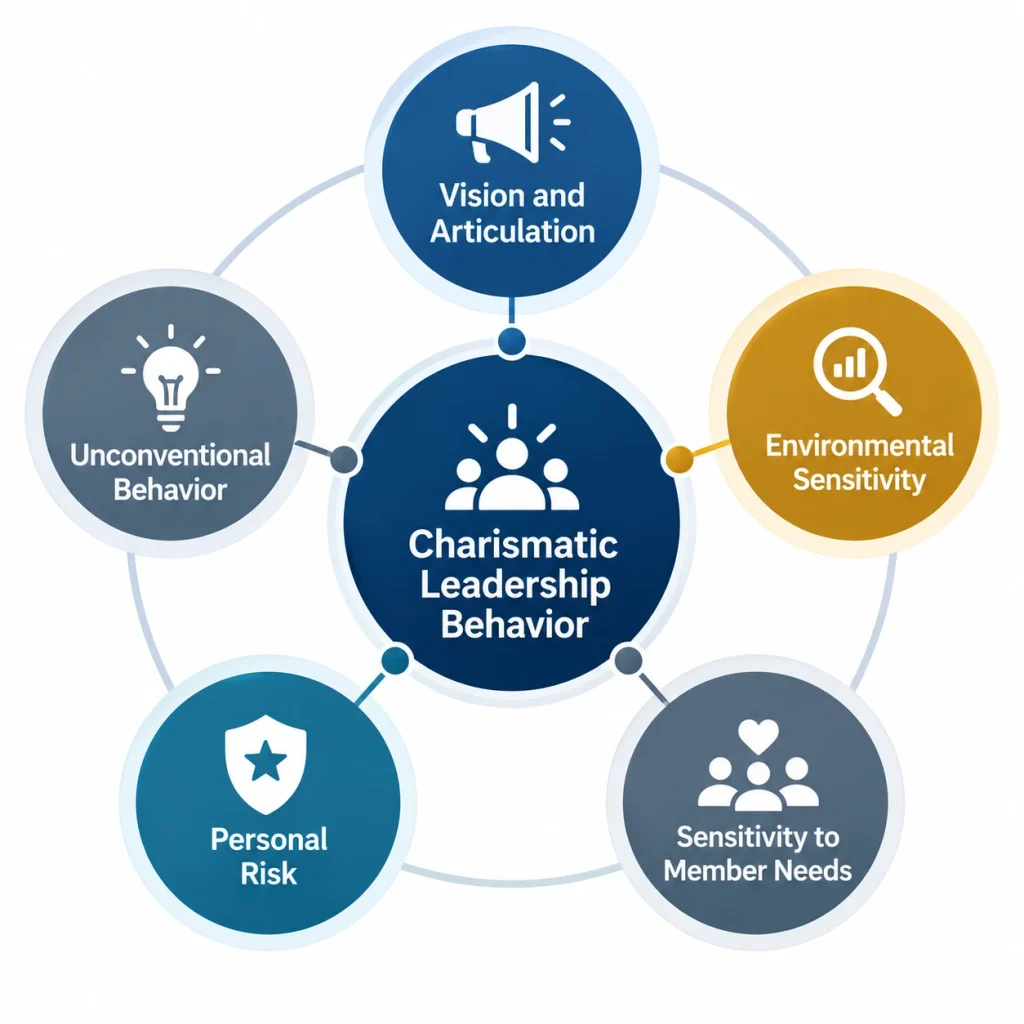
Researchers Jay Conger and Rabindra Kanungo built on House’s work. They created a more detailed behavioral model in 1987. It was published in the Academy of Management Review. Their model identifies five distinct behavioral dimensions.
Strategic vision and articulation is the first dimension. It describes a leader’s ability to form and clearly communicate a goal. Sensitivity to the environment is the second. It reflects awareness of constraints and opportunities around the organization.
Sensitivity to member needs is the third dimension. It captures how attentive a leader is to followers’ feelings. Personal risk is the fourth dimension. It refers to a willingness to accept high personal cost for the mission.
Unconventional behavior is the fifth and final dimension. It describes a readiness to use novel, nontraditional methods. Charismatic leaders often break from standard organizational practice to pursue their goals.
Together, these five dimensions offer real practical value. They give leadership development professionals a way to assess charismatic behavior. This approach is more precise than relying on personality impressions alone.
How Charismatic Leadership Works
Charismatic leadership operates through a specific psychological sequence. Understanding each step helps explain why the style is so powerful.
It begins with sensitivity to the environment. Effective charismatic leaders notice a gap. They see the difference between the current situation and a better future. They then form a vision that names this gap. That vision also offers a clear path forward.
Next comes articulation. The leader communicates this vision in emotionally resonant language. They often use stories, symbols, or bold statements. Technical detail usually takes a back seat. This step matters because an unclear vision cannot inspire anyone.
Followers then begin to identify with the leader. They also identify with the vision itself. Self-concept theory explains why this happens. Researchers Boas Shamir, Robert House, and Michael Arthur developed this theory in 1993.
Their theory suggests charismatic leaders tie their vision to followers’ identity. Followers start to see the mission as part of who they are. Their motivation shifts from external rewards to internal commitment. This shift is what makes charismatic influence so durable.
Trust builds through the leader’s own actions, not just words. Personal risk and unconventional behavior act as proof of commitment. These behaviors come directly from the Conger-Kanungo model described above. Followers interpret these actions as evidence the leader truly believes in the vision.
This combination produces a powerful result. An appealing vision, persuasive articulation, identity based motivation, and demonstrated commitment work together. They create the strong emotional bond that defines charismatic leadership. This same mechanism creates a key risk. Charismatic leadership tends to concentrate influence in one person. That risk is covered later in this article.
Charismatic Leadership vs Other Leadership Styles
Charismatic leadership shares traits with several other leadership styles. This overlap often causes confusion among readers and even researchers. The table below highlights the key distinctions.
| Leadership Style | Primary Focus | Source of Influence | Typical Limitation |
| Charismatic | Leader’s personal appeal and vision | Personal charm and conviction | Heavy dependence on one individual |
| Transformational | Developing and empowering followers | Shared vision plus follower growth | Requires sustained investment in people |
| Transactional | Exchanging rewards for performance | Formal incentives and monitoring | Limited inspiration beyond the exchange |
| Visionary | Crafting and communicating future direction | Clarity and credibility of the vision | Can lack the emotional intensity of charisma |
| Servant | Serving followers’ growth and needs first | Trust built through service | Can be slower to drive rapid change |
Charismatic vs Transformational Leadership
Charismatic and transformational leadership overlap closely. Both rely on vision and strong communication skills. The key difference lies in orientation.
Charismatic leadership centers on the leader’s personal appeal. Transformational leadership centers on developing followers instead. Its goal is helping them eventually lead themselves.
Transformational leaders build lasting capability within their teams. Charismatic leaders build a strong emotional bond instead. That bond can fade once the leader leaves.
Charismatic vs Transactional Leadership
Transactional leadership relies on clear expectations and rewards. Charismatic leadership relies on inspiration rather than exchange. Many effective leaders actually combine both approaches. They use a transactional structure for daily operations. They use charismatic communication for major change efforts.
Charismatic vs Visionary Leadership
Visionary leadership focuses on the clarity of the future direction. Charisma adds emotional force to that vision. It is not required for visionary leadership to succeed. A leader can be visionary without being personally magnetic.
Charismatic vs Servant Leadership
Servant leadership, a concept introduced by Robert Greenleaf in 1970, puts followers’ needs first. The leader’s role is to support and develop the team. Charismatic leadership works in the opposite direction. It flows from the leader’s vision outward to followers.
Both styles can build strong loyalty over time. Servant leadership tends to build it more slowly and steadily. Charismatic leadership can build loyalty fast, especially during a crisis. Neither style is inherently better than the other. The right choice depends heavily on organizational context and need.
Advantages and Organizational Impact of Charismatic Leadership
Charismatic leadership is associated with several organizational benefits. The strength of that evidence varies depending on the specific outcome measured.
Team vs. Individual Performance
A 2000 meta-analysis in the Canadian Journal of Administrative Sciences examined this question. Researchers Timothy DeGroot, D. Scott Kiker, and Thomas Cross reviewed multiple charismatic leadership studies. They found a moderate association between charismatic leadership and group-level performance. The correlation was weaker at the individual employee level. They also found the link to leader effectiveness was weaker than earlier research suggested. This held once measurement issues were controlled for. Evidence for effects on individual effort and satisfaction was mixed and inconsistent across studies.
This means charismatic leadership tends to matter more for team and group outcomes than for any single employee’s output. Organizations should treat individual-level motivation claims about charismatic leadership with some caution.
Strengthening Culture and Retention
Charismatic leaders also strengthen organizational culture. A clearly articulated vision gives employees a shared reference point. This shared point can improve alignment across different teams.
Research from Cornell’s Center for Advanced Human Resource Studies examined this link directly. The study looked at small firms and their leadership and HR practices. It found voluntary turnover was lowest when charismatic leadership and strong HR practices were both present. Firm performance relative to peers was also highest under those same conditions. Even a charismatic leader alone, without strong HR practices, still outperformed having neither. This finding comes from one specific study of small firms. It should not be read as a guarantee for every organization.
Crisis Response and Risk Factors
Crisis response is an area where charismatic leadership is often discussed as especially relevant. This connects to Weber’s original observation that charismatic leaders tend to emerge during upheaval, described earlier in this article. Direct organizational evidence for a crisis-specific advantage is more limited than the group-performance findings above.
Finally, these benefits depend heavily on the leader’s underlying motives. Emotional intelligence plays a role in translating charisma into positive rather than harmful outcomes. The same traits that produce these advantages can also produce serious risks, which are covered in the next section.
Risks and the Dark Side of Charismatic Leadership
Charismatic leadership carries real organizational risk. Researchers have studied this risk closely since the 1980s. Several high-profile charismatic business leaders produced both dramatic turnarounds and spectacular failures during that decade.
Personalized vs Socialized Charisma
Researchers distinguish between two types of charismatic leaders. Socialized charismatic leaders direct their influence toward collective goals. They also focus on the wellbeing of their followers. Personalized charismatic leaders direct their influence toward personal power instead. Their focus tends to center on self-interest.
This distinction matters for an important reason. The traits that create charisma do not guarantee good intentions. Confidence, conviction, and persuasive skill can serve either purpose. Research has found positive associations between charismatic leadership and Dark Triad traits. These traits include narcissism, Machiavellianism, and psychopathy in some leaders.
A personalized charismatic leader can misuse the same emotional bond that motivates followers. That bond can become a tool for manipulation instead of inspiration. Followers may struggle to see this shift while it is happening. Their trust in the leader can make them slower to notice warning signs.
Organizations can reduce this risk in several practical ways. Strong accountability structures help keep leaders in check. Transparent decision-making processes make manipulation harder to hide. Careful leader selection processes should assess motive, not just charisma.
The Succession Problem
Charismatic authority is, by Weber’s own account, unstable over time. It depends on one individual’s ongoing perceived exceptionalism. When that leader leaves, problems often follow quickly. The organization can struggle to sustain the same level of commitment.
This creates what researchers call a succession problem. Charismatic leaders are genuinely difficult to replace. A successor rarely inherits the same personal appeal or presence. This gap can create real instability during leadership transitions.
Effective organizations address this risk directly. They build strong succession planning processes well ahead of any transition. They also embed the leader’s vision into formal systems and culture. This way, the mission does not depend on one person remaining in place forever.
Real World Examples of Charismatic Leaders
Charismatic leadership appears across politics, social movements, and business. These examples show how differently the style can look in practice.
Martin Luther King Jr. is one of the most cited examples in leadership research. His oratory and moral conviction defined the civil rights movement. This illustrates Weber’s original description of charismatic authority well. His influence came from personal conviction and communication skill. It did not come from any formal political office.
In business, Steve Jobs is commonly cited as a charismatic leader. He cofounded Apple and later returned as its CEO. Jobs was widely known for generating enthusiasm around new products. He communicated an ambitious vision for technology’s role in daily life. His leadership is also discussed as an example of charisma’s dark side. Accounts of his management style describe both inspiring and highly demanding behavior.
Richard Branson, founder of Virgin Group, is another frequently referenced example. His public persona ties closely to enthusiasm and risk-taking. His unconventional approach to business maps directly onto the Conger-Kanungo model.
Indra Nooyi, former Chairman and CEO of PepsiCo, offers a different example. She was widely recognized for communicating a clear, long-term vision for the company. Her passion for that vision helped energize employees around major strategic shifts.
These examples span different fields and eras. What connects them is a consistent pattern. Each leader offered a compelling vision, strong communication, and a personal connection with the people they led.
How to Develop Charismatic Leadership Skills
Charisma is often treated as an inborn trait. Research suggests it can actually be developed with practice. A 2003 study in Personnel Psychology supports this idea directly. Researchers Michael Frese, Susanne Beimel, and Sandra Schoenborn led the study. They found leaders can improve charismatic communication through targeted training.
Start with vision. Leaders can practice framing goals around long-term purpose. Short-term tasks should take a back seat in most messages. Instead of stating what needs to happen this quarter, explain why the work matters. Explain where that work ultimately leads.
Connect vision to shared history next. Charismatic leaders often link a future goal to past achievements. They tie it to the group’s shared identity as well. This technique builds directly on self-concept based motivation, described earlier in this article. It ties the mission to followers’ sense of who they are.
Practice confident, expressive communication. Body language, eye contact, and vocal energy all affect how a message lands. Leaders can rehearse key messages before delivering them. This makes delivery feel natural rather than scripted.
Build followers’ confidence directly and consistently. Charismatic leaders express genuine belief in their team’s abilities. This kind of encouragement can raise followers’ own sense of self-efficacy.
Challenge the status quo, but do so carefully. Charismatic leaders question existing methods and propose real alternatives. This should be paired with disciplined change management practices. Those practices help manage the risk that unconventional ideas can introduce.
These practices do not guarantee charisma on their own. Individual personality still plays a meaningful role in the outcome. They do, however, give leaders concrete tools grounded in published research.
Conclusion
Charismatic leadership style is built on personal appeal, vision, and persuasive communication. It is rooted in Max Weber’s concept of charismatic authority. Robert House later formalized it in his 1976 organizational theory. Its defining traits are mapped clearly in the Conger-Kanungo behavioral model. Together, these foundations explain both its power and its risk.
Used responsibly, charismatic leadership can raise motivation and strengthen culture. It can help organizations move through periods of major change. Used irresponsibly, especially with personalized rather than socialized motives, it creates real problems. Dependency, unstable succession, and organizational harm can all follow.
The clearest takeaway is simple. Charisma is a tool, not a guarantee of good leadership. Its value depends on the intentions behind it. It also depends on the systems built around it.
Charismatic leadership concentrates influence in one person. This raises a natural next question. How can that influence be built into something more lasting? Transformational leadership answers this question directly. It shares charisma’s emphasis on vision and inspiration. But it adds a structured focus on developing followers. This way, organizational capability does not depend on one individual staying in place.
Frequently Asked Questions
No, charisma is not the same as extroversion. It depends more on communication skill and conviction. Some highly charismatic leaders are actually introverted. They channel focused energy into key moments, like a major speech.
Watch for consistency between a leader’s stated vision and their actions. Also check whether followers are growing in capability over time. Socialized charismatic leaders tend to build up their people. Personalized charismatic leaders tend to centralize decisions and discourage dissent.
It is harder to sustain charismatic leadership remotely. This style relies heavily on tone, body language, and in-person presence. Leaders can adapt in a few practical ways. They can use video communication with real intention. They can write vision statements with real emotional clarity. Frequent, shorter check-ins with teams also help maintain connection.
The Conger-Kanungo Scale is a research questionnaire. Jay Conger and Rabindra Kanungo developed it to measure charisma. It lets followers rate a leader across the model’s five dimensions. Organizations mainly use it for leadership assessment and academic research.
Charismatic leadership is especially valuable during periods of major change. Founder-led startups often depend heavily on this style. Political campaigns and nonprofit leadership rely on it too. Turnaround management is another strong fit for charismatic leaders. It matters less in highly structured, process-driven roles. Transactional or procedural leadership tends to perform better there.