
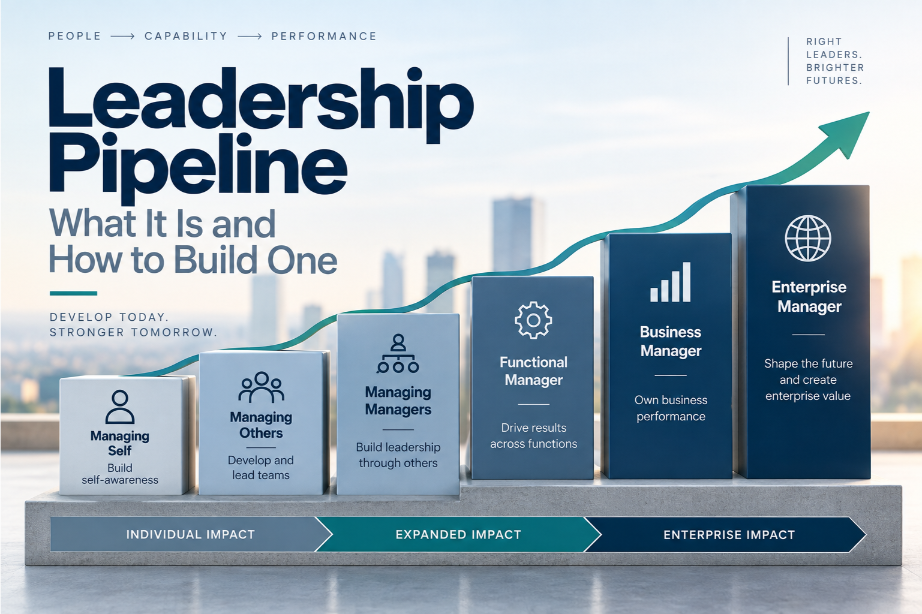
A leadership pipeline is a structured system that identifies, develops, and prepares people for leadership roles at every level of an organization, not just at the top. It maps the transitions a person makes as responsibility grows, from managing oneself to managing an entire enterprise, and builds the skills each transition requires. Organizations use a leadership pipeline to keep a steady, capable supply of leaders ready before roles become vacant.
What Is a Leadership Pipeline?
A leadership pipeline treats leadership development as a continuous system rather than a single event. Instead of training leaders once and hoping the lessons stick, it defines what capability looks like at each level of management. It then builds a repeatable process for developing that capability before it is actually needed.
The concept was introduced by Ram Charan, Stephen Drotter, and James Noel in their 2001 book, The Leadership Pipeline: How to Build the Leadership-Powered Company. Their framework built on earlier internal talent development work at General Electric, led by Walter Mahler. Charan, Drotter, and Noel argued that most leadership failures are not failures of character or intelligence. They are failures of transition. A person keeps doing the work of their old role instead of learning the new one.
At its core, a leadership pipeline connects four elements. The organization identifies leadership competencies required at each level. It assesses which employees are developing those competencies. It provides targeted development, such as stretch assignments, coaching, and formal learning, to close the gaps that assessment reveals. Finally, it tracks whether that development actually produces leaders who are ready when a role opens.
This distinguishes a pipeline from a simple talent pool. A talent pool is a list of promising employees. A pipeline is the mechanism that turns potential into demonstrated readiness, level by level, using a defined structure rather than informal judgment. The name itself reflects the mechanism: leaders move through the pipeline the way material moves through a physical pipe, and a blockage at any one point starves everything downstream of it.
A leadership pipeline also spans the entire organization rather than a handful of senior titles. It starts with the transition into a person’s first management role, continues through functional and business leadership, and ends with enterprise level leadership. This full range matters because most leadership failure does not happen at the top. It happens earlier, when someone is promoted into their first management role without the support needed to succeed at it, and that early gap tends to compound as the person is promoted again before the original gap is closed.
The Leadership Pipeline Model: Six Passages of Leadership Growth
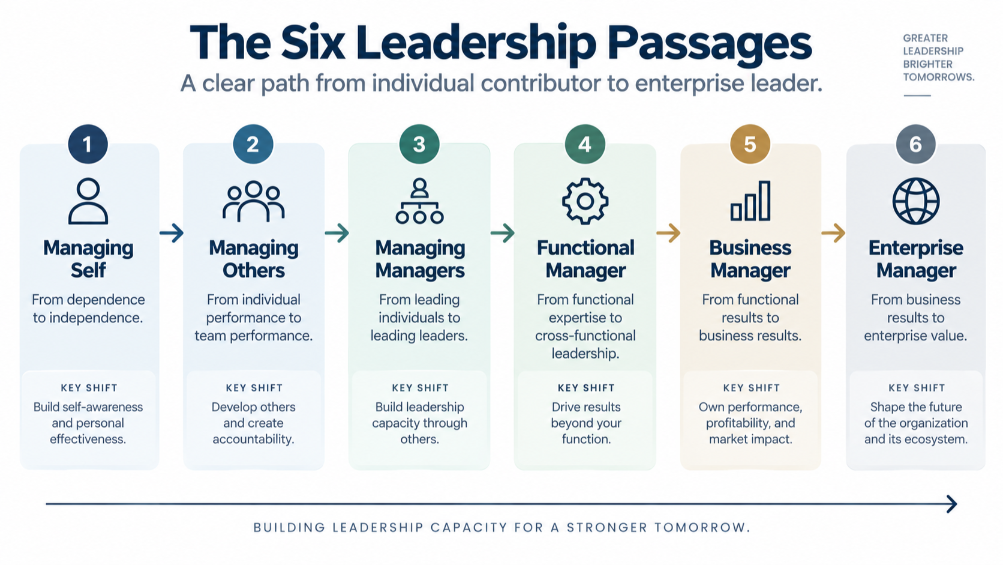
Charan, Drotter, and Noel’s original framework identifies six major transitions, or passages, that a leader moves through as responsibility increases. Each passage requires new skills, a new allocation of time, and a new set of work values, meaning what a leader believes is important enough to spend energy on.
| Passage | Transition | Core Shift Required |
| 1 | Managing oneself to manage others | Moving from personal technical output to team results; learning to coach, delegate, and evaluate the work of others. |
| 2 | Managing others to manage managers | Selecting and developing managers rather than managing a team directly; letting go of hands-on team leadership. |
| 3 | Managing managers to functional managers | Leading an entire function, such as sales or finance, and communicating across functional boundaries rather than within one. |
| 4 | Functional manager to business manager | Balancing multiple functions against each other and taking accountability for overall profit, not just functional excellence. |
| 5 | Business manager to group manager | Valuing the success of businesses led by others as much as one’s own; allocating capital and attention across a portfolio. |
| 6 | Group manager to enterprise manager | Setting long-term vision and culture for the whole organization; balancing short-term results against long-term health. |
Each passage demands that a leader release habits that made them successful at the previous level. This is where many leadership pipelines break down in practice. A newly promoted functional manager who still spends most of their time on individual technical work, instead of leading the function, is operating below the passage they were promoted into. Charan, Drotter, and Noel describe this as a values problem as much as a skills problem. The leader has not yet decided that the new work matters more than the old work.
Organizations that skip passages, often by promoting high performers rapidly through several levels at once, tend to produce leaders who look capable on paper but struggle once they reach roles that require judgment the shortcut never built. This is one reason bench strength, meaning the depth and readiness of a company’s internal leadership candidates, so often disappoints even when leadership development budgets are growing.
Why a Leadership Pipeline Matters
A leadership pipeline is not a nice to have talent program. Weak pipelines carry a measurable cost, and the evidence for that cost has grown stronger in recent years.
Gallup’s long-running research on manager quality found that only about one in 10 people naturally possesses the combination of traits needed to manage well and that companies fail to select the candidate with the right talent for a management role roughly 82% of the time. When organizations do get the selection right, the difference is significant. Managers with high natural talent, combined with strong engagement in their own strengths, contribute meaningfully higher profit than average managers do.
The pattern continues at senior levels. DDI’s 2023 Global Leadership Forecast, based on responses from nearly 14,000 leaders across more than 1,500 organizations, found that only 12% of companies were confident in the strength of their leadership bench. Only 40% rated their overall leadership quality as high, a 17 percentage point drop from two years earlier. Half of the CEOs surveyed named developing the next generation of leaders a top organizational challenge.
That same research connects bench strength directly to organizational diversity, not just headcount. Companies with strong leadership benches were found to have 22% more women leaders and 36% greater leader background diversity than companies with weak benches. This suggests a pipeline built on defined competencies and structured assessment does more than fill seats. It also reduces the informal bias that tends to creep into promotion decisions made on instinct alone.
More recent data suggests the pressure has not eased. DDI’s 2025 Global Leadership Forecast, covering more than 10,000 leaders and 2,000 HR professionals, found that trust in immediate managers had fallen to 29%, a 37% decline since 2022.
40% of stressed leaders said they had considered leaving leadership roles altogether. Among high-potential individual contributors, the share who intend to leave their organization rose from 13% in 2020 to 21% in 2024, and high-potential employees were found to be nearly four times more likely to leave within a year if their manager did not regularly provide growth opportunities.
Together, these findings point to the same conclusion from two directions. Good management talent is naturally scarce, so leaving leadership selection to instinct is a weak strategy on its own. And even where leadership potential exists, it erodes quickly without deliberate development and visible growth paths, which is exactly what a well-designed pipeline is built to provide.
Leadership Pipeline vs Succession Planning
The terms leadership pipeline and succession planning are often used interchangeably, but they describe different things. Confusing them is one of the most common reasons pipelines underperform.
Succession planning names specific candidates for specific senior roles. It typically produces a document or chart: who could replace the CFO, who could replace a regional vice president, and how ready each candidate currently is. It is usually reviewed on an annual cycle and focuses on a small number of critical positions.
A leadership pipeline is broader. It is the ongoing system that builds leadership capability at every level of the organization, from first-time supervisors to the executive team, so that when any leadership role opens, qualified internal candidates already exist. Succession planning draws from the pipeline. It cannot succeed without one.
| Dimension | Succession Planning | Leadership Pipeline |
| Nature | An output: a document or chart naming successors | A system: an ongoing process of identifying and developing leaders |
| Scope | A limited set of critical senior roles | Every leadership level in the organization |
| Time horizon | Typically reviewed annually | Continuous, with regular talent reviews |
| Primary question | Who could replace this person? | Who is ready, and what do they still need to develop? |
| Risk if used alone | Can look complete on paper while resting on underdeveloped candidates | Requires more sustained investment and cross-functional coordination |
An organization can have a polished succession plan and still face a leadership crisis if the pipeline beneath it is shallow. Named successors who have not actually built the required skills are not truly ready, no matter how their names appear on a chart. This is why the priority for most organizations should be building the underlying leadership development program first, then using succession planning as the mechanism that applies it to specific critical roles.
How to Build a Leadership Pipeline
Building a leadership pipeline is not a single initiative. It is a set of connected practices that reinforce one another over time.
Define the Leadership Transitions and Competencies
Start by mapping the transitions that actually exist in your organization, rather than importing a generic model wholesale. A retail chain, a software company, and a manufacturing firm will each have a different number of management layers and different points where the nature of the work genuinely changes.
For each transition, define what success requires in observable terms, not vague adjectives. “Has led a cross-functional project to completion” is a usable criterion. Demonstrates strategic thinking” is not, because two evaluators can easily disagree about what it means in practice. Translate the required skills, time allocation, and work values from the six passage model into a leadership competency framework specific to each level in your own structure.
This framework becomes the shared language for every later stage. Without it, assessment turns into opinion, development becomes generic training, and promotion decisions default to whoever performed best in their previous role, which is precisely the trap the leadership pipeline model was built to avoid.
Assess Talent Objectively
Once competencies are defined, assess employees against them consistently. Many organizations use a 9-box talent review, which plots employees on two axes: current performance and future potential. The resulting nine categories separate high performers who are ready to grow from high performers who have reached the ceiling of their current role, and from developing employees who simply need more time.
Performance reviews alone are insufficient for this step, because performance measures how someone does their current job, not whether they can succeed in a different one. Structured assessments, 360 degree feedback, and simulations of higher-level decisions give a more accurate picture of true readiness.
The most common failure at this stage is mistaking performance for potential. A strong individual contributor is not automatically a strong manager, and a strong functional manager is not automatically ready to run a business unit. Each transition in the pipeline requires evidence specific to that transition, not a general assumption that past success predicts future success at a different kind of work.
Develop Leaders Through Real Work
Classroom training alone rarely builds leadership capability on its own. Development that actually changes behavior usually combines three elements: stretch assignments that require new skills under real pressure, mentoring or executive coaching from someone who has already made the same transition, and formal learning that gives leaders a shared vocabulary for their new responsibilities.
Stretch assignments tend to be the most powerful of the three, because they force leaders to practice the new work values the passage requires, such as delegating instead of doing, or thinking across functions instead of within one. A first-time manager asked to lead a cross-departmental initiative learns coordination skills that no course can fully replicate.
Coaching matters because leadership transitions are as much about unlearning old habits as learning new ones. An experienced coach can identify when a leader is still operating at their previous level long before performance data reveals the problem. Development plans should be tied to the specific competency gaps identified during assessment, not applied as a standard curriculum for everyone at a given level.
Support the Transition Itself
The period immediately after a promotion is when leadership pipelines are most fragile. New leaders are learning a different job while still expected to deliver results, often without much formal support.
Structured onboarding for new leaders, clear expectations set by their own manager, and regular check-ins during the first 90 to 180 days meaningfully reduce derailment. Peer networks of leaders navigating the same passage at the same time also help, since problems that feel unique in isolation are usually common to the transition itself.
Organizations that skip this step often see promising leaders struggle publicly during their first year in a new role. That struggle damages both the leader’s confidence and the organization’s confidence in the pipeline as a whole. Strong transition support is what converts a theoretically ready candidate into an actually effective leader.
Review and Renew the Pipeline Continuously
A leadership pipeline is not a project with an end date. Business needs change, people leave, and readiness shifts as employees develop or disengage. Talent reviews conducted quarterly, rather than once a year, catch these changes while there is still time to act on them.
Each review should ask the same three questions. Who is ready now for the next level? What specific gap is preventing others from being ready? And is the pipeline as a whole getting stronger or weaker over time? Treating the pipeline as a living system, rather than a static chart produced once a year, is what separates organizations with genuine bench strength from those with succession plans that look reassuring but do not hold up under real pressure.
Common Mistakes That Weaken a Leadership Pipeline
Even organizations that invest heavily in leadership development often see their pipelines underperform. A handful of mistakes appear repeatedly.
Confusing performance with potential is the most common one. Promoting the best individual contributor or the best functional manager assumes that skill transfers automatically to a different kind of work. It often does not. The better practice is assessing potential separately from current performance, using criteria specific to the next passage rather than the current one.
Treating the pipeline as an annual event is another. When talent reviews happen once a year, readiness data is already outdated by the time it gets used for a real decision. Quarterly reviews keep the pipeline current with actual business change.
Skipping passages looks efficient in the short term but leaves gaps in judgment and skills that surface later, usually at the worst possible time, such as during a difficult transition or a crisis. Development at each passage matters even when a leader is clearly talented.
Leaving new leaders unsupported after promotion undermines everything the earlier stages built. Readiness on paper does not guarantee success in practice, and without structured onboarding and coaching during the first months in a new role, even well-prepared leaders can struggle and lose confidence.
Finally, building the pipeline in HR isolation weakens it over time. When leadership pipeline metrics are defined only by HR, without input from finance or business leaders, they rarely connect to the decisions executives actually care about, and the program loses visibility and funding. Involving business leaders in defining what “ready” actually means keeps the pipeline tied to real organizational needs, rather than becoming a parallel process nobody outside HR fully trusts.
None of these mistakes are failures of the underlying model. They are implementation failures, and each one has a direct fix built into the process described above: define readiness clearly, assess it on a real cadence, support people through the transition, and keep business leaders inside the process rather than outside it.
How to Measure Leadership Pipeline Health
A leadership pipeline that is not measured tends to drift toward looking busy rather than producing results. A small set of metrics, reviewed regularly, gives an honest picture of whether the pipeline is actually working.
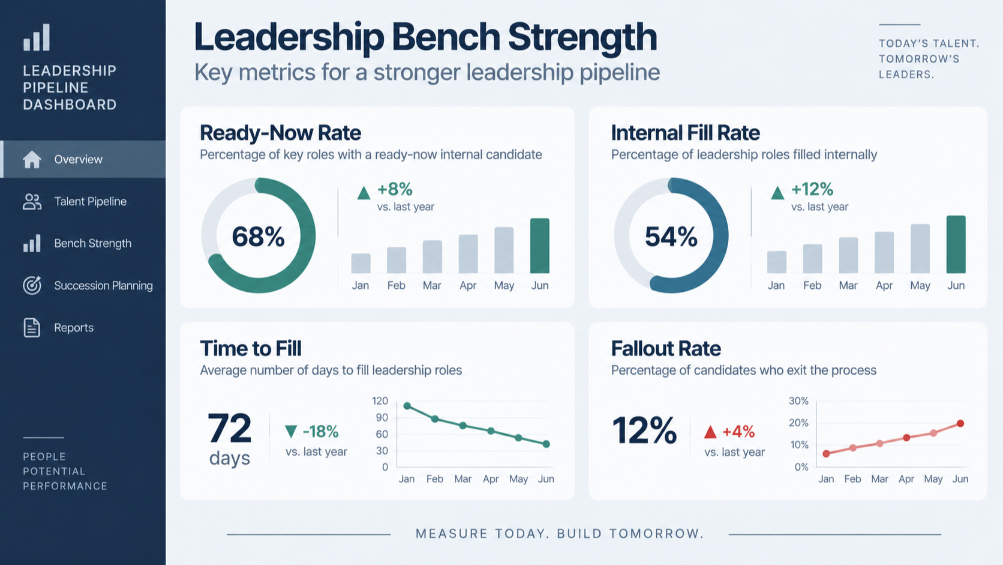
Bench strength describes how many qualified internal candidates exist for a role and how ready they are. It is often expressed as a ratio of ready-now successors to critical roles. Many practitioners treat somewhere between 1.5 and 2 ready-now successors per critical role as a reasonable target, though the right number depends on how fast an organization is growing and how quickly its senior leaders typically turn over.
Other useful metrics include the following.
- Ready-now rate: the share of identified successors who could step into a role within roughly 12 months, rather than requiring years of further development.
- Internal fill rate: the percentage of leadership openings filled by internal candidates rather than external hires, which indicates whether the pipeline is actually being used.
- Time to fill leadership roles: how long a leadership vacancy stays open, which reflects the practical cost of a thin bench.
- Fallout rate: the percentage of identified high-potential employees who leave the organization or are removed from development tracks before reaching readiness.
No single metric tells the full story on its own. A high internal fill rate paired with a high fallout rate, for example, suggests the pipeline is producing leaders but losing many of them along the way, which points to a retention problem rather than a development problem. Reviewing these metrics together, on a consistent quarterly cadence, gives leaders an accurate diagnosis rather than a single comforting but incomplete number.
Building a Leadership Pipeline in the Age of AI and Hybrid Work
The skills a leadership pipeline needs to build are shifting. DDI’s 2025 Global Leadership Forecast found that leaders most commonly identify “setting strategy” and “managing change” as their biggest skill gaps, yet only 22% of HR teams currently prioritize developing those specific skills in their leadership programs. That is a meaningful mismatch between what leaders say they need and what organizations are actually building for them.
Artificial intelligence adds another layer of complexity. The same research found that frontline managers are roughly three times more likely than senior leaders to have concerns about AI’s impact on their work, and they report lower trust in senior leadership’s ability to guide that change well. A leadership pipeline that only teaches technical or operational competence, without building the ability to lead a skeptical team through uncertainty, will leave frontline managers underprepared for exactly the conditions they now face.
This has a direct implication for pipeline design. Competency frameworks written several years ago, before generative AI tools became common in daily work, are likely to underweight skills such as leading through ambiguity, communicating change credibly, and helping teams adapt processes as tools evolve. Updating the competency framework to reflect these realities, and building them into assessment and development at the earlier passages rather than only at senior levels, helps ensure the pipeline prepares leaders for the environment they will actually manage.
Hybrid and remote work compounds this further. Leaders earlier in the pipeline, such as first-time managers, often have less practice reading team dynamics without in-person cues, which makes structured coaching and peer support even more valuable during the earliest passages, not something reserved only for senior transitions.
Frequently Asked Questions
How long does it take to build an effective leadership pipeline?
Building a functioning leadership pipeline typically takes 12 to 24 months to show measurable results. Since it requires defining competencies, running assessments, and giving development enough time to change behavior. A fully mature pipeline, with strong bench strength at every level, is usually a multi-year effort rather than a single program.
Can small and mid-sized companies benefit from a leadership pipeline, or is it only useful for large enterprises?
Yes. Smaller organizations often have fewer leadership levels, which can make the model easier to apply, though they may need to combine some passages, such as merging the manager of managers and functional manager stages, to fit a flatter structure. The core discipline of defining readiness and developing people before roles open still applies regardless of company size.
Is a leadership pipeline the same as a talent pipeline?
The terms are often used interchangeably, but a talent pipeline usually covers a broader range of critical roles across the organization, including specialist and technical positions, while a leadership pipeline focuses specifically on management and executive transitions. Many organizations run leadership pipeline work as one part of a wider talent pipeline strategy.
How does the 9-box grid actually work?
A 9-box grid plots each employee on two axes: current performance on one axis and future potential on the other, creating nine possible combinations. Employees who score high on both are typically prioritized for accelerated development, while those high on performance but lower on potential are usually recognized and retained in their current type of role rather than pushed toward a transition they are not ready for.
What happens when an organization has no leadership pipeline?
Without a pipeline, organizations typically rely on external hiring to fill leadership vacancies, which tends to take longer and cost more than promoting a prepared internal candidate. Leadership gaps also tend to widen during the search process, since interim coverage is rarely as effective as a leader who was already developing toward the role.
Does a leadership pipeline only apply to senior executive roles?
No. The Leadership Pipeline model explicitly starts with the transition from individual contributor to first-time manager, which is usually the highest volume and highest failure rate passage in most organizations. Building pipeline discipline at this early level often has the largest overall impact, since it is the entry point every future senior leader eventually passes through.
Conclusion
A leadership pipeline works because it treats leadership development as infrastructure rather than as an occasional event. The Leadership Pipeline model gives organizations a shared language for the transitions leaders go through, from managing themselves to managing an enterprise, and each transition requires its own skills, time allocation, and values.
The evidence is consistent across sources. Good management talent is naturally scarce, confidence in leadership benches remains low even among organizations that invest heavily in development, and high-potential employees leave quickly when growth opportunities are not visible. None of these problems are solved by better succession documents alone. They are solved by a pipeline that defines competencies clearly, assesses talent honestly, develops leaders through real work, supports them through the transition itself, and is reviewed often enough to stay accurate.
Organizations that treat their leadership pipeline this way, as a continuously maintained system rather than a static chart, build the kind of bench strength that holds up when a critical role opens unexpectedly, not just when everything goes according to plan.
Once a leadership pipeline’s structure is in place, the next practical question is how to fill it accurately. A pipeline is only as strong as the people entering it, and that depends on how well an organization identifies who actually has leadership potential before performance reviews or promotion cycles force the decision. High-potential employee identification builds on the assessment principles covered here, translating the 9-box framework and competency criteria into a repeatable process for spotting future leaders early, well before a critical role opens and the decision has to be made under pressure.