

Leadership principles are the fundamental beliefs that guide how a leader makes decisions, treats people, and responds to challenges. They act as a personal or organizational compass, providing consistent direction even when a specific rule does not exist. Leadership principles matter because they turn good intentions into repeatable, trustworthy behavior. This article explains what leadership principles are, why they matter, the core principles most effective leaders share, and how to develop and apply your own.
What Are Leadership Principles?
Leadership principles are the core beliefs that shape how a leader thinks, decides, and behaves. Unlike specific rules or one-time tactics, principles apply broadly across situations. They give leaders a consistent way to judge new problems, even ones they have never faced before.
A useful way to understand leadership principles is to see them as the reason behind consistent leadership behavior. A leader who values transparency, for example, will apply that principle whether they are delivering good news, addressing a mistake, or negotiating a budget. The situation changes. The principle does not.
Leadership principles typically share several characteristics. They are foundational, meaning they address core beliefs about people and purpose rather than surface-level preferences. They are consistent, applying the same way across different situations. They are actionable, showing up in daily choices rather than staying abstract. And they are visible, meaning other people can observe them through a leader’s actions.
This distinction matters because principles are what allow a leader to act consistently in situations nobody planned for. A written policy cannot anticipate every scenario a team will face, but a genuine principle can be applied to a new situation the moment it appears, without waiting for someone to write a new rule.
Leadership Principles vs. Rules and Policies
Rules and policies tell people exactly what to do in a specific situation. Principles work differently. They give leaders a framework for judgment when a rule does not exist or when following a rule exactly would not serve the underlying goal.
For example, a company policy might require managers to respond to customer complaints within 24 hours. A leadership principle such as “put the customer first” explains why that policy exists and helps a leader decide what to do when a situation the policy did not anticipate comes up. Rules can change quickly. Principles tend to stay stable over long periods of time.
This is also why principles are harder to enforce than rules. A rule violation is usually easy to identify and address. A principle violation is more subjective, which means leaders must rely on judgment, and on the trust they have built with their team, to hold themselves and others accountable to it.
Leadership Principles vs. Core Values
Leadership principles and core values are closely related, but they are not identical. Core values usually describe what an entire organization believes and stands for, such as integrity, respect, or innovation. Leadership principles apply that same spirit specifically to how leaders behave, decide, and lead others.
In practice, many organizations build their leadership principles directly from their core values, then translate each value into a specific expectation for how leaders should act. This makes leadership principles more concrete and easier to apply to daily decisions than a general value statement. A leader who understands this relationship can explain not just what they believe, but where that belief comes from, which makes the principle easier for a team to trust as more than a personal preference.
Why Leadership Principles Matter in the Workplace
Leadership principles matter because they create consistency, and consistency builds trust. When a leader’s decisions are guided by clear principles, employees can predict how that leader will respond to a given situation. This predictability reduces anxiety and helps people feel safe raising problems early.
This effect compounds over time. Once a team has evidence that a leader’s decisions match their stated principles, team members tend to raise problems earlier, before small issues become expensive ones. Without that trust, employees often wait, hide bad news, or route decisions around the leader entirely, which slows the organization down and increases the risk of avoidable mistakes.
Clear principles also tend to support better decision quality under pressure. A leader who has already decided, in advance, what matters most does not have to work out their priorities from scratch during a crisis. The principle does that work ahead of time.
The connection between clearly defined guiding beliefs and workplace outcomes is measurable. A Leadership IQ study of 4,360 employees and leaders found that employees are 115 percent more engaged when their organization has a well-defined set of values. The same study found that organizations that clearly detail the specific behaviors expected of their people see even stronger engagement gains. This research examined organizational values broadly rather than leadership principles by name, but the mechanism applies directly, since leadership principles function as the leadership-specific expression of those same values.
Beyond employee engagement, principled leadership tends to support smoother collaboration and faster decisions. When a team understands the principles a leader operates by, fewer decisions need to be escalated or re-explained, because the reasoning behind them is already shared.
The Core Leadership Principles Most Effective Leaders Share
While every leader’s principles are personal, most effective leadership frameworks converge on a similar set of ideas. These principles generally fall into three functional groups: principles that guide decisions, principles that guide how leaders treat people, and principles that guide standards and execution.
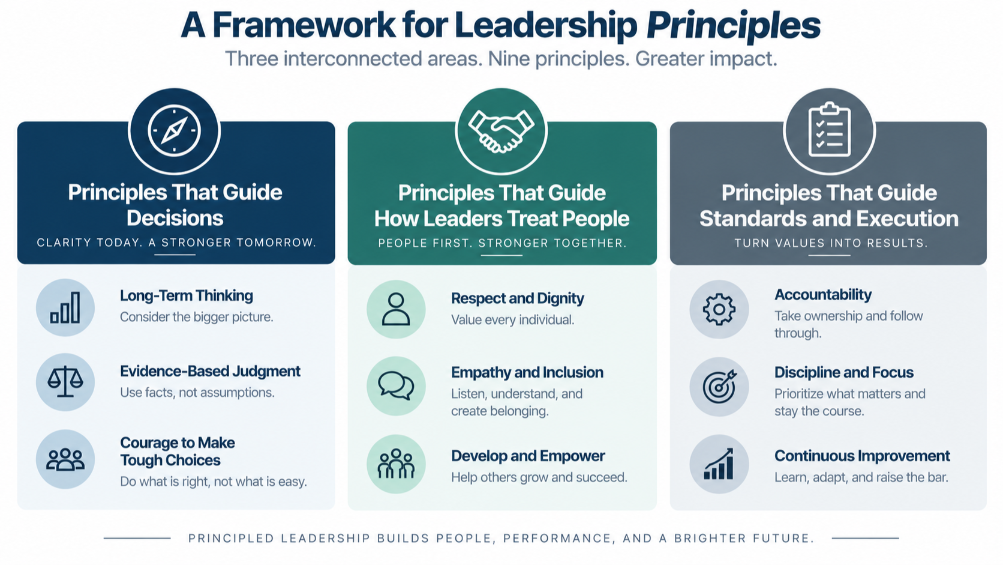
Principles That Guide Decisions
Vision. Effective leaders commit to a clear, long-term direction rather than reacting only to whatever problem is most urgent that day. Vision gives a team something to work toward beyond the next deadline. Without a stated vision, teams tend to optimize for whatever is measured that week, even when it conflicts with the organization’s longer-term interests.
Sound judgment. Leaders who make good decisions consistently rely on evidence and experience, and they seek out different perspectives before committing to a course of action. This does not mean leaders must be right every time. It means the reasoning behind the decision is defensible even when the outcome turns out to be wrong.
Bias for action. Many decisions can be reversed if they turn out to be wrong, so leaders who wait for perfect information often move too slowly. Strong leadership principles favor calculated speed over unnecessary delay.
Principles That Guide How Leaders Treat People
Ownership. Leaders who practice ownership take responsibility for outcomes, including outcomes outside their direct control, rather than deflecting blame to other teams or circumstances. This principle also shapes how a leader responds when something goes wrong. They look first at what they could have done differently before looking for someone else to blame.
Empowerment. Effective leaders give people room to act on their own judgment. This principle is closely related to servant leadership, an approach in which a leader’s primary role is to support the growth and success of the people they lead rather than to direct every action personally.
Developing others. Leaders who prioritize the growth of their people raise the overall performance bar of their team over time, rather than relying on a small number of high performers to carry the workload. This principle asks leaders to treat coaching and mentoring as part of the job itself, not as an activity that competes with what they see as their real work.
Principles That Guide Standards and Execution
High standards. Leaders who hold consistently high standards push their teams to produce better work, even when a lower standard would technically be acceptable. The challenge is holding those standards without becoming so demanding that people become afraid to bring forward early, imperfect work.
Accountability. Leaders who model accountability hold themselves to the same expectations they set for others, and they address performance gaps directly rather than avoiding difficult conversations.
Deliver results. Leadership principles must eventually translate into outcomes. A principle that never shows up in actual results functions as a slogan, not a leadership principle. This principle is what keeps every other principle honest, since vision, ownership, and high standards are only meaningful if they eventually show up in something the organization can measure.
How Organizations Apply Leadership Principles: Two Real-World Examples
Leadership principles look different depending on the organization’s context. Comparing two very different examples shows how the same underlying idea, a shared framework for judgment, can take different forms.
Amazon’s Leadership Principles
Amazon operates with a published, company-wide set of leadership principles that its employees reference daily when discussing projects, solving problems, and making hiring decisions. The original list included 14 principles, such as Customer Obsession, Ownership, Invent and Simplify, Insist on the Highest Standards, and Deliver Results. Amazon has since added further principles, including Strive to Be Earth’s Best Employer and Success and Scale Bring Broad Responsibility, bringing the current published set to 16.
What makes Amazon’s approach notable is not the specific wording of each principle, but the discipline of using them consistently. Employees are expected to reference specific principles by name during meetings and decisions, which keeps the framework active rather than treating it as a document that only appears once, during onboarding. Amazon is also known for evaluating job candidates directly against these principles during interviews, in addition to assessing technical skill, which extends the framework into hiring rather than confining it to existing employees.
Structured Leadership Principles in the Military
Military leadership doctrine offers a different model. Programs such as the Junior Reserve Officers’ Training Corps teach an established set of leadership principles that include knowing yourself and seeking self-improvement, being technically and tactically proficient, making sound and timely decisions, and knowing your people and looking out for their welfare.
This model emphasizes structure and repetition. The same principles are taught early in a leader’s development and reinforced consistently across ranks and units. Compared with Amazon’s business-context principles, the military version places more explicit weight on personal competence and the welfare of subordinates, reflecting the high-stakes environment in which the principles are applied. This repetition is deliberate. In an environment where a leader may need to act without time to deliberate, principles reinforced since early training are more likely to guide behavior automatically, rather than requiring conscious recall in the moment.
Together, these two examples show that effective leadership principles are shaped by context. A technology company optimizing for innovation speed and a military organization optimizing for readiness and safety will naturally emphasize different principles, even though both use the same underlying framework of consistent, values-based guidance.
How To Develop Your Own Leadership Principles
Leadership principles work best when a leader develops them deliberately rather than adopting someone else’s list without reflection. The process does not need to be complicated, but it does need to be honest.
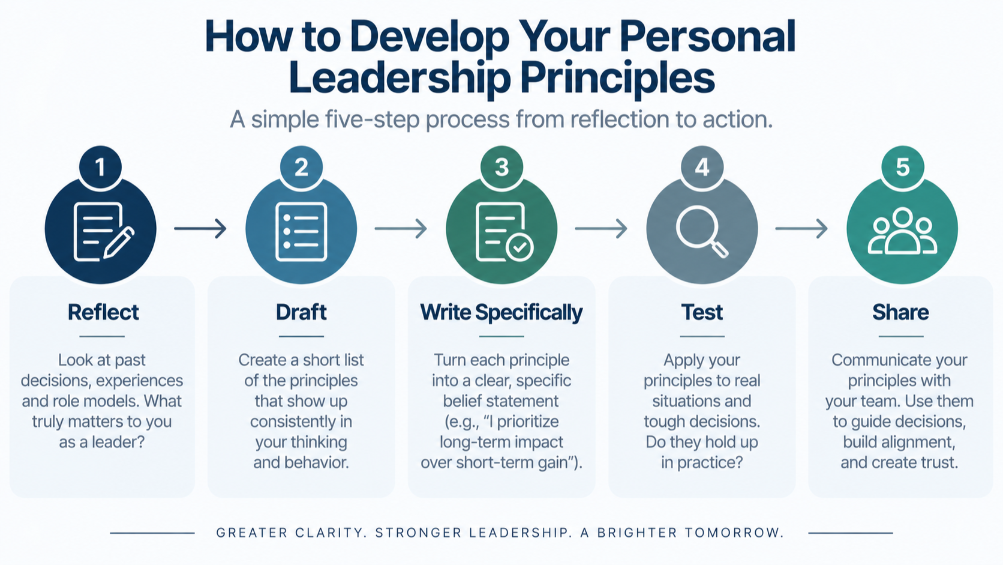
Start by identifying moments that already reveal your priorities. Think about a difficult decision you made, a time you disagreed with a request, or a situation where you felt frustrated with your own leadership. These moments usually point to a principle you already hold, even if you have never written it down.
Next, draft a short list. A useful set of personal leadership principles is short enough to remember under pressure and specific enough to actually change behavior when it matters.
Write each principle as a belief statement rather than a slogan. Instead of writing “communication,” write something closer to “I will share bad news as quickly as I share good news.” The second version is specific enough to guide a real decision.
Test your draft principles against real decisions for a few weeks. If a principle never comes up, or if you consistently act against it under pressure, it may need to be revised or replaced. Some leaders also find it useful to refine their principles through executive coaching, since an outside perspective can identify gaps between a stated principle and actual behavior that are hard to see on your own.
Finally, share your principles with the people you lead. Principles that stay private cannot build the trust and predictability that make them valuable in the first place.
Plan to revisit your principles periodically, such as once a year or after a significant change in role or responsibility. A principle that made sense when you managed a small team may need to be restated, though not necessarily replaced, once you are responsible for an entire department.
How Leadership Principles Shape Daily Decisions
Leadership principles influence decisions through a fairly direct mechanism. A new situation arises, the leader checks it against an existing principle, and the principle narrows the range of acceptable responses before the leader even considers the specific details of the case.
Consider a leader whose principle is that the organization does not sacrifice long-term value for short-term results. When a proposal comes in that would boost this quarter’s numbers but damage a customer relationship, the leader does not need to relitigate their priorities from scratch. The principle has already ruled out the short-term option, which lets the leader focus attention on finding an alternative that satisfies both the principle and the immediate need.
A different example illustrates the same mechanism from another angle. A leader whose principle is that people are developed rather than simply managed will respond differently to a team member’s mistake. Instead of immediately reassigning the task to someone more experienced, the leader is more likely to treat the mistake as a coaching moment, because the principle has already established what response fits their values before they even know the specific details of what went wrong.
This mechanism becomes especially valuable during high-pressure situations. Under stress, people tend to default to whatever response requires the least effort, which is not always the response that reflects their real priorities. A well-internalized principle acts as a check against that default, because it was already decided in advance, away from the pressure of the moment.
Over time, teams learn to anticipate this pattern. When a leader is known for a specific principle, team members start to filter their own proposals accordingly, which reduces the number of misaligned ideas that reach the leader’s desk in the first place. This is part of how leadership principles influence organizational culture beyond the individual leader who holds them.
Leadership Principles vs. Leadership Style
Leadership principles and leadership style are often confused, but they answer different questions. Principles answer what a leader believes. Style describes how a leader typically behaves, communicates, and makes decisions in practice.
| Aspect | Leadership Principles | Leadership Style |
| Definition | Core beliefs that guide judgment | Observable pattern of behavior |
| Stability | Stays relatively stable over time | Can adapt to the situation or team |
| Example | “I take ownership of outcomes” | Directive, participative, or coaching approach |
| Primary Role | Determines what a leader values | Determines how a leader expresses that value |
A leader can hold the same principles while using different styles depending on the situation. A leader who values developing others, for example, might use a more directive style with a brand new employee and a more participative style with an experienced team member. The underlying principle does not change. The style adapts to fit the person and the moment. This distinction connects to the broader difference in leadership vs management, where leadership focuses on direction and influence and management focuses on process and execution.
Confusing the two can cause problems in both directions. A leader who changes their stated principles to fit each new team member is not adapting their style, they are abandoning consistency. A leader who refuses to adjust their style at all, regardless of the person or situation, is often mistaking a rigid habit for a genuine principle.
Common Mistakes When Implementing Leadership Principles
Even well-intentioned leadership principles fail in practice for a few predictable reasons.
Writing principles that are too vague. A principle like “be a good leader” does not provide enough information to guide an actual decision. Effective principles are specific enough that two different leaders reading them would make the same call in a given situation. Vague principles also make it easy for a leader to claim they are following the principle no matter what they actually decide, which defeats the purpose of having one.
Failing to model the principles personally. Leaders lose credibility quickly when their own behavior contradicts a principle they expect from others. A leader who preaches transparency while withholding information from their own team teaches people to ignore the stated principle rather than follow it.
Treating principles as a one-time announcement. Principles introduced once during onboarding and never mentioned again tend to fade from daily use. Principles stay relevant when leaders reference them regularly in real decisions, not just in formal documents.
Adopting someone else’s principles without adaptation. A list of principles copied directly from a well-known company or leader can sound impressive, but it will not hold up under pressure unless it reflects beliefs the leader actually holds. Principles that are not authentic tend to disappear during the first real conflict.
Ignoring the connection to organizational systems. Principles that are not reflected in hiring, promotion, or performance management decisions send a mixed message. If a company claims to value ownership but promotes people who consistently avoid responsibility, employees will trust the promotion pattern over the stated principle. This mismatch is often more damaging than having no stated principles at all, because it signals to employees that the principles are decorative rather than genuine.
Frequently Asked Questions
A leadership philosophy is broader than a set of principles. It typically includes a leader’s principles alongside their sense of purpose and their vision of what good leadership looks like. Principles are one component of a leadership philosophy, not the entire thing.
They often do, and that is expected. A company’s leadership principles reflect its collective priorities and are meant to apply to every leader in the organization. A leader’s personal principles can be more specific to their own values and experience, as long as they do not directly conflict with the organization’s stated framework.
Writing them down is not strictly required, but it helps considerably. Unwritten principles are harder to communicate consistently to a team and easier for a leader to unintentionally abandon under pressure, since there is no clear reference point to check decisions against.
The clearest signal is consistency between decisions and stated principles over time, particularly in situations where following the principle carries a real cost. Teams typically notice quickly when a leader’s actions contradict a principle they have publicly committed to.
Yes. Anyone who influences a team’s direction, including an individual contributor leading a project, can benefit from defining clear principles for how they make decisions and treat colleagues, even without formal management authority.
Conclusion
Leadership principles give leaders a consistent, repeatable way to make decisions, treat people, and respond to pressure. They are distinct from rules, which are specific and situational, and from broad organizational values, which they translate into concrete leadership behavior. The most effective principles are specific, personally authentic, and visible in daily decisions rather than confined to a document. Whether drawn from a company framework like Amazon’s, a structured model like military leadership doctrine, or built individually through reflection, leadership principles work because they are used consistently, tested against real situations, and modeled by the leader who holds them.
From Principles to Practice
Defining your leadership principles is the foundation, but principles only create value once a leader has the specific skills to act on them consistently. That next step usually involves leadership development, which builds the practical capabilities, such as communication, decision-making, and coaching skills, that allow a leader to put their principles into action across increasingly difficult situations.