
Leadership governance is the system that decides how organizational leaders are chosen, empowered, overseen, and replaced. It combines structures, decision rights, information flows, and accountability. Boards and executives use it to set direction and answer to stakeholders. No single standard defines the term, so this guide builds a working definition from governance standards and research.
What Is Leadership Governance?
Leadership governance is the set of rules, structures, and routines that shape how organizational leaders use power. It covers who appoints leaders and what authority they hold. It also covers what information reaches the board, how performance is judged, and what happens when leaders fall short.
Three Ways the Term Is Used
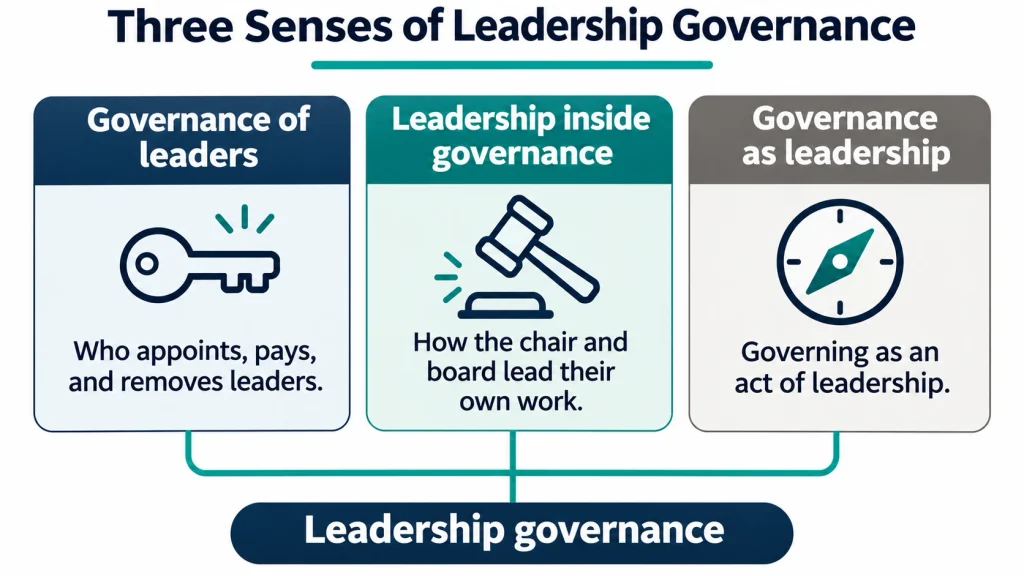
The phrase carries three different senses, and most pages reviewed for this guide do not separate them.
- Governance of leaders. Rules decide how leaders are appointed, evaluated, paid, and removed. The international standard ISO 37000 lists leadership among eleven governance topics. It describes that topic as ethical and effective leadership arrangements.
- Leadership inside governance. Boards and their chairs lead the governing process itself. Spencer Stuart’s 2026 Board Index finds members of top-performing boards more likely to say their board leader encourages high-quality discussion.
- Governance as leadership. Richard Chait, William Ryan, and Barbara Taylor argued in 2004 that governing well takes leadership as well as monitoring.
What the Term Covers and Leaves Out
The scope here is organizational. It covers the appointment, authority, oversight, development, and succession of leaders. It leaves out leadership style, such as communication or motivation, and the governance of nations and of data.
Most evidence comes from company boards and healthcare organizations, with some from nonprofits. Each claim below names its setting.
Leadership, Governance, and Management: How They Differ
Leadership mobilizes people toward goals. Management runs operations to deliver them. Governance sets limits, assigns authority, and holds both to account.
Fulop and Ramsay’s 2023 Cambridge Element on healthcare says the two concepts overlap but play different, interlinked roles. It describes governance as a system that enables oversight, monitoring, and accountability. Leadership, it says, may be seen as a key component of that system.
| Dimension | Leadership | Management | Governance |
| Core question | Where are we going, and why should people follow? | How do we deliver this reliably? | Who decides, who checks, and who answers? |
| Typical holders | Executives, chairs, and informal leaders | Managers and support functions | The board or governing body and its committees |
| Main tools | Vision, framing, influence, example | Plans, budgets, processes, controls | Charters, delegation, oversight, reporting, evaluation |
| Answers to | The governing body, for formal leaders | Executive leaders and the governing body | Stakeholders |
| Typical failure | Direction without legitimacy | Execution without direction | Oversight without information or independence |
This table is an analytical synthesis of the Cambridge Element definitions and the IIA role descriptions. It is not a published model.
Each of the three fails differently. Strong leadership under weak governance can hide risk behind good results. Strong governance under weak leadership can produce compliance without direction. Both pairings are analytical inferences, not research findings.
How Leadership Governance Relates to Corporate Governance
The wider system is corporate governance. The Cadbury Committee published the first UK Code in 1992. It defined corporate governance as “the system by which companies are directed and controlled”. The 2018 Code text adds that boards of directors are responsible for the governance of their companies. The OECD Principles describe it as a set of relationships among a company’s management, board, shareholders, and stakeholders.
Leadership governance is the part of that system that deals with leaders’ power. It also reaches beyond companies. ISO 37000 applies to organizations regardless of type, size, location, structure, or purpose. Nonprofits, universities, and hospitals typically have governing bodies that oversee leaders.
The Core Components of Leadership Governance
The six components below group the topics in ISO 37000 and the roles the IIA assigns to a governing body. The grouping is analytical, not an official model.
| Component | Function | Mechanism | Intended result |
| Purpose and direction | Defines what leaders are for | The governing body sets purpose, values, and strategy; ISO 37000 lists purpose first | Leaders share one test for decisions |
| Decision rights and delegation | Allocates authority | The governing body delegates responsibility and resources to management | Fewer turf disputes and faster decisions |
| Oversight and information | Lets the board see what leaders do | Reports from management, internal audit, and external providers reach the governing body | Problems surface early |
| Accountability and consequences | Links results to reward and sanction | Evaluation, pay, and removal decisions follow documented performance | Leaders answer for outcomes |
| Leadership arrangements | Governs who leads | Appointment, development, evaluation, and succession run on a schedule | Capability and continuity |
| Culture and ethics | Shapes conduct that rules cannot cover | The governing body nurtures ethical behavior, and leaders set the tone | Rules are followed in spirit |
Decision Rights: Where Authority Sits
Written decision rights remove guesswork. A board charter or delegation policy can state which decisions the board keeps and which it delegates. It can also say what management must report back.
The IIA notes that governing bodies can be more or less hands-on. Either way, it says, the board and management need strong communication. Without clear boundaries, a board may depend on whoever presents the proposal (an inference, not an IIA statement).
Information: The Board Sees What It Is Shown
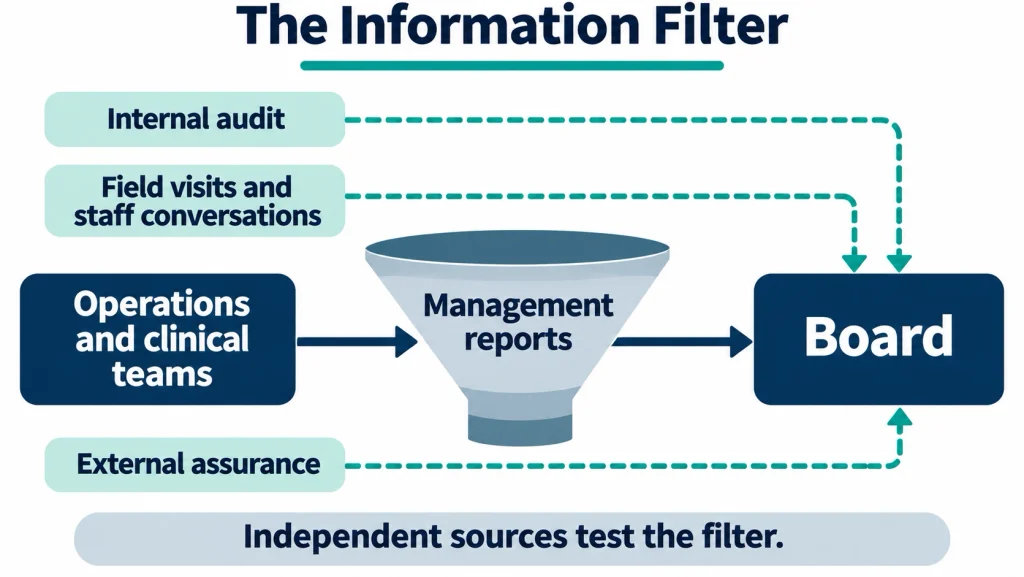
Boards depend on information that management largely controls. That dependence creates a verification problem. Information filters upward through management, so independent sources must test the filter.
The Cambridge Element describes both sides in healthcare. Boards of Australian organizations with low engagement with quality described themselves as “drowning in data”. In English boards with low quality improvement (QI) maturity, data made it hard to see the wood from the trees. Boards with high QI maturity linked benchmarks directly to improvement priorities. Their managers built a logical narrative through the data.
The Element also describes soft data. Examples include discussions with clinicians or patients and walk-arounds by senior managers. It says soft data helps boards understand the realities of quality and safety on the ground.
Culture: Rules Cannot Cover Every Case
ISO 37000 says leaders set the tone for an ethical organizational culture. The IIA gives the governing body a related duty: to nurture a culture that promotes ethical behavior and accountability.
In practice, people fill rule gaps with what they see leaders reward. This is a reasoned inference, not a measured finding.
The Senate’s Enron report summarizes a related 1999 study by the Committee of Sponsoring Organizations of the Treadway Commission (COSO). The study evaluated 200 publicly traded companies involved in financial statement fraud. Those companies often had boards dominated by insiders and weak audit committees that rarely met. The study stressed the need for an effective control environment, or “tone at the top.”
How Leadership Governance Works in Practice
Leadership governance runs as a loop of delegation, reporting, assurance, and accountability.
The Accountability Chain
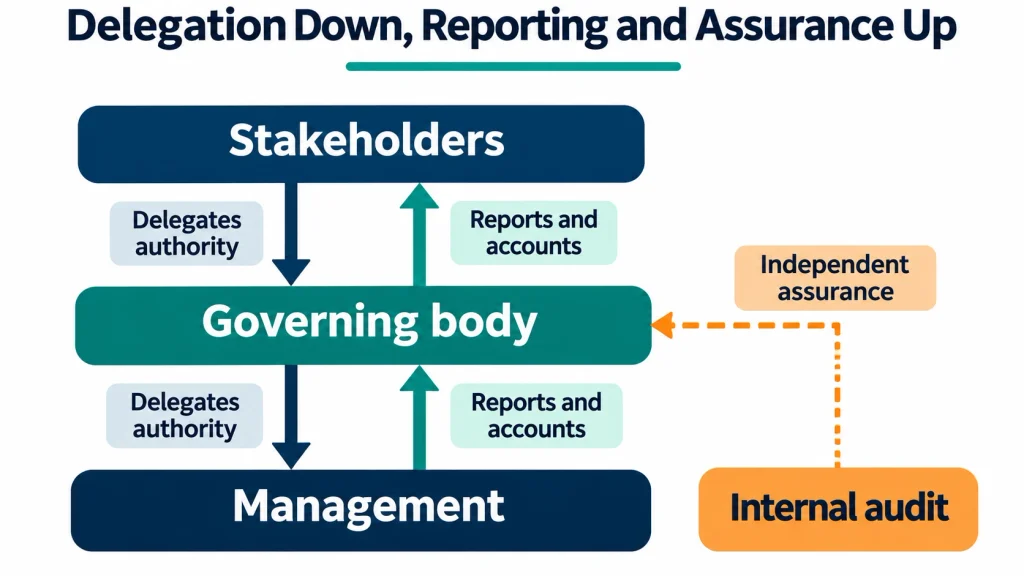
The IIA’s Three Lines Model, published in July 2020, describes who answers to whom.
- Stakeholders entrust oversight of the organization to a governing body.
- The governing body delegates authority and resources to management.
- Management leads operations, manages risk, and reports to the governing body.
- Independent internal audit gives the governing body assurance about governance and risk management.
- The governing body accounts to stakeholders for the result.
The IIA states that all roles operate concurrently. The numbering shows accountability, not a sequence of steps.
Internal audit’s independence rests on accountability to the governing body, unfettered access to people and data, and freedom from interference. The IIA also expects the governing body to give the chief audit executive private sessions without management present.
Three Modes of Board Work
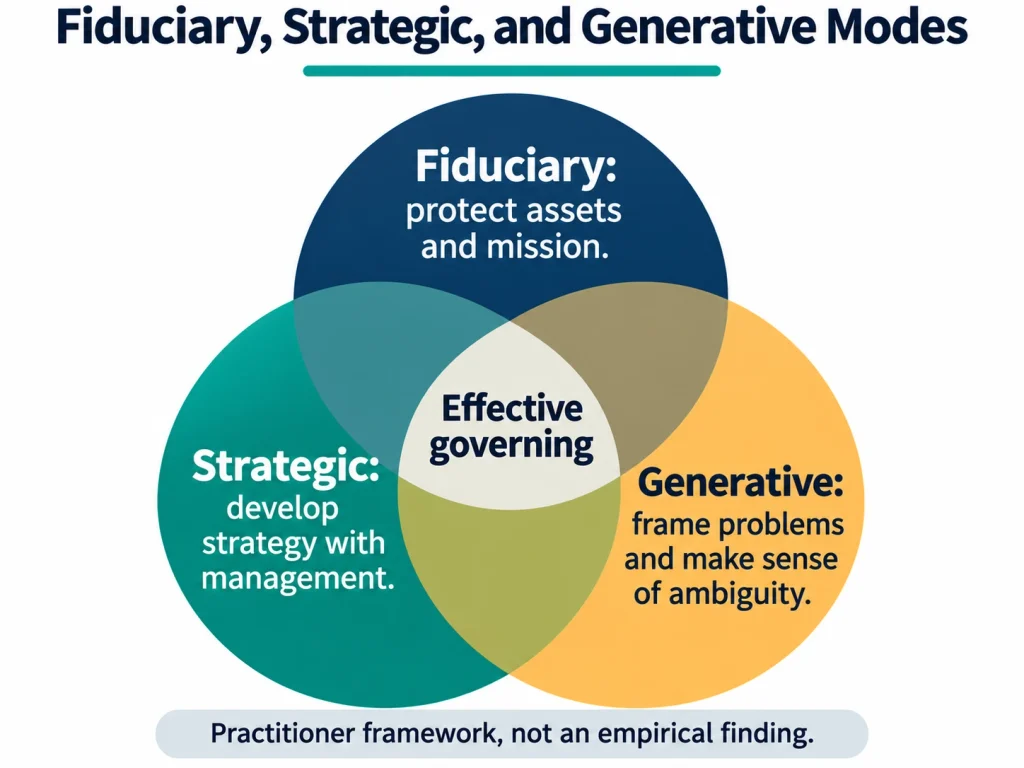
Chait, Ryan, and Taylor described three modes of governing. In the fiduciary mode, boards protect assets, comply with laws, and stay faithful to mission. In the strategic mode, they develop strategy with management. In the generative mode, they help frame problems and make sense of ambiguous situations.
The authors argue that boards strong in all three modes govern far better than boards strong in one or two. That is a conceptual argument from practitioners, not an empirical finding. It can still serve as a diagnostic.
A board that spends its time on budgets, audits, and reports may be strong in fiduciary work. It may also be absent from the generative work that shapes strategy.
Where Oversight Ends and Operations Begin
The line between board and management is rarely sharp. A board that drifts into operations can weaken management’s authority and lose time for long-term risk. Management that bypasses the board removes the check the board exists to provide.
The IIA says the CEO is typically the focal point for communication between the two. It also notes that some organizations and regulators require risk and compliance leaders to report directly to the governing body. Direct lines like these reduce reliance on a single information channel.
The IIA adds that in some jurisdictions the CEO may sit on the governing body and even chair it. In those cases, independent directors and independent assurance carry more of the oversight load. That conclusion is an inference, not an IIA finding.
Governance at Several Levels
Fulop and Ramsay separate macro (national), meso (organizational), and micro (team or individual) levels in health systems. They call these layers heavily intertwined. Applied to one organization, the same logic suggests three layers: the board, the executive team, and operating teams. Each needs clear authority and reporting lines.
What the Standards Say
The four documents below set formal expectations for governing bodies. They differ in scope and legal force.
| Standard | Issuer and date | Relevance to leadership governance | Status |
| G20/OECD Principles of Corporate Governance | OECD; revised 8 June 2023; endorsed by G20 Leaders in September 2023 | Six chapters, including the responsibilities of the board; states there is no single model of good governance | Non-binding |
| ISO 37000:2021 | ISO; published 2021 | Eleven topics, including leadership, oversight, and accountability; the governing body is ultimately accountable | Guidance that adds no new regulatory requirements |
| Three Lines Model | Institute of Internal Auditors; July 2020 | Governing body accountable to stakeholders; delegates to management; relies on independent internal audit | Principles-based model that organizations adapt |
| UK Corporate Governance Code 2024 | Financial Reporting Council; applies from 2025, with Provision 29 from 1 January 2026 | Board monitors the risk and control framework and declares the effectiveness of material controls | Comply or explain; covers companies in the commercial companies and closed-ended investment funds categories |
The IIA also tasks the governing body with setting the organization’s risk appetite. That duty ties leadership discretion to board oversight.
What the Standards Share
ISO 37000 and the IIA model both place accountability with the governing body. The OECD Principles give the board a chapter of responsibilities of its own. The IIA separates governing body and management roles but still requires strong communication between them.
None prescribes a single structure. The OECD says no single model of good corporate governance exists. The IIA says to adapt its model to circumstances, and ISO 37000 applies to any organization.
What the Evidence Shows and What It Does Not
Evidence on leadership governance is uneven. In the sources reviewed, it is richest in healthcare, thinner for listed companies, and mostly observational.
Boards and Quality in Healthcare
The Cambridge Element reviews evidence on boards and quality. It suggests boards tend to perform better on quality and safety under three conditions. They make quality a strategic priority, give it meeting time, and form quality committees.
In one QI maturity study of English boards, high-maturity boards spent most of their time on quality. They prioritized issues escalated by the quality committee and trusted the wider governance structure to identify what needed attention.
These findings show association, not proof of cause. They come from healthcare, so they may not transfer to other sectors.
Governance Functions and Firm Performance
Muhammad Nadeem’s 2026 study appeared in Strategy & Leadership. It coded annual reports and Form 10-K filings from large listed firms for 2016 to 2023. It tested whether coordination, accountability translation, and trust building related to firm performance.
Coordination showed a consistently positive direction without a statistically significant independent effect. Accountability translation showed no direct relationship. Trust building showed a negative but statistically insignificant association.
The author concludes that these functions work as an interdependent system. The study measures what firms disclose, not what leaders do. Its findings are observational, and this guide reviewed only the published abstract.
A cautious reading is that no single function should carry the whole load. That reading is an inference from the author’s conclusion, not a result the study tested.
Structure Is Not Behavior: The Chair and CEO Question
A Conference Board Director Note by Richard Leblanc and Katharina Pick, posted in September 2011, examines the question. It ties separate roles on the Canadian study boards to guidelines advocating separation. Spencer Stuart reports that 59 percent of S&P 500 boards separated them in 2026. It also reports that 41 percent had an independent chair.
The authors call the link between board leadership structure and corporate performance ambiguous and complex. They say board effectiveness is affected by the chair’s industry knowledge and leadership skills. The chair’s influence on board process matters too.
The note’s qualitative evidence came from two studies: one Canadian, one American. The American study covered five boards. Some separate chairs were seen as ineffective “caretaker-chairs”. One board with tough-minded, challenging director interactions had a combined chair and CEO.
The American study was small, and the note dates from 2011. The authors say a separate chair has authority that comes with the office, which a lead director lacks. Whether directors challenge management still depends on how they behave (an inference).
How Leadership Governance Fails
Leadership governance fails when oversight loses information, independence, or will.
Enron: Warning Signs, Little Challenge
A Senate subcommittee examined the role of Enron’s board of directors and published its report on 8 July 2002. It cited over one million pages of subpoenaed documents. It also drew on interviews with 13 past and present board members. It made six findings, covering fiduciary failure, high-risk accounting, conflicts of interest, off-the-books activity, excessive compensation, and weak independence.
The first finding concerned fiduciary duty. The report said the board witnessed numerous indications of questionable practices by management and chose to ignore them. The board received substantial information about Enron’s plans. It also explicitly authorized or allowed many questionable transactions.
The report found that the board routinely relied on management and auditor statements with little effort to verify them. It also found the board readily approved new ventures and complex transactions.
The LJM1 vote shows the pattern. On 28 June 1999, a special board meeting ratified a code of conduct waiver for the chief financial officer. The meeting lasted one hour. The waiver concerned his role in LJM1, an entity he owned in part and managed. The subcommittee says the board approved the proposal with little study or debate. The agenda also included a stock split and the purchase of a new corporate jet.
The directors disputed the criticism. In interviews, all 13 strongly disagreed with the Powers Report conclusions. That report came from a special committee of Enron’s own board in February 2002. The directors said they had reasonably relied on management, the auditor, and outside counsel.
The findings show a board that depended on management for information. The subcommittee found its independence compromised by financial ties between Enron and certain directors. Directors described relations as harmonious, and they could recall only two dissenting votes over many years.
The subcommittee also found considerable expertise in accounting, derivatives, and structured finance among the directors. That points to a gap in challenge, not expertise (an inference).
Healthcare: Governance as Part of the Problem and the Solution
Healthcare inquiries show a similar pattern in another sector. The Cambridge Element cites the Bristol Royal Infirmary Inquiry into children’s heart surgery. Its final report reached Parliament in July 2001. It also cites investigations at Mid Staffordshire and, in 2015, into Morecambe Bay maternity services.
Findings differ by case. Bristol found insufficient monitoring of quality and a culture that failed to acknowledge problems. Mid Staffordshire showed a failure to monitor and enforce standards. Morecambe Bay found poor processes for learning from adverse events.
The Element calls Bristol’s recommendations a key driver for the later development of clinical governance. Its authors conclude that governance and leadership are often part of both the problem and the solution.
Five Failure Patterns
| Pattern | How it works | Documented example | Better practice |
| Reliance without verification | The board accepts assurances from the people it oversees | Enron’s board relied on management and auditor statements with little effort to verify them | Independent assurance, private sessions with internal audit, and field data |
| Compromised independence | Financial ties reduce willingness to challenge | The Senate subcommittee found financial ties between Enron and some directors | Independence reviews and sessions without management |
| Consensus without challenge | A harmonious board approves risky proposals quickly | Enron directors recalled only two dissenting votes over many years | Norms that reward dissent and a chair who manages disagreement |
| Target gaming | Staff meet the measure but miss its purpose | Hospitals added “hello nurses” to meet a 5-minute emergency department triage target, per the Cambridge Element | Pair targets with qualitative data |
| Structure without behavior | Roles are separated, but the chair is seen as ineffective | The Conference Board note’s Canadian study found some separate chairs were seen as ineffective “caretaker-chairs” | Select chairs for skills and write explicit position descriptions |
These patterns are an analytical synthesis. Each row cites the source that documents its example.
How to Assess and Strengthen Leadership Governance
Assess leadership governance by testing whether each component works in practice. A policy on paper does not settle that.
A Five-Question Diagnostic
These questions are an analytical tool derived from the components above. They are not a validated instrument.
| Question | Evidence to look for | Warning sign |
| Is purpose clear enough to settle disputes? | Written purpose and strategy that board papers reference | Strategy appears only at an annual offsite |
| Are decision rights written and respected? | A delegation policy and a list of decisions the board reserves | Major proposals pass in rushed meetings, as at Enron’s 1999 special meeting |
| Does the board receive independent information? | Internal audit reports to the board, with private sessions | All board information passes through the CEO |
| Do evaluations lead to action? | Named owners and follow-up for each evaluation finding | Evaluations are completed and then shelved |
| Is leadership continuity planned? | Succession plans for the CEO and the board chair | Successors are considered only after a departure |
Spencer Stuart’s report echoes two of these tests. It says an annual strategy offsite is not enough for strategy oversight. It also urges boards to assign ownership for agreed evaluation priorities.
Board Evaluation and Succession in 2026
At large U.S. companies, board evaluation is now routine. Spencer Stuart reports from proxy disclosures that 99 percent of S&P 500 boards conduct an annual evaluation. Nearly half (49 percent) disclose that they evaluate individual directors, and one-third (33 percent) use an outside facilitator. Eighty percent disclose a director skills matrix.
Spencer Stuart says boards must turn evaluation findings into meaningful action to capture the full value of an evaluation. It also says board succession planning should include board leadership. It describes the independent board leader as either a chair or a lead director.
High-performing boards, it says, discuss potential CEO successors and the external talent market. They also discuss leadership development priorities and risks to continuity. The figures cover S&P 500 companies. Spencer Stuart says the individual-evaluation and outside-facilitator percentages could be underreported.
Succession timing adds urgency. Departing S&P 500 CEOs in 2026 had a median tenure of 7.8 years. Nearly one-quarter left within their first five years in the job. Planning therefore has to run ahead of departures.
Fitting Governance to Size and Context
The OECD says no single model of good corporate governance exists. ISO 37000 applies to organizations of every size and type. The IIA recommends adapting its model to organizational objectives and circumstances.
Consider a hypothetical small nonprofit. It might document delegated authorities on one page and review them each quarter. A listed bank typically faces committees, formal assurance, and regulatory reporting. The principles repeat, and the formality changes.
New Oversight Demands: Controls and Cybersecurity
Recent rules push boards toward explained, evidence-backed oversight. The FRC says the 2024 UK Corporate Governance Code applies to financial years beginning on or after 1 January 2025. Provision 29 starts one year later.
Provision 29 asks the board to monitor the risk management and internal control framework. The board should review its effectiveness at least annually. The annual report should also declare whether material controls were effective at the balance sheet date.
In the United States, SEC rules effective 5 September 2023 require public companies to describe board oversight of cybersecurity risks. Companies must also describe management’s role in assessing and managing material risks. The SEC did not adopt a proposed requirement to disclose board cybersecurity expertise. How a board organizes its cybersecurity oversight therefore remains its own choice (an inference).
These rules may change. In April 2026, industry groups urged the SEC to rescind Item 106, the cybersecurity governance disclosure. Their letter responded to a request from SEC Chair Atkins for public input on reforming Regulation S-K. The eCFR, an unofficial reference, still listed the item as of 16 June 2026. Confirm the current text before relying on it.
Both the UK and US rules ask boards to explain how they oversee a risk. That tests whether the board has the information and independence to do so.
What Executives and HR Leaders Can Do With This
The steps below are analytical recommendations that follow from the sources above. No study tests them as a package.
- Write down delegated authority, name the decisions the board keeps, and review the document every year.
- Ask which board information comes from outside the executive team. If the answer is none, the board sees only what management chooses to show.
- Give the board its own view of the leadership pipeline, including potential CEO successors.
- Assign an owner and a date to every evaluation finding.
- Check how often the board has changed or declined a management proposal. A record of near-unanimous approval deserves a closer look.
HR leaders hold a specific position in this system. They run the processes that appoint, assess, pay, and develop leaders. The board relies on those processes, so weak HR data weakens the board’s oversight of leadership.
Limits of This Guide
Most statistics here describe large U.S. listed companies. The healthcare evidence comes mainly from the United Kingdom, Australia, and the United States. Company law and listing rules differ by country, so readers should check the rules that apply to their own organization.
Conclusion
Leadership governance links four things: direction, authority, information, and consequences. ISO 37000 and the IIA model both place accountability with the governing body. The OECD Principles give boards a chapter of responsibilities of their own.
The evidence is thinner than the standards suggest. In the sources reviewed, structure alone rarely explains outcomes. Enron’s directors had real finance expertise, yet the board approved deals with little study or debate. Healthcare inquiries show similar weak points in another sector: monitoring, transparency, and culture.
Expectations keep moving, from the Cadbury Committee’s first Code in 1992 to Provision 29 in 2026. A governing body therefore needs a routine of review. The practical test has four parts. Leaders should be able to show who decides and who checks. They should also show which information the board trusts and what follows when results fall short.
Overseeing current leaders raises a second question: who holds those roles next? A board answers it through executive succession planning, which prepares CEO transitions before a departure forces the issue.
Frequently Asked Questions
What are the four P’s of governance?
A guest article on the Institute of Directors site names four Ps: purpose, people, process, and performance. People is the P closest to leadership governance. It covers transparent, ethical, and accountable leadership. The other three cover the organization’s reason for being, its operating systems, and how it measures and reviews results.
The article, by Trusha Lakhani, does not say who devised the framework, so treat it as one practitioner’s model.
What are the 5 S’s of governance?
The five Ss are support, stretch, scrutiny, stewardship, and strategy. A 2019 Responsible Finance article credits the framework to Julia Unwin, a former chief executive of the Joseph Rowntree Foundation. Unwin also wrote a 2006 Civil Society article titled “The five S’s of governance”.
- Support helps the executive team solve problems.
- Stretch encourages good practice.
- Scrutiny provides checks and balances on critical decisions.
- Stewardship guards commercial, intellectual, and reputational assets.
- Strategy sets direction with stakeholder input.
What are the 7 pillars of effective governance?
The standards reviewed for this guide do not use a list of seven. The OECD Principles have six chapters. ISO 37000 lists eleven topics.
The six OECD chapters cover the governance framework and shareholder rights. They also cover investors and markets, disclosure, board responsibilities, and sustainability and resilience. Choose a framework for its source and purpose, not for its count.
What are the 8 characteristics of good governance?
A UN ESCAP paper titled “What is Good Governance?” lists eight characteristics:
- Participatory
- Consensus oriented
- Accountable
- Transparent
- Responsive
- Effective and efficient
- Equitable and inclusive
- Follows the rule of law
The paper frames the list around society and its institutions, not one company. It calls good governance an ideal that is hard to achieve in full.