

Leadership as infrastructure treats leadership as a durable organizational system, not a trait of individual leaders. The system combines decision rights, operating routines, capability standards, and shared knowledge. Organizations build it so that decisions, coordination, and leader development stay consistent when individual leaders change. The concept responds to a common critique: training aimed at individuals often fails to change organizational results.
What Does “Leadership as Infrastructure” Mean?
Leadership as infrastructure means building leadership into an organization’s structures, routines, and shared knowledge. Leaders still matter. The organization does not rely on a few strong individuals to make decisions, align teams, and develop successors. The system carries part of that load.
The phrase carries several meanings in practice. InteraWorks asks whether leadership development is a form of infrastructure rather than a program. CITI, a human services technology provider, describes the components as documented processes, shared institutional knowledge, and transparent decision-making practices.
The term has an earlier history. Bill Ott and Matt Motherwell described it in T+D magazine in 2007. Their system centered on executive roles and responsibilities. In their model, hiring, development planning, and succession planning depend on those roles.
A third group uses the words literally, for the leadership of roads, utilities, and other physical networks. This article covers the organizational meaning only.
Why Infrastructure Is a Useful Comparison
Susan Leigh Star’s 1999 paper lists nine properties of infrastructure. Five of them map readily onto leadership. The mapping is this article’s own analysis, not a research finding.
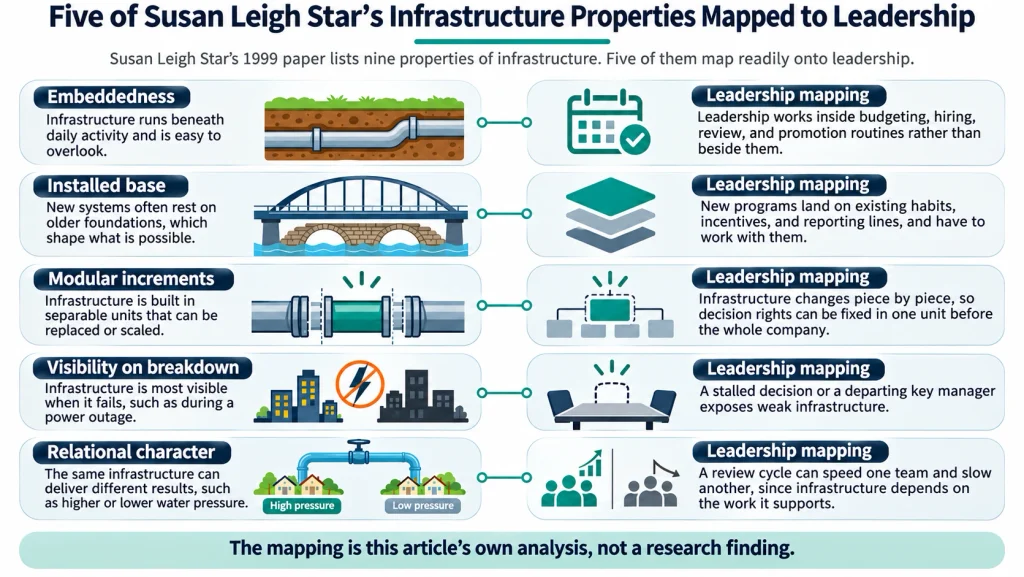
- Embeddedness: leadership works inside budgeting, hiring, review, and promotion routines rather than beside them.
- Installed base: new programs land on existing habits, incentives, and reporting lines, and have to work with them.
- Modular increments: infrastructure changes piece by piece, so decision rights can be fixed in one unit before the whole company.
- Visibility on breakdown: a stalled decision or a departing key manager exposes weak infrastructure.
- Relational character: a review cycle can speed one team and slow another, since infrastructure depends on the work it supports.
Leadership as a System, Not a Person
Barbara Kellerman made a related argument in Dædalus in 2016. She described leadership as a system of three equally important parts: the leader, the followers, and the context. She argued that the leadership industry’s focus on single individuals has hampered its ability to improve the human condition.
Her critique is conceptual, so it cannot show that any infrastructure improves results. Still, it explains why design should start with context. A decision chart that suits a small team may fail in a matrixed firm.
Why Individual Leadership Alone Falls Short
Individual leadership falls short when results depend on how consistently an organization decides, coordinates, and develops people. Three kinds of evidence bear on this: training studies, manager variance data, and surveys of leadership benches.
Training Fades When the System Does Not Change
Michael Beer, Magnus Finnström, and Derek Schrader wrote in Harvard Business Review in 2016. They cited about $160 billion in US training and education spending in 2015, and close to $356 billion worldwide. They argued that the learning mostly fails to improve organizational performance. People soon revert to their old ways. The article’s description adds that needed fixes in organizational design and managerial processes must come first.
A meta-analysis paints a more positive picture. In 2017, Christina Lacerenza and colleagues pooled 335 independent samples. Leadership training improved reactions, learning, transfer, and results, with average effect sizes from .63 to .82. Effects were stronger when programs used a needs analysis, feedback, spaced sessions, and several delivery methods, especially practice.
The two sources answer different questions. The meta-analysis estimates what training can achieve when it is well designed. The HBR authors describe what happens when training meets an unchanged organization. Read together, they suggest that both program quality and system fit matter, which is this article’s synthesis.
Management Quality Varies Between Teams
Gallup estimated in 2015 that managers account for at least 70% of the variance in employee engagement across business units. Randall Beck and Jim Harter reported the estimate. It describes variance between units. It does not show that managers cause engagement, and it does not say how much any single manager can change.
For manager effectiveness, the implication is that routines, not only individual skill, shape how consistently teams are led. Gallup did not test that implication.
Leadership Benches Are Thin and Trust Is Low
DDI’s Global Leadership Forecast 2025 surveyed 10,796 leaders and 2,185 HR professionals in more than 50 countries. Only 40% of leaders rated leadership quality as high. Just 20% of HR professionals expressed confidence in their leadership bench. DDI also reported that trust in immediate managers fell from 46% to 29%. DDI sells leadership development, and these figures measure perceptions, not performance.
The Core Components of Leadership Infrastructure
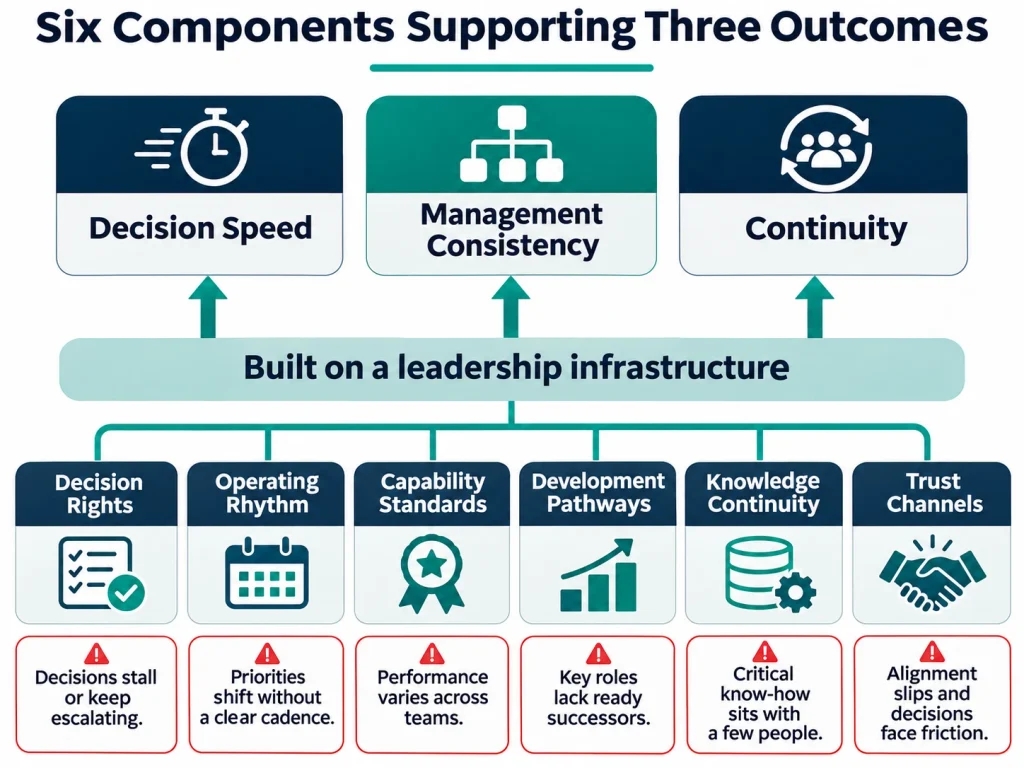
No standard model of leadership infrastructure exists. The six components below are this article’s synthesis of the sources reviewed. Their definitions and mechanisms are the article’s own analysis. Each component links a function to a mechanism and a visible failure sign.
| Component | Function | Mechanism | Failure sign |
| Decision rights | Assign who decides, who advises, and who acts | Removes ambiguity so decisions close faster | The same decision returns to the agenda |
| Operating rhythm | Set regular forums for planning, review, and escalation | Surfaces risks while correction is still cheap | Problems appear only at quarter end |
| Capability standards | Define good leadership at each level | Aligns hiring, promotion, and feedback | Managers apply different standards to similar work |
| Development pathways | Provide practice, feedback, and stretch roles | Builds skills through practice and feedback | Training happens but behavior does not change |
| Knowledge continuity | Record processes, context, and decisions | Reduces dependence on individual memory | Performance drops when one person leaves |
| Trust and feedback channels | Keep informal routes open for honest information | Moves bad news upward quickly | Leaders hear about issues late |
Decision Rights and Escalation Paths
Clear decision rights state who decides what, at which level, and within what limits. They also set escalation paths for decisions beyond those limits.
Marcia Blenko and Michael Mankins of Bain & Company describe decision effectiveness through four dimensions: quality, speed, yield, and effort. Their brief offers measurement examples. A semiconductor company tracked the decisions it delayed and revisited, and how often decisions escalated to a higher level.
One pharmaceutical company in the brief scored below average on speed. Nearly 80% of its respondents said decisions required too much effort. Unclear decision rights could be one cause, but the brief does not test that link. Check it against your own data.
Operating Rhythm
An operating rhythm is a repeating calendar of forums, each with a defined purpose, set inputs, and decision outputs. Typical forums cover planning, performance review, risk escalation, and talent review.
The rhythm matters because it creates scheduled points where leaders see problems. Without it, information moves up only when someone chooses to escalate it. Bain makes a related point about meetings. It says top-performing companies set decision-focused agendas that name the decisions to be made and who is accountable.
Capability Standards and Development Pathways
A leadership capability framework states what good leadership looks like at each level. In this model it counts as infrastructure only when hiring, promotion, and feedback use it.
Pathways then build the capabilities the standards describe. Lacerenza and colleagues found stronger training effects when programs used needs analysis, practice, and feedback. That supports building pathways around observed gaps, not generic course catalogs, although the meta-analysis did not test catalogs directly.
Knowledge Continuity and Succession
Continuity depends on what an organization retains when people leave. CITI links leadership infrastructure to documented processes and shared institutional knowledge. It says lost knowledge brings longer onboarding, inconsistent practices, and greater vulnerability during workforce transitions. CITI sells related software, so treat this as a practitioner view.
Both succession planning and a healthy leadership pipeline apply the same logic to roles. Ott and Motherwell wrote in 2007 that a strong leadership infrastructure reduces the need to hire outside the company. Good knowledge management adds the context behind past decisions.
Trust and Informal Governance
Helmrich and Chester define formal governance as power granted through hierarchy or rules. They define informal governance as power established through social relationships. The two are interdependent, so infrastructure that covers only formal rules misses the channels where people share early warnings.
Informal channels work through relationships. A manager who trusts a peer may mention a problem before it appears in a report. Formal design can support this by protecting time for cross-team contact and by responding constructively to bad news. No source reviewed tests this mechanism.
DDI’s falling trust figures point to a possible weakness in these channels. No source reviewed links the two.
How Leadership Infrastructure Works
Leadership infrastructure works by reducing variation in how decisions get made and how managers behave. Each component acts on a different source of variation.
The Causal Chain
- Clear decision rights reduce ambiguity about who closes a decision. Fewer decisions return to the agenda or escalate, and follow-through can improve.
- A regular operating rhythm moves risks into scheduled forums, where leaders see them earlier and correction costs less.
- Shared capability standards give managers one definition of good practice. Team experience then varies less from manager to manager.
- Documented knowledge and succession routines reduce dependence on individuals, so performance holds when people leave.
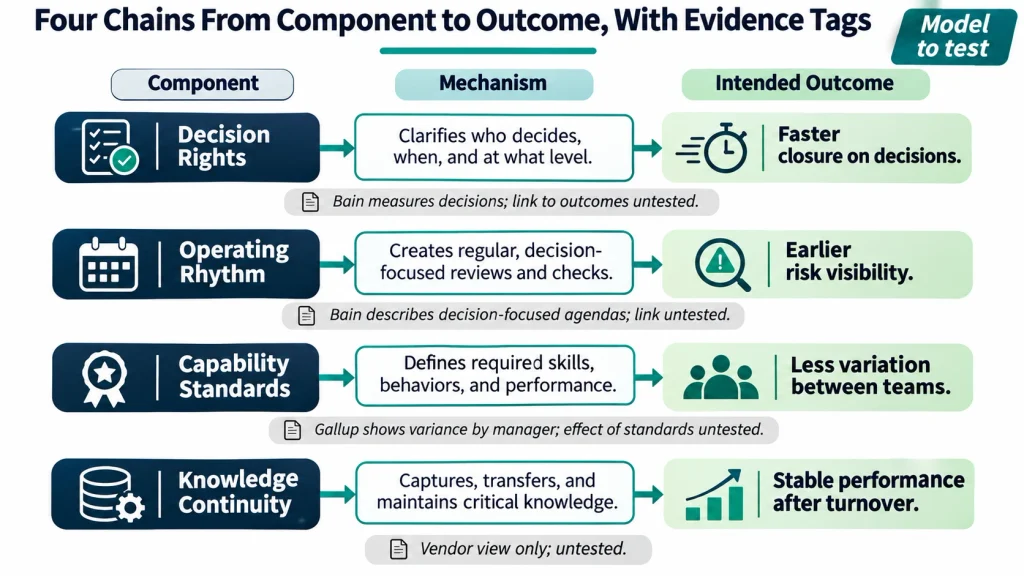
The sources support parts of this chain, such as Bain’s decision measures and Gallup’s variance estimate. None tests the full chain as a package. Treat it as a model to test, not a proven result.
Conditions That Change the Effect
Evidence on shared leadership, where team members take on leadership roles together, is mixed on task complexity. Danni Wang, David Waldman, and Zhen Zhang pooled 42 independent samples in 2014. Shared leadership related positively to team effectiveness, and the relationship was stronger when members’ work was more complex.
Lauren D’Innocenzo and colleagues pooled 50 effect sizes in 2016. They found a positive relationship with team performance but lower effects with more complex tasks. Network-based measures showed higher effects than aggregated ones.
The two meta-analyses define outcomes differently. Wang and colleagues examined team effectiveness, which includes attitudes and processes. D’Innocenzo and colleagues examined team performance. That difference may explain part of the gap. This is an inference, and neither abstract resolves the conflict.
Stability also matters. Helmrich and Chester say complex settings require both exploitative and explorative leadership. Exploitative behavior refines what works. Explorative behavior tests alternatives. They add that hierarchical structures can restrict flexibility by perpetuating standardization and reducing collaboration.
Scale may be a further condition, though no source tested it. The more managers an organization has, the more variation it must manage.
Leadership Infrastructure Compared With Related Concepts
These terms overlap but answer different questions. Development programs build individual skills, capability frameworks define standards, and leadership infrastructure connects both to decisions, routines, and knowledge.
| Dimension | Development program | Capability framework | Leadership infrastructure |
| Core question | How do we build skills in these people? | What does good leadership look like here? | How does the organization decide, coordinate, and renew leaders? |
| Main unit | Individual or cohort | Role or level | Whole organization |
| Typical mechanism | Training, coaching, practice | Competencies and behavior standards | Decision rights, routines, standards, pathways, knowledge |
| Time pattern | Bounded program | Periodic refresh | Continuous maintenance |
| Main limit | Gains fade if the system is unchanged | Becomes a poster if unused | Can harden into bureaucracy |
Practitioner pages often blur these terms. Stuart Andrews is an independent consultant who sells capability programs. He argues that building capability is a sequencing problem and that organizations should grant decision rights before they fund development. That is a practitioner opinion, not a tested finding.
How to Diagnose Weak Leadership Infrastructure
Weak leadership infrastructure shows up as repeated friction, not one dramatic failure. Most organizations already hold the data needed to see it.
Four signals can be measured:
- Decisions return to the agenda after they were supposedly closed. Bain’s semiconductor example counted delayed and revisited decisions.
- Decisions escalate further than the risk requires; the same example tracked how often decisions escalated.
- Engagement varies sharply between managers. Gallup’s variance estimate is a reason to examine team-level data.
- Performance drops when one person leaves, which points to gaps in knowledge or succession.
Bain also recommends surveying employees, who rate decision quality, speed, yield, and effort on a scale of one to four. It calls employee surveys the best gauge of performance on each dimension.
The table maps common symptoms to likely gaps. It is a diagnostic aid built from this article’s model, not a validated instrument.
| Symptom | Likely gap | First check |
| Decisions keep returning | Decision rights | Is the owner named and written down? |
| Risks surface late | Operating rhythm | Which forum should have seen the risk? |
| Managers behave inconsistently | Capability standards | Do hiring and promotion use the same standards? |
| Skills do not transfer | Development pathways | Does the program include practice and feedback? |
| Knowledge leaves with people | Knowledge continuity | Is the process documented and easy to find? |
| Bad news arrives late | Trust and feedback channels | Do people believe candor is safe? |
A Hypothetical Diagnosis
The following example is hypothetical and does not describe a real company.
A firm with twelve product teams sees pricing exceptions reach its executive committee every month. The committee approves most of them within minutes. Sales leaders say they escalate because the policy does not say who may approve a discount above a set size.
The diagnosis starts with decision rights, not training. The firm counts how often pricing decisions escalate and how many return to the agenda. It writes an approval limit for each level and names one owner per product line. Then it tracks escalation frequency for two quarters.
Escalations may fall, which would support the decision-rights explanation. If they stay high, the cause may lie elsewhere, such as incentives that reward discounting. The test narrows the diagnosis; it does not guarantee a fix.
How to Build Leadership Infrastructure
Build in stages: diagnose first, assign decision rights next, and add routines, standards, and pathways after that. Measure continuously and revise as strategy changes. The sequence is this article’s synthesis, not a tested protocol.
- Diagnose friction first. Collect decision-effectiveness data and team-level variation before designing anything.
- Assign decision rights for the recurring decisions that matter most, writing down who decides, who advises, and the limits.
- Set the operating rhythm, with a purpose, inputs, and decision outputs for each forum.
- Define capability standards by level, and tie them to hiring, promotion, and feedback.
- Build development pathways around observed gaps, with practice, feedback, and spaced sessions.
- Capture knowledge and succession plans for critical roles.
- Measure leading indicators and review the design on a fixed schedule.
In this model, sponsorship matters because decision rights move authority. A senior sponsor has to be willing to give some up, not only endorse the design. Otherwise the design stays on paper.
Choosing Where to Start
Most organizations cannot fix all six components at once. Two criteria help rank them: how often the symptom appears, and how costly delay is when it occurs.
Decision rights are often a practical first step. Changing them mainly needs agreement among senior leaders, not a new budget. Knowledge continuity may come first where a critical role has no successor, since one departure would expose the gap.
A pilot in one unit limits risk and produces local data to test the design before wider rollout.
Common Mistakes
Four mistakes follow from the mechanisms above. They are analytical judgments, not findings from a study.
- Standards that never reach decisions. A framework is easy to publish, but managers read it once while hiring and promotion continue unchanged. Tie each standard to a specific hiring, promotion, or feedback step.
- Programs funded before decision rights are fixed. Participants come back to the same stalled decisions, which matches the HBR concern that people revert to old ways. Test decision flow first.
- A design treated as finished. Rules harden over time, the lock-in problem Helmrich and Chester describe, so set review dates for decision rights and standards.
- Only lagging measures. Engagement and turnover data are easy to collect, but they surface problems quarters late. Add leading indicators.
Measuring Progress
Start with leading indicators, which show change before outcomes do. Useful examples include decision cycle time, escalation rate, and successor readiness for critical roles. These leadership metrics need a baseline from the diagnosis stage.
Bain’s examples cover delayed decisions, revisited decisions, and escalation frequency. Cycle time and successor readiness are this article’s additions.
Lagging indicators confirm results later. Turnover and engagement scores are common examples. Review both sets together, because lagging data alone arrives too late to guide adjustments.
Where Leadership Infrastructure Applies
The pages reviewed describe the framing in policing, construction, and human services. Each page comes from a provider or commentator, and none reports outcome data.
- Policing: InteraWorks describes the ASPIRE Leadership Institute. It is a public-private partnership with the Metropolitan Nashville Police Department and the Nashville Public Safety Alliance. It develops emerging leaders, both sworn officers and professional staff. The page offers participant reflections and no measured results.
- Construction: Harris Whitesell Consulting asks whether leadership capability could get the intentionality applied to other critical infrastructure. Its page names a progression from leading self to leading others to leading organizations. A linked white paper was not reviewed.
- Human services: CITI ties leadership infrastructure to organizational resilience and to knowledge preservation during staff turnover. It also promotes its own software platforms.
The settings share a pattern: workforce turnover or complexity that individual leaders struggle to absorb. That pattern is descriptive, not evidence of effect.
Limits and Risks
Leadership infrastructure can harden into bureaucracy, hide informal work, and rest on thin evidence.
Bureaucracy and Lock-In
Helmrich and Chester describe lock-in as an inability or resistance to change due to past decisions. Inflexible rules, performance measures, and norms can deepen it. Leadership infrastructure can produce the same effect when its rules become fixed.
Review decision rights and standards on a schedule. The authors also note that temporary decentralization is already used in infrastructure systems during disaster recovery.
Invisible Work
Star observed that invisible labor pervades most infrastructure and is usually noticed only when it fails. Nurses were her main example. Leadership has an analogous layer: coaching a peer, smoothing a conflict between teams, or briefing a new manager.
Formal design that ignores this work can weaken it. Star also noted that making such work visible can invite cost accounting. Name the work in role expectations and reviews, then check whether naming it changes how people do it.
Thin Evidence
No study reviewed here tests leadership infrastructure as a bundle. The evidence comes from adjacent research on training, shared leadership, decision effectiveness, and governance. Many retrieved pages come from firms that sell related services.
Helmrich and Chester add a caution. They write that investment in leadership capabilities will not independently create resilient infrastructure organizations. It may still provide a pathway toward retooling institutions. Claims of large percentage gains need traceable sources before anyone relies on them.
Conclusion
Leadership as infrastructure moves the design question from who leads to how the organization decides, coordinates, and renews its leaders. The evidence supports the parts better than the whole. Well-designed training can change behavior, management quality varies between teams, and decision effectiveness can be measured. Rigid governance can also limit adaptation.
No study tests the full bundle, so claims of financial gains remain unproven. The practical value lies in diagnosis. Repeated escalations, late-surfacing risks, and performance drops after a departure each point to a component that can be repaired. In this analysis, the long-run test is how many decisions still depend on one person’s judgment or memory.
Diagnosis begins with one practical question: who decides? Once an organization lists the decisions that keep returning, the next need is a clear way to assign them. Tools called decision rights frameworks give that assignment a structure. RAPID, a Bain tool, names who recommends, who provides input, and who decides. RACI is another common example.
FAQ
Who should own leadership infrastructure?
Business leaders should hold the decision rights and standards. HR or learning teams can maintain the tools, data, and review calendar. If line managers skip the standards in hiring and promotion, the system exists only on paper. This is an analytical judgment, not a tested finding.
How long does it take to build leadership infrastructure?
Duration depends on scope. Key factors are the number of decisions to redesign, the number of people processes to align, and sponsor availability. This is an analytical judgment.
How is leadership infrastructure different from organizational culture?
Culture describes shared norms and behaviors. Leadership infrastructure is the set of designed structures and routines. Those routines may shape culture over time. That link is plausible but untested here.
Can small organizations or startups use leadership infrastructure?
Probably, in a light form. A small organization can write down a few decision rights and set one regular review. No source reviewed tests this at small scale.
Does leadership infrastructure work for remote or hybrid teams?
Written decision rights and scheduled forums may matter more when informal contact is limited. That is an analytical judgment, so check it against your own escalation data.
What role does technology play in leadership infrastructure?
Tools can store decisions, preserve knowledge, and display dashboards. They do not create decision rights or trust. CITI states that technology does not replace leadership but can strengthen the infrastructure around it. CITI sells such platforms, so weigh that view accordingly.