

Leadership accountability is a leader’s obligation to answer for decisions, behavior, and results. It also means creating conditions where others do the same. It rests on clear expectations, an audience that evaluates performance, and fair, consistent consequences. In Gallup’s March 2026 analysis, leaders and managers both rated accountability as leadership’s weakest competency. Research on its effects is mixed, so design choices matter.
What Is Leadership Accountability?
Leadership accountability is the expectation that a leader will explain decisions and results and face consequences for them. Two definitions are in common use. They describe different sides of the same idea.
Academic researchers define accountability from the individual’s point of view. Hall, Frink, and Buckley reviewed the field in the Journal of Organizational Behavior in 2017. Their term is felt accountability. It means a perceived expectation that someone will evaluate your decisions or actions.
The person must also believe that rewards or sanctions depend on that evaluation. They must believe they may have to explain their actions to an audience whose view matters to them.
Gallup uses a narrower, leader-focused definition. It treats creating accountability as one of seven leadership competencies. It defines the competency as holding everyone responsible for exceptional performance.
The two definitions fit together. The research definition explains why accountability changes behavior. The Gallup definition describes what leaders must do to produce it. A practical synthesis gives three working components:
- Expectations: goals, standards, and decision rights are explicit before work starts.
- Answerability: a defined audience can ask for an account of decisions and results.
- Consequences: recognition, correction, or sanctions follow results fairly and consistently.
This synthesis is analytical, not an empirical finding.
Accountability, Responsibility, and Blame
Responsibility is the duty to do a task. Accountability is the obligation to answer for results. Blame is a judgment that someone is at fault. The three ideas overlap in everyday speech, but they lead to different leader behavior.
Researchers do not use these terms identically. Hall, Frink, and Buckley note that some studies treat responsibility and accountability as interchangeable. Other scholars separate them. They argue that accountability adds an external audience that can ask for an account.
| Concept | Core question | Timing | Typical leader behavior |
| Responsibility | Who does the work? | Before and during the task | Assigns tasks and decision rights |
| Accountability | Who explains the result and acts on it? | After results, before the next cycle | Reviews results and states what changes |
| Blame | Who is at fault? | After a failure | Assigns fault, often without fixing causes |
A leader can use delegation to assign tasks and still owe an account of the result. Blame treats that account as a verdict. Accountability treats it as information for the next decision.
Gallup draws a similar line. It describes blame as assigning fault without addressing the conditions behind a problem.
The Three Directions of Leadership Accountability
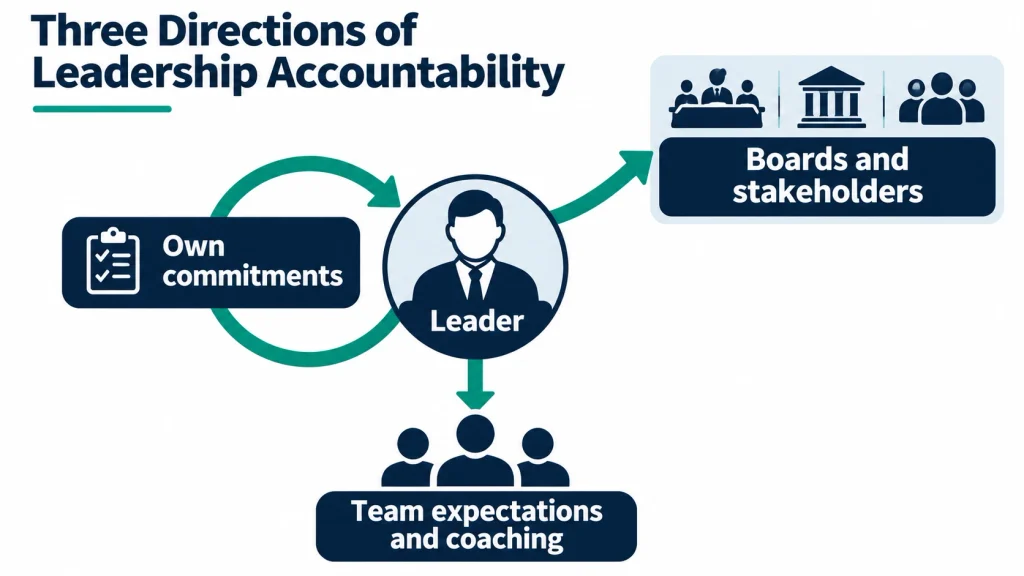
Leaders carry accountability in three directions. First, they answer for their own commitments. They also build accountability across the teams they manage. Finally, executives report upward to boards, regulators, and external stakeholders.
The four practitioner guides reviewed for this article focus mainly on managing teams. None of those guides mention boards or regulators. Academic research explains why all three directions matter: true accountability requires an audience.
| Direction | Audience | Typical mechanism | Evidence basis |
| Self | The leader and the people who watch the leader | Keeping stated commitments | Practitioner argument |
| Team | Direct reports and managers | Specific expectations, regular coaching, consistent standards | Gallup survey and practitioner analysis |
| Upward and outward | Boards, shareholders, regulators, employees | Board oversight, formal feedback, pay recovery rules | SEC rule and academic review |
This table is an analytical framework built from the sources named in it. It is not a published model.
Self: Keeping the Leader’s Own Commitments
NeuroLeadership Institute researchers David Rock, Emma Sarro, and Chris Weller wrote about accountability in Harvard Business Review in June 2024. The Institute’s own post says accountability depends on whether people feel their leader practices what they preach.
It says employees who are told one thing and see leaders do another may read the mismatch as a threat. This is a practitioner argument, not a controlled finding. It still suggests a simple self-check: visible actions should match stated standards.
A leader can run this check by listing the three standards they most often state to their teams. Then the leader can ask whether their own calendar, decisions, and follow-through show the same standards. This is an analytical suggestion.
Team: Creating Accountability in Others
Gallup ties this direction to the leader’s performance responsibility. Leaders define exceptional performance in light of the organization’s purpose and plan with key leaders and managers. They also hold individuals and teams accountable for results and customer value.
This work maps onto the three components defined earlier. Setting the standard supplies expectations. Making progress visible creates answerability. Responding to results is where consequences apply. The mapping is an analytical reading, not a Gallup finding.
Upward and Outward: Boards, Regulators, and Stakeholders
Formal upward mechanisms exist. One example is executive compensation recovery. In 2022, the US Securities and Exchange Commission adopted Rule 10D-1. The rule directs stock exchanges to require listed companies to adopt recovery policies.
Those policies recover incentive pay that rested on erroneously reported financial information. They apply to current and former executive officers. The lookback period covers the three completed fiscal years before a required restatement.
The rule took effect in January 2023. Exchange listing standards based on it took effect on October 2, 2023.
The SEC states that recovery applies regardless of any fault of the executive officer. This is accountability without a fault finding. Consequences attach to a restated outcome, not to proven misconduct.
The rule covers US-listed companies and illustrates one mechanism, not a global standard. A March 2026 law-firm guide describes the rule as in force. Searches on 11 November 2026 found no amendment or stay.
Upward accountability is a corporate governance matter as well as a leadership one. Boards, investors, and regulators define the audience and the consequences.
Feedback tools add a less formal channel. Gallup notes that 360-degree feedback assessments are commonly used for performance management and developmental feedback. Such tools can give peers and direct reports a structured voice. That function is an inference, not a Gallup claim.
Why Leadership Accountability Matters: What the Evidence Shows
The evidence links accountability to better judgment and, in survey data, to higher engagement. It is uneven. Experiments show numerous desirable effects on decisions and behavior. Field research in organizations shows mixed results. Direct research on leaders is thin.
Survey Evidence From Gallup
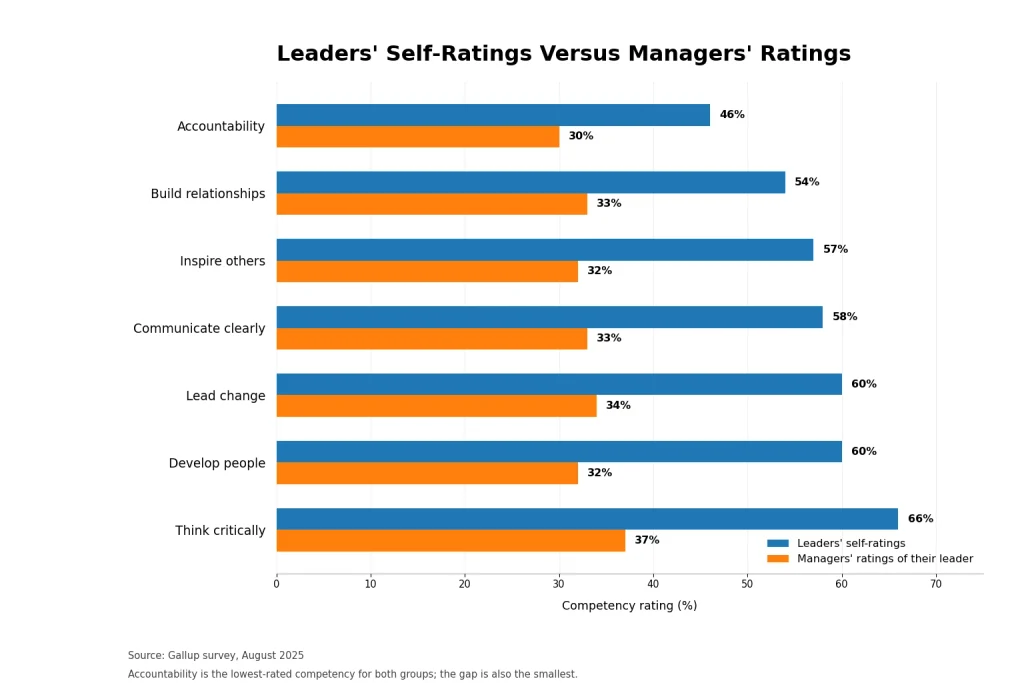
Gallup surveyed 23,068 employed US adults from August 5 to 19, 2025. Its March 2026 analysis, by Jim Harter and Corey Tatel, compared leaders’ self-ratings with managers’ ratings across seven competencies.
Accountability ranked lowest for both groups. Among leaders, 46% rated themselves outstanding or exceptional at it. Only 30% of managers gave their leaders that rating.
The rating also tracked employee engagement. Managers who gave their leaders that rating were three times as likely to be engaged at work. Their engagement rate was 51%, compared with 17% for other managers.
Gallup also reports that clarity of expectations is one of the engagement elements that has dropped the most. Clear expectations are one input to accountability, because people cannot answer for standards they do not know.
Treat these figures with care. They show an association, not a cause. Reverse causation is possible, because engaged managers may rate leaders more generously. Gallup is also a commercial provider of engagement and leadership services.
Experimental and Field Research
Aleksovska, Schillemans, and Grimmelikhuijsen reviewed 266 experiments across 211 articles published between 1970 and 2016. Their analysis uncovered numerous benefits of accountability on individual decisions and behavior. The researchers also documented both positive and negative effects across different accountability mechanisms. Finally, they cautioned that lab-based behavioral findings do not always transfer directly to public settings.
Hall, Frink, and Buckley reviewed organizational research. They found 234 articles on individual accountability and responsibility, including 57 empirical studies in organizations since 1998.
Empirical research showed both constructive and harmful consequences. Results were mixed, so moderators and nonlinear relationships matter. The authors described the field as still at an early stage.
For leaders, the practical meaning is conditional. The same mechanism can sharpen judgment in one design and produce strain or defensiveness in another. A leader should therefore ask which design suits the task before copying a practice from another organization.
What the Evidence Does Not Show
Direct evidence on leaders is limited. Melo, Martins, and Pereira searched Web of Science and found 37 articles on leadership and accountability. They concluded that evidence on the topic is sparse.
The evidence supports a cautious claim. Well-designed accountability can improve judgment and may support engagement. It does not show that more accountability always improves performance. Claims that accountability guarantees profit or productivity go beyond the sources reviewed.
Why Leaders Struggle to Create Accountability
Leaders struggle because accountability feels uncomfortable and requires specific details. People also apply it unevenly. Executives and managers agree on this weakness, and Gallup’s analysis highlights several common causes.
The Comfort and Specificity Barrier
Holding people accountable feels uncomfortable. Gallup notes that defining great performance means telling some workers they fall short. Enforcing accountability also demands specific metrics. Big-picture leaders often struggle with that level of detail.
Agreement on the Weakness
Accountability shows the smallest perception gap of any competency. Managers rated leaders 16 points below self-ratings on accountability. Across the other six skills, gaps ranged from 21 to 29 points.
Both groups agree on this weakness and rate it lowest overall. Gallup suggests a common cognitive bias explains these inflated self-ratings. People often miss their own blind spots. Gallup offers this theory as a possible explanation, not proven fact.
Six Common Causes of Weak Accountability
Gallup lists six common causes of weak accountability. The table below maps each cause to the exact component it damages.
| Cause named by Gallup | Component weakened | Analytical leader response |
| Unclear or misaligned expectations that ignore how work gets done | Expectations | Translate strategy into role-level standards and dates |
| Underdeveloped managers who need support for review talks | Answerability | Train managers to run effective review conversations |
| Inconsistent standards that make accountability seem optional | Consequences | Apply one standard across all teams and levels |
| Harsh correction instead of consistent coaching | Answerability | Hold routine check-ins before problems appear |
| Ineffective recognition that fails to reward key results | Consequences | Link praise directly to specific behaviors and outcomes |
| Disconnection from work when tasks clash with natural talents | Personal ownership (a precondition) | Review role fit when expectations are clear but ownership lags |
Gallup synthesized the first column rather than running a controlled study. The other two columns provide analytical solutions.
Weak accountability rarely stems from one missing piece. Causes span all three components. Fixing consequences alone leaves major gaps behind. Annual reviews also fail to carry accountability alone because they happen too late for routine feedback.
Three Common Failure Patterns
These root causes create three distinct failure patterns across organizations.
Inconsistency: Leaders enforce strict rules for some people while excusing others.
Avoidance: Leaders ignore missed expectations, which erodes the standard itself.
Blame: Managers react by assigning fault, teaching employees to hide mistakes.
How Accountability Changes Behavior and Judgment
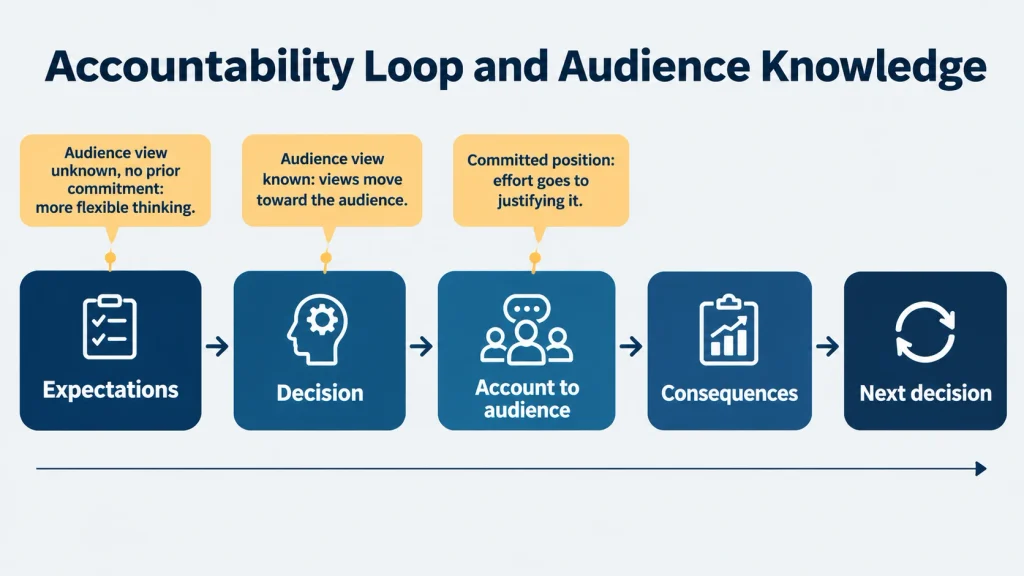
Accountability changes behavior through an expected evaluation by an audience, backed by consequences. The timing, focus, and intensity of that evaluation change how people think and act. Design choices therefore matter as much as intent.
The mechanism runs in a sequence. A leader sets an expectation. People anticipate an evaluation by an audience whose opinion matters to them. That anticipation changes how they prepare for decisions and explain their reasoning.
The outcome depends on what people know about the audience and whether they have already committed to a position. This sequence is an analytical summary of the next three subsections, not a published model.
Audience Knowledge and Prior Commitment
Tetlock, Skitka, and Boettger (1989) tested how people cope with accountability to an audience. The results supported three patterns.
People accountable to an audience with unknown views, and with no prior commitments, thought in more flexible, multidimensional ways. The authors describe this as preemptive self-criticism. People who knew the audience’s views moved toward them. People committed to a position put most of their effort into justifying it.
A practical inference follows. A leader who announces a preferred answer before a review may receive agreement instead of analysis. A leader who asks only after people have committed may receive defense. This is an inference from one experiment, not a tested leadership finding.
Process Versus Outcome Accountability
Process accountability asks people to explain how they decided. Outcome accountability asks them to explain results. The research does not name a universal winner.
Studies cited in the review show that process accountability does not help equally on every task. De Langhe and colleagues (2011) ran three multiple-cue judgment studies. Process accountability improved judgment quality on simple, linear tasks. That advantage did not carry over to complex, configurational tasks.
Pitesa and Thau (2013) tested financial decisions made with other people’s money. Accountability for the decision process reduced self-serving decisions. It also reduced the negative effects of power.
The review’s authors also warn that an emphasis on outcomes can create a setting where the ends justify the means. That raises the risk of shortcuts and unethical behavior. The warning connects accountability design to ethical leadership.
The SEC compensation recovery rule is an outcome design. It ties consequences to a restated result, not to proven misconduct.
An analytical reading of this mixed evidence is to match the form to the task. Review the reasoning on decisions with ethical or political risk. On complex work, process review showed no proven advantage, so also review results.
Intensity, Stress, and Autonomy
The review identifies accountability as a potential stressor. Several studies it cites generally found a positive association between accountability and job tension. Findings on job satisfaction conflict.
Autonomy changed the picture. Hall and colleagues (2006) ran two studies. In the first, autonomy neutralized the dysfunctional effects of accountability on job tension and job satisfaction. The second repeated the pattern with job satisfaction and emotional exhaustion.
A leader can therefore hold people accountable for results and leave decisions about methods to them. That reading is an inference from these two studies.
Hall and Ferris (2011) found a U-shaped relationship between felt accountability and supervisor-rated contextual (extra-role) performance. A U-shape means performance was lowest at moderate levels.
Accountability and Psychological Safety
Accountability and psychological safety work together. Psychological safety is a shared belief that the team is safe for interpersonal risk-taking. Accountability supplies the standards. Together, they let people admit problems and still meet high expectations.
Amy Edmondson introduced the construct of team psychological safety in a 1999 study. The study covered 51 work teams in a manufacturing company. Psychological safety was associated with learning behavior. Learning behavior mediated the link between psychological safety and team performance.
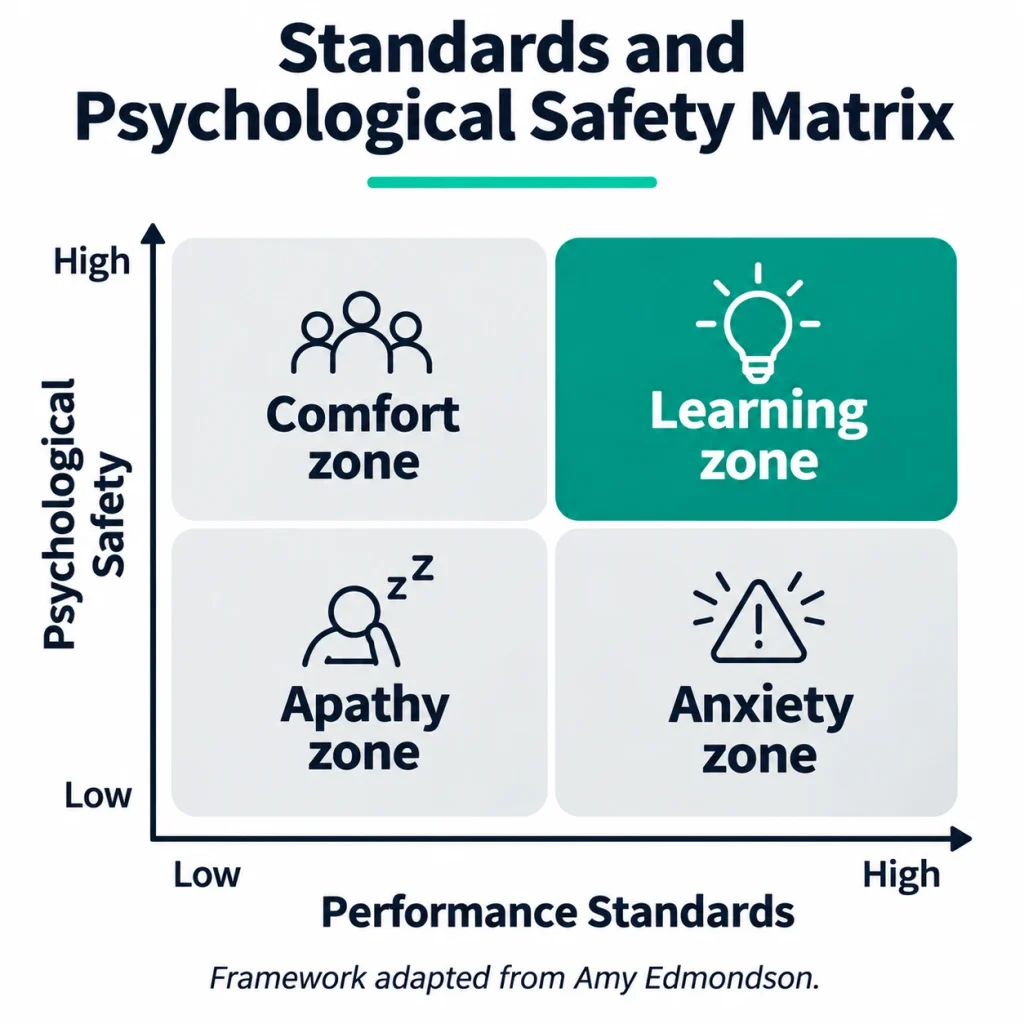
Edmondson later paired psychological safety with performance standards in a four-zone model. It appears in her 2019 presentation for the Lean Enterprise Institute. The model is conceptual, not a test result.
| Low standards | High standards | |
| Low safety | Apathy zone | Anxiety zone |
| High safety | Comfort zone | Learning zone |
In the anxiety zone, people may hide mistakes. In the comfort zone, people feel safe but are not challenged. The learning zone combines high standards with high safety.
The NeuroLeadership Institute authors separate two forms of accountability. In punitive accountability, people who miss expectations are punished and told to do better. In the growth-oriented form, people treat tasks as worthy challenges and setbacks as chances to improve.
This form resembles growth mindset thinking. That comparison is analytical, not a claim by the authors.
The authors name three habits: thinking ahead, owning commitments, and anchoring on solutions. Institute researchers identified them by examining leaders who build accountability in their teams. The framework has not been independently tested in the sources reviewed.
Analytically, safety changes how people respond to an account. Standards give the account its content. Without safety, people may hide problems instead of reporting them. Without standards, there is little to account for.
How to Build Leadership Accountability in Practice
Build accountability by defining exceptional performance, setting routines that make results visible, applying standards consistently, and developing managers. Start with the leader’s own commitments.
- Define exceptional performance for each role. Gallup advises translating organizational purpose into role expectations. Every manager should be able to explain how the team creates customer value.
- Write clear expectations with specificity. Specific goals, dates, and standards leave less room for different readings. The NeuroLeadership Institute notes that leaders may assume expectations are obvious even when people interpret them differently.
- Set a weekly routine. Gallup recommends weekly manager conversations that combine coaching, recognition, priority-setting, and discussion of individual strengths. It says accountability works only when practiced as a regular discipline that is fair, consistent, and tied to performance.
- Apply standards consistently across teams and levels. Gallup lists inconsistent standards as a cause of weak accountability. When teams apply standards unevenly, accountability can seem optional.
- Ask for reasoning before decisions are final. The 1989 experiment suggests this can prompt more complex thinking. Where possible, withhold your preferred answer until the team has given its own.
- Review both process and results. Match the emphasis to the task, as described above.
- Protect autonomy over methods. Set the standard and the checkpoints. Let people decide how to meet them.
- Invest in manager development. Gallup says managers need development and support to hold meaningful performance conversations.
- Include accountability in leadership development. Gallup says accountability can be strengthened through deliberate development and practice.
Consider a hypothetical example. A regional director’s team misses a quarterly target after a supplier delay. One response would ignore the miss. Another would blame the team. An accountable response states the miss, separates controllable causes from external ones, names recovery steps, and sets a review date.
A Review Structure That Applies the Research
The steps above need a regular forum. A review conversation can apply the timing, blame, and autonomy findings in one meeting. This structure is an analytical suggestion, not a tested protocol.
- Ask the owner for their reasoning first. Share your own preferred answer only afterward.
- State the result in plain terms. Hold back any judgment of fault at this stage.
- Separate controllable causes from external ones. Make the controllable causes the agenda.
- Agree what will change, who owns it, and by when. Leave the method to the owner.
- Record the commitment and set the next review date. Open the next meeting with that record.
Consequences, such as recognition or correction, then follow from the record and the agreed standard. The meeting stays focused on the account, so it does not slide into blame.
How to Measure Leadership Accountability
Measure accountability from several viewpoints, not from leaders’ self-reports. Useful measures include manager and employee ratings, engagement data, consistency of standards across teams, and whether commitments are met. No single metric captures accountability.
Gallup suggests looking beyond individual performance metrics to measures of culture. Its examples include engagement data and feedback, manager effectiveness scores, and how consistently managers connect recognition to useful behaviors.
Self-reports are risky. Leaders rated themselves higher than managers did on all seven Gallup competencies. Hall, Frink, and Buckley also note that most people say they feel accountable. They ask whether such answers reflect social desirability.
| Indicator | What it shows | Data source | Basis |
| Ratings of leaders by the managers who report to them | Whether leaders hold everyone responsible | Survey of managers | Gallup’s approach |
| Engagement trend by team | An associated outcome | Engagement survey | Gallup (association only) |
| Review cadence across teams | Whether standards are applied evenly | Calendar or management records | Analytical suggestion from Gallup’s causes |
| Commitment completion rate | Whether leaders keep stated commitments | A shared commitments log | Analytical suggestion |
| Time from a miss to disclosure | Answerability in practice | Project or incident records | Analytical suggestion |
The last three rows are analytical suggestions. No published benchmark exists for them in the sources reviewed.
Limits and Common Mistakes
Accountability fails when it becomes surveillance, blame, or selective enforcement. Research also identifies accountability as a potential stressor. The table lists common mistakes and better practices.
| Mistake | Mechanism | Consequence | Better practice |
| Treating accountability as micromanagement | On a micromanaged team, the boss’s opinion can become the only thing that matters (Gallup, 2020) | Fear, paralysis, dishonesty, and avoided responsibility (Gallup, 2020; practitioner analysis) | Give people autonomy over methods |
| Rewarding outcomes only | Outcome-only focus can make shortcuts attractive | Ethical and quality risk | Review reasoning along with results |
| Applying standards selectively | Inconsistent standards make accountability seem optional | Loss of credibility | Use the same standard across teams and levels |
| Correcting only after failure | Accountability that arrives only after a failure can be read as punishment | Fear and hidden problems (an inference from the safety model) | Build routine coaching and recognition |
Several limits apply to the evidence itself. Hall, Frink, and Buckley note that much of what scholars know about accountability comes from laboratory studies. Survey results, such as Gallup’s, show association, not cause.
Sequence is a practical limit as well. Adding consequences before expectations are clear measures people against a standard they cannot see. Gallup lists unclear expectations as a cause of weak accountability. A sensible order is to clarify expectations, then build review routines, then apply consequences. This order is an analytical inference.
Conclusion
Leadership accountability links expectations, answerability, and consequences. Leaders carry it in three directions: toward their own commitments, their teams, and boards and stakeholders.
Gallup’s 2026 survey shows that leaders and managers rate accountability as the weakest leadership competency. Survey data link a strong accountability rating to higher manager engagement, although they do not prove cause. The research reviewed here shows that design matters. Timing, process versus outcome focus, autonomy, and psychological safety each change how accountability affects people.
Credibility builds through repeated routines and consistent standards. The evidence base on leaders is still thin, so leaders should measure from several viewpoints and avoid strong claims. Gallup and the NeuroLeadership Institute both point to consistency: standards applied evenly, and leaders who follow them.
Accountability becomes real in the conversations where expectations are set and results are reviewed. Knowing the design choices is not enough. Managers also need the skill to run those conversations without sliding into blame. The next step is coaching conversations, which turn these principles into a routine.
Frequently Asked Questions
What are the 5 C’s of leadership accountability?
Published versions differ, so no single standard list exists. Strategy People Culture lists common purpose, clear expectations, communication and alignment, coaching and collaboration, and consequences. ProofHub lists clarity, communication, consistency, courage, and consequences. Both are practitioner checklists, and neither page cites a validation study.
What are examples of leadership accountability?
These examples are illustrative, not documented cases. A leader reports a missed target early, explains the controllable causes, and sets a recovery date. A manager applies the same standard to a top performer and a new hire. A senior executive accepts feedback from direct reports and shares what will change.
Where can I find research on leadership accountability?
Start with Hall, Frink, and Buckley (2017) in the Journal of Organizational Behavior, DOI 10.1002/job.2052. For experiments, see Aleksovska, Schillemans, and Grimmelikhuijsen (2019), an open-access review at DOI 10.30636/jbpa.22.66. For leader-specific evidence, see Melo, Martins, and Pereira (2020) in the Journal of Entrepreneurship Education.
What are the 7 pillars of accountability?
No standard list exists. A 2025 EMS1 article for emergency medical services lists seven: character, unity, learning, tracking, urgency, reputation, and evolution. A US Air Force commentary uses the same “culture” mnemonic. Both are practitioner writing, not research findings.