

Autocratic leadership is a management style where one leader makes decisions alone. The leader sets direction, assigns tasks, and expects compliance without debate. Team members have little or no input into major decisions. This style favors speed and control over collaboration. It works best in high pressure situations that need quick, consistent action. Examples include emergencies, safety critical operations, and crisis management.
What Is Autocratic Leadership?
Autocratic leadership concentrates decision-making power in one person. That leader defines goals, sets rules, and directs how work gets done. Employees carry out instructions rather than help shape them.
The term is often used alongside authoritarian leadership. In practice, most sources treat the two as close synonyms, though authoritarian leadership sometimes implies a harsher, more controlling tone. This article treats autocratic leadership as the broader style, and addresses the harsher end of that spectrum separately later on.
Under autocratic leadership, the leader rarely asks for opinions before deciding. Once a decision is made, the leader expects it to be followed without debate. This creates a clear chain of command, and everyone knows who holds final authority.
The style is not limited to business. It appears in the military, in emergency response, in some family owned companies, and in historical political systems as well. Wherever it appears, the core pattern stays the same. One person decides, and others execute.
Kurt Lewin’s 1939 Research and the Origins of the Style
Psychologist Kurt Lewin, working with Ronald Lippitt and Ralph White, studied leadership styles in 1939. Their research took place at the Child Welfare Research Station, then part of the State University of Iowa, now the University of Iowa. The team observed groups of ten year old boys working on craft and hobby projects under adult leaders.
Each group experienced a different leadership style during the study. One leader acted autocratically, making all decisions and giving direct orders. Another leader acted democratically, involving the boys in decisions. A third leader took a laissez-faire approach, offering minimal direction.
What the Iowa Study Found
The autocratic groups worked steadily, but mainly while the leader stayed in the room. Boys under autocratic leaders showed more hostility and more dependence on the leader. When the leader stepped out, their output dropped sharply and behavior became disorganized.
Democratic groups kept working at a steady pace even without direct supervision. Boys in these groups reported higher satisfaction and showed more initiative on their own. Laissez-faire groups were the least productive and the most confused about what to do next.
Secondary summaries of the study do not fully agree on which group produced the highest raw output. Some describe autocratic groups as more productive overall, while others describe democratic groups that way. The finding researchers cite most consistently is different: democratic groups sustained their effort without supervision, while autocratic groups did not.
Limits and Legacy of the Study
This early study helped establish the vocabulary still used to describe leadership today. It also has real limits. The sample was small, and the setting was a hobby club rather than a workplace. The leaders directed children rather than working professionals, and the main measured outcome was aggressive behavior, not business performance.
Modern organizational research has explored similar questions with adult employees, with mixed results depending on industry and context. The Iowa study remains useful as a starting point for understanding the basic trade off between control and participation. It should not be treated as definitive proof of how autocratic leadership performs in a modern workplace.
Despite its limits, Lewin’s framework left a lasting mark on management theory. Later situational and contingency models built on the same basic question the Iowa study first raised. That question is simple to state. How much control should a leader hold onto, and when should it be shared.
Core Characteristics of Autocratic Leadership
Autocratic leadership has a recognizable set of traits. These traits distinguish it from more participative styles, and they tend to appear together rather than in isolation.
Centralized decision making: the leader holds all meaningful decision authority. Team members are rarely consulted, even on decisions that affect their daily work directly.
One way communication: information flows down from the leader to the team. Feedback moving upward is limited or actively discouraged, and instructions tend to be direct and final.
Close supervision: autocratic leaders monitor work closely and check progress often. They correct mistakes quickly, which reduces errors but can feel intrusive to experienced staff.
Strict rules and procedures: policies come from the leader and apply consistently across the team. Employees are expected to follow them exactly, with little room for exceptions.
Limited delegation: authority stays with the leader rather than spreading through the team. Even routine decisions may need direct approval before moving forward.
Task focus over relationship focus: attention centers on completing work correctly and on time. Building consensus or team relationships is secondary to hitting the standard the leader has set.
Together, these traits create a workplace where direction is clear but participation is minimal. Employees generally know exactly what is expected of them. They rarely know why, unless the leader chooses to explain.
How Centralized Decision-Making Works
Autocratic leadership works through a simple mechanism. Concentrating authority in one person removes the time normally spent on discussion and consensus building. Decisions move directly from judgment to action, without a review cycle.
This speed comes with a trade off. A sense of control over one’s own work is a well documented driver of motivation. When employees lose input into decisions that affect them, their sense of ownership over the outcome tends to fall. Over time, this can reduce discretionary effort, the extra energy people bring beyond the minimum their job requires.
The size of this effect depends heavily on context. Inexperienced employees may welcome clear direction, since it reduces uncertainty about what to do. Experienced professionals often resist the same direction, since it can signal that their expertise is not valued.
Consider two examples. A new hire in a call center is still learning the script and the systems. That person usually benefits from explicit, step by step instructions.
A senior engineer with ten years of experience is working on an ambiguous design problem. That person is far more likely to disengage under the same instructions. The mechanism is identical in both cases. The outcome differs because the starting conditions differ.
Advantages of Autocratic Leadership
Autocratic leadership offers real benefits in the right setting. Its main strengths center on speed, consistency, clarity, and accountability.
Faster decisions: a single decision maker skips the delay of gathering input from a group. This matters most when time pressure is high, such as during equipment failures or safety incidents.
Consistent direction: because one person sets the rules, standards stay uniform across a team. This reduces confusion about expectations and keeps output more predictable week to week.
Clear accountability: responsibility sits with the leader who made the call. When something goes wrong, there is no ambiguity about who owns the decision and its outcome.
Support for inexperienced teams: new or unskilled employees often benefit from explicit instructions. Clear direction can reduce costly mistakes while people are still building skill and confidence.
Fewer decision conflicts: with one clear decision maker, teams spend less time debating direction. This can be useful in fast moving environments where prolonged discussion carries a real cost.
Leadership style is one of the strongest known drivers of team level outcomes. Gallup research finds that managers account for at least 70 percent of the variance in employee engagement scores.
This does not mean autocratic leadership automatically improves engagement. It means how a manager leads has an outsized effect on results, for better or worse. How much control a manager holds onto is part of that.
Disadvantages of Autocratic Leadership
Autocratic leadership carries meaningful costs, especially over time. These costs tend to grow the longer the style is used without adjustment or explanation.
Lower morale: employees who cannot influence decisions that affect their work often feel undervalued. This can lower job satisfaction, even when performance stays technically acceptable on paper.
Reduced innovation: new ideas usually come from the people closest to the daily work. When their input is not welcomed, useful ideas go unheard and problems can persist.
Leader dependency: because decisions stay with one person, the organization becomes fragile. It struggles if that leader is unavailable, makes a poor call, or eventually leaves.
Higher turnover: employees who feel unheard are more likely to look elsewhere. This is especially true when other employers offer more say in decisions that affect their work.
Resistance and conflict: some employees push back against constant top down control. This creates friction between the leader and the team, especially among experienced staff.
Stress and burnout risk: constant close supervision can create a tense environment. Over time, this pressure contributes to stress for the team and the leader alike.
The mechanism behind most of these costs is the same. People generally want some influence over decisions that affect them directly. Removing that influence tends to reduce commitment, even when short term output holds steady for a while.
When Autocratic Leadership Works Best
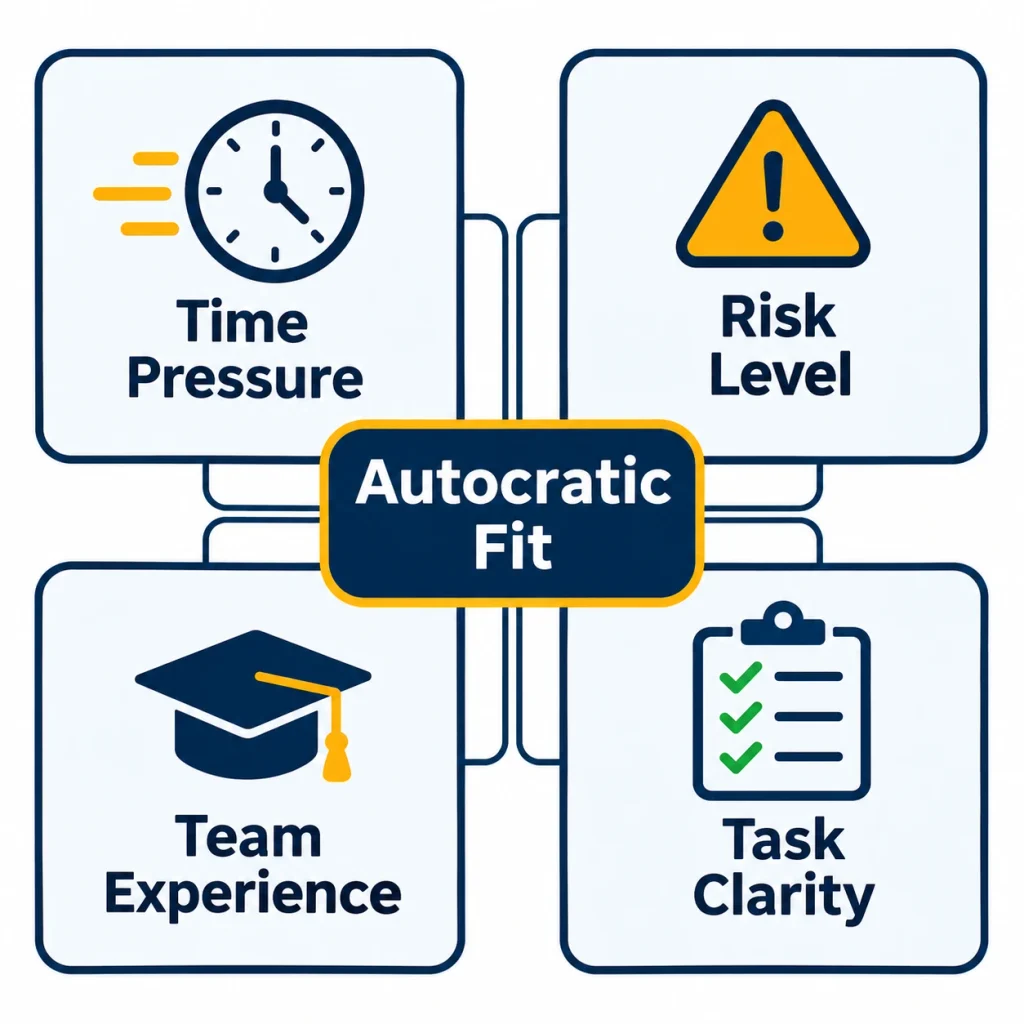
No single leadership style fits every situation. Autocratic leadership fits best when several conditions line up together, rather than when only one applies.
Time pressure is high: decisions must be made quickly, with little room for discussion. Emergencies, safety incidents, and sudden operational failures are common examples.
Risk is significant: mistakes are costly or dangerous, and consistent execution matters more than creative input. Aviation, healthcare emergencies, and heavy manufacturing often fall into this category.
Employees are inexperienced: team members lack the background needed to make informed decisions on their own. Clear instructions reduce errors while skills are still developing.
The task is well defined: the right course of action is already known or highly constrained. There is little value in gathering opinions when the correct answer is not in question.
The organization is in crisis. A company facing a serious threat to survival often needs fast, decisive action instead of extended debate.
When most of these conditions are absent, autocratic leadership tends to cost more than it delivers. A skilled, stable team facing an ambiguous, non urgent problem is usually better served by a more participative style.
These conditions explain why autocratic leadership clusters in specific industries. Military units, air traffic control, emergency medicine, and construction safety programs share this pattern. Each combines high stakes with a need for immediate, unambiguous action.
Outside these settings, the same style often does more harm than good. A common mistake is applying autocratic leadership to routine, low risk choices. This wastes its main advantage, speed, while still paying its full cost in morale.
How It Compares to Other Leadership Styles
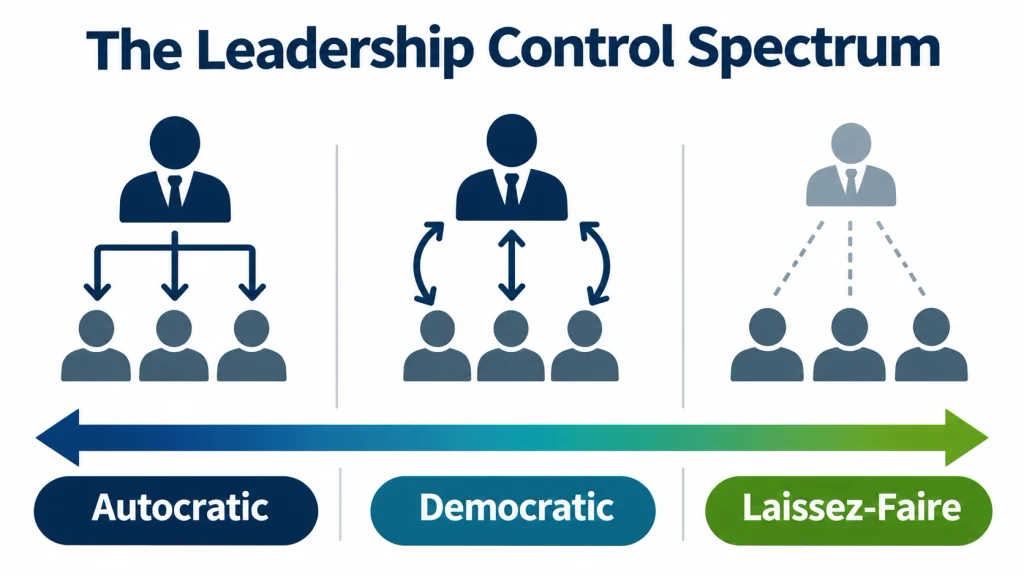
Autocratic leadership is easier to understand next to the styles it differs from. Three comparisons are especially useful for leaders deciding which approach fits their team: democratic leadership, laissez-faire leadership, and transformational leadership.
Autocratic vs Democratic Leadership
Democratic leadership invites team members into the decision process before a final call is made. The leader still owns the final decision, but only after gathering input from the group. This approach tends to produce higher morale and stronger buy in, at the cost of slower decision making. Autocratic leadership trades that input for speed and consistency, which matters more when time is short.
Autocratic vs Laissez-Faire Leadership
Laissez-faire leadership sits at the opposite end of the control spectrum from autocratic leadership. The leader provides minimal direction, and the team manages most decisions on its own. This style can unlock creativity in highly skilled, self motivated teams that already know what good work looks like. It often fails with inexperienced teams that need more structure. That is exactly the setting where autocratic leadership tends to perform better.
Autocratic vs Transformational Leadership
Transformational leadership focuses on inspiring commitment through vision and shared purpose rather than direct control. Transformational leaders still make final calls on major decisions. They invest heavily in motivating genuine buy in rather than demanding compliance. Autocratic leadership can produce faster short term results, particularly under pressure. Transformational leadership tends to build stronger, more durable engagement over the long run.
| Dimension | Autocratic | Democratic | Laissez-Faire |
|---|---|---|---|
| Decision authority | Leader alone | Leader, with team input | Team, with minimal leader input |
| Decision speed | Fast | Moderate | Variable, often slow to start |
| Best team fit | Inexperienced or high risk teams | Stable, moderately experienced teams | Highly skilled, self directed teams |
| Main risk | Low morale, low innovation | Slower decisions under pressure | Lack of direction, drift |
No style on this table is universally correct. Each one solves a different problem. The best leaders learn to recognize which problem they are actually facing before choosing an approach.
Autocratic Leadership vs Toxic Authoritarian Behavior
Autocratic leadership and toxic authoritarian behavior are often confused. They are not the same thing, and the distinction matters for anyone evaluating a leader’s style.
Situational autocratic leadership stays accountable. The leader explains decisions when time allows, takes responsibility for outcomes, and applies rules consistently. Control is used as a tool for a specific purpose, such as safety or speed. It is not used as an end in itself.
Toxic authoritarian behavior lacks these safeguards. The leader uses intimidation or fear rather than clear expectations. Rules apply inconsistently, often based on favoritism. Disagreement is punished rather than heard, even when it is offered respectfully.
A useful test looks at four factors: accountability, reversibility, transparency, and respect. Does the leader answer for outcomes? Can decisions be revisited when they turn out to be wrong? Are reasons given, even briefly? Is dissent met with punishment, or simply overruled?
Leadership that fails most of these tests has likely crossed from directive control into something more damaging.
Consider two managers who both cancel a team’s preferred approach to a project. One explains that a client deadline forced the decision, and commits to revisiting the approach next time.
The other offers no explanation and dismisses questions as insubordination. Both leaders used autocratic control. Only one crossed into toxic territory.
This distinction matters for workplace wellbeing. Teams led with situational control but genuine respect can maintain psychological safety. This is the shared belief that it is safe to speak up. Teams led through fear typically cannot.
Real World Examples of Autocratic Leadership
Two well documented examples show how autocratic leadership plays out in business today.
Steve Jobs led Apple with tight, centralized control over product decisions. According to Walter Isaacson’s biography of Jobs, he was known for rejecting ideas quickly and changing direction without consultation. He also held teams to exacting personal standards.
This approach is widely credited with Apple’s design discipline and its reputation for polish. It also created a demanding, high pressure culture that many employees found difficult.
Elon Musk’s leadership after acquiring Twitter, now X, in 2022 offers a more recent example. Musk made sweeping changes quickly after the acquisition. These included large workforce reductions, the end of remote work policies, and major changes to platform rules. Most of these decisions were made without employee consultation.
The approach allowed rapid change during a period of significant business uncertainty. It also drew sustained public criticism over how the decisions were made and communicated to staff.
Both examples show a similar pattern. Centralized control produced fast, decisive action at a critical moment. Both leaders also faced ongoing criticism about the human cost of that control. This mirrors the trade offs described earlier in this article.
How to Apply Autocratic Leadership Without Damaging Long Term Engagement
Leaders who rely on autocratic leadership can reduce its downsides with a few deliberate practices.
Explain reasoning when time allows: a brief explanation after a decision does not slow execution down. It helps employees understand the logic, even when they were not consulted first.
Reserve it for the right moments: autocratic leadership works best as a tool for specific situations, not a default setting. Leaders who use it constantly tend to see morale drop faster.
Invite input outside urgent moments: a leader can be directive during a crisis and participative during routine planning. This blend protects speed when it matters and buy in when it does not.
Watch for silence as a warning sign: teams that stop offering ideas may have disengaged rather than agreed. Silence under autocratic leadership is not the same as genuine support.
Match the approach to the person. A new employee and a ten year veteran need different levels of direction, even on the same team.
Invest in leadership development: leaders who only know one style struggle when conditions change. Ongoing leadership development helps a leader build range across directive and participative approaches.
Review the approach periodically: a leadership style that fit a crisis six months ago may no longer fit today. Revisiting the choice keeps the style matched to real conditions rather than old habit.
One common mistake is treating autocratic leadership as a personality trait rather than a tool. Leaders who see it as simply who they are rarely adjust it, even when circumstances no longer call for it. Leaders who see it as one option among several tend to use it more effectively. They can switch styles as conditions change.
Conclusion
Autocratic leadership concentrates decision authority in one person. It delivers real advantages, including speed, consistency, and clear accountability, particularly in high pressure or high risk situations. It also carries real costs, including lower morale, reduced innovation, and higher turnover. These costs grow when it becomes a permanent default rather than a situational tool.
The style works best under a few conditions. Time pressure is high, risk is significant, employees are inexperienced, or the right action is already clear.
It works poorly with skilled, experienced teams facing ambiguous, non urgent problems. Leaders get the most value from autocratic leadership when they use it deliberately. Pairing it with more participative approaches once the pressure eases helps even more.
Choosing the right leadership style is rarely a one time decision. It depends on the situation a leader faces at any given moment. The next step for most leaders is learning to match style to context deliberately. This beats defaulting to one approach in every situation.
The situational leadership model offers a practical framework for making that call. It weighs task difficulty and team readiness rather than personal preference alone.
FAQ
Does autocratic leadership work well with remote or hybrid teams?
It tends to work less well. Close supervision is harder to maintain remotely, and one way communication feels more isolating over chat or email than in person. Morale and trust effects also tend to intensify when employees cannot see the reasoning behind a decision in real time.
Is autocratic leadership a good fit for startups?
It is common in the earliest stage, when a founder needs to move fast and the team is small. As a startup scales and hires experienced specialists, the same style often becomes a liability, since skilled hires usually expect more input into decisions.
What personality traits are common among autocratic leaders?
Autocratic leaders often show high confidence, a strong need for control, and low tolerance for ambiguity. These traits are common patterns, not fixed rules. Many effective leaders show some of these traits without leading in a purely autocratic way.
Can autocratic leadership create legal or compliance risk?
The style itself is not illegal. Risk appears when centralized control crosses into harassment, discrimination, unsafe working conditions, or retaliation against employees who raise concerns. Leaders should separate directive decision making from any behavior that could expose the organization to legal liability.
How is autocratic leadership different from micromanagement?
Autocratic leadership is about who holds decision-making authority. Micromanagement is about the intensity of oversight applied to how work gets done. A leader can be autocratic without micromanaging by setting clear direction and then leaving execution details to the team.