
Leadership skills are the specific, learnable abilities a person uses to guide a team, make sound decisions, and help others perform at a higher level. They include communication, emotional intelligence, decision-making, delegation, and the capacity to lead change. Unlike personality traits, leadership skills are built through practice, feedback, and experience. Any professional, not only those with a formal title, can strengthen these skills to improve team results and career growth.
What Are Leadership Skills?
Leadership skills are the measurable behaviors and abilities a person uses to guide a team, make sound decisions, and help others perform well. They are different from leadership traits, such as confidence or charisma, which relate more closely to personality. Some traits may come naturally to people. Skills, by contrast, can be practiced, coached, and improved by almost anyone.
This distinction matters because it changes how people approach leadership development. If leadership were purely a trait, only a small group of naturally gifted people could lead effectively. Because leadership is largely a set of skills, most professionals can build real capability through deliberate effort.
Leadership skills apply across roles and levels. A frontline employee coordinating a project uses many of the same skills as a senior executive setting strategy, even though the scale and stakes differ. The management skills used to run daily operations often overlap with leadership skills, but the two are not identical, a distinction explored later in this article.
Understanding leadership skills as learnable capabilities also changes the expected information depth for professionals researching this topic. Readers typically want a clear definition, a practical list of the most important skills, and a path for building them, which is the structure this article follows.
Why Leadership Skills Matter for Organizations and Careers
Leadership skills matter because the quality of leadership directly shapes how well a team performs, how long employees stay, and how much they trust their organization. This is not a general assumption. It is a pattern confirmed by large scale workplace research.
Gallup’s research on the American workplace found that managers account for at least 70 percent of the variance in employee engagement scores across business units. In practical terms, the difference between a highly engaged team and a disengaged one is explained mostly by who leads that team, not by pay, perks, or company-wide policy alone. This finding has been replicated across industries and company sizes, which gives it unusual weight among workplace statistics.
Leadership capability is also becoming a more urgent organizational priority. Research from DDI’s Global Leadership Forecast found that 83 percent of HR organizations expect the need for new leadership capabilities to increase over the next five years. Flatter organizational structures, faster decision cycles, and continuous technological change are pushing companies to develop leadership skills earlier and more broadly across levels, rather than reserving development for senior executives alone.
Leadership capability also affects outcomes that are harder to measure directly but still consequential, including decision quality and innovation. Teams led by someone who listens to dissenting views and delegates real ownership tend to surface more options before a decision is made, compared with teams where one person controls every choice. This does not guarantee a better outcome in every case, but it widens the range of information available before a decision is finalized.
For individual professionals, leadership skills influence hiring and promotion decisions. Recruiters and hiring managers frequently treat leadership skills as a top differentiator when evaluating candidates for advancement, even in roles that do not carry a formal leadership title. Strong leadership skills also support better day to day outcomes: clearer decisions, more productive meetings, and stronger working relationships.
The organizational and individual cases reinforce each other. Organizations need more people with strong leadership skills, and professionals who build these skills gain a durable advantage in their careers.
The Core Leadership Skills Every Professional Needs
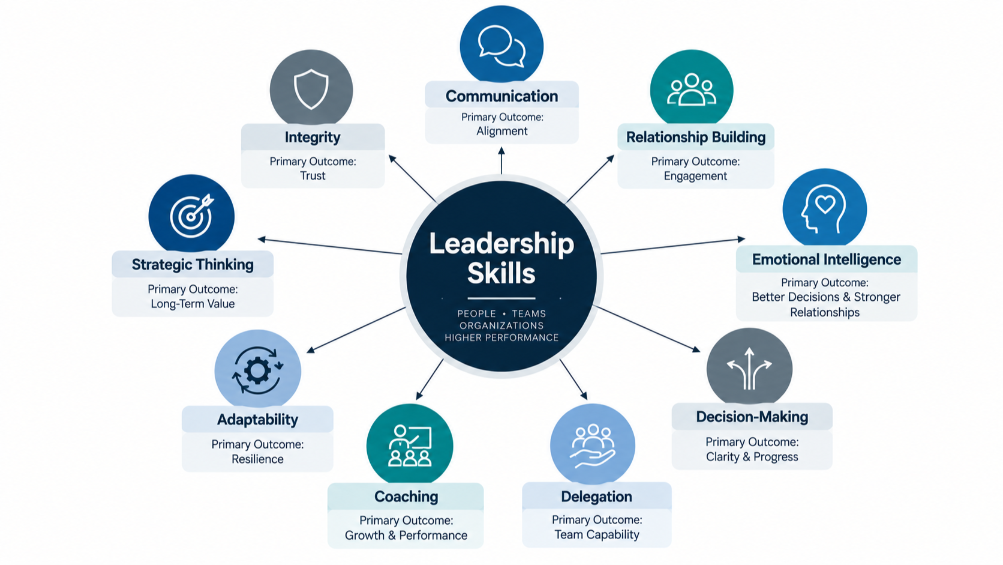
Different research organizations describe slightly different lists of core leadership skills. The Center for Creative Leadership highlights four fundamentals: self-awareness, communication, influence, and learning agility. DDI’s research identifies seven, including emotional intelligence, coaching, and decision-making. Despite the different counts, the same skills reappear consistently across serious research. The following list synthesizes that recurring pattern into nine core leadership skills, explained by what each skill does and why it produces results.
Communication
Communication is the ability to convey information clearly, listen actively, and adjust a message for a specific audience. It matters because unclear communication creates confusion, duplicated work, and missed expectations, while clear communication creates shared understanding quickly.
The mechanism is straightforward. A leader who states expectations clearly, listens for understanding, and confirms alignment reduces the chance of misdirected effort. This same skill supports conflict resolution, since many workplace conflicts stem from a mismatch between what was said and what was understood, rather than from a genuine disagreement in goals.
Communication also shapes trust. Teams that receive clear, honest updates, including about setbacks, tend to trust their leader more than teams that receive vague or inconsistent information.
Remote and hybrid teams raise the stakes on this skill. Without regular in-person contact, a written update or a recorded message often carries more weight than it would in a shared office, since it may be the primary way a leader signals priorities and tone for days at a time. Leaders who write clearly and communicate on a predictable schedule tend to reduce the uncertainty that distributed teams are especially prone to.
Relationship Building
Relationship building is the ability to form and maintain trust-based professional connections with team members, peers, and stakeholders across an organization, not only with direct reports. It matters because a leader’s influence rarely stays confined to their own reporting line, and strong relationships outside a leader’s immediate team often determine how quickly they can gain support for a new initiative or resolve a cross-functional problem.
The mechanism differs slightly from communication. Communication focuses on conveying information clearly in a given moment. Relationship building is cumulative: it grows through consistent, small interactions over time, such as following up on a commitment, remembering context from an earlier conversation, or offering help before it is requested.
Leaders who invest in relationships tend to find it easier to secure buy-in during a change initiative or a difficult decision, since colleagues who already trust them are more likely to extend the benefit of the doubt. This is related to, but distinct from, integrity: integrity earns trust through consistent honesty, while relationship building earns trust through consistent, positive interaction over time.
Emotional Intelligence and Self-Awareness
Emotional intelligence is the ability to recognize and manage one’s own emotions while understanding and responding appropriately to the emotions of others. It includes self-awareness, the capacity to accurately assess one’s own strengths, weaknesses, and impact on others.
This skill matters because leadership decisions are rarely purely technical. A leader who misreads a team’s frustration, or who reacts to pressure with impatience, can damage trust quickly, even when the underlying decision was reasonable. A leader who manages emotional reactions and responds with empathy tends to preserve trust even during difficult conversations.
Self-awareness is the starting point for most other leadership development. Without an accurate view of current strengths and gaps, a professional cannot target the right skills to build.
Technical expertise and emotional intelligence are not substitutes for each other. A leader can be highly skilled in their functional area and still struggle to lead if they cannot read a room, manage their own stress under pressure, or notice when a team member is disengaged. This is one reason organizations that promote based on technical skill alone often see new leaders struggle in their first year.
Decision-Making
Decision-making is the ability to recognize a problem or opportunity, weigh available information and trade-offs, and choose a course of action within a reasonable timeframe. It matters because indecision has a cost. Delayed decisions slow teams down, create uncertainty, and can allow problems to grow.
The mechanism runs from information gathering, to evaluating alternatives against clear criteria, to a timely choice, to monitoring the outcome and adjusting if needed. Leaders who skip the evaluation step tend to make reactive decisions. Leaders who never reach a decision create paralysis. Effective decision-making balances analysis with timeliness.
The right balance depends on the stakes and reversibility of the decision. A low-stakes, easily reversible choice, such as which format to use for a routine report, rarely justifies extended analysis. A high-stakes, difficult to reverse decision, such as a major resourcing shift, usually warrants slower, more structured evaluation. Leaders who apply the same level of scrutiny to every decision tend to waste time on small choices and rush the ones that matter most.
Delegation and Empowerment
Delegation is the practice of assigning tasks and decision-making authority to others, with clear expectations, support, and follow-up. It matters because a leader who tries to control every task personally limits both their own capacity and their team’s growth.
Effective delegation works through a specific mechanism: a leader identifies which decisions genuinely require their direct involvement and which can be owned by someone else, then transfers real authority, not just tasks, along with the context needed to succeed. This frees the leader to focus on higher value priorities while giving team members the chance to build new capability.
Delegation done poorly, such as assigning tasks without authority or context, tends to produce frustration rather than growth. The distinction between task assignment and genuine delegation is one of the more commonly misunderstood parts of this skill.
Deciding what to delegate is itself a skill. Routine, repeatable work is usually the easiest to hand off, since the risk of a poor outcome is low and the learning value for the team member is high. Decisions that carry legal, financial, or reputational risk typically warrant closer involvement from the leader, at least until the person taking on the task has demonstrated sound judgment in lower stakes situations.
Coaching and Developing Others
Coaching and developing others is the ability to help team members build skills and capability through feedback, guidance, and developmental opportunities, rather than simply directing their work. It matters because teams led by leaders who invest in development tend to show stronger engagement and lower turnover.
Research from DDI found that leaders whose managers actively coach them are roughly nine times more likely to trust their manager, compared with leaders who do not receive this kind of coaching. That gap illustrates how directly this single skill affects the relationship between a leader and their team.
The mechanism behind coaching is straightforward: a leader observes performance, gives specific and constructive feedback, and creates opportunities for the person to practice and improve. Over time, this builds both individual capability and organizational depth, since a team is less dependent on any single person when more people are developed.
This connects directly to succession planning. Organizations that struggle to fill leadership roles internally often trace the problem back to a lack of consistent coaching at earlier career stages, not a lack of raw talent. Leaders who coach consistently are, in effect, building the pipeline of future leaders their organization will eventually need.
Adaptability and Change Leadership
Adaptability is the ability to adjust plans, behavior, and strategy in response to changing conditions. Change management is the related, more structured skill of helping a team understand, accept, and implement change successfully.
This skill matters because business conditions rarely stay stable for long. Leaders who cling to a fixed plan despite new information tend to make decisions that no longer fit reality. Leaders who explain the reason for a change clearly, address concerns directly, and support the team through the transition tend to see faster adoption and less resistance.
DDI’s research found that managing change is one of the most critical leadership capabilities organizations need, yet only about a third of leaders report receiving formal development in this area. This gap between importance and preparation makes change leadership one of the more valuable skills for a professional to deliberately build.
Adaptability has a limit worth noting. A leader who changes direction too frequently, without a clear reason communicated to the team, can create the same uncertainty that rigidity does. Genuine adaptability responds to real changes in information or circumstance. It is not the same as shifting priorities on impulse.
Strategic Thinking and Influence
Strategic thinking is the ability to see beyond immediate tasks and connect a team’s daily work to broader organizational goals. Influence is the related ability to move people toward a shared direction without relying solely on formal authority.
This matters most clearly in cross-functional or matrixed environments, where a leader may need cooperation from people who do not report to them. In these situations, the mechanism of influence, building credibility, making a clear and reasoned case, and understanding what matters to the other party, replaces the mechanism of direct authority. Negotiation skills draw on this same foundation, applying it to situations where two parties need to reach a specific agreement rather than simple alignment.
Strategic thinking also helps leaders prioritize. A leader who understands how a project connects to a larger goal can make faster, more consistent trade-off decisions than one who evaluates each request in isolation.
This matters most when resources are limited, which is nearly always the case. A team with a clear sense of strategic priority can decline or postpone lower value requests with confidence. A team without that clarity tends to treat every incoming request as equally urgent, which spreads effort thin and slows progress on the work that matters most.
Integrity and Accountability
Integrity involves making ethical choices and communicating honestly, even in difficult situations. Accountability is the related practice of taking ownership of decisions and their outcomes, rather than assigning blame elsewhere.
This skill matters because trust, once damaged by a perceived lack of integrity, is difficult to rebuild. Leaders who acknowledge mistakes directly and follow through on commitments tend to retain credibility even when outcomes fall short. Leaders who avoid accountability tend to lose credibility quickly, regardless of their technical competence.
Integrity is also foundational to every other skill on this list. Communication, coaching, and delegation all depend on a baseline of trust that integrity helps establish and accountability helps maintain.
This skill is tested most clearly during difficult trade-offs, such as budget cuts or a reorganization. A leader who communicates honestly about the reasoning behind a hard decision, even when the news is unwelcome, tends to preserve more trust than one who avoids the conversation or offers an incomplete explanation.
Leadership Skills vs. Management Skills
Leadership skills and management skills overlap but are not the same. Leadership skills focus on inspiring people toward a shared vision and helping them grow. Management skills focus on planning, organizing, and controlling the processes and resources needed to execute that vision reliably.
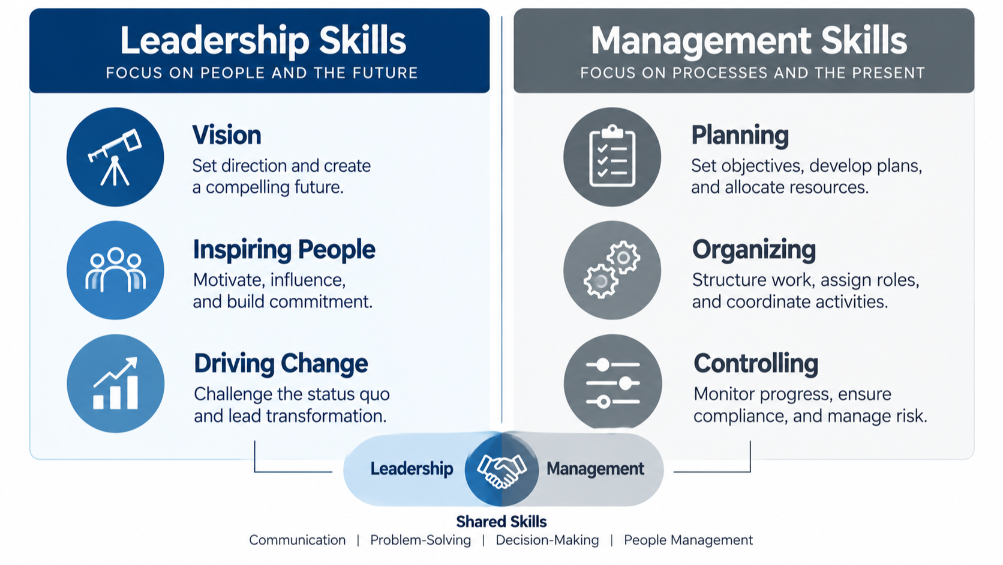
The distinction matters practically. A person can be a highly organized, process-driven manager without necessarily inspiring their team, and a person can be a naturally inspiring leader without having strong operational discipline. The strongest professionals tend to develop both skill sets, since a vision without execution rarely produces results, and execution without direction rarely produces meaningful progress.
The overlap between the two categories is real and worth naming directly. Communication and decision-making, for example, support both leadership and management work, even though the table below separates the two for clarity. The goal of the comparison is not to force every skill into a single category, but to help a professional recognize which type of capability a specific situation calls for.
| Aspect | Leadership Skills | Management Skills |
| Primary focus | Inspiring people toward a shared vision | Coordinating resources and processes |
| Time horizon | Longer term direction and change | Day to day execution |
| Core skill examples | Emotional intelligence, coaching, influence | Planning, budgeting, process control |
| Source of authority | Voluntary trust and credibility | Formal position and role |
| Typical outcome | Engagement, innovation, change adoption | Consistency, efficiency, predictable results |
Neither set of skills is inherently more valuable. Organizations need both, and most experienced professionals build a working combination of the two rather than specializing exclusively in one.
How to Develop and Improve Leadership Skills
Leadership skills develop through structured, repeated practice rather than passive learning alone. Reading about communication or watching a video on delegation can build awareness, but skill only grows when a person applies it, receives feedback, and adjusts.
Assess Your Current Strengths and Gaps
Development starts with an honest, specific view of current ability. 360-degree feedback, a process that gathers input from peers, direct reports, and supervisors, gives a more complete picture than self-assessment alone, since it surfaces blind spots a person cannot see from their own perspective.
A useful assessment goes beyond a general sense of “I should communicate better” and identifies specific situations, such as how clearly expectations were set during a recent project, or how effectively a difficult conversation was handled.
Seek Regular Feedback and Coaching
One-time assessment is not enough. Ongoing feedback from managers, peers, and mentors helps a professional see how their behavior is landing in real time, rather than only during a formal review cycle.
Specific, behavior-based questions tend to produce more useful feedback than general ones. Asking “how clearly did I communicate the goals for this project” produces more actionable input than asking “how am I doing as a leader.”
Apply the 70-20-10 Development Model
The 70-20-10 model, developed by researchers at the Center for Creative Leadership based on decades of study into how executives actually learn, offers a practical structure for leadership development. The model suggests that roughly 70 percent of leadership capability develops through challenging, on the job experience, 20 percent through coaching, feedback, and learning from others, and 10 percent through formal coursework or training.
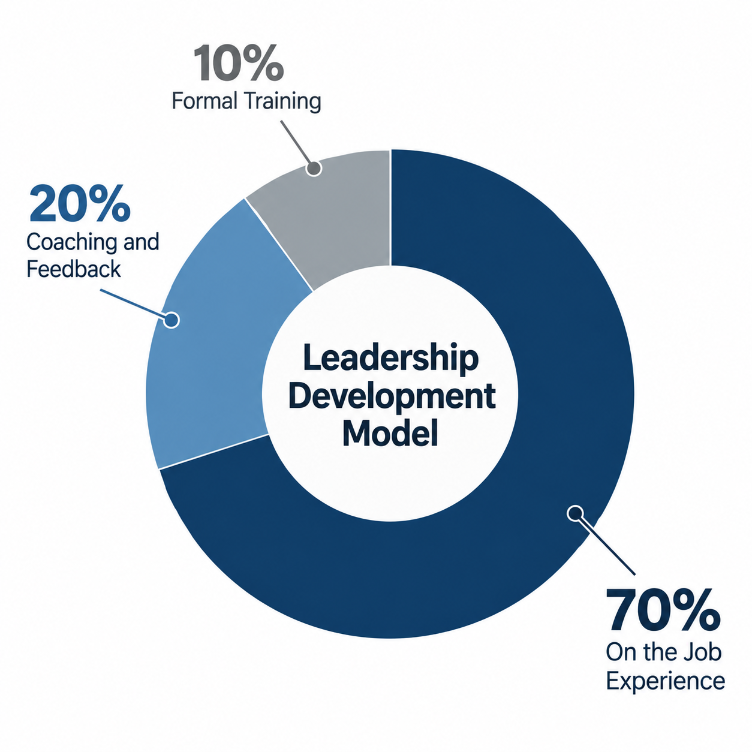
This framework helps explain why classroom training alone rarely produces lasting behavior change. A professional who wants to build decision-making skill, for example, benefits far more from making real decisions and reviewing the outcomes than from a workshop alone, though the workshop can still provide useful concepts and language.
Practice Through Stretch Assignments
A stretch assignment is a task or project that extends slightly beyond a person’s current comfort zone or proven ability. These assignments create the on the job experience that the 70-20-10 model identifies as the largest source of leadership growth.
Useful stretch assignments might include leading a cross-functional project, presenting a recommendation directly to senior leaders, or managing a team through an unfamiliar type of change. The value comes from the combination of real stakes and the chance to apply a specific skill under pressure.
Calibrating the difficulty matters. An assignment that is too far beyond current ability can produce a failure severe enough to undermine confidence rather than build skill. An assignment with no real stretch produces little growth at all. The most useful assignments sit close to the edge of current capability, with enough support available that a struggle is likely but a serious failure is not.
Build a Long-Term Development Habit
Leadership skill development works best as an ongoing habit rather than a one time initiative. Professionals who set specific, time bound goals, such as improving how they run team meetings over the next quarter, tend to make more visible progress than those pursuing vague, open-ended improvement.
Tracking progress matters as much as setting the goal. Comparing feedback and outcomes over time, rather than relying on a single impression, helps confirm whether a skill is genuinely improving. A combination of measures tends to work best: a quantitative signal where one exists, such as team retention or meeting length, alongside qualitative feedback from the people directly affected by the leader’s behavior.
Common Mistakes That Undermine Leadership Skill Development
Several recurring mistakes slow leadership skill development, even among motivated professionals.
Treating leadership as tied only to job title is one common mistake. Waiting for a formal promotion before practicing leadership skills delays development unnecessarily, since most of these skills, including communication, decision-making, and coaching, can be practiced in any role.
Relying on training alone is another. A workshop can introduce a concept, but without follow-up practice and feedback, the concept rarely translates into a lasting behavior change. This mirrors the imbalance the 70-20-10 model was designed to correct.
Avoiding or ignoring feedback is a third mistake. Some professionals interpret critical feedback as a personal judgment rather than useful data, which leads them to seek it less often. Over time, this creates a growing gap between how a leader believes they are performing and how their team actually experiences their leadership.
Developing skills in isolation from real accountability also limits growth. Practicing decision-making only on low stakes, hypothetical scenarios builds less capability than making real decisions with real consequences and then reviewing what worked and what did not.
A final mistake is assuming a skill transfers automatically from one context to another. A person who communicates well with peers does not automatically communicate well when giving direction to former peers who now report to them, since the dynamic and the stakes have changed. Leaders who recognize that a new context requires deliberate adjustment tend to adapt faster than those who assume their existing habits will simply carry over.
Frequently Asked Questions
How can I demonstrate leadership skills in a resume or job interview?
Use specific, measurable examples rather than general claims. Describe a situation where you made a decision, led a project, or developed a team member, and state the result, since concrete examples carry more weight with hiring managers than a general statement like “strong leadership skills.”
How long does it typically take to develop strong leadership skills?
There is no fixed timeline, since it depends on the starting point, the skill, and how consistently a person practices and receives feedback. Meaningful improvement in a specific skill, such as delegation or difficult conversations, is often noticeable within a few months of deliberate practice, while broader leadership capability tends to develop over years of accumulated experience.
Are leadership skills the same as soft skills?
Leadership skills overlap with soft skills but are not identical. Soft skills, such as communication or empathy, are broader interpersonal abilities used in many contexts, while leadership skills apply those and other abilities specifically toward guiding people and achieving shared goals.
Can someone lead effectively without formal authority or a management title?
Yes. Skills such as influence, communication, and strategic thinking allow a person to guide outcomes and align others even without formal decision-making power, which is why leadership skills are often described as valuable for individual contributors, not only for people managers.
What leadership skills do employers prioritize most when hiring or promoting?
Employers frequently prioritize communication, decision-making, and the ability to develop others, since these skills have a direct, visible effect on team performance and are easier to assess through examples during an interview than more abstract qualities like vision.
Can introverts become effective leaders?
Yes. Introversion is a personality trait related to how a person recharges energy, not a leadership skill, and it does not prevent someone from developing strong communication, decision-making, or coaching ability. Many introverted leaders rely on careful listening and one-on-one relationship building rather than high energy public speaking, and both approaches can be effective.
Conclusion
Leadership skills are learnable, measurable capabilities, not fixed personality traits reserved for a select few. Communication, relationship building, emotional intelligence, decision-making, delegation, coaching, adaptability, strategic thinking, and integrity work together to help a person guide others toward shared goals, and each skill produces its effect through a specific, explainable mechanism rather than through vague inspiration alone.
The evidence for investing in these skills is strong. Gallup’s research shows that managers account for the large majority of variance in team engagement, and organizations increasingly expect the need for leadership capability to grow. Professionals who assess their current strengths, seek regular feedback, and apply frameworks like the 70-20-10 model tend to build real, durable leadership capability rather than surface level awareness.
Leadership skills also work alongside, not instead of, management skills. The strongest professionals build a working combination of both, since vision without execution rarely produces results.
Assessing leadership skills honestly is only the first step. Once a clear picture of current strengths and gaps exists, the next step is turning that assessment into a structured, time bound plan. A well built leadership development plan translates the general goal of “becoming a better leader” into specific skills, target behaviors, and a realistic timeline, which is what allows the kind of deliberate practice described in this article to actually take hold.