
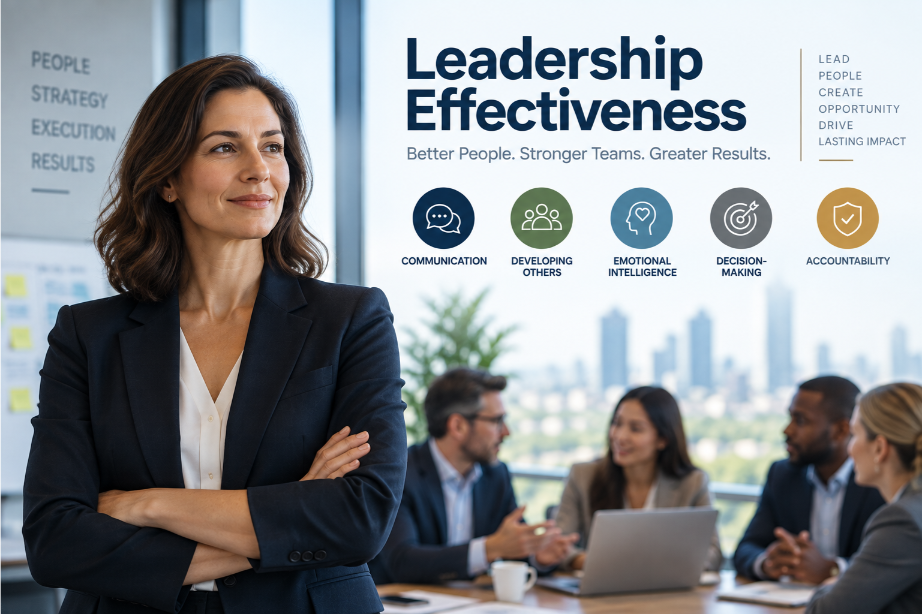
Leadership effectiveness is the degree to which a leader achieves desired results while building a team that is engaged, capable, and able to sustain performance over time. It combines two elements: the outcomes a leader produces and the way those outcomes are produced. A leader can hit short-term targets and still be ineffective if trust, retention, or team capability suffer in the process. Understanding leadership effectiveness matters because it directly shapes engagement, productivity, and long-term organizational health.
For professionals evaluating their own leadership or their organization’s leadership pipeline, the concept is worth separating from related ideas such as authority, seniority, and promotion speed, since these are frequently confused with effectiveness even though they measure different things.
What Is Leadership Effectiveness?
Leadership effectiveness is the measurable ability of a leader to guide people toward shared goals while maintaining their trust, commitment, and performance. It is not the same as authority, popularity, or job title. A person can hold a senior title and still lead ineffectively if their team is confused about priorities, disengaged, or leaving at a high rate.
Effectiveness has two connected parts. The first is results: whether the team meets its goals with the expected quality and speed. The second is process: whether those results come from clear direction, fair treatment, and genuine development of people, rather than from pressure, micromanagement, or unsustainable effort. Both parts matter. A leader who only produces results without building a healthy team is not fully effective, even if short-term numbers look strong.
This two-part definition also explains why leadership effectiveness is harder to judge from the outside than raw performance. A quarterly report shows results. It does not show whether those results came from a team that trusts its leader or from a team that is quietly burning out. Organizations that only look at output risk missing the second half of the picture until turnover or disengagement makes the cost visible.
Leadership Effectiveness vs Leadership Success
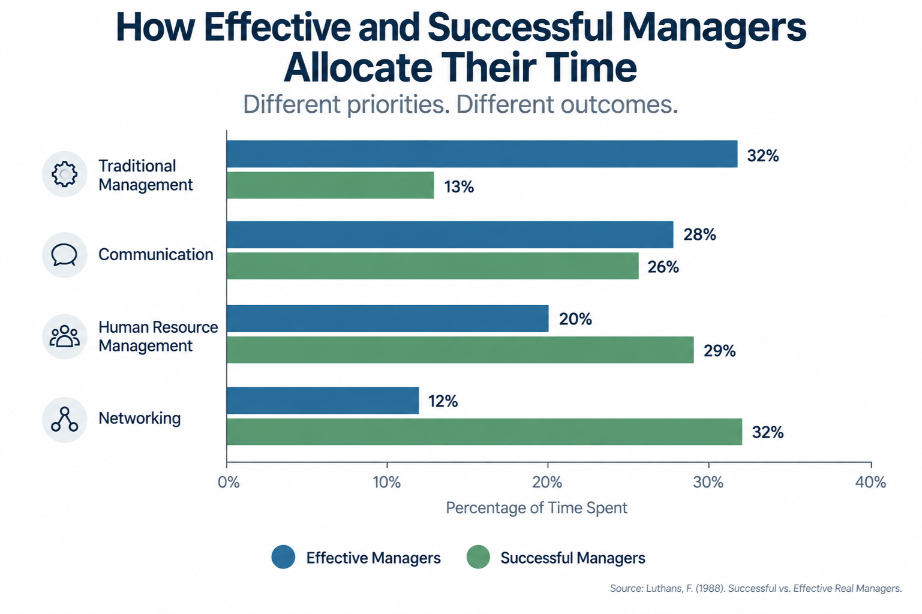
Leadership effectiveness and leadership success are often treated as the same thing. Research suggests they are not. A classic study by Fred Luthans, Richard Hodgetts, and Stuart Rosenkrantz observed more than 450 real managers and tracked how they spent their time across four activities: traditional management, communication, human resource management, and networking.
The researchers found that managers who were promoted quickly, defined as “successful,” spent a large share of their time networking and relatively little time on human resource management. Managers who were rated as effective by their teams, defined by high performance combined with employee satisfaction and commitment, spent most of their time on communication and human resource management instead.
This distinction is useful for leaders and organizations. It suggests that the behaviors that accelerate a career are not always the same behaviors that build a genuinely effective team. Organizations that promote based only on visibility and networking risk elevating people who are successful in career terms but not necessarily effective as leaders of people. Very few managers in the original research scored highly on both dimensions at once, which is a useful reminder that career advancement and team effectiveness need to be evaluated separately rather than assumed to move together.
Why Leadership Effectiveness Matters to Organizations
Leadership effectiveness is one of the strongest known drivers of team performance. Gallup’s research on the American workforce found that managers account for at least 70 percent of the variance in team employee engagement scores across business units. In practical terms, the difference between a highly engaged team and a disengaged one is explained largely by who leads it, not by company policy, compensation, or industry.
This matters because engagement is connected to outcomes organizations already track. Gallup and other workplace researchers have linked higher engagement to better customer ratings, higher productivity, fewer quality defects, and lower turnover. When leadership effectiveness is low, these downstream costs tend to show up gradually, through slower execution, higher attrition, and weaker collaboration, rather than through a single visible failure. This gradual pattern is part of why ineffective leadership can persist for a long time before it is addressed: the damage accumulates quietly instead of triggering an obvious alarm.
Leadership effectiveness also affects succession planning. Organizations that track effectiveness, not just output or seniority, make better decisions about who is ready for larger roles. Without this data, promotion decisions tend to reward visibility and self-promotion rather than the ability to lead people well, which reinforces the effectiveness and success gap described above.
At an organizational level, leadership effectiveness functions as a multiplier. A skilled individual contributor affects their own output. A skilled leader affects the output, engagement, and retention of everyone on their team, and often shapes how those team members lead others later in their careers. This is why organizations that invest in leadership effectiveness tend to see the return compound across the reporting structure rather than stay contained to one role.
Turnover is one of the clearest financial signals of this multiplier effect. Losing an employee involves recruiting, onboarding, and lost productivity while a replacement ramps up, costs that recur every time a team member leaves. Since manager quality is so closely tied to engagement, and disengagement is a leading predictor of voluntary turnover, ineffective leadership tends to show up on the balance sheet indirectly, through repeated hiring and ramp-up costs, well before it shows up as an explicit line item labeled “leadership.”
Core Components of Effective Leadership
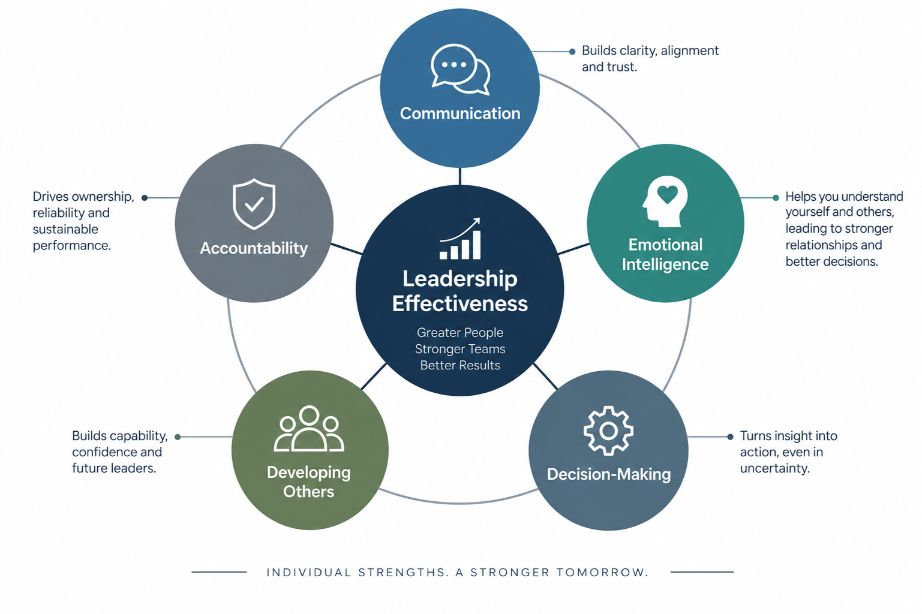
Effective leadership is built from a small number of interconnected components. Each one influences how a leader is experienced by their team, and each has a mechanism that connects the behavior to a business outcome.
Communication and Clear Expectations
Effective leaders explain what needs to happen, why it matters, and what success looks like. Unclear expectations force employees to guess at priorities, which slows decisions and increases errors. Clear, consistent communication reduces this friction and gives people the information they need to act independently, which is a major driver of both speed and trust.
This matters most during periods of change or ambiguity, when employees have the least context to fill gaps on their own. A leader who over-communicates during a reorganization or a shifting deadline will generally see less anxiety and fewer mistakes than one who assumes people will figure it out. The mechanism is simple: uncertainty consumes mental energy that would otherwise go toward the work itself.
Emotional Intelligence and Self-Awareness
Emotional intelligence is the ability to recognize and manage one’s own emotions and to read and respond appropriately to the emotions of others. It is usually broken into four connected components: self-awareness, or recognizing one’s own emotional patterns; self-management, or regulating those emotions productively under pressure; social awareness, or accurately reading the emotions and needs of others, often described as empathy; and relationship management, or using that awareness to build trust and resolve conflict. Each component builds on the one before it, which is why self-awareness is typically treated as the foundation.
The Center for Creative Leadership, a long-established leadership research organization, has found that empathy specifically, one part of social awareness, is positively related to job performance, and that managers who show more empathy toward direct reports are rated by their own bosses as better performers. This is a useful, concrete example of how an emotional intelligence component translates into a measurable outcome rather than remaining an abstract trait.
Self-awareness deserves particular attention because it is also where leaders most often misjudge themselves. Research by organizational psychologist Tasha Eurich found that while most people believe they are self-aware, only a small fraction, roughly 10 to 15 percent in her studies, actually meet the criteria for genuine self-awareness. This gap matters for leaders specifically, because inaccurate self-perception makes it harder to interpret feedback correctly, correct blind spots, or recognize how one’s own behavior affects the team. A leader who believes they are approachable but is consistently described by their team as intimidating will keep behaving the same way until that gap is surfaced through honest feedback.
Sound Decision-Making
Effective leaders make timely decisions with the information available, rather than waiting for certainty that rarely arrives. This does not mean rushing every decision. It means matching the speed and rigor of a decision to its actual stakes, reserving careful analysis for high-impact choices and moving quickly on lower-stakes ones.
Leaders who apply the same level of caution to every decision, regardless of stakes, create bottlenecks that slow their entire team. Leaders who move quickly on everything create instability. Effectiveness in this area comes from correctly sorting decisions by consequence, not from being naturally fast or naturally cautious.
Developing Other People
Leadership effectiveness includes the ability to grow the people being led, not just direct their current output. Leaders who invest in coaching, delegation, and skill building create teams that can operate with less oversight over time. This is one of the clearest differences between the “effective” managers and “successful” managers identified in the Luthans research, since human resource management activities were far more central to the effective group.
Developing others also has a compounding effect on capacity. A leader who never delegates or trains anyone remains a bottleneck for every decision that touches their team. A leader who consistently builds capability in others gradually frees up their own time for higher-level priorities, while also creating a stronger internal pipeline for future roles.
Accountability and Follow-Through
Effective leaders hold themselves and their teams accountable for commitments. This includes following up on agreed actions, giving direct feedback when performance falls short, and modeling the standards they expect from others. Without follow-through, clear expectations lose their weight, because people learn that deadlines and standards are negotiable.
Accountability works in both directions. Leaders who hold their teams to standards but exempt themselves from the same standards tend to lose credibility quickly. Consistency between what a leader expects and what a leader actually does is one of the fastest ways trust is either built or broken.
How Leadership Effectiveness Is Measured
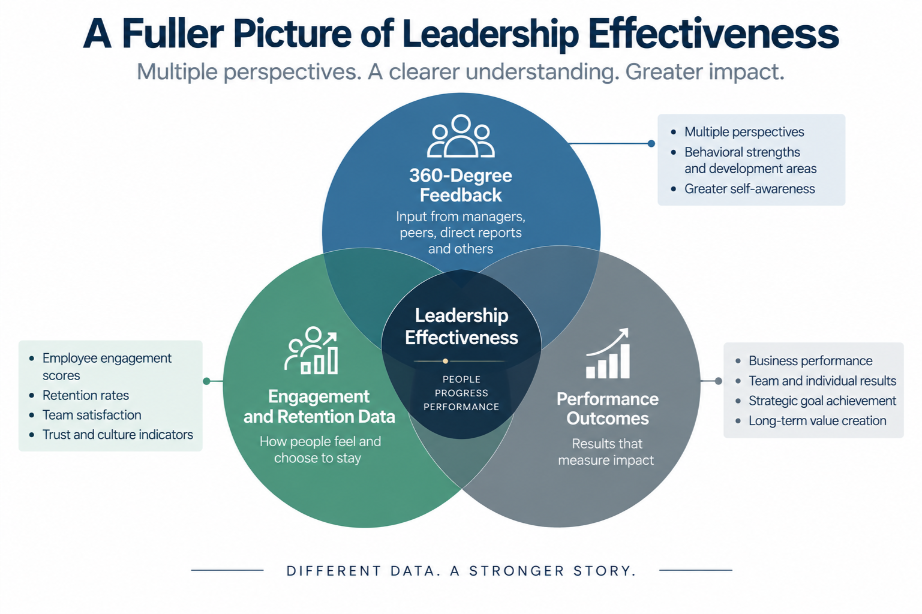
Leadership effectiveness is rarely captured by a single number. Organizations typically combine several measurement methods, each of which captures a different part of the picture, because relying on only one source tends to produce a distorted view.
360-Degree Feedback
360-degree feedback collects input from a leader’s manager, peers, and direct reports, along with the leader’s own self-assessment. This method is useful because it reveals gaps between how a leader sees themselves and how others experience them, which is often where the most useful development insight is found. Its main limitation is that a single assessment is only a snapshot; it becomes far more useful when repeated over time alongside coaching and follow-up action, since a lone data point cannot show whether behavior has actually changed.
Engagement and Retention Data
Team-level employee engagement survey results and voluntary turnover rates are strong indirect indicators of leadership effectiveness, since Gallup’s research links manager quality so closely to engagement variance. A consistent pattern of low engagement or high turnover on a specific team, especially when other teams in the same organization do not show the same pattern, points toward leadership as a contributing factor rather than an industry-wide or company-wide trend.
Performance and Business Outcomes
Team-level performance data, such as project completion rates, quality metrics, and customer satisfaction scores, shows the results side of effectiveness. These metrics should be read alongside engagement and feedback data rather than alone, since a team can hit short-term performance targets under a leader who is damaging trust or burning out employees in ways that will surface later, often after that leader has already moved to a new role.
| Method | What It Measures | Key Strength | Key Limitation |
| 360-degree feedback | Perceived leadership behavior from multiple perspectives | Reveals blind spots and self-perception gaps | Point-in-time snapshot; needs repetition to show change |
| Engagement and retention data | Team experience and commitment over time | Strong link to business outcomes | Influenced by factors beyond the individual leader |
| Performance and business outcomes | Results the team produces | Directly tied to organizational goals | Can look strong short term even under poor leadership |
How Leadership Effectiveness Changes Across Organizational Levels
The core components of leadership effectiveness stay the same at every level, but the behaviors that matter most shift as scope of responsibility grows. Understanding this shift matters for how effectiveness is coached, expected, and measured at different points in a career.
Front-line leaders, who supervise individual contributors directly, are judged heavily on day-to-day communication, task clarity, and timely feedback, because their team’s output depends on decisions made in the moment. Mid-level leaders, who typically manage other managers or coordinate across functions, are judged more on translating strategy into workable priorities and managing handoffs between teams, since their impact on results becomes more indirect. Senior and executive leaders are judged largely on vision-setting, resource allocation, and the effectiveness of the leaders they develop underneath them, rather than on direct supervision of individual output.
This progression explains a pattern organizations frequently encounter: a strong front-line leader promoted into a senior role does not automatically remain effective, because the behaviors that made them effective at close supervision are not the same behaviors that make someone effective at developing other leaders and setting direction at scale. An executive’s effectiveness is partly a function of how effectively the leaders below them lead their own teams, which means senior leadership effectiveness cannot be evaluated using the same criteria applied to a first-time manager. Organizations that apply one fixed effectiveness standard across every level often misjudge both new managers, who are held to strategic expectations too early, and senior leaders, whose actual leverage point, developing other leaders, goes unmeasured.
What Causes Leadership Ineffectiveness
Leadership ineffectiveness usually develops gradually rather than appearing as a single obvious failure. A few patterns explain most cases.
The most common cause is a mismatch between self-perception and reality. A leader who believes they communicate clearly, but whose team consistently reports confusion, will keep repeating the same behavior because they do not see it as a problem. This connects directly to the self-awareness gap described earlier: without accurate feedback, leaders cannot identify what to change.
A second common cause is prioritizing short-term output over team capability. Leaders under pressure sometimes take over tasks themselves rather than developing their team to handle them, which produces faster results in the moment but leaves the team less capable and more dependent over time. This mirrors the Luthans finding that managers who focus heavily on traditional management and control, rather than communication and people development, tend to be less effective even when they appear busy and in control.
A third cause is inconsistency between stated expectations and actual behavior. When a leader says accountability matters but does not follow through on missed commitments, or says feedback is welcome but reacts poorly to it, employees learn to trust actions over words. This erodes the clarity and trust that effective leadership depends on.
A fourth cause, less discussed than the others, is applying one leadership approach regardless of the situation. A leader who succeeded early in their career with a highly directive style may keep using that style after being promoted to lead a more experienced team that needs autonomy instead of instruction. The approach that once worked becomes a limitation once the context changes, and the leader may not recognize the shift because the old approach is familiar and comfortable.
How Leaders Can Improve Their Effectiveness
Leadership effectiveness is not fixed. It can be improved through deliberate practice, feedback, and structured support, though it rarely improves through good intentions alone.
Building Accurate Self-Awareness
Because self-perception is often inaccurate, the most reliable starting point is structured external feedback rather than self-reflection alone. Regular 360-degree feedback, paired with specific follow-up questions to direct reports, gives leaders a more accurate picture of how their behavior is actually experienced. The goal is not to collect praise but to identify the one or two behaviors most worth changing.
Adapting to the Situation
Effective leaders adjust their approach based on the team’s experience level, the urgency of the situation, and the complexity of the task. A new team facing an unfamiliar problem generally needs more direction and structure, while an experienced, high-performing team usually needs more autonomy and less oversight. Applying the same approach regardless of context is a common reason effectiveness declines as circumstances change, as noted above, and reviewing that fit periodically, not just once, keeps a leader’s approach aligned with a team that is itself evolving.
Using Coaching and Structured Development
Executive coaching and formal leadership development programs give leaders a structured way to practice new behaviors, receive ongoing feedback, and be held accountable for changes over time. A single feedback report or workshop rarely changes behavior on its own. Sustained improvement typically requires feedback, practice, and follow-up spread across several months, supported by a coach, mentor, or manager who reinforces the change and helps the leader notice when old patterns resurface under pressure.
Does Leadership Style Determine Effectiveness?
Leadership style influences effectiveness, but no single style is effective in every situation. This idea has a name in leadership research: situational leadership, the principle that the right leadership approach depends on the readiness and experience of the people being led, not on a leader’s fixed personal preference. Transformational leadership, which focuses on vision, inspiration, and developing people, tends to perform well in situations involving change, innovation, or teams that need direction and motivation. Transactional leadership, which focuses on clear structure, defined roles, and performance based rewards, tends to perform well in stable, process-driven environments where consistency matters most.
| Factor | Transformational Leadership | Transactional Leadership |
| Primary focus | Vision, inspiration, and development | Structure, roles, and rewards |
| Best fit | Change, innovation, ambiguous problems | Stable, process-driven environments |
| Risk if overused | Lack of structure or follow-through | Rigidity and low engagement over time |
The relevant factor is fit between style and context, not the inherent superiority of one style. A leader using a highly directive, transactional approach with an experienced, autonomous team may reduce engagement and slow decision-making. The same leader using that approach during a crisis that requires fast, coordinated action may be exactly what the situation needs. Leadership effectiveness, in this sense, depends partly on a leader’s ability to recognize what a given situation requires and adjust accordingly, which connects back to the change management skills leaders draw on during periods of organizational transition.
Frequently Asked Questions
What is the difference between leadership effectiveness and leadership potential?
Leadership effectiveness measures how well someone is currently performing in a leadership role, based on results and team experience. Leadership potential is a forward-looking estimate of how well someone might perform in a future, typically larger, role. A person can show strong potential without yet being effective, and an effective leader in one role does not automatically have high potential for a very different one.
Are effective leaders born or made?
Most current leadership research treats this as a false choice rather than an either-or question. Some inherited traits, such as certain temperament and personality tendencies, are associated with leadership emergence, but the specific skills that drive effectiveness, such as communication, self-awareness, and decision-making, are behaviors that can be learned and improved through feedback and practice. In practice, this means natural tendencies may make leadership come more easily to some people, but effectiveness itself is built rather than fixed at birth.
Is leadership effectiveness the same as management effectiveness?
They overlap but are not identical. Leadership effectiveness is typically associated with setting direction, inspiring commitment, and navigating change, while management effectiveness is typically associated with planning, organizing, and controlling processes to keep operations running smoothly. Many roles require both, and a person can be strong in one area while still developing the other.
Does being well liked make a leader effective?
Being well liked can support effectiveness, but it is not the same thing. Some effective leaders are respected rather than universally liked, particularly when they hold people accountable or make unpopular but necessary decisions. Leaders who prioritize being liked over giving honest feedback often struggle with the accountability component of effectiveness.
How long does it typically take to improve leadership effectiveness?
Meaningful improvement in leadership effectiveness typically takes several months rather than weeks, since it depends on repeated feedback, practice, and follow-up rather than a single training event. Organizations using structured coaching programs often plan for a minimum of two to three quarters before expecting measurable change in feedback scores or team outcomes.
Does leadership effectiveness look different for remote and hybrid teams?
The core components of effectiveness stay the same, but the visible behaviors often change. Remote and hybrid leaders generally need to be more deliberate about communication, since informal, in-person cues are largely absent, and they need clearer systems for tracking commitments since casual hallway follow-ups are not available.
Can one single assessment measure leadership effectiveness accurately?
No single assessment is considered sufficient on its own. Feedback tools such as 360-degree assessments, engagement data, and performance outcomes each capture a different part of leadership effectiveness, and combining them gives a far more accurate picture than relying on any one source alone.
Conclusion
Leadership effectiveness is the combination of the results a leader produces and the way those results are produced, measured through team performance, engagement, and honest feedback rather than title or promotion speed. It depends on a small set of connected components: clear communication, emotional intelligence, sound decisions, developing others, and consistent accountability. Research consistently shows that manager quality is one of the strongest predictors of team engagement, and that self-awareness gaps are one of the most common barriers to improvement.
No leader is equally effective in every context. The leaders who sustain effectiveness over time are the ones who seek accurate feedback, adjust their approach to fit the situation, and treat development as an ongoing practice rather than a one-time achievement.
Once a leader understands what effectiveness requires and where their own gaps are, the natural next step is turning that understanding into a plan. Structured leadership development translates individual feedback and self-awareness into a defined set of skills to build, practiced over time with accountability built in, which is what turns awareness of a gap into a measurable improvement in how a leader actually performs.