
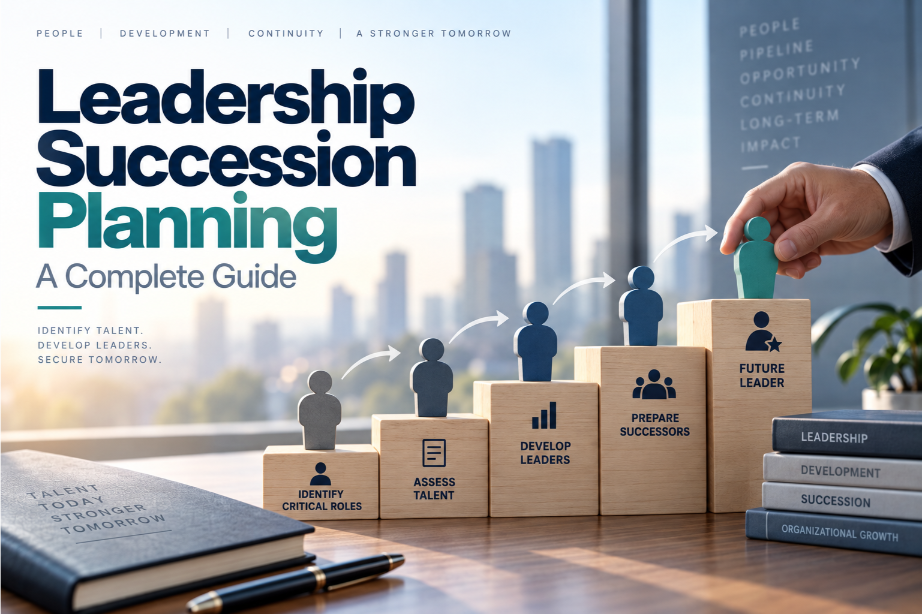
Leadership succession planning is the structured process of identifying and developing employees who can step into key leadership roles when current leaders retire, resign, or leave unexpectedly. It protects an organization from disruption during leadership transitions. Unlike simple replacement planning, succession planning builds a pipeline of prepared candidates over time. Executives and boards use it to reduce risk, retain talent, and keep strategy on track when leadership changes.
What Is Leadership Succession Planning?
Leadership succession planning is a deliberate process that identifies critical leadership roles, evaluates internal talent against those roles, and prepares selected employees to take over when a transition happens. It applies to the CEO, senior executives, and other roles where a vacancy would create significant risk. The goal is readiness, not just a name on a list.
A complete succession plan usually includes five connected parts.
Critical role identification comes first. Organizations map which positions carry outsized influence over strategy, operations, or client relationships. Not every role needs a formal succession plan. The focus stays on roles where an unfilled vacancy would create real damage.
Success profiles come next. A success profile describes the skills, experience, and leadership behaviors a role will require in the future, not just today. This distinction matters because business needs change faster than most leadership tenures.
Talent assessment follows. HR and senior leaders evaluate current employees against those success profiles, using performance data, feedback, and structured reviews rather than instinct alone.
Development planning turns assessment into action. Candidates receive stretch assignments, mentoring, or leadership development experiences designed to close specific capability gaps.
Readiness tracking closes the loop. Most organizations classify candidates as ready now, ready in one to two years, or ready in three or more years. This classification tells the board or executive team how exposed the organization is if a transition happens tomorrow.
Why Leadership Succession Planning Matters
Leadership succession planning matters because leadership transitions are frequent, costly when mishandled, and increasingly visible to investors and employees. When a key leader leaves without a prepared successor, the organization loses momentum, institutional knowledge, and sometimes strategic direction.
The scale of the problem is well documented. Challenger, Gray & Christmas tracked 446 CEO exits among United States publicly traded companies in 2025, the highest annual total since it began tracking this data in 2002. Korn Ferry’s 2025 CEO Succession Study found that boards were unprepared for roughly one in four CEO successions, with successors identified only after the departure in many of those cases. PwC has reported that CEO succession rates in the Russell 3000 held near 11 percent even as turnover increased among the largest public companies in 2025.
The gap is not limited to public companies. A SHRM survey found that 56 percent of HR professionals said their organization had no succession plan in place, and only 21 percent had a formal plan. The remaining organizations relied on informal, undocumented approaches that rarely hold up under real pressure.
This gap carries a direct cost. Unplanned transitions often force organizations into interim leadership arrangements, rushed external searches, or promotions made without adequate vetting. Each of these choices increases the odds of a mismatch between the new leader and the role. The organization can also lose institutional knowledge and strategic momentum while the gap persists, since a new leader typically needs time to rebuild the relationships and context the departing leader carried.
Boards and executives who invest in succession planning report a different experience. Preparedness lets an organization respond to a departure in days rather than months, keeping strategic priorities and stakeholder confidence intact.
Succession Planning vs Replacement Planning vs Talent Management
Leadership succession planning, replacement planning, and talent management are related but distinct. Confusing them leads organizations to build the wrong process for their actual risk.
Replacement planning is reactive. It identifies a single backup name for a specific role, usually without a development plan behind it. Succession planning is proactive. It builds a pool of several developing candidates for each critical role, backed by structured development. Talent management is the broadest term. It covers the full system of attracting, developing, and retaining employees, of which succession planning is one focused application.
| Dimension | Replacement Planning | Leadership Succession Planning |
| Orientation | Reactive, activates after a vacancy | Proactive, prepared before a vacancy |
| Candidate pool | Usually one named backup per role | Multiple candidates at varying readiness levels |
| Development investment | Minimal or none | Structured coaching, stretch roles, and training |
| Time horizon | Immediate | One to five years |
| Primary use case | Emergency coverage for a sudden exit | Building sustained leadership capability |
Most mature organizations use both. A talent pipeline built through succession planning provides the long-term bench strength, while a simple replacement chart provides immediate coverage if a leader departs without warning.
The Leadership Succession Planning Process
Building a leadership succession plan follows a consistent sequence, regardless of company size. Each step depends on the one before it, so skipping a step weakens everything that follows.
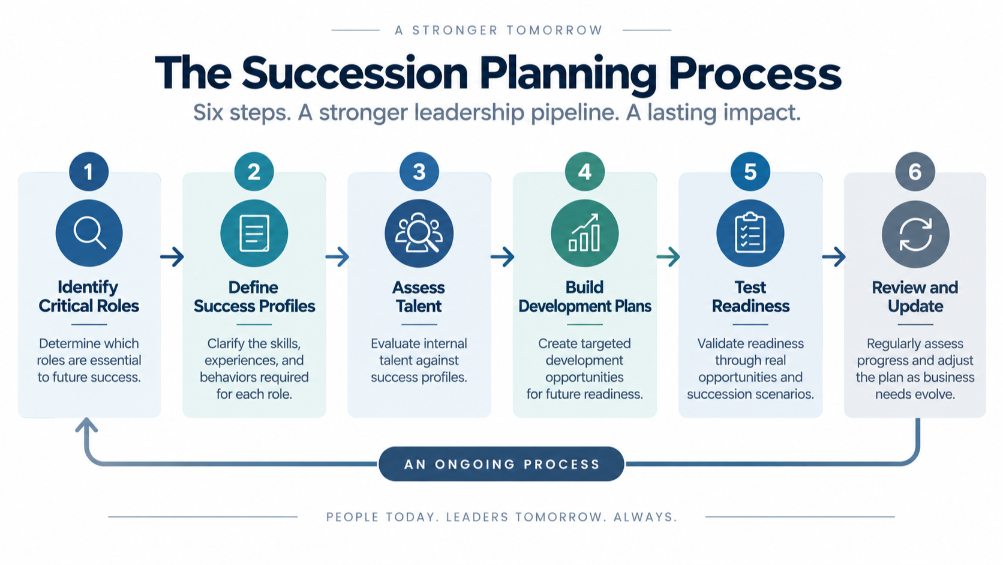
Identify Critical Roles
Start by listing roles where a vacancy would meaningfully disrupt operations, client relationships, or strategy execution. This usually includes the CEO and other C-suite roles, but it can also include specialized technical roles or regional leadership positions that are hard to backfill quickly.
Avoid the common trap of building a succession plan only for the C-suite. A talent pipeline that stops at the top few roles leaves the organization exposed at the level just below it, where most future executives are actually developed. Reviewing the organizational chart for single points of failure, roles held by one person with no obvious backup, is a practical way to surface roles that deserve inclusion.
Define Success Profiles and Competencies
For each critical role, define the competencies, experience, and leadership behaviors the role will require going forward. Base this on where the business is headed, not only on what the current leader does well.
A success profile built around today’s incumbent tends to produce a successor who looks like a copy of that person. A success profile built around future strategy produces a successor equipped for what comes next. This is especially important when a company is entering a new market, adopting new technology, or changing its operating model, since the leadership skills that fit the current environment may not fit the next one.
Assess Talent and Readiness
Evaluate current employees against each success profile using performance reviews, 360-degree feedback, and structured talent reviews. Separate performance, how someone does their current job, from potential, how well they could handle a bigger or different role.
This separation is harder than it sounds. Gallup’s research on succession practices found that only a small share of chief human resources officers at large companies strongly agree their organization is effective at identifying and selecting the right candidates for leadership roles. Building assessment criteria around future demands, not just current output, helps close that gap.
Build Targeted Development Plans
Once candidates are identified, give them development experiences matched to their specific gaps. This can include stretch assignments, cross-functional rotations, formal training, or executive coaching focused on the behaviors the target role demands.
Generic leadership training rarely closes a specific gap. A development plan tied to the actual success profile, and reviewed with the candidate directly, is more likely to produce someone who is genuinely ready when the role opens rather than someone who has simply attended more courses.
Test and Validate Readiness
Before naming someone ready, test the assumption. Give candidates temporary project leadership, board exposure, or acting-role assignments that mirror parts of the target position.
This step catches a common failure mode: a strong individual performer who has not yet demonstrated the judgment or influence a leadership role requires. Testing readiness in a lower-stakes setting protects both the candidate, who avoids being placed in a role before they are prepared, and the organization, which avoids discovering the gap only after the promotion.
Review and Update the Plan Regularly
A succession plan is a living document, not a one-time exercise. Business priorities, organizational structure, and individual readiness all change. Governance research on board practices shows that most companies with formal succession plans review them at least once a year, with many reviewing more often when a transition appears imminent.
Set a fixed review cadence, and revisit the plan immediately after any major strategic shift, reorganization, or unexpected departure. A plan that only gets attention during a crisis has already failed at its primary purpose.
Frameworks and Tools for Succession Planning
Most organizations use one or more structured tools to make succession decisions less subjective. Three tools appear most often across mature succession programs.
The 9-Box Grid
The 9-box grid plots each candidate on two dimensions: current performance and future potential. The result is a 3 by 3 matrix that groups employees into categories such as ready now, developing, or not yet suited for advancement.
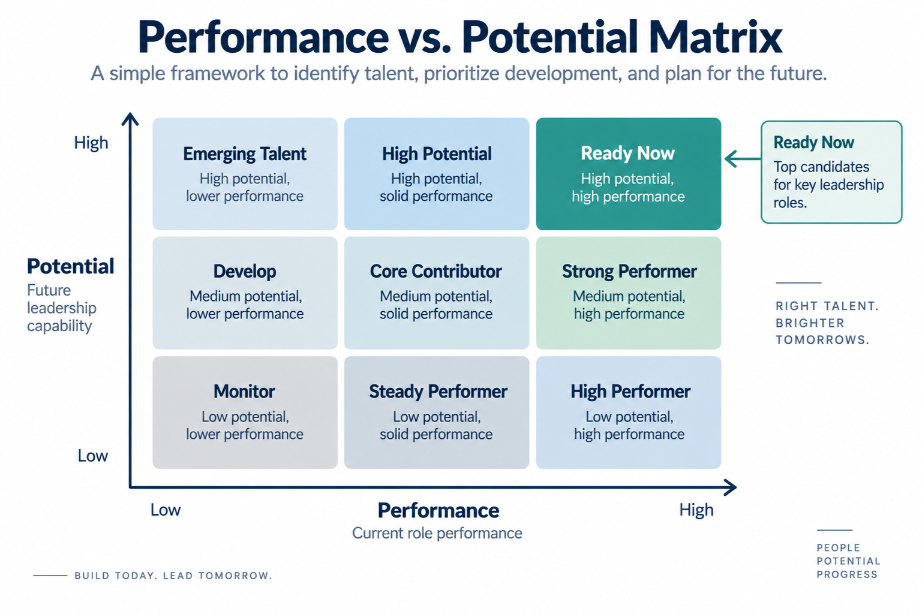
The tool is popular because it forces a structured conversation among leaders rather than relying on a single manager’s private opinion. It also has a well documented limitation. In Gallup’s survey of large-company chief human resources officers, most reported that their organization uses the 9-box grid for succession decisions, but only a small share strongly agreed it was actually effective for their organization. The grid works best as a starting point for structured discussion, not as a final verdict on a candidate’s future. Pairing it with direct conversations about a candidate’s aspirations and documented performance evidence reduces the risk of a purely subjective placement.
Replacement Charts
A replacement chart maps each critical role to one or more named backups and their current readiness level. It is simpler than a full succession plan and works well as an emergency layer underneath a broader succession strategy.
Replacement charts answer a narrow question: who could step in tomorrow. They do not, by themselves, build long-term bench strength, which is why most organizations use them alongside, rather than instead of, a full succession plan.
Talent Pools and Leadership Pipelines
Rather than tying one candidate to one role, a talent pool approach develops a group of high-potential employees who could fill several related roles as they become available. This model gives organizations more flexibility and reduces the risk of losing a strong candidate because the one role they were being groomed for never opened.
Talent pools work particularly well in larger organizations with multiple similar leadership roles across regions or business units, where a candidate ready for one role is often a reasonable fit for a comparable role elsewhere in the company.
CEO and Board-Level Succession Planning
CEO succession is a board responsibility, not solely an HR function. Boards that treat succession planning as an annual governance duty are better positioned to respond calmly when a transition happens, whether planned or sudden.
Governance surveys of corporate secretaries and general counsel show that a majority of boards assign primary succession responsibility to the nominating and governance committee or to the full board, with roughly two-thirds reviewing the plan at least once a year. Most board-level succession plans cover the CEO first, followed by other named executive officers and senior management.
Board involvement changes the nature of the conversation. Directors bring an external, strategic view of what the organization will need in three to five years, which can differ from the internal view held by the departing leader. This outside perspective helps prevent a succession plan built only around continuity with the past.
Corporate governance expectations have also raised the visibility of succession planning. Investors increasingly ask boards direct questions about CEO succession readiness, treating it as a measure of overall board effectiveness rather than a private personnel matter.
Emergency Succession Planning
An emergency succession plan covers a scenario a standard succession plan often overlooks: a sudden, unplanned departure caused by death, illness, or immediate termination. It identifies who takes interim authority the moment a vacancy occurs, before a permanent successor is confirmed.
Every organization, regardless of size, benefits from at least a short, documented emergency succession plan for its top role. Without one, decision-making authority can be unclear for days or weeks at the exact moment clarity matters most. A useful emergency plan names an interim leader, defines what decisions that person can make immediately, and specifies who to notify first.
Common Mistakes in Leadership Succession Planning
Even organizations with a formal succession plan on paper often undermine it in practice. The same mistakes appear across industries and company sizes.
Treating succession planning as a one-time project. A plan built once and never revisited goes stale as the business and its people change. The fix is a fixed annual review, at minimum, tied to a specific calendar date rather than left to whenever someone remembers.
Grooming only one candidate per role. Relying on a single named successor leaves no backup if that person leaves, declines the role, or is not ready when the moment arrives. Building a small pool of two or three candidates per critical role removes this single point of failure.
Overrating strong individual performers too early. Excelling in a current role does not guarantee success in a leadership role, which demands different skills such as influence, judgment under ambiguity, and managing other leaders. Testing readiness through acting assignments before confirming it prevents a promotion built on unproven assumptions.
Selecting successors who resemble the current leader. Leaders sometimes unconsciously favor candidates who share their own style or background. This narrows the pool of ideas and perspectives available during a transition and can leave genuinely qualified candidates overlooked.
Keeping the process entirely confidential. Excessive secrecy prevents candidates from understanding what is expected of them and can cause high-potential employees to leave for a role elsewhere that offers a clearer path forward. At least some level of honest conversation about development and possibility tends to outperform total silence.
Skipping contingency planning. A succession plan built only for a planned retirement leaves the organization exposed to sudden illness, resignation, or termination. Pairing every long-term plan with a documented emergency succession plan closes this gap.
Measuring the Organizational Impact of Succession Planning
Succession planning’s value shows up in how an organization performs during and after a leadership change, not just in whether a plan exists on paper.
Organizations with prepared successors typically fill critical vacancies faster and rely less on costly interim or emergency external searches. This speed matters because extended vacancies at senior levels tend to slow decision-making and can unsettle both employees and external stakeholders during the gap.
Succession planning also strengthens employee retention. Employees who see a credible path toward leadership roles are more likely to stay and invest in their own development. A pipeline with no visible next step, by contrast, tends to push ambitious employees to look for that path somewhere else, taking their accumulated institutional knowledge with them.
Boards and investors increasingly treat succession readiness itself as a governance signal. A documented, regularly reviewed plan demonstrates that leadership continuity is being actively managed rather than left to chance, which supports stakeholder confidence independent of whether a transition is imminent. Over time, this discipline also tends to produce better decision quality during an actual transition, since the organization has already done the hard work of defining what the role requires and who is genuinely ready for it.
Succession Planning for Small and Family-Owned Businesses
Small and family-owned businesses need succession planning as much as large corporations, but the process looks different. Ownership, management, and family relationships are often intertwined in ways that formal corporate frameworks do not address directly.
Many small business owners delay succession planning because it forces uncomfortable conversations about retirement, mortality, or family capability. This delay carries real risk. A business built around one owner’s relationships and decisions can struggle to continue operating smoothly if that person leaves without preparation, since the informal knowledge that person holds is rarely written down anywhere.
Family businesses face an additional complication: deciding between family and non-family leadership. Limiting candidates to family members alone can shrink the pool of genuinely qualified successors. A well-run process evaluates family and non-family candidates against the same success profile used for any other critical role, rather than assuming a family member is automatically the right choice.
Smaller organizations do not need the full governance apparatus of a public company board. A practical starting point is identifying the one or two most critical roles, documenting an emergency succession plan for each, and building a simple development plan for the strongest internal candidate. This scaled-down approach still delivers most of the risk reduction that a larger, more formal process provides, without requiring a dedicated HR or governance function to run it.
Frequently Asked Questions
How long does it typically take to develop a successor into a ready leader?
There is no fixed timeline. Development speed depends on how large the gap is between a candidate’s current capability and the target role, and how much stretch experience the organization can realistically provide. A candidate close to a role’s requirements may be ready within a year, while someone earlier in their career may need several years of structured development first.
How many succession candidates should be identified for each critical role?
Most governance and talent experts recommend identifying at least two to three candidates per critical role when possible. A single named successor creates a single point of failure, since that person may leave, decline the role, or turn out not to be ready when the opening occurs.
Should employees be told they are being considered as a successor?
Practices vary, but many organizations now favor at least partial transparency. Telling a high-potential employee they are being developed for a future role can increase engagement and retention, while total secrecy can leave candidates uncertain about their future and more open to outside offers.
Does being named a successor guarantee someone will get the role?
No. A succession plan identifies likely candidates and prepares them, but it does not bind the organization to a specific choice. Business needs, timing, and candidate readiness can all change before a role actually opens, and the final decision typically still involves a formal selection process.
How is succession planning different from leadership development?
Leadership development is the broader practice of building leadership capability across an organization. Succession planning is a more targeted application of that practice, aimed at preparing specific people for specific critical roles rather than developing leadership skills generally.
Can external candidates be part of a succession plan?
Yes. Many succession plans compare internal candidates against an external market view, even when the intent is to promote from within. This comparison helps confirm that an internal candidate is genuinely ready rather than simply the only available option.
Conclusion
Leadership succession planning turns leadership continuity from a matter of luck into a managed process. It starts with identifying the roles that matter most, defining what those roles will require in the future, and building a pool of candidates who are genuinely ready rather than simply next in line.
The organizations that do this well treat succession planning as an ongoing governance and talent discipline, not a document filed away until a crisis forces it open. They review their plans regularly, test readiness before confirming it, and pair long-term development with a clear emergency plan for the unexpected.
The result is an organization that can absorb a leadership transition, planned or sudden, without losing strategic momentum or the confidence of the people who depend on it.
Once a succession plan identifies who could step into a leadership role, the next question is how to prepare them. Executive coaching gives identified successors focused, one-on-one support for building the specific judgment, communication, and decision-making skills a target role requires. It is often the most direct way to close the gap between a candidate’s current capability and what the next role will demand