
Leadership culture shapes every part of an organization. It grows from the common beliefs, habits, and decisions that leaders show every day.. It shapes how leaders communicate, make decisions, hold people accountable, and treat employees. Leadership culture differs from broader organizational culture because it centers specifically on how people in leadership roles operate, not on the values of the entire workforce. A strong leadership culture directly influences employee engagement, retention, and business performance.
What Is Leadership Culture?
Leadership culture describes the shared beliefs and behaviors that leaders across an organization consistently practice. It includes how leaders communicate, make decisions, give feedback, and treat the people who report to them. These patterns become the norms that other leaders imitate and pass down, often without anyone writing them into a formal policy.
It is different from an individual leader’s personal style. One manager might be direct and data driven. Another might be collaborative and relationship focused. This culture is the pattern that emerges when many leaders, across many teams, share similar assumptions about what good leadership looks like.
This pattern rarely appears in a company handbook. A leader demonstrates this culture every day through simple actions: reacting to mistakes, granting teams autonomy, and resolving disagreements in meetings. Employees learn to read these signals quickly, and they adjust their own behavior to match what leadership rewards.
Leadership shows up in actions, not framed posters. Two teams might share identical values on paper but live entirely different workplace realities. Closing this gap prevents widespread employee frustration.
Leadership vs. Authority
Separating authority from leadership makes leadership culture much easier to understand. A title or position grants a person formal authority. It gives someone the right to direct others, and people generally follow it because the organizational structure requires them to.
Leadership is different. It is the ability to influence people toward a goal, and that influence is given voluntarily rather than required by a reporting line. A person can hold significant authority and still lead poorly, and a person with no formal authority can still influence a team’s direction through trust and credibility.
A strong leadership culture depends on leaders who earn genuine influence, not just leaders who hold formal authority. When an organization’s managers rely on title alone to get results, the leadership culture tends to stay dependent, since compliance rather than genuine commitment is doing the work.
Leadership Culture vs. Organizational Culture
Leadership culture and organizational culture are related but not identical. Organizational culture unites the entire company through shared values, beliefs, and everyday norms. It shapes how employees at every level interact, make decisions, and understand company priorities.
Leadership culture is a more specific layer within that broader culture. It focuses on how people in leadership and management roles think, decide, and behave. Because leaders set the tone for daily work, leadership culture strongly influences organizational culture over time, but the two are not interchangeable terms.
The table below summarizes the key differences.
| Aspect | Leadership Culture | Organizational Culture |
| Primary focus | How leaders think, decide, and behave | Shared values and norms across the entire company |
| Who it centers on | Managers, executives, and other people in leadership roles | All employees, including individual contributors |
| Where it shows up | Decision making, feedback, accountability, communication style | Company mission, rituals, workplace norms, general employee behavior |
| How it changes | Through leadership development, coaching, and behavior modeling | Through broader initiatives involving policy, hiring, and communication |
| Primary owner | Senior leaders and the management team | HR, executive leadership, and every employee collectively |
Daily leadership behavior drives company culture. Employees watch what leaders do every day, making leadership habits the primary tool for putting organizational culture into practice. A company can state ambitious cultural values, but if its leaders do not consistently practice them, the stated culture and the lived culture will diverge. This divergence is a leadership culture problem even when the official organizational culture statement looks strong on paper.
Why Leadership Culture Matters to Business Performance
Leadership behavior directly drives employee engagement and performance. Gallup research proves that managers create the vast majority of team engagement. When leaders act inconsistently, team engagement drops fast.
Recent trend data supports this connection. Gallup’s State of the Global Workplace 2026 report found that global employee engagement fell to 20 percent in 2025, down from a peak of 23 percent in 2022, marking a second consecutive year of decline and the lowest level since 2020. Manager engagement fell even further over the same period, dropping from 31 percent in 2022 to 22 percent in 2025, with the steepest single-year drop occurring between 2024 and 2025. Gallup linked this decline to an estimated 10 trillion dollars in lost productivity worldwide, equivalent to roughly 9 percent of global GDP.
Employee engagement is just one of many outcomes that a strong leadership culture delivers. McKinsey’s Organizational Health Index research, built on data from millions of survey respondents across thousands of organizations, has found that healthy organizations are three times more likely to outperform unhealthy ones financially. To measure organizational health, McKinsey tracks nine core outcomes, including leadership as well as culture and climate. Both areas directly shape an organization’s financial results
Leadership culture also affects whether an organization can retain its own leaders, not just its frontline employees. DDI’s Global Leadership Forecast 2025, based on responses from nearly 11,000 leaders and over 2,000 HR professionals across more than 50 countries, found that 40 percent of stressed leaders had considered leaving their leadership roles specifically to protect their wellbeing. A weak or unsupportive leadership culture accelerates this kind of attrition at the exact level where institutional knowledge and team stability are hardest to replace.
Beyond retention, leadership culture shapes decision quality. Leaders who operate inside a culture of open, two way communication tend to receive more accurate information from their teams, which allows them to catch problems earlier. Leaders operating inside a fear based culture often make decisions with incomplete or filtered information, because employees have learned that raising concerns carries risk.
How Leadership Culture Forms
Leadership culture does not appear by accident, and it does not change simply because someone announces new values. It develops through a repeating cycle of behavior, observation, and imitation.
The Behavior to Norm Cycle
A leader’s daily choices, such as how they run a meeting, respond to a missed deadline, or share credit for a win, are individually small. Repeated across weeks and months, these choices become predictable patterns. Other leaders and employees notice these patterns and begin to treat them as the unwritten rules of how leadership works in that organization.
Once a pattern becomes an unwritten rule, it starts to reproduce itself. New managers learn to lead by watching how senior leaders around them behave, not by reading a leadership philosophy document. A newly promoted manager who sees senior leaders punish honest mistakes will quickly learn to hide problems rather than surface them, regardless of what the employee handbook says about open communication.
This is why leadership culture can be difficult to change through policy alone. Policies describe the culture an organization wants. Only consistent leader behavior actually builds it, and inconsistency between stated policy and observed leader behavior is often more damaging than having no stated policy at all.
The Role of Direction, Alignment, and Commitment
Research from the Center for Creative Leadership frames leadership as the process of creating direction, alignment, and commitment, often shortened to the DAC framework. Direction is how an organization agrees on where it is going. Alignment connects work across teams so everything fits together smoothly. Commitment is how people stay dedicated to the collective effort over time, even when it requires short term sacrifice.
How an organization builds direction, alignment, and commitment reveals its leadership culture. Certain organizations force direction through compliance with a single leader. In others, progress relies on negotiation between managers who protect their own turf. The most mature teams build direction together, with everyone sharing responsibility for the outcome instead of following one person’s decree.
The Three Types of Leadership Culture
Research from the Center for Creative Leadership identifies three types of organizational leadership culture: dependent, independent, and interdependent. Organizations tend to move through these stages over time, and each stage represents a different way of creating direction, alignment, and commitment.
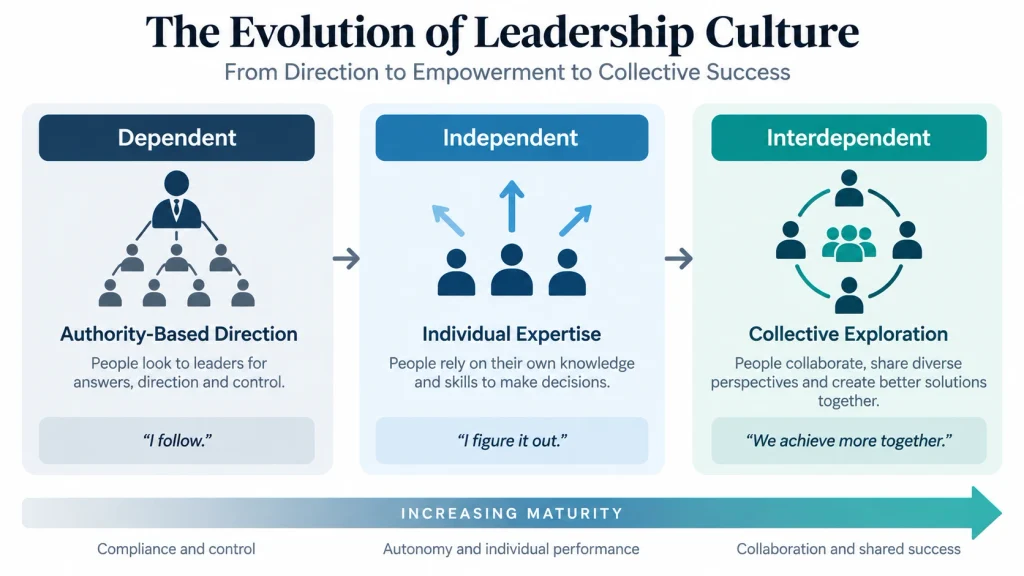
Dependent Leadership Culture
It operates on the belief that people in formal authority are responsible for leadership. Decisions flow from the top, and employees look to senior leaders for direction rather than generating direction themselves. Alignment comes from fitting into the expectations set by the larger system, and commitment comes from loyalty to the authority figure or the institution itself.
This structure can work well in highly regulated or safety critical environments where consistency and a clear chain of command matter more than speed of adaptation. Its main limitation is fragility. If senior leaders make a poor decision or become unavailable, the organization has few mechanisms for generating direction on its own, and the entire structure can stall.
Independent Leadership Culture
It operates on the belief that leadership emerges from individual expertise and initiative rather than formal title alone. Top performers use their expertise and track record to shape outcomes. They create alignment by negotiating directly with each other, rather than waiting for orders from the top.
This culture rewards expertise, initiative, and personal accountability, which tends to produce strong individual performers. Its main risk is fragmentation. When individual leaders optimize primarily for their own area of responsibility, coordination across the wider organization becomes harder to sustain, and competing priorities can pull teams in different directions.
Interdependent Leadership Culture
In an interdependent culture, people see leadership as a shared daily activity. The whole organization carries the responsibility instead of placing it on one manager or a select group of specialists. Shared exploration among system-minded team members creates direction, ongoing mutual adjustment drives alignment, and genuine engagement with a common purpose fuels commitment.
CCL’s research describes this as the most mature organizational stage because it gives companies the greatest capacity to handle complexity and rapid change. Building this environment requires sustained investment in employee development at every level. Because this approach relies on collective effort, people across the entire business must be ready to step up, not just senior executives.
How Leadership Culture Must Scale as an Organization Grows
A leadership culture that works well at fifty employees rarely works the same way at five hundred. As headcount grows, the number of people relying on a single leader for direction increases, and a dependent leadership culture that once felt fast and decisive starts to create bottlenecks instead.
Growth also multiplies the number of leaders responsible for carrying the culture forward. A founder or small executive team can model consistent behavior directly when they interact with most employees personally. Once middle management layers appear, that direct modeling stops reaching everyone, and the organization needs a deliberate leadership pipeline to keep behavior consistent across people the original leaders may never meet.
This is why scaling leadership culture is a talent development problem as much as a values problem. Organizations that grow successfully tend to identify and develop leadership capability well before it becomes urgent, rather than promoting people into leadership roles reactively once a gap appears.ithout this preparation, fast-growing companies often watch their leadership culture quietly slip back into old, dependent habits. New managers default to command-and-control behavior simply because no one trained them to lead any other way.
Matching leadership culture to organizational maturity means periodically reassessing which of the three culture types currently fits, rather than assuming an early stage culture will scale on its own. A structure that once matched a small, fast moving team can become the exact constraint that slows a larger one down.
Core Components of a Strong Leadership Culture
A strong leadership culture is built from several reinforcing components. Each one shapes how leaders behave and how employees experience that behavior day to day.
Trust and consistency
Employees need to know that a leader’s decisions today will match their decisions tomorrow. Consistency builds the predictability that makes people comfortable raising problems early, before those problems become serious.
Psychological safety
Google’s internal research on team effectiveness, known as Project Aristotle, identified psychological safety as the strongest predictor of high performing teams among the factors studied. When people believe they can raise concerns or admit mistakes without punishment, teams surface problems faster and adapt more quickly to changing conditions.
Clear accountability
A strong leadership culture holds leaders to the same standards it expects from employees. Leaders quickly break trust when they hold workers accountable without measuring themselves by the same bar. Employees notice this unfair pattern right away.
Two-way communication
Strong leaders treat communication as a two-way conversation, not a megaphone. They share the “why” behind every decision and give employees real space to respond, disagree, and offer input.
Coaching orientation
Leaders who coach build confident teams. Instead of handing out simple instructions, they teach employees how to solve problems. This shift spreads decision-making power across every level, laying the groundwork for shared leadership.
Each of these components reinforces the others. Trust makes psychological safety possible. Psychological safety makes honest two-way communication possible. Consistent accountability keeps all of it credible over time, rather than becoming another set of values that leaders state but do not practice.
Signs of a Weak or Toxic Leadership Culture
A weak leadership culture usually shows measurable warning signs well before it becomes a full organizational crisis.
High turnover concentrated under specific leaders is often the clearest signal. When departures cluster around one manager or department while the rest of the company remains relatively stable, the leadership culture in that specific area is the more likely root cause, not general market conditions or industry wide trends.
Fear based communication is another common sign. When employees avoid raising concerns, stop challenging decisions in meetings, or quietly filter bad news before it reaches senior leadership, the organization has lost the psychological safety that a healthy leadership culture depends on.
Toxic leadership behaviors compound these effects over time. Patterns such as micromanagement, public blame, favoritism, and inconsistent enforcement of standards erode trust quickly. Academic and practitioner research on toxic leadership consistently links sustained exposure to these behaviors with reduced discretionary effort and lower quality collaborative work, even among employees who remain employed and do not visibly quit.
Inconsistent accountability is a subtler but equally damaging sign. When rules apply strictly to some employees and loosely to favored ones, or when leaders are not held to the standards they set for others, the credibility of the entire leadership culture weakens, often faster than any single policy change can repair.
Organizations should treat these signs as early indicators rather than isolated incidents. A single difficult leader can often be corrected through direct coaching and clearly stated expectations. A pattern spanning multiple teams or departments usually signals a deeper leadership culture problem that requires structural intervention, not just individual coaching.
Common Mistakes That Undermine a Leadership Culture
Warning signs describe what a struggling leadership culture looks like. It is equally useful to name the specific decisions that cause a healthy one to erode, since these mistakes are usually preventable.
Prioritizing management over leadership. Organizations that promote based on technical skill or tenure alone often end up with managers who can direct tasks but cannot build genuine commitment. This keeps the organization’s approach to leadership versus management unbalanced, and it tends to pull the leadership culture back toward dependent, authority based patterns.
Losing sight of stated values under pressure. A leadership culture is tested most during difficult periods, such as layoffs, missed targets, or rapid change. Leaders who abandon stated values under pressure send a stronger signal than any values statement written during calmer times, and employees remember the exception far longer than the rule.
Tolerating negative behavior from high performers. When a leader who delivers strong results is allowed to treat people poorly, the organization teaches everyone watching that results outweigh behavior. This single decision can undo years of consistent leadership culture work faster than almost any other mistake.
Failing to adapt to changing work models. Shifts such as hybrid work, restructuring, or rapid hiring change how often leaders and employees interact. Leaders who keep using pre-change habits, without adjusting how often and how intentionally they communicate, often let their leadership culture drift without noticing until engagement data reveals the problem.
How to Build a Strong Leadership Culture
Building or strengthening a leadership culture requires a deliberate, multi step approach. It rarely improves through a single training session or a newly published values statement.
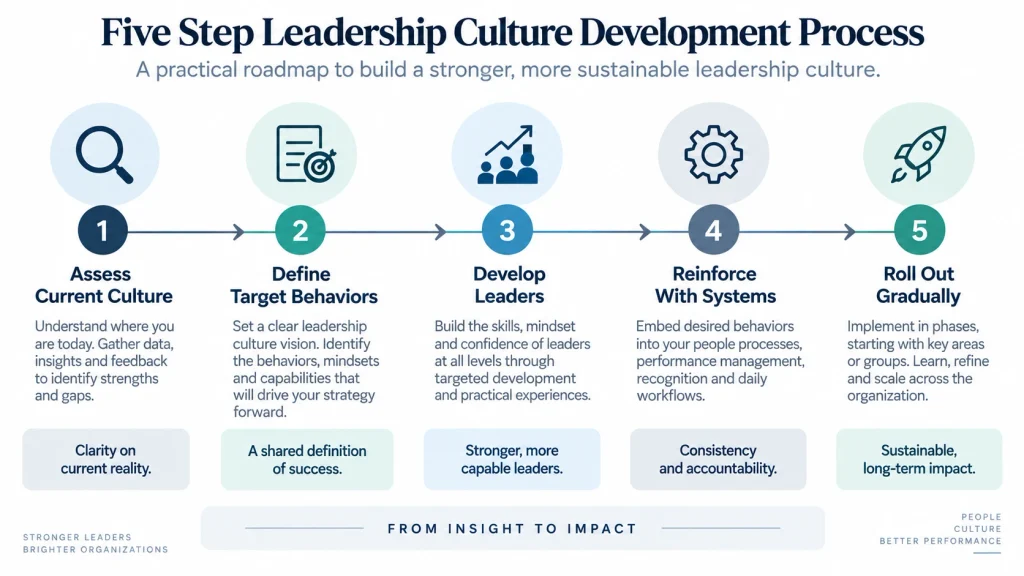
Assess the Current Leadership Culture
Before changing your leadership culture, you need an accurate view of where it stands today. Surveys, exit interview trends, and structured assessments expose hidden habits across management. This step is critical because a company’s actual environment often clashes with its official values, and employees live that difference every day.
Define the Leadership Behaviors You Need
Once the current state is clear, leaders need to define the specific behaviors the organization wants to see going forward. Vague aspirations such as better communication are difficult to act on directly. Specific behaviors, such as explaining the reasoning behind decisions or responding to mistakes with coaching rather than blame, give leaders something concrete to practice and something concrete for others to observe.
Develop Leaders at Every Level
A leadership culture cannot change through senior leadership alone. Leadership development and executive coaching need to reach managers at every level, since frontline and mid level leaders have the most frequent daily contact with employees. Succession planning should also reflect the behaviors the organization wants to reinforce, so that future leaders are selected partly based on how well they already model the desired culture, not solely on technical performance.
Reinforce Through Systems and Feedback
Behavior change needs reinforcement to stick. Performance reviews, promotion criteria, and recognition programs should reward the leadership behaviors the organization is trying to build, not just business results achieved regardless of how they were achieved. Regular 360-degree feedback gives leaders a consistent, structured view of how their behavior is actually experienced by peers and direct reports, which often differs from how leaders view their own behavior.
Roll Out Change Gradually and Communicate Consistently
Leadership culture change works best when it starts with a smaller group of leaders who can demonstrate the new behaviors and generate visible early results. Attempting to change every leader’s behavior simultaneously across a large organization is difficult to sustain and easy to lose momentum on. Regular, honest communication about progress, including setbacks, helps maintain credibility throughout the change management process and prevents the effort from being dismissed as another temporary initiative.
How to Measure and Assess Leadership Culture
Although leadership culture consists of behavioral patterns rather than one simple score, organizations can still measure it effectively by combining a few core tools.
- Engagement Surveys: Offer a company-wide view of employee experience and track high-level trends.
- Structured Diagnostics: Use frameworks like direction, alignment, and commitment to spot whether the organization functions at a dependent, independent, or interdependent level.
- 360-Degree Feedback: Expose blind spots by contrasting self-ratings with input from managers, peers, and direct reports.
- Qualitative Signals: Highlight emergent issues through exit interview trends, complaint patterns, and informal skip-level chats long before formal reviews catch them.
Mixing these methods provides a complete baseline to measure long-term improvements accurately.
Conclusion
Leadership culture is the pattern of shared beliefs and behaviors that leaders in an organization consistently practice. It shapes how decisions get made, how accountability works, and how employees experience their day to day work, regardless of what any official values statement says.
A strong leadership culture supports higher employee engagement, better organizational health, and stronger leader retention. A weak or toxic leadership culture produces the opposite outcomes: rising turnover, fear based communication, and declining performance that often shows up in the numbers before anyone names the root cause.
Leadership culture is not fixed. Organizations can move from dependent patterns toward more independent and interdependent ones through honest assessment, clearly defined behaviors, sustained leadership development, and consistent reinforcement. The organizations that treat leadership culture as something to actively build, rather than something that simply exists on its own, are the ones most likely to sustain strong performance over time.
Next Step
Diagnosing a culture exposes where current leadership behaviors fall short of future goals. Leadership development programs bridge this gap. They build the specific habits and decision-making patterns that transform an assessment into long-term behavioral change.
Frequently Asked Questions
What is the difference between leadership style and leadership culture?
Leadership style describes how one individual leader tends to behave, such as directive or collaborative. Leadership culture describes the shared pattern that emerges when many leaders across an organization behave in similar ways over time.
Can one leader change an entire company’s leadership culture?
A single leader, especially a senior one, can influence leadership culture significantly, but sustainable change usually requires consistent behavior from leaders at multiple levels. One leader’s example can start the shift, but the pattern only becomes a true culture once it spreads and repeats across the organization.
Is leadership culture the same across every department in a company?
Not always. Larger organizations often develop subcultures where one department’s leaders model different behaviors than another’s, even under the same overall company values. These subcultures usually form around a specific senior leader or a long standing team history.
How long does it take to change a leadership culture?
Meaningful leadership culture change typically takes months to multiple years, depending on organization size and how deeply the existing patterns are established. Gradual rollouts that start with a smaller group of leaders and build visible results tend to sustain change more effectively than attempts to change everyone at once.
Does remote or hybrid work change how leadership culture forms?
Remote and hybrid arrangements reduce the number of informal, in person moments where employees observe leader behavior, which can slow how quickly new norms spread. Leaders in distributed teams generally need to be more intentional and explicit about the behaviors they want to model, since fewer signals travel through casual daily contact.
Which KPIs can be used to measure leadership culture?
Common KPIs include voluntary turnover broken out by manager or department, employee engagement or favorability scores from pulse surveys, internal promotion rates, and manager scores from 360-degree feedback. Tracking these metrics by leader and over time, rather than as a single company wide snapshot, gives the clearest signal of where a leadership culture is strong and where it needs attention.